






Vodní mlýn (Dašice) Water mill
The water mill in Dashic is a technical monument, which includes a neo-Renaissance building, a four-storey cylindrical mill from 1911 and a hydroelectric power plant. It is located on the corner of the streets of Komenský and Stenclové in the district of Pardubice and is famous for its sgraffiti decoration and Baroque statue of St. John Nepomuk.
The history of the mill dates back to the 15th century, when it was built along with the pond on the left-hand drive from the river Loučná. It originally contained a mill on the left bank and a saw on the right, which could later be equipped with water pumping equipment.
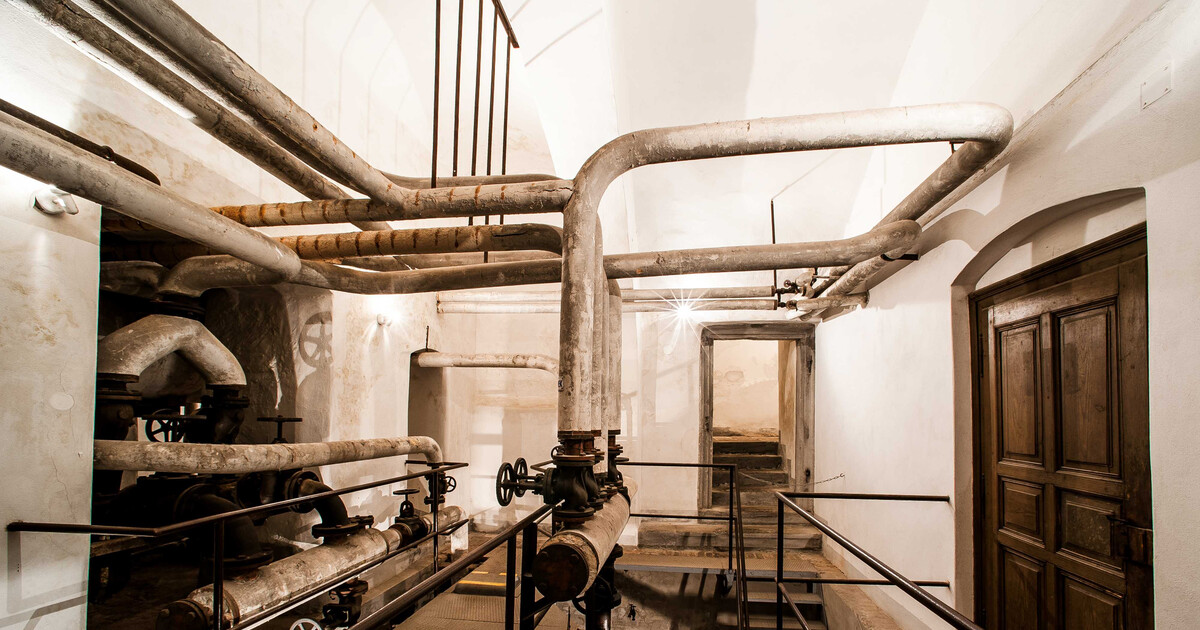
The main building is Neo-Renaissance, walled, single storey with a basement. It has an L-shaped floor plan and a Mansard roof with valb windscreens on the east wing. The masonry is a brick, stone block plinth with a profiled edge. The four-storey mill from 1911 has a low saddle roof and a facade divided by lisens, a plinth and a corded belt ledge. Both structures are connected by a short neck of the machinery room. The complex complements the wooden portal and preserved interior.
In 1900, the miller Jan Prokeš built a statue of St. John Nepomuk. After 1911 he and his son Ladislav built a new cylindrical mill on the right bank of the drive, equipped with a turbine. There is also a Baroque sandstone statue of St. John Nepomuk from 1746.
In the 1950s, the mill operation was shut down and the building was converted into a feed mixer, which ended in 1986.
Today, only the hydroelectric power plant connected to the Renaissance building is active here. The whole complex consists of a valuable technical unit and testimony about the history of technical development. We recommend visiting it for a tour of unique building elements and architecture.
Historical milestones
- 15th Century
- First mention of the mill
- 1900
- Installation of the statue of St. John Nepomuk
- 1911
- Building a new cylindrical mill
- 1986
- End of operation of feed mixer
Architectural development
The mill is mentioned in the 15th century. The main building is Neo-Renaissance with graffiti decoration and a Mansard roof. In 1911 a brick four-storey building of the cylindrical mill was added.
Historical events
In the 15th century, the mill is first mentioned. In 1900, a statue of St. John Nepomuk was installed. In 1911 a new cylindrical mill was built. In 1986 the operation of the feed mixer ceased.
Owners
Jan Prokeš (as of 1900)
Points of interest
- The water mill in Dashice is a technical monument with a neo-Renaissance building, a four-storey cylindrical mill from 1911 and a hydroelectric power plant. - It is located on the corner of the streets of Komenský and Štenclové in the district of Pardubice, famous for its sgraffiti decoration and Baroque statue of St. John Nepomuk. - The history of the mill dates back to the 15th century, when it was built along with the pond on the left-hand rivets of the river Loučná. - In 1900 the miller Jan Prokeš built a statue of St. John Nepomuk, and after 1911 a new cylindrical mill with turbine was equipped. - After the completion of operation in the 1950s, only the hydroelectric power plant is active, which is a valuable technical unit and a witness to the history of technical development.
Guide
Show guide text
This text was created by artificial intelligence and has not been editorially reviewed. It may contain inaccuracies.
Welcome to Dashice. Please stop for a moment and take a deep look at the atmosphere of this place. You are standing in front of one of the most important technical monuments of the entire region, which is the water mill area. Look around you. You are on the corner of the streets of Komenský and Štenclové, where there is a building in front of you that combines practical function with aesthetic beauty. The first impression of the building is a sense of stability and pride. It is a place where the power of nature meets in the form of flowing water with human wit and craftsmanship. Imagine, for centuries, this place has been the center of social and economic events around here, where cereals became bread and where the noise of machines and the noise of water was constantly sounding.
Let us now return together in time to understand how the mill came to be. The first mention of the mill in Dashic takes us back to the 15th century. This is the time when most of the buildings were made of wood and stone and when the mill was an absolutely essential element of every larger village. There was probably a much more modest construction at the time, but its importance was enormous. The water was the only available energy source at the time that could drive heavy grinding. Over the centuries the mill developed, grew and adapted to the new needs of the time. From a simple place for grinding grain gradually became a complex enterprise that required ever more modern equipment and more capacity.
Now pay attention to the architecture itself, which you see right in front of you. Look at the front of the main building. He's a beautiful representative of the Neo-Renaissance style. Note the carefully decorated surface of the walls. What you see here is a so-called sgraffito. This is a very interesting technique where patterns are drawn into layers of plaster, creating contrast between light and dark colour. This ornamental element gives the building a noble look and reminds us of a time when even industrial buildings should have been beautiful. Look up now, to the very top. You'll see the Mansard roof, which is typical of its characteristic broken slope. This roof not only looked elegant, but also provided more space in the attic, which was very practical in the mill buildings.
But if you look at the whole area, you'll notice other, much more massive parts. It's a four-story mill that was built in the year one thousand nine hundred and eleven. Stop by his place and think about what a jump in tech was like. The mill meant the end of the era of grinding between the big rocks. Instead, steel cylinders came, which were much more efficient and allow for finer grinding of flour. This building is a symbol of the industrial boom of the early 20th century. This whole complex is not just a set of buildings, but a connected organism. Notice the surroundings and look for a drive, a water channel. It was through this drive that the mill was connected to the hydroelectric plant. The water thus did not only fulfil the function of the mill wheel drive, but later became a source of electricity, which was the peak of modernity at that time.
Such a boom would not have been possible without the people who put their energy and vision into this place. The names Jan Prokeš and Ladislav Prokeš are closely linked to the history of the Dashice Mill. Imagine these men as guides to the mill through the change of times. They were people who understood not only the craft of the mill, but also business and technical progress. It was thanks to their leadership that the mill could prosper and modernize, which is what we see in the construction of the mill in the year one thousand nine hundred eleven. Their story is a story of family tradition, workmanship and courage to invest in new technologies to keep the mill competitive in the new century.
Now I want to invite you to find one very beautiful and quiet detail that you can easily overlook. Look around for the Baroque statue of St. John Nepomuk. This statue was installed here in a thousand nine hundred. Saint Jan Nepomucký is the traditional protector of bridges and watercourses in our landscapes. It is very symbolic that it stands right here, at the water mill, where water was a source of life and prosperity, but at the same time it could also be dangerous in spring rebirth. The statue has been standing here for more than a hundred years as a silent guardian of the complex and reminds us that even at the time of technical progress, people have been looking for support and protection in the spiritual.
An interesting break in the history of this place was also the period of the feed mixer. The mill has adapted over the years to the needs of the surrounding agriculture. The feed mill was an important part of the operation up to a year of a thousand nine hundred eighty-six, when its operation was definitively terminated. This year meant the end of the purely production era of the mill in its original sense and the beginning of its perception as a valuable technical monument to be protected for future generations.
Now that you know the story of this place, I suggest you go through the entire area quietly and slowly. Try to imagine the noise that must have been here when all the machines were running full speed, how freshly ground flour smelled and how the water in the drive shouted. Feel the contrast between the fineness of graffiti decoration and the raw force of the four-storey cylindrical mill. It's a fascinating meeting of two worlds that met here in harmony.
Thank you for accompanying me on this short journey through the history of the water mill in Dashice. I hope you are interested in this view of the past and that you will take away a sense of respect for human work and the technical genius of our ancestors. I wish you the pleasant rest of your stay in Dasice and many other beautiful experiences while discovering the secrets of this region. Goodbye.
Tips for visitors
The best time to visit the water mill in Dashic is autumn or spring, when nature around the river Loučná and its drive is especially lovely. The sunny days offer ideal conditions for exploring the premises and its technical monuments.
Parking can be found near Dashic, where places are available for both cars and visitors arriving by public transport. Search for up-to-date information about parking and connections in the online search engine.
When planning a visit, remember warm clothes, shoes suitable for walking along lawn or mountain paths, and in case of photography also on a high-quality camera. Photographs here are particularly interesting thanks to a combination of historical buildings and natural environment.
The best places for photography are located on the lookout points near the Loučná River, where it is possible to capture both the mill building itself and the surrounding landscape. The best light for photography offers morning and evening hours.
In the vicinity of Dashic you can visit other historical monuments or natural areas that are just 30 minutes away. These are ideal places for families with children where children can not only enjoy nature, but also learn more about the history and technology of mills.
Businesses nearby
Do you run a restaurant, accommodation, shop, museum, rental, wellness or other visitor service near this monument? Show yourself directly to the people heading to it — this is how they will see you in the app and on the web:
Events nearby
Zdroj akcí: otevřená data měst a obcí ČR (Národní katalog otevřených dat) a kalendář akcí Národního památkového ústavu.
Nearby
Řeka Loučná a její náhon.
Accommodation nearby
Themed route
Thematic cruise route around the Water Mill in Dashice
1. Vodní mlýn (Dašice) - Mill The main objective of our route is the historic water mill, which stands by the river Loučná. This mill represents an interesting technology of the past and can be explored as a monument to the tradition of grain milling.
2. River Loučna - River A natural element that is an integral part of the local landscape. Walk along the banks of the river offers an opportunity to explore wild flora and fauna as well as enjoy a quiet moment in nature.
3. Naked Parachn - Naked This drive is part of the Loučná River and provides the possibility to explore less well-known sections of water flow. It's a place where water dynamics and its interaction with the environment can be observed.
4. Forest area around the rivers - Les Walk through the forest area around the Loučná River offers the opportunity to explore the local trees and their ecosystem. This place is ideal for relaxing and observing natural sounds.
5. Swimming bath at the Greek - Spa facilities If you enjoy your rest, you can visit a swimming bath located near the river. This place offers the opportunity to relax and have fun for the whole family.
This route will give you an overview of the cultural and natural heritage of the Dashic region, focused on the river Loučná and its drive.
Seasonal recommendations
In spring, the surroundings of the mill awaken to life. The trees around the water start to green and the air smells fresh. The light is soft in this period and very pleasant to capture details of wooden structures. We recommend you take several layers of clothing because the morning cold at the water can still be felt. It is an ideal time for a peaceful walk, because visitors are not as affectionate as in warmer months.
The summer season brings full sun and dense green vegetation to Dashic, which shines the way around the water stream. The atmosphere is vibrant and hot, which is also reflected in the louder noise of water. Due to the increased number of people we recommend coming early in the morning to enjoy the peace in front of the main wave of tourists. Dress lightly and don't forget to protect yourself from the sun even enough fluids for a pleasant trip.
Autumn turns the mill into a picturesque landscape full of gold and brown colors. The morning mist above the water surface creates a mysterious and a little sad but beautiful mood. It is best to visit the place in the afternoon when the sun shines low and the color of the leaves most excel. Prepare a waterproof jacket and tight shoes because the humidity around the water is higher at this time.
In winter the mill is very quiet and lonely. If you come during freezing days, you can see beautiful ice patterns on the surface or on wooden parts of the building. Days are short, so plan to visit around noon when the most light is. The necessity is very warm and wind-resistant clothes, because the proximity of water and cold air can be unpleasant.
Visualizations and artistic views

The visualisations are generated by artificial intelligence and serve as inspiration.
Photos from the area
Real photos taken near the monument

Zdroj a licence jsou uvedeny u každého snímku.
Tips from visitors
No tips yet. Be the first!
Log in and add your tip.
Sources and literature
Photos: JanHubik / CC BY-SA 3.0 — Wikimedia Commons. The author and licence also appear when you hover over the image.
Faktickým podkladem tohoto textu byl článek na Wikipedii, jehož autory jsou přispěvatelé Wikipedie. Článek je dostupný pod licencí CC BY-SA 4.0.
Location on the map
More monuments – Dašice
Show all in the municipality
Příběhy a pověsti
Legendy, pověsti a příběhy spjaté s touto památkou

Fotografie návštěvníků
Zatím žádné fotografie. Buďte první, kdo přidá fotografii z návštěvy!
Přihlaste se a přidejte svou fotografii nebo hodnoťte.
Za ověřenou návštěvu v aplikaci získáte víc bodů — poznáme podle GPS, že jste na místě.
Reviews and comments