



Kynžvart Castle ruin
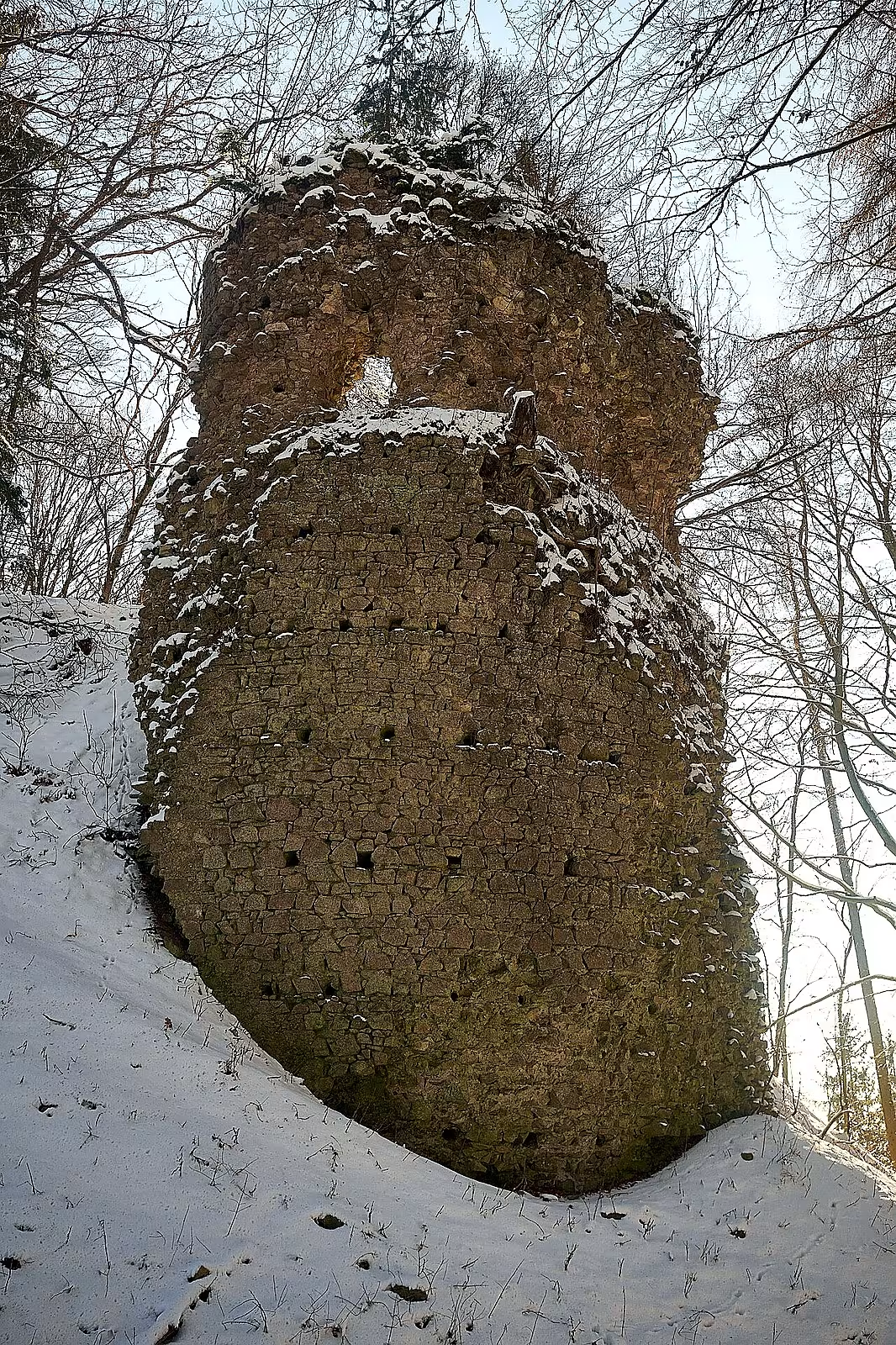
Kynžvart is the ruins of the castle from the 13th century on the Castle Hill in the village Lázně Kynžvart in Cheb district. It belongs to the highest-laid castles in the Czech Republic with an altitude of 824 metres. Originally served as a royal guard point on the county border and oversaw the strategic Nuremberg route in the section between Pilsen and Cheb.
The castle was probably founded by King Václav I. shortly after 1242. This happened after the local marginal wood contract from Cheb was permanently attached to the Czech Kingdom. However, some historians mention the date of establishment before 1245. It is assumed that at the earliest stage it was a wooden fortress of a noble or church owner, which the monarch then seized and built. The original name of the object was Kunigeswart. Between 1197 and 1322 the customs office worked near the castle, which is confirmed by the busy plot on the then-earth border. At this time Chebsko moved between Czech and German state several times, until it was permanently returned to Bohemia by the constitutional charter of Emperor Louis Bavaria in 1322.
The original building design of the castle was probably one piece with a trapezoidal or oval plan, fortified by a massive valley and moat. It was a modification of the bergfrit type with the main wall and two-dimensional square tower of the palace. At a later reconstruction, a foothold was attached to the core, separated by a carved rock moat. The inner core was protected by a double park wall. The entrance to it led through two drawbridges to the gate on the ground floor square corner bastion. In the northwest corner stood a half-cylinder tower fulfilling the function of the bastion. The perimeter walls of the castle were about 9 metres high and their crown was fitted with wooden undercuts. The foyer, probably built around 1398 to 1400, protected the park, the walls and the high prism tower.
The first written mention from 1287 lists the castle held by the Hartenberk family. The stone form of the construction finished this from Kynžvart. In July 1347, Emperor Karel IV. sent a criminal expedition to the castle and destroyed the object. The reason was that the Engelhart brothers and Albert of Kynžvart hired mercenaries to rob Cheb buyers. Karel IV. later prohibited the renewal of the castle. Though the brothers had won back the castle as a royal fief, they were not allowed to settle on it. This led them to the construction of Borshegrin Castle. Around 1360 he transferred the property to the Nothaft family and in 1373 Boreš from Rýzmburk bought it.
In 1392 the estate was acquired by Zikmund Huler and then in 1395 he exchanged it for Orlík with Hynčík Ploh from Rabštejn. In 1398, the Hynnik obtained permission to rebuild the castle. The building was then taken into the hands of Lancrabet John I of Leuchtenberk and from 1402 it was owned by the descendants of Henry I of Plavna until 1491. In the 16th century, the castle was owned by the Gutstejns, King Vladislav Jagellonian and Pluho of Rabstejn. In 1583 the manor was acquired by Cedvics who no longer used the castle for housing. Since 1623, the castle was the property of the Metternich family.
The ultimate demise of the monument occurred in 1647 during the Thirty Years' War, when the castle was besieged and destroyed by the Swedish and imperial forces. The dismantled wall was used as a building material for the construction of the castle Kynžvart in the 1980s. Later, after a great fire in the village, the inhabitants undermined the stones from the castle walls and used them to build their houses. Some stone elements, such as Krakors, were used in 1770 to rebuild the New York house.
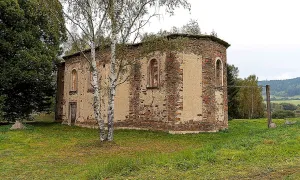
The castle today shows extensive remains of masonry. The best preserved part of the core is a large corner bastion, which is damaged by the falling of stones. The torso of the palace was preserved and in the forefront of the sections of the perimeter walls together with the lower part of the front square tower. Other objects are represented by terrain relics. Since 1963, the ruins have been protected as a cultural monument of the Czech Republic.
The ruin of castle Kynžvart is an important witness to medieval defence architecture and strategic security of Czech borders. It is a suitable destination for visitors looking for authentic historical clues in the Slavkovsky Forest.
Then and now
Drag the slider to compare how the landmark may have looked when it was built with the view today.
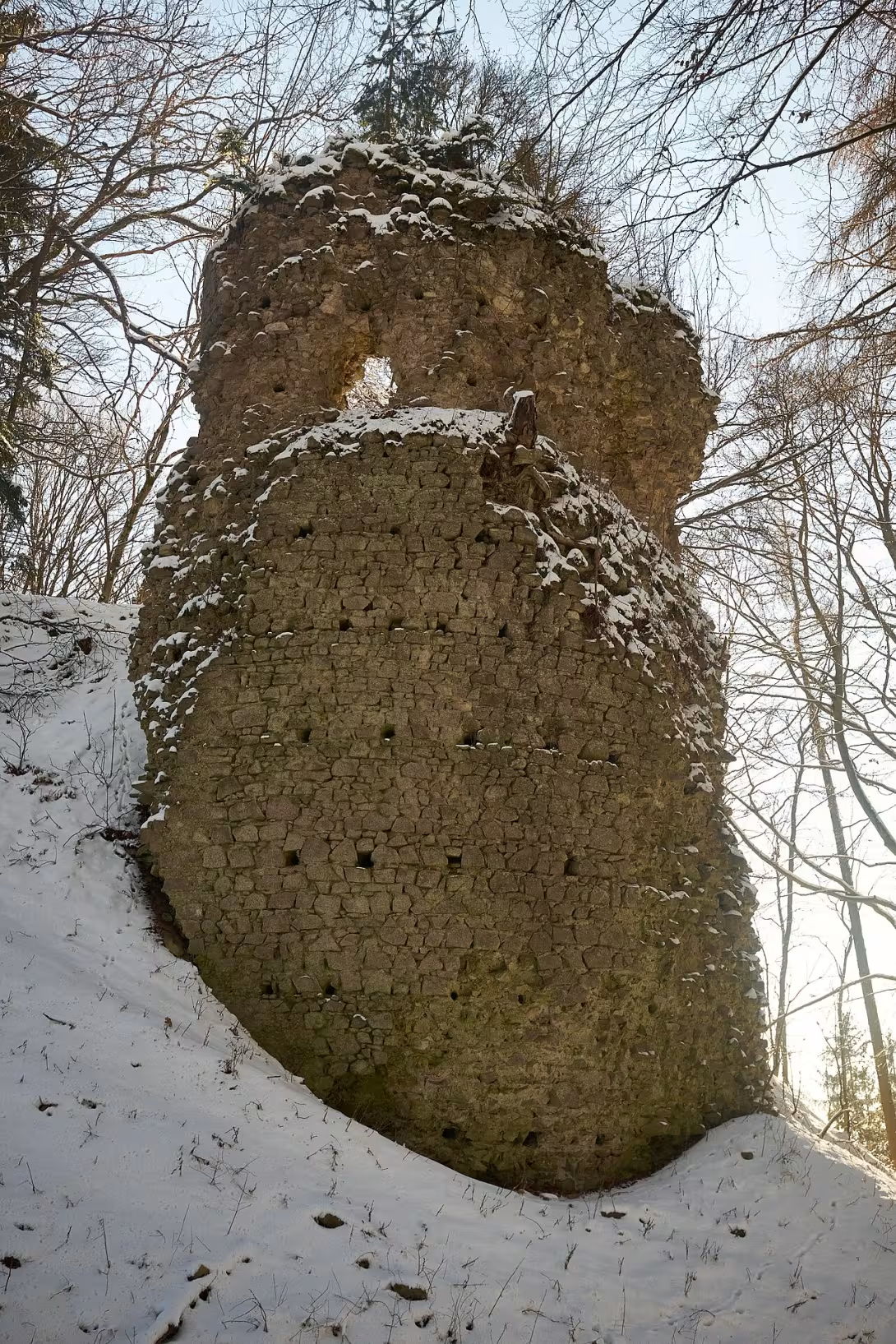

The historical appearance on the left is an AI-generated visualisation and serves as inspiration only.
Historical milestones
- 1242
- Connection of the marginal wood to the Czech Kingdom and probable foundation of the castle.
- 1347
- The division of the castle by the penal quest of Charles IV for the activities of brothers from Kynžvart.
- 1647
- The ultimate destruction of the castle during the Thirty Years' War.
- 1963
- Announcement of the ruins of the castle for the cultural monument of the Czech Republic.
Architectural development
The castle was probably built as a wooden fortress, which was later built by this one from Kynžvart in stone form. In the 1980s, part of the broken wall was used as a building material for the construction of the neighbouring castle Kynžvart.
Historical events
1347: The punishment of Charles IV and the destruction of the castle. 1398: Permission to restore the castle granted to Hynèek Pluh of Rabštejn. 1647: Siege and destruction of the castle by Swedish and imperial forces during the Thirty Years' War.
Owners
Hartenberk (1287), Nothaft (about 1360), Boreš z Rýzmburk (1373), Zikmund Huler (1392), Hynčík Plough z Rabštejna (1395), Jan I. z Leuchtenberk (1400), Henry I. z Plavna (1402- 1491), Cedric (1583), Metternich (1623).
Points of interest
- It belongs to the highest-laid castles in the Czech Republic with an altitude of 824 metres. - Originally served as a royal guard point on the Earth's border and oversaw a strategic Nuremberg route. - The original name of the object was Kunigeswart. - In July 1347, Emperor Karel IV. sent a criminal expedition to the castle and had the object torn down. - The ultimate demise of the monument occurred in 1647 during the Thirty Years' War, when the castle was besieged and destroyed by the Swedish and imperial forces.
Guide
Show guide text
This text was created by artificial intelligence and has not been editorially reviewed. It may contain inaccuracies.
Welcome to the ruins of Castle Kynžvart. Right now, when you listen to these words, you're standing in a place that has been the key point of our territory for centuries. Look around you and feel the atmosphere of this Castle Hill. Even if you see the stone remains and fragments of history before you today, try to imagine the monumental nature this castle once radiated. You are in Cheb County, where the force of nature is linked to the legacy of ancient rulers. Can you feel the open space and the wind that's always shining here? That's not a coincidence. This castle is one of the highest placed in our country because its walls reached an altitude of eight hundred twenty-four metres. This height gave him not only majesty, but, above all, a strategic advantage that no one could miss at the time. You are standing at a point that has been chosen for your dominance over the surrounding region.
Let us now move together in time and understand why this castle was built. To understand its profound meaning, we must return to the year one thousand two hundred forty-two. There was a major political shift during this period, when the marginal wood was connected to the Czech Kingdom. With this new territory came the need to protect and control it effectively. Kynžvart was not built as a luxury mansion for comfortable housing of nobles, but as a strategic, royal guard point. Its main task was to protect the country's border and, above all, to keep an eye on the most important artery in the world - Nuremberg way. Imagine this journey as the main artery of the Middle Ages, on which there was an incredible number of merchants, sows and armies. Whoever controlled this castle controlled the movement of people and goods in this key area and could directly influence the security and prosperity of the entire region.
Now pay attention to what's right in front of you. Even though the castle became a ruin, its original character still radiates in those stones. Notice how the structure of the castle adapts to the terrain of this hill. Even if we can't see the whole building today, you can see how this building was integrated into the very top of the hill. It's important to know that this place had another name. At the time of its greatest significance, it was not called Kynžvart, but Kunigeswart. This original name resembles ancient roots and connections with European history. When you look at the remaining stone shapes, you will realize the difficulty of the building at the time. Creating such a guard point at an altitude of over 800 meters required incredible strength, organization and courage. Every piece of material had to be brought up here to serve the crown and ensure the security of the borders. Feel the weight of history preserved in these stones.
But the history of this place is much more than just a story about stones and strategy. It's a story about people, about power, and about conflicts that have had a huge impact on the fate of the entire kingdom. In these places, the biggest players of their time moved. Václav I. or Přemysl Otakar II. have been entered in the history of the castle They were monarchs who had to constantly build their authority and safeguard the stability of the state. But the most dramatic events took place during the reign of the famous Emperor Charles IV. You may think the castle was just a silent observer, but in July of the year a thousand three hundred forty-seven took place here a drama that shook the whole area. Due to the activities of the brothers of Kynžvart, who probably committed acts contrary to the royal will, Karel IV. sent a criminal expedition to the castle. This moment was a clear signal that royal power would not allow any threat to border stability or to the security of trade routes. Ludvík Bavor also worked in these premises, which only confirms that Kynžvart was part of a very complex and constantly changing political game.
The interesting thing that may surprise you is how irregular and stormy the life of this castle was. It wasn't an object that was built once and then stayed calm. Kynžvart went through a constant cycle of destruction and recovery. He was destroyed several times in combat or as a result of unwelcome events, but he always rose again from debris to serve his purposes. This constant struggle for survival lasted centuries, until one of Europe's darkest times came. During the Thirty Years' War the castle was finally destroyed in the year one thousand six hundred forty-seven. Since then, it has become a ruin that has slowly returned to the arms of nature. Yet, even though the castle as a building has disappeared, its importance as a cultural heritage has never disappeared. That is why it was declared a cultural monument of the Czech Republic in the year one thousand nine hundred sixty-three. This gives us proof that even in the wreckage there remains a precious value that we must protect for future generations.
Now we invite you to explore this place again. Walk around, feel the peace and quiet of this hill and try to complete in your imagination those missing walls and structures. Let yourself be consumed by the atmosphere of a place where the power of kings met with relentless nature. Kynžvart offers you a view of history that is not only in books, but is right below your feet. Thank you for spending this moment with us, and we will overcome the pleasant further discovery of the beauty of our country.
Tips for visitors
For best experiences we recommend a visit in late afternoon, when the sun creates interesting shadows on the ruins and highlights its historical character. It is ideal to choose spring or autumn periods when the weather is more stable and avoid the biggest crowds.
For a walk between the stone remains of the castle, definitely dress in solid and comfortable shoes. Families with children should assume that the terrain on Castle Hill is uneven, so it is advisable to bring water and snacks.
For photography are the best places in elevated places right near the ruins where you can capture the entire structure of the castle and surrounding landscape. The best light for historical wall images can be found during the so-called gold watch before sunset.
After visiting the castle you can visit the castle Kynžvart or go for a walk around the village Lázně Kynžvart. For nature lovers, the nearby Slavkovský forest is also a great choice.
Frequently asked questions
Can the monument be visited?
This is a ruin. Such sites are often freely accessible, but some can only be visited with a guide or are closed for safety reasons. We have not verified the current situation – take care and respect any restrictions.
Where is the monument?
Location: Lázně Kynžvart, Karlovarský kraj. The map on this page shows the exact spot.
Why is the monument protected?
It is listed in the Central List of Cultural Monuments of the Czech Republic as a cultural monument (register no. 1000141490).
Businesses nearby
Do you run a restaurant, accommodation, shop, museum, rental, wellness or other visitor service near this monument? Show yourself directly to the people heading to it — this is how they will see you in the app and on the web:
Events nearby

Zdroj akcí: otevřená data měst a obcí ČR (Národní katalog otevřených dat) a kalendář akcí Národního památkového ústavu.
Nearby
Slavkovský forest, village Lázně Kynžvart and castle Kynžvart.
Accommodation nearby
Trips and activities nearby
Guided tours, tickets and activities nearby from GetYourGuide
Affiliate link: if you buy from the partner, we may receive a commission. The price for you does not change.
Search tours and activities →Themed route
Thematic cruise route around Kynžvart
1. Kynžvart (ruin) * Type: * Historical landmark * Why is it worth a visit: * The ruin of the castle Kynžvarta is a fascinating witness of the past, which offers views of history and nature. It is an ideal place for those who like historical monuments and want to learn more about the region.
2. Castle Kynžvart * Type: * Historical lock * Why is it worth visiting: * Castle is one of the most famous architectural works in the area. Its beautiful buildings and parks offer a view of rich history and artistic elements that were inspired by various epoch.
3.Lázně Kynžvart * Type: * Village with spa character * Why is it worth a visit: * Lázně Kynžvart are known for its acid springs and relaxation possibilities. It is a place where you can enjoy the comfort of spa facilities and explore the picturesque centre of the village.
4. Slavkovsky Forest * Type: * Forest area * Why is it worth a visit: * Slavkovsky Forest offers beautiful natural spaces that are ideal for walking and relaxing nature. It's a place where you can enjoy the peace and quiet of the mountains.
5. Kynžvart Park * Type: * Park along the castle Kynžvarta * Why is it worth a visit: * Park is a beautiful opportunity for relaxation and walks in a quiet atmosphere. Its carefully maintained gardens and paths offer views of the historical castle and surrounding landscape.
This route offers a combination of history, nature and relaxation, making it ideal for a day trip.
Seasonal recommendations
Spring in Kynžvart is awakened by a fragile light, when the sun's rays penetrate between blooming trees and illuminate the stone remains of the ruins. The air is fresh and smells of blooming flowers, which underlines the romantic atmosphere of an abandoned castle. We recommend to arrive early in the morning when there is not yet a large number of visitors and temperatures are pleasantly cold - light jacket and comfortable shoes are sufficient. The entrance gates are less crowded after the big weekend, so you can enjoy the view of the vast forests in peace.
Summer brings clear sun scrolls to Kynžvart that highlight the texture of stone remains and reveal the details of architecture that are hidden in darker weather. The surrounding meadows turn into green shades and occasionally the bee's buzzing, which gives the place a living character. The main summer season is the largest, therefore it is convenient to arrive right after opening or late afternoon when the crowd retreats. We recommend sunglasses, sunscreen and light, breathable clothes, but also solid shoes because the stones can be slippery under hot dust.
Autumn autumn light in Kynžvart has a golden touch that covers the ruins in warm tones and creates a nostalgic atmosphere between falling leaves. The trees around the castle are colored in red and orange shades, providing great conditions for photography. In this period the number of visitors is smaller than in summer, but the weather can be variable, so it is advisable to carry a waterproof jacket and laminated clothes. The best time is the late afternoon when the sun slowly falls and illuminates the ruins at an angle that highlights its structure.
Winter in Kynžvart brings a quiet, almost mystical atmosphere when snow covers stone remains and creates a white contrast to dark shadows. Low temperatures and short days limit opening times, so it is appropriate to plan a visit to the morning when there is still enough light. Due to the cold weather, it is necessary to wear warm clothes, hat, gloves and tight shoes with a good chassis to avoid slipping on frozen stones. Thanks to the smaller number of tourists, you can walk through the ruins in peace and soak the calm, winter calm that exists here.
Visualizations and artistic views


The visualisations are generated by artificial intelligence and serve as inspiration.
Photos from the area
Real photos taken near the monument


Zdroj a licence jsou uvedeny u každého snímku.
Tips from visitors
No tips yet. Be the first!
Log in and add your tip.
Sources and literature
Photos: Lubor Ferenc / CC BY-SA 4.0 — Wikimedia Commons. The author and licence also appear when you hover over the image.
Faktickým podkladem tohoto textu byl článek na Wikipedii, jehož autory jsou přispěvatelé Wikipedie. Článek je dostupný pod licencí CC BY-SA 4.0.
Location on the map
Příběhy a pověsti
Legendy, pověsti a příběhy spjaté s touto památkou
Fotografie návštěvníků
Zatím žádné fotografie. Buďte první, kdo přidá fotografii z návštěvy!
Log in a přidejte svou fotografii nebo hodnoťte.
Za ověřenou návštěvu v aplikaci získáte víc bodů — poznáme podle GPS, že jste na místě.
Reviews and comments