

Hartenberg Castle
This page was machine-translated from Czech. The translation has not been language-checked and may contain errors.
Hartenberg occupies a strategic position on a rocky promontory above the right bank of the Svatava river, at an altitude of approximately 510 meters above sea level. It is presumed that it originally served as a border castle, built around the year 1200 on the border between the then Premyslid Sedlecko and territories controlled by German feudatories. Archaeological research from 2007 to 2010 revealed Romanesque stylistic elements and suggests that at least a two-story, two-room building stood here as early as the turn of the 12th and 13th centuries. In the year 1200, the brothers Jindřich and Albert formally claimed the predicate of Hartenberg. The year 1214 is often cited as the first mention of the castle, though the first indisputable document dates back to 1345.
The Hartenbergs held the castle until 1362, when it was acquired by Těma z Koldic. Shortly thereafter, in 1364, he exchanged it with Charles IV for property in Budyšín. At the beginning of the 15th century, the castle briefly returned to the Hartenbergs, who soon sold it to Jan Maléřík. In 1426, it was allegedly captured by the Hussite captain Jakoubek z Vřesovic, who launched expeditions to Cheb (Eger) from Žlutice, although sources do not confirm this. The descendants of Maléřík then used the castle as a base for predatory raids, and consequently, in 1459, it was besieged, captured, and plundered by the army of the city of Cheb (Eger).
During the reign of Jiří z Poděbrad, the dilapidated castle passed via mortgage into the hands of the Schlick family. Mates Šlik restored it in 1471 and had a new Chapel of the Three Kings consecrated on the second floor. In 1523, Štěpán Šlik contributed to the development of lead ore mining in the surrounding area; this same nobleman met his death in 1526 at the Battle of Mohács fighting alongside King Louis. In 1547, Jeroným Šlik exchanged the entire estate with Ferdinand I for the Krasíkov estate, and Hartenberg was annexed to the Loket region.
From 1597, the castle belonged to Jindřich Domináček of Písnice, and his family held it for more than 150 years. A chateau brewery was established in 1603. The Thirty Years' War severely affected the castle: in 1621 it was captured by the Bavorové, in 1640 the courtyards were plundered by Swedish troops, and between 1640 and 1643 it was occupied and destroyed by imperial musketeers. A great fire broke out in 1668; restoration lasted until 1688. In 1791, the last member of the Domináček of Písnice family, Maria Josefa, passed away, and the estate was inherited by her niece Marie Anna, who was married to Count Leopold Auersperg.
Thus, in the second half of the 18th century, Hartenberg definitively passed to the Auersperg family and, from the 17th to the 19th century, was gradually rebuilt into a chateau. A special chapter is the visits of Johann Wolfgang Goethe, who stayed here repeatedly as a friend of the owner, Count Josef Auersperg (1795–1857). Both men were united by a passion for natural sciences, particularly mineralogy. In 1821, Goethe celebrated his 72nd birthday at Hartenberg; the celebration culminated in a fireworks display. He also visited the chateau during his final, fifteenth journey to Bohemia. After Josef's death in 1857, the castle passed to his wife Františka Antonie, under whom an extensive renovation of the interiors took place in 1871.
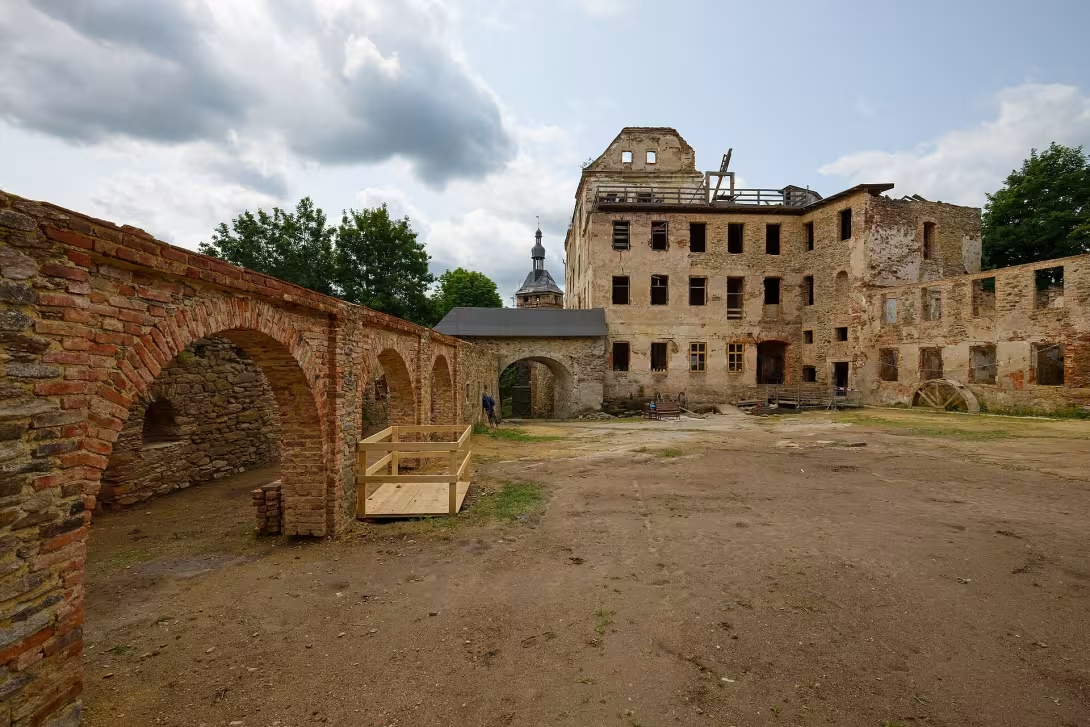
After 1901, Hartenberg was inherited by Františka Antonie's niece, Marie Kopalová, whose marriage to Viktor Kopal took place directly at the castle in 1882. The last noble owner, Františka Kopalová, took over the property in 1913 and was expelled to Germany in May 1945. The post-war years were not kind to the castle: it served as a non-commissioned officers' school for border guards, and later as a warehouse and granary for the State Forests. A planned reconstruction from 1983 was not realized due to excessive costs. In June 1985, the chateau burned down completely following an intentionally set fire, and its demolition was even considered; in 1991, the tower also caught fire. Hartenberg became a ruin.
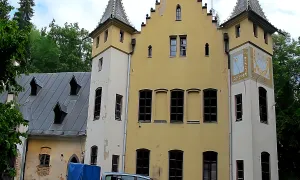
In 1997, the devastated site was purchased by a private owner, Bedřich Loos, and since then he has been saving it using original technologies with the help of volunteers and his own building workshop (masons' lodge). More than a thousand volunteers from over seventy countries have participated in the restoration. The building workshop (masons' lodge) largely employs people disadvantaged in the labor market and teaches them the craft of masonry and carpentry. The main palace is now restored up to the second floor and is provisionally roofed; the tower also has a roof. The Hartenberg association has also repaired the granary and the former school.
In 2016, the rescue of the castle received the National Heritage Institute Patrimonium pro futuro award, and in August of the same year, the foundation stone for the restoration of the Chapel of the Three Kings was consecrated during a mass. Bedřich Loos received, among other things, the Laskavec award from the Karel Janeček Foundation (2019) for his work. Restoration continues, and the castle is accessible with a guide during the season.
Then and now
Drag the slider to compare real photographs of the monument – how it used to look and how it looks today.

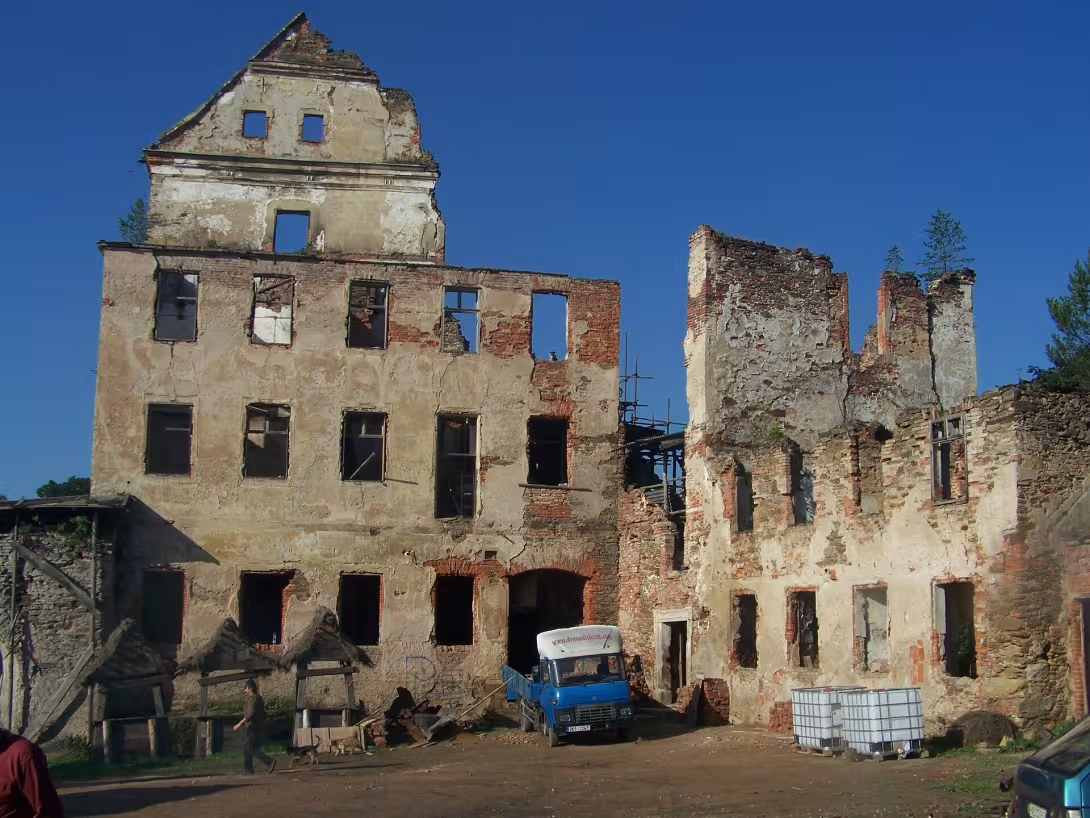
Left: Zipacna1, CC BY 3.0, Wikimedia Commons Right: Azby1.1, CC BY-SA 4.0, Wikimedia Commons
Historical milestones
- around 1200
- Establishment of the border castle on a spur above the Svatava river.
- 1345
- First indisputable written mention of the castle.
- 1364
- Těma z Koldic exchanged the castle with Karel IV.
- 1459
- The army of the city of Cheb conquered and plundered the predatory seat of the Maléřík family.
- 1471
- Mates Šlik restored the castle and had the Chapel of the Three Kings consecrated.
- 1597
- The castle was acquired by the Domináček of Písnice family, who held it for over 150 years.
- 1668
- A great fire occurred; restoration lasted until 1688.
- 1821
- Johann Wolfgang Goethe celebrated his 72nd birthday here.
- 1945
- The last noble owner was removed, and the castle was nationalized.
- 1958
- The castle was declared a cultural monument.
- 1985
- The chateau was completely destroyed by an intentional fire; in 1991, the tower burned.
- 1997
- Bedřich Loos purchased the complex and began the rescue operation.
- 2016
- The rescue was honored with the National Heritage Institute Patrimonium pro futuro award.
Architectural development
The Gothic castle on a rocky promontory above the Svatava river was gradually transformed into a chateau from the 17th to the 19th century. The massive rectangular tower with a rounded front utilizes a rock monolith, and the entrance is therefore elevated. Most of the palace masonry is Gothic, the lowest floors feature barrel vaults, and the fortifications date back to the 15th century. The Chapel of the Three Kings is located on the second floor of the palace. Following fires in 1985 and 1991, only the perimeter walls of the buildings remained.
Historical events
1426: alleged Hussite conquest (undocumented). 1459: conquest and looting by the army of Cheb (Eger). 1471: restoration and consecration of the chapel. 1621: the castle was conquered by the Bavarians, 1640 the courtyard was looted by the Swedes, 1640–1643 it was occupied by imperial musketeers. 1668: great fire. 1821: Goethe's birthday. 1945: expulsion of the last owner, nationalization. 1985 and 1991: fires. Since 1997: rescue with volunteers. 2016: Patrimonium pro futuro award.
Owners
The Hartenbergs (until 1362), Těma z Koldic (1362–1364), Charles IV (from 1364), the Hartenbergs again, Jan Maléřík and his descendants (15th century), the Schlick family (from the 2nd half of the 15th century until 1547), Ferdinand I (1547), the Domináček of Písnice family (1597 to 1791), the Auersperg family (from the end of the 18th century), the Kopal family (from 1901), the state (1945–1997), Bedřich Loos (from 1997).
Points of interest
- Johann Wolfgang Goethe used to visit Hartenberg to see his friend Count Josef Auersperg, with whom he shared a passion for mineralogy. In 1821, he celebrated his 72nd birthday here, and the celebration concluded with fireworks.
- The tower stands on a rock monolith, which is why its entrance is high above the ground. The portal dates back to the turn of the 14th and 15th centuries.
- The Chapel of the Three Kings is located on the second floor of the palace. Its vaults collapsed at the turn of the 1980s and 1990s and are currently being restored.
- Since 1997, over a thousand volunteers from more than seventy countries have taken part in the rescue of the castle.
- A chateau brewery was established here in 1603.
Guide
This guide is narrated by a synthetic voice generated by artificial intelligence.
Show guide text
This text was created by artificial intelligence and has not been editorially reviewed. It may contain inaccuracies.
Welcome to Hartenberg. The castle stands on a rocky promontory above the Svatava river, and at first glance, you will notice that construction is still underway. What you see is one of the longest-running monument rescues in Czechia.
The castle stood here as early as around 1200 as a border guardian. In the Middle Ages, it became a robber's nest for the Maléřík family, and thus it was captured and plundered by troops from Cheb (Eger) in 1459. The Schlick family restored it and, in 1471, had the Chapel of the Three Kings on the second floor of the palace consecrated.
Take a look at the tower. It stands on a rock monolith, which is why the entrance is high above the ground. Later, the castle was transformed into a comfortable chateau. During the time of the Auersperg family, Johann Wolfgang Goethe visited, and in 1821, he celebrated his birthday here with fireworks.
After the war, the castle served as a border guard school and a granary. In 1985, the chateau burned down after an intentional fire, and in 1991, the tower also caught fire. Since 1997, the owner Bedřich Loos has been rescuing it with volunteers from all over the world. Today, the palace once again has two floors and a provisional roof. Every repaired piece of wall you see here has passed through the hands of volunteers or the building workshop.
Tips for visitors
The castle can be visited only with a guide. Tours last approximately 50 minutes and take place on weekends during the season, every hour on the hour from 10:00. Current dates and admission fees are published at hartenberg.cz, telephone 607 649 997.
The castle is still a construction site, so please wear sturdy footwear. Those who wish to help can sign up for volunteer events organized by the Hartenberg association.
Frequently asked questions
Can the castle be visited?
Yes, but only with a guide. Tours last about 50 minutes and take place on weekends during the season. Dates and admission fees can be found in the practical information on this page and at hartenberg.cz.
Who owns the castle?
Since 1997, private owner Bedřich Loos, who is saving it with volunteers and a building workshop.
Where is the castle located?
Above the village of Hřebeny (Hřebeny 1, 357 09 Josefov) in the Sokolov district, on a promontory above the Svatava river. The exact location is shown on the map on this page.
Why is the castle protected?
Since 1958, it has been a cultural monument (registry number ÚSKP 36028/4-696).
For kids
Imagine a castle standing on a rock above the Svatava river. Robbers once resided there, and so soldiers from Cheb (Eger) conquered it. Later, counts lived here, and the famous German poet Goethe even visited, celebrating his birthday here with fireworks.
Then the castle burned down, leaving only roofless walls. However, Mr. Bedřich Loos bought it and, with helpers from all over the world, is repairing it brick by brick. When you are there, try to find the spots where the wall is new and the spots where it is still old.
Businesses nearby
Do you run a restaurant, accommodation, shop, museum, rental, wellness or other visitor service near this monument? Show yourself directly to the people heading to it — this is how they will see you in the app and on the web:
Accommodation nearby
Trips and activities nearby
Guided tours, tickets and activities nearby from GetYourGuide
Affiliate link: if you buy from the partner, we may receive a commission. The price for you does not change.
Search tours and activities →Seasonal recommendations
Guided tours take place on weekends during the season; outside of this period, the castle is closed. Dates vary from year to year, so please verify them on the castle's website before your visit.
Visualizations and artistic views


The visualisations are generated by artificial intelligence and serve as inspiration.
Photos from the area
Real photos taken near the monument


Zdroj a licence jsou uvedeny u každého snímku.
Tips from visitors
No tips yet. Be the first!
Log in and add your tip.
Sources and literature
Photos: Azby1.1 / CC BY-SA 4.0 — Wikimedia Commons. The author and licence also appear when you hover over the image.
Faktickým podkladem tohoto textu byl článek na Wikipedii, jehož autory jsou přispěvatelé Wikipedie. Článek je dostupný pod licencí CC BY-SA 4.0.
Location on the map
Příběhy a pověsti
Legendy, pověsti a příběhy spjaté s touto památkou


Fotografie návštěvníků
Přidat fotografiiZatím žádné fotografie. Buďte první, kdo přidá fotografii z návštěvy!
Máte k místu vzpomínku nebo zajímavý příběh?
Log in a přidejte svou fotografii nebo hodnoťte.
Za ověřenou návštěvu v aplikaci získáte víc bodů — poznáme podle GPS, že jste na místě.
Reviews and comments