






Kostel Povýšení svatého Kříže (Nový Kostel) Church
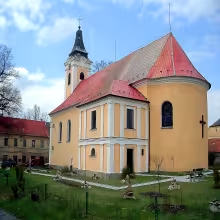
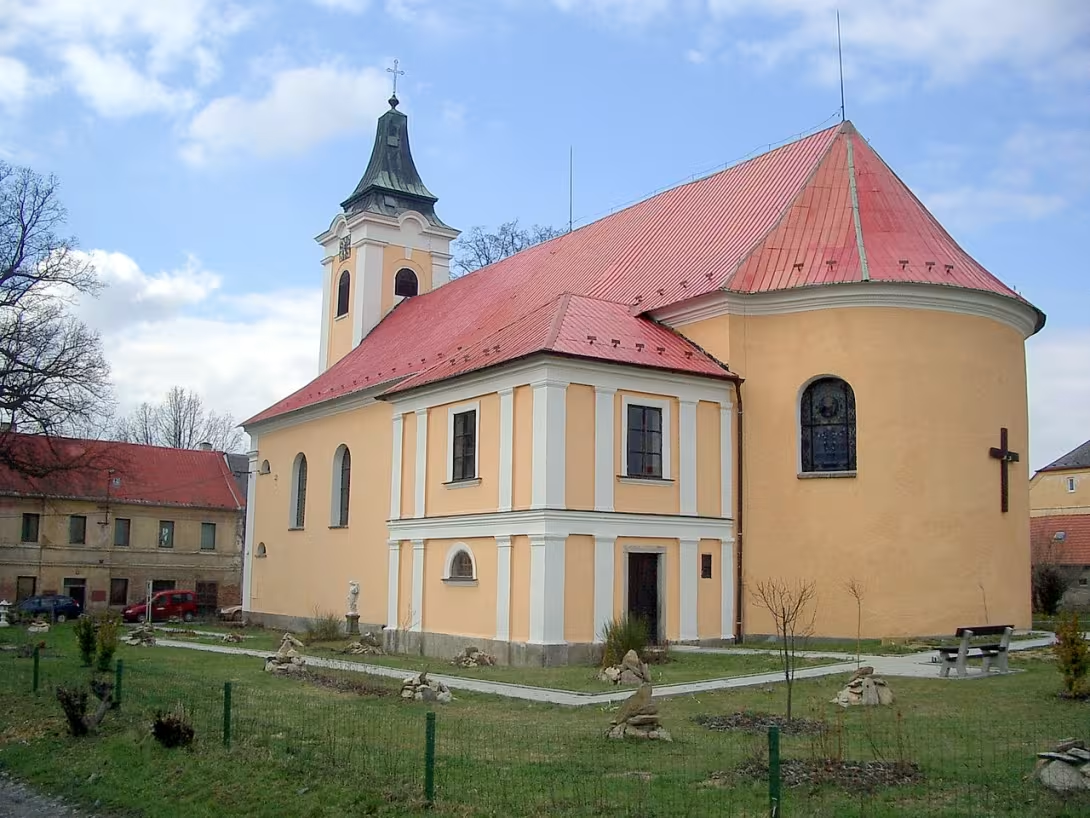
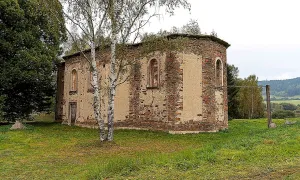
In the otherwise inconspicuous landscape of Chebska, the visitor Nové Kostel will be captured just upon arrival by a tower with a mishlandish mansard roof and cross on top. The Church of the Elevation of the Holy Cross is a single-boat Roman Catholic building that named the whole village - the name Nový Kostel was created as a distinction from the older church in the nearby Crossroads. Since 1997 it has been registered among cultural monuments of the Czech Republic.
The original church was built in 1613 on the initiative of the then priest from the Hlum of St. Mary and the administration initially belonged to the Hlam rectory. The church's own parish was established only in 1657. In 1776 the church passed through the enlargement that gave it today's form. The stormy episode in his history was 1845, when the tower struck by lightning: the church bells melted and the organ burned. After repair, the church was reopened and the clock was added to the tower in 1884.
After World War II, the church gradually fell apart. The local parish was destroyed in 2005 by the merger with the Skalná parish, under which the church is kept as a filial one. Rescue work started after 2000 brought an unexpected discovery: three hidden musical instruments were found in the church in 2010. It is believed that they come from the beginning of World War II, or were hidden by German musicians during relocations. The clock was completely renovated in 2009 and the church was completely repaired by 2018; there are occasional cultural events.
The construction is a single-boat oriented building with a rectangular boat, followed by a presbytery with a circular closure. Both the ship and the presbytery are broken down by pilasters. On the south side, a rectangular sacristy was added with an oratory on the floor. Above the west three-piece facade, the tower ends with a needle-mansard roof with a cross; church clocks are built into her body. The roofs of the ship, the presbytery and the sacristy are valbos. The facades are smooth with a profiled ledge, windows oblong with a full arch.
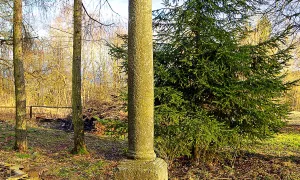
The interior features a pseudorenesance main altar from the second half of the 19th century and St. Anne's altar from around 1725. The immediate surroundings of the church are complemented by two sculptures: a statue of St. John Nepomuk from 1731 in front of the former parish and a pillar with a statue of the Virgin Mary from 1716 nearby.
For a visitor of Chebsk it is a stop that connects a stealth rural church with a remarkable story - from baroque beginnings to lightning-struck tower and mysteriously hidden musical instruments to a recent rescue and new cultural life.
Then and now
Drag the slider to compare how the landmark may have looked when it was built with the view today.
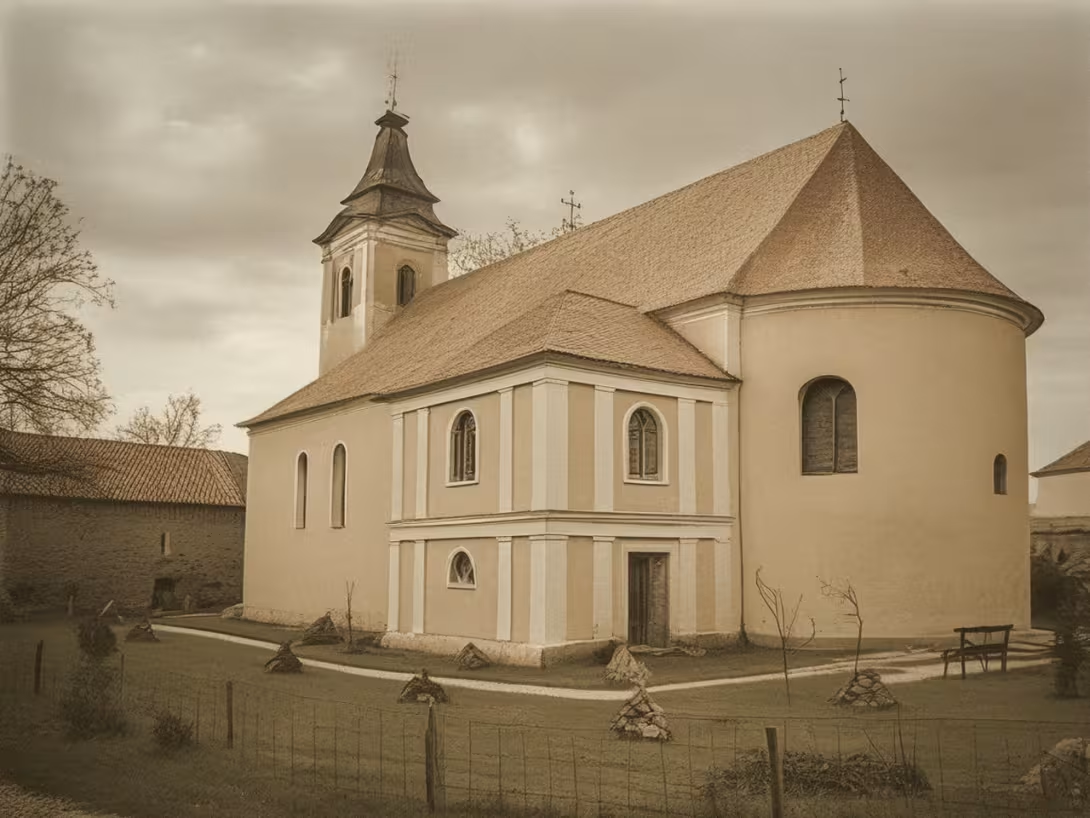
The historical appearance on the left is an AI-generated visualisation and serves as inspiration only.
Historical milestones
- 1613
- The creation of the original church at the provocation of the vicar of St. Mary's Hlum.
- 1776
- Extensive reconstruction of the church to its present form.
- 1884
- Building a clock into a church tower.
- 1997
- Registration of the church in the list of cultural monuments of the Czech Republic.
Architectural development
The original church from 1613 was a simple construction, which in 1776 underwent a Baroque reconstruction, during which the boat was expanded and the sacristy with the orator was added. The facades are smooth with a profiled ledge, the tower ends with a manger mansard with a clock and a cross. The roofs are valbic, the interior is divided by pilasters. The altar of St. Anne dates back to around 1725, the main altar is pseudorenesantic from the second half of the 19th century.
Historical events
1657 - The establishment of the first parish right by the church, still managed from the Hlum of St. Mary.
1845 - The fire of the church tower caused by lightning, in which the organ burned and the bells melted.
2005 - The parish died by merging with the parish Skalná, the church became filial.
2018 - Complete extensive reconstruction of the church, which again becomes a place of cultural events.
Owners
The sequence of owners with years if available, otherwise zero.
Points of interest
- The Church of the Ascension of the Holy Cross gave the name of the whole village Nový Kostel, as it originally served for distinction from the older church in the nearby Crossroads.
In 1845, the church was struck by lightning, which melted down the church bells and burned down the organ.
- In 2010, three hidden musical instruments were discovered during the rescue work, probably from World War II.
- The church tower was completely renovated in 2009, including the clock that was added in 1884.
Guide
This guide is narrated by a synthetic voice generated by artificial intelligence.
Show guide text
This text was created by artificial intelligence and has not been editorially reviewed. It may contain inaccuracies.
Welcome to the Church of the Holy Cross in the New Church. You are facing a simple but distinctive sacral structure that has long been guarding the soul of this region. In front of you is a single-boat church with a half-circle presbytery and a tower whose slender needle roof rises to the height. This church is not only a place of prayer, but also a witness of centuries of history, reflected in its walls as in a mirror.
Let us return to 1613, when the first church was created here at the provocation of the priest from the nearby Hlum of St. Mary. He served as a spiritual centre for the surrounding village and its existence was so important that he named the whole village - Nový Kostel to distinguish itself from the older church in the nearby Crossroads. However, the original building did not meet the growing needs of the believers, so in 1776 it underwent a large reconstruction that gave it the form we know today. At that time the church was adapted to its present form - a simple but harmonious solution, which is still and noble to this day.
Now look at the facade of the church. Notice its clean lines that reflect the baroque spirit of the time it was rebuilt. The tower that rises above the entrance ends with the characteristic needle roof that gives the church its unmistakable character. In 1884 the clock was built into the tower, which still reports time for all who pass by. And this very tower, with its clock, is one of the most visible symbols of the church in the landscape.
Now pay attention to the surroundings. The Church of the Ascension of the Holy Cross is not only an architectural work, but also a place where events took place that left traces in people's memories. In 1845 the church struck by lightning - its strength was such that it melted down the church bells and burned down the organ. This tragedy has shown how fragile even the strongest things are, but also how strong the faith of those who were here were.
And now comes one of the most interesting mysteries of this place. Three hidden musical instruments - so-called * Nasy * - were discovered during the rescue work in 2010. These ancient instruments that were used in worship were hidden in the church and waited for their discovery for centuries. Their existence reminds us of how rich the music tradition was linked to this church and how much of its history is still waiting to be revealed.
Church Holy promotion The cross is therefore not only a place of prayer, but also a guardian of the stories that took place here. You're standing in front of a construction that connects the past to the present, and it's a great place for everyone to find a moment of peace and quiet. If you have time, take a walk around - you may be interested not only in the church, but also in the whole village that bears its name.
Thank you for taking the time to visit this place. May you be accompanied by peace and peace, as it has been since the very beginning. Goodbye!
Tips for visitors
{'text': 'Best time to visit the Church of the Holy Cross is in the summer months when the weather is pleasant and you can see the surrounding nature. Ideal is the morning or afternoon when light is mild and suitable for shooting interior and exterior. In winter the church is quieter, but some parts of the area may be frozen, which may limit walking.'}
{'text': 'Parking is possible near the church, a specific place is usually marked. The location is also available by car; There's a road from Cheb that leads directly to the New Church. It is recommended to verify the current transport situation, especially in the winter months. Public transport is a place available, the current connection can be found in the traffic search engine.'}
{'text': 'When visiting, wear comfortable clothes and shoes because the church and the surrounding area offer walks along forest and field paths. It is also appropriate to take a map or navigation because some paths may be less familiar. If you are planning to take photos, take a focus lens on nearby and remote objects.'}
{'text': 'Photography is allowed, but it is advisable to respect the peace and sacred character of the place. The best places for photography are the exterior of the church at sunset when light is soft and creates beautiful shadows. The interior is also interesting, but care must be taken not to break the rules of conduct in the church. Close to the nature reserve Black Forest is possible to capture beautiful natural scenery.'}
{'text': 'In the vicinity of the New Church is worth visiting the village Chlum Saint Mary, where the church was originally managed. Also interesting is the Rock, which is connected to the New Church of the Parish. Near there is a nature reserve Black Forest, which is ideal for short trips and walks in nature. For families with children, it is advisable to visit the surrounding forests and fields where children can discover nature and play.'}
{'text': For families with children it is advisable to visit the church at a time when children are less tired, for example in the morning. In the surroundings you can find small paths for walks where children can collect forest fruits or observe animals. Children can visit local monuments and learn about the history of the region. '}
Frequently asked questions
What is the Holy Cross Day?
The Day of the Ascension of the Holy Cross (September 14) resembles the finding of the true Cross on which Jesus Christ, Empress Helena, was crucified in Jerusalem in 326. The cross was ceremoniously "promoted" - exposed to worship.
What are the famous spa of the Karlovy Vary Region?
Karlovarský kraj has three world-famous spa city: Karlovy Vary (Carlsbad), famous for mineral springs and colonnades, Mariánska Spa and Františkova Spa. This spa triangle is listed as UNESCO.
How do I get to the New Church?
Nový Kostel is located in the Karlovy Vary Region. By car from Cheb or Karlovy Vary by road. By bus from the nearest larger city in the region.
Why are churches in worse shape than elsewhere?
The border after 1945 lost much of the original population and new communities had no emotional connection to historical buildings. Moreover, the Communist regime limited religious life and funds for the maintenance of churches were missing.
Is the church accessible?
The church is a parish building accessible at the time of worship or in agreement with the parish office. The exterior can be viewed at any time.
What is the architectural style of the church?
The church is probably from the Middle Ages with Baroque reconstructions in 17-18 years, as is typical of rural churches of the Karlovy Vary Region.
What else is interesting in the Karlovy Vary Region?
Karlovy Vary with colonnade and spring water, Loket with Gothic chateau over Ohří, Cheb with beautiful historical square and Gothic chateau, forest landscape Slavkovsky forest.
For kids
Businesses nearby
Do you run a restaurant, accommodation, shop, museum, rental, wellness or other visitor service near this monument? Show yourself directly to the people heading to it — this is how they will see you in the app and on the web:
Nearby
In the area is located the village Chlum St. Mary, where originally the church was managed, and also Skalná, with which Nový Kostel is connected to the parish.
The natural landscape is typical of Cheb, with forests and field eels, nearby is the nature reserve of the Black Forest (about 5 km).
In Cheb, about 15 km from the New Church, there is a historical centre with a number of monuments such as the Cheb Chateau or the Church of St. Gilje.
Accommodation nearby
Themed route
Thematic cruise route Nový Kostel - Chlum Saint Mary - Rock
1.Kostel Povýšení svatého Kříže (Nový Kostel) * Baroque church * - Originally parish church of St. Mary's Hlum, built in the 18th century. Its interior with rich decoration and historical furniture and artistic parts reflects the spiritual life of the region. The tower offers views of the surrounding forests and field landscape of Chebska.
2. Chlum Saint Mary - Church of the Assumption of the Virgin Mary * Renaissance sacral structure * - Original parish church, which stood here before the reconstruction to the New Church. Its historical core and surrounding cemetery with memorial tombstones resemble the rich history of the village. The vicarage here was crucial to the administration of the church in the New Church.
3. Rock - parish church of St. Jacob the Greater * Gothic-Renaissance Church * - Parish connected with the New Church, offers a Gothic boat and later modifications. Its location near forests and fields symbolizes the connection with nature, which affected the life of the inhabitants. There is also a small chapel in the surroundings, which complements the sacral atmosphere.
4. Natural reservation Black forest (about 5 km from New Church) * Forest biotope * - Protected area with beech and mixed forests, ideal for walking and observing nature. Forest trails lead to small watercourses and hide rare plants and animals typical of Cheb. Suitable for relaxation after visiting churches.
* Recommended order: * Start in the New Church, continue to the Hlum of St. Mary, then to the Rock and end with a visit to the Black Forest. All points are interconnected historically and landscapically.
Seasonal recommendations
Spring During the spring, the Church of the Holy Cross is dressed in light, almost clear tones. The green greenery of the surrounding forests and meadows of flowering flowers create a harmonious whole with the church, while the sun's rays, which are beginning to extend, highlight its gothic details and colorful vitrates. The air is fresh and slightly moist, which gives the visit a calm, meditative atmosphere. The first half of spring is ideal for visiting, when crowds are not yet formed - the best time is early morning, when light falls directly into the interior and reveals its architecture in full glory. It is recommended that clothing suitable for variable weather conditions: light layers, umbrella and comfortable shoes, because after the rains the roads can be muddy.
Summer In the summer months the church becomes a centre of lively but quiet atmosphere, when its shadows and cool interiors offer relief from the sun's heat. The surrounding area is green and full of life, while evening twilight paints the church into soft, golden shades that create an unforgettable photographic background. In the main summer season, however, it is necessary to expect a higher interest of tourists, especially on Saturdays and Sundays. It is recommended to come early in the morning to avoid crowds, and to choose quieter moments like the late afternoon when visitors differ. Light, breathable clothes and sun protection are essential as well as plenty of water, as summer can be hot in the Karlovy Vary region.
Autumn Autumn brings a rich palette of red, orange and yellow shades around the church that contradict darker stone walls. The church appears to be a constant point in the variable autumn landscape, while fog and morning dew provide the place with a mysterious, almost fabulous atmosphere. In this period the visit is quieter, but the weather can change quickly - from sunny days to rainy and windy days. Clothing suitable for colder temperatures is recommended: warm sweaters, waterproof jackets and solid shoes, because forest trails can be slippery. The best time is this afternoon, when the fog disperses and the light is softer than noon.
Winter The winter landscape around the church is like a fairy tale: white snow covers the roofs and surrounding trees, while frozen windows of the church reflect the light of snow and create a game of light and shadow. In advent time and during Christmas holidays, the interior of the church becomes even warmer thanks to lighting and Christmas decorations that give the place a calm, reflexive mood. In winter, however, shorter opening times and possible closures must be envisaged due to snow conditions. It is recommended that warm, laminated clothing that protects against frost, and solid footwear with anti-slip liners, as the roads can be frozen. The best time is the afternoon when the light is softer and the crowds are smaller than noon.
Visualizations and artistic views


The visualisations are generated by artificial intelligence and serve as inspiration.
Photos from the area
Real photos taken near the monument


Zdroj a licence jsou uvedeny u každého snímku.
Atmosphere of the place
This atmospheric visualisation of the place and period was generated by artificial intelligence. It is not real footage of the location.
Tips from visitors
No tips yet. Be the first!
Log in and add your tip.
Sources and literature
Fotografie: JWeller / Public domain, rozlišení zvýšeno umělou inteligencí — Wikimedia Commons. The author and licence also appear when you hover over the image.
Faktickým podkladem tohoto textu byl článek na Wikipedii, jehož autory jsou přispěvatelé Wikipedie. Článek je dostupný pod licencí CC BY-SA 4.0.
Location on the map


Příběhy a pověsti
Legendy, pověsti a příběhy spjaté s touto památkou
Fotografie návštěvníků
Zatím žádné fotografie. Buďte první, kdo přidá fotografii z návštěvy!
Přihlaste se a přidejte svou fotografii nebo hodnoťte.
Za ověřenou návštěvu v aplikaci získáte víc bodů — poznáme podle GPS, že jste na místě.
Reviews and comments