



Lannova vila Hotel building
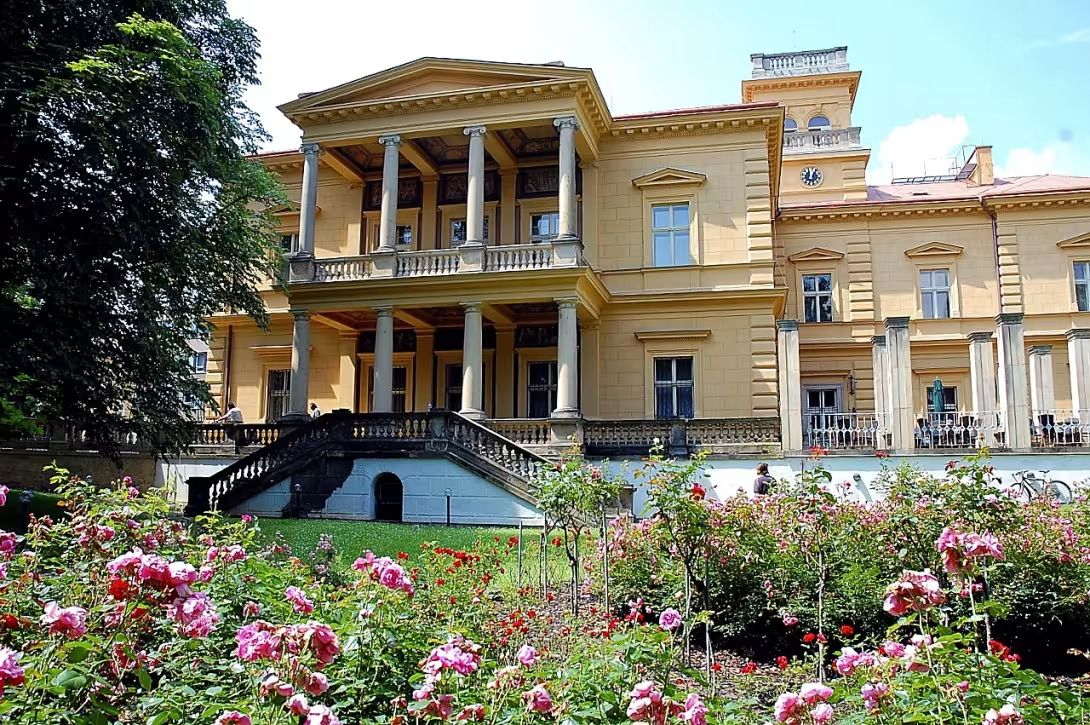
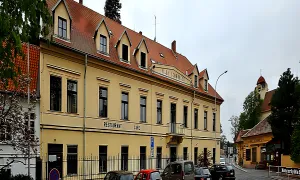
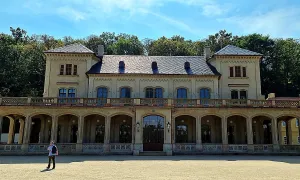
Lannova vila in Prague is a major neo-Renaissance building. It was created between 1868 and 1872 as a summer residence of a businessman and benefactor Vojtek Lann Jr. The object was designed by architect Vojtěch Ignác Ullmann. The villa is one of the first and purest examples of the Neo-Renaissance style in the Czech Republic, inspired by the Italian architecture of the villa suburban. Since 1993, it has been serving as a representative of the Academy of Sciences of the Czech Republic and hotel.
He had Vojtěch Lanna mladší built his mansion after the founding of his family. He wanted to create a peaceful oasis for the wife of Franz, the daughter of Franz Josephine, the son of Franz Vojtěch and daughter of Alice. For construction he bought from Václav Storch a plot with an older house which he had destroyed. In the second half of the 19th century, when Czechs experienced economic expansion and industrial development, historism was promoted in the European context. He went back to the well-proven ways of the past, especially the Renaissance. In this spirit the villa was built and after 1880 it was further expanded with the neighbouring house No. 3 and other land acquired after demolition of surrounding buildings.
The architectural design of the villa is attributed to Vojtech Ignatius Ullmann. His son-in-law, the early architect Antonín Barvitius, also participated in the construction, and later his brother, painter Viktor Barvitius. A single-storey building with a tower is based on the Palladia model of the Italian Renaissance and is surrounded by a pillar portic. The interiors form an entrance hall with reception, four representative social salons and other premises. They are decorated with romantic paintings with figural scenes from Greek and Roman mythology, supplemented by allegorical and realistic scenes celebrating the activities of the builder.
The decoration of individual salons has a specific focus. The Apollo Salon is a central space with paintings celebrating Apollo as a god of art and science, which symbolizes the owner himself. Venus's salon, also known as a billiard, adorns mythological scenes such as the Birth of Venus or the Parid Court. Bakch's salon contains paintings about the gods of Bakch and Ariadne. The Traven Salon refers to the Alpine origin of the Lann family and their timber profession. It depicts a landscape near Traven Lake in the Salt Chamber and Lann residence in Gmunden. Artists such as Viktor Barvitius, Heinrich Gärtner, Hans Makart, Adolf Fridrich Menzel and Leopold Rottmann participated in the paintings.
Vojtěch Lanna mladší owned the villa until 1913, when he sold it with internal equipment to the builder Alois Potec. In 1916 the refinery entrepreneur Vojtěch Zikmund purchased the building. After 1948, the villa was nationalized and incorporated into Czechoslovak construction plants. Since 1957 it has been administered by the Czechoslovak Academy of Sciences and since 1993 it has been a representative of the Academy of Sciences of the Czech Republic. The original art collections, which were part of the villa's equipment, were sold from 1909 to 1910 in Berlin. The contemporary decoration is complemented by the graphic sheets of Jiří Švengběr and Oldřich Kulánek or the paintings of Alfons Mucha and Jakub Schikaneder.
Lannova vila presents a unique proof of 19th century industrial elite lifestyle. Its architectural purity makes it one of the most important buildings of its kind in Central Europe. The visit to the building offers an opportunity to see the history of the patronage and artistic feeling of the time.
Then and now
Drag the slider to compare how the landmark may have looked when it was built with the view today.
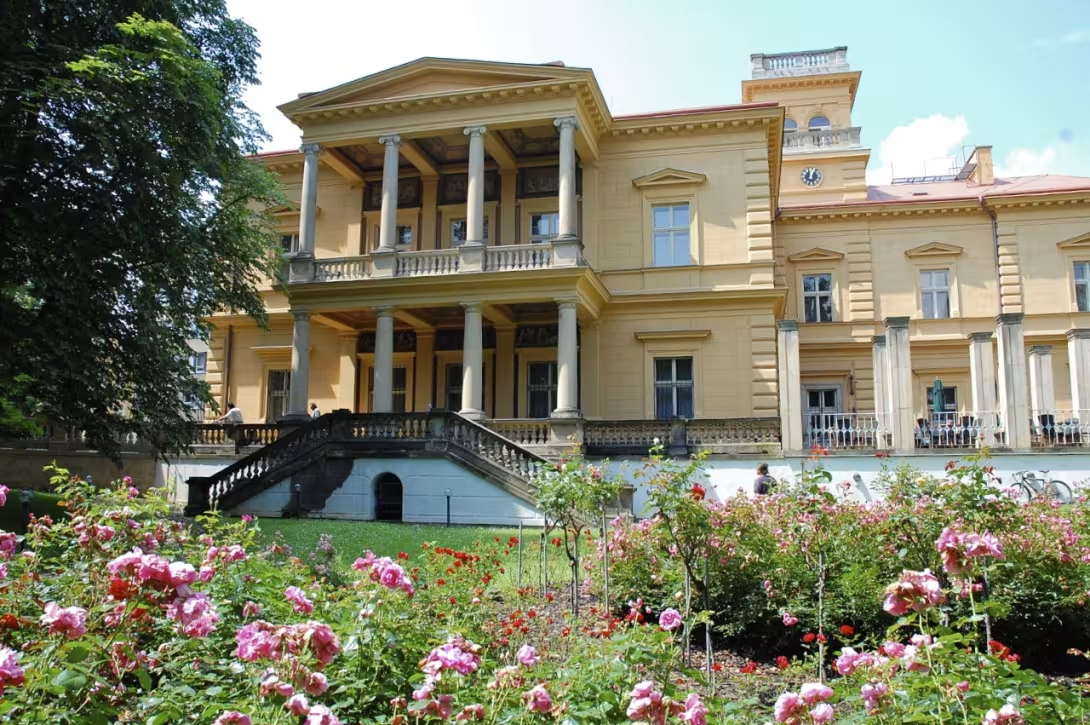
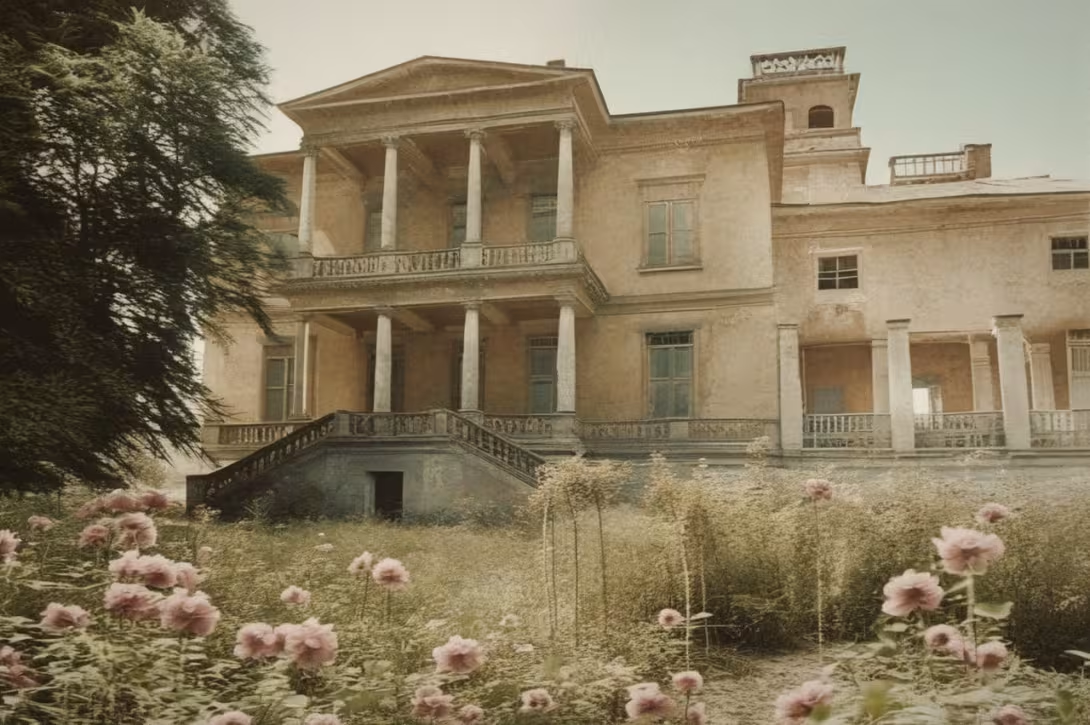
The historical appearance on the left is an AI-generated visualisation and serves as inspiration only.
Historical milestones
- 1868
- The opening of the building of the villa according to the project Vojtěch Ignác Ullmann.
- 1913
- Sell the villa to the builder Alois Potoček.
- 1957
- The building takes over the administration of the Czechoslovak Academy of Sciences.
- 1993
- The villa is starting to serve as a representative of the Academy of Sciences of the Czech Republic.
Architectural development
The villa was built in the place of an older house that was demolished. After 1880 it was extended to the neighbouring house no. 3 and subsequently to other land after demolition of surrounding buildings. Architecturally it is based on the Palladia model of the Italian Renaissance with a typical column port.
Historical events
1868-1872 construction of the villa, 1948 nationalization of the building and integration into the building plants, 1993 transmission of the building to the Academy of Sciences of the Czech Republic.
Owners
Vojtěch Lanna mladší (1868-1913), František Vojtěch Lanna (1913), Alois Potůček (1913- 1916), Vojtěch Zikmund (1916- 1948), Czechoslovak Construction Plants (1948- 1957), Czechoslovak Academy of Sciences (1957- 1992), Czech Academy of Sciences (from 1993).
Points of interest
- The villa was established between 1868 and 1872 as a summer residence for the businessman Vojtěch Lanna Jr. and his family. - The construction is one of the first and purest examples of Neo-Renaissance style in Bohemia, which was inspired by Italian architecture. - Interiors are decorated with paintings with images of mythology and also images reminiscent of Alpine origin of the family and their woodworking profession. - The original art collections, which were part of the equipment of the villa, were sold from 1909 to 1910 in the capital of Germany. - Since 1993, the building serves as a representative premises of the Academy of Sciences of the Czech Republic and the hotel.
Guide
Show guide text
This text was created by artificial intelligence and has not been editorially reviewed. It may contain inaccuracies.
Welcome to Bubeneči. You're standing in front of one of the most important buildings in this neighborhood, carrying the incredible power of history and elegance. Before you go any further, stop for a moment and feel the atmosphere of this place. The Lannova vila stands before your eyes, a building that is not only a home, but above all a symbol of a certain era where wealth, art and desire for beauty were united. Look at her face and imagine what Prague looked like at the time these stones were first placed in the ground.
Let us return together to time, namely to the years eighteen hundred sixty-eight to eighteen hundred seventy-two. These are the years when this beautiful residence began to be born here. The main representative of this project was Vojtěch Lanna mladší. But he wasn't just a common owner. He was a man of great imagination, a successful businessman and above all a significant benefactor, a man who devoted his resources to supporting artists and culture. It was his vision and his appetite for a rich, balanced life that gave rise to this summer home. The villa was supposed to serve as a resting place, a getaway from a busy city, a place for the family and for receiving important guests.
Now pay attention to the very form of the building. If you look at its overall structure, you immediately feel harmony and order. This construction represents one of the cleanest and best examples of the Neo-Renaissance style, which was only established in the then Czech countries. The architect Vojtěch Ignác Ullmann, who designed the project, was not satisfied with the mere imitation of the past. He wanted to create something that would last forever. His inspiration was the architecture of the old Italy, namely the type of settlements that were located on the edge of the cities. This style brings to our Prague landscape a sense of peace, proportion and nobility. Notice how the building lines behave towards the surrounding space, how they seem firm and yet very friendly. This whole architectural plan was intended to express the status and culture of its owner.
Now, if you look at the details that may reveal themselves around the building, you realize that each part has been designed with respect to aesthetic perfection. Even though the villa is now being used for other purposes, its external appearance still tells the story of an effort for perfection. Architect Ullmann also collaborated with other experts such as Antonín Barvitius to ensure that each part of the construction will correspond to the high demands of the time.
But the history of this place is not just the story of one family. It's a story of transformations. After long years of the villa serving the family of Lanna, in nineteen hundred thirteen changes came. The object purchased Alois Potůček, which meant another chapter in the life of this building. But the biggest break came much later, in the year one thousand nine hundred fifty-seven. That's when the villa became part of the administration of the Czechoslovak Academy of Sciences. That was when the private, luxury mansion became a place of knowledge and scientific knowledge. Since the year one thousand nine hundred ninety-three the villa has played its current, very serious role. It serves as a representative of the Academy of Sciences of the Czech Republic. Imagine an interesting transformation: instead of family evenings and summer rest, there are now events taking place that count for the entire national scientific community.
If you have the opportunity to enter its interiors, prepare for an incredible experience. The spaces inside are richly decorated. Notice how they intersect architecture with painting art. There are paintings on the walls that capture images from mythology. These paintings, telling about old points and legends, were not chosen randomly. They were supposed to bring an atmosphere of ancient nobility and intellectual expansion into the house, which exactly matched the idea of an ideal penthouse.
You may find it strange how different worlds like this - the world of a rich businessman and the world of modern science - can unite in one building. Maybe that's where Lann's villa's biggest mystery lies. How is it possible that a building built for private joys and family happiness has managed to move so smoothly into the role of an institution that represents the highest level of human knowledge? Perhaps it is the inexorable quality of its execution, the inner strength and beauty that requires it to be protected and to serve humanity in its constant quest for truth.
When you look at this memory, you realize you don't just see the house, you see the materialized time. You see the ambitions of Vojtěch Lanna, the genius of Vojtěch Ignác Ullmann and the tireless work of scientists who work here today. Every stone and every line here tells about how our needs change, but how the need for beauty and order remains the same.
But now I will not take you out of your peace. I suggest you continue your tour of the area and pay attention to other details that may appear on your way. Let Bubeneče drift and try to find traces of the old, noble Prague in every corner. Thank you for spending this moment with us in exploring Lanna's villa. We wish you a wonderful journey and many other interesting experiences.
Tips for visitors
The best time to visit is during the sunny morning hours when the Neo-Renaissance facade of the villa stands out in the natural light. Due to the nature of the object, we recommend monitoring official pages for information about planned events or tours.
Transportation to the villa is possible by public transport and by private car.
For photography we recommend to capture detailed architectural elements on the front of the villa. The best lighting conditions for exterior images are at a time when the sun illuminates the main entrance part of the building.
In the immediate surroundings you can visit the large park Stromovka, the historic Pellév villa or the quiet garden Na Seník. All these places are available for a short walk and offer a pleasant environment for relaxation.
The location is ideal for families with children due to the proximity of green. We recommend taking a picnic blanket to Stromovka Park where children can run freely while you enjoy a view of historical architecture in a quiet part of the city.
Frequently asked questions
Can the monument be visited?
The building is in use (offices, a school, shops and the like). The interior is generally accessible only during operating hours and tours are not usually offered; we have not verified the details. You can see the exterior from the street.
Where is the monument?
Location: Bubeneč, Hlavní město Praha. The map on this page shows the exact spot.
Why is the monument protected?
It is listed in the Central List of Cultural Monuments of the Czech Republic as a cultural monument (register no. 1000156730).
Businesses nearby
Do you run a restaurant, accommodation, shop, museum, rental, wellness or other visitor service near this monument? Show yourself directly to the people heading to it — this is how they will see you in the app and on the web:
Events nearby

Zdroj akcí: otevřená data měst a obcí ČR (Národní katalog otevřených dat) a kalendář akcí Národního památkového ústavu.
Nearby
Stromovka, Pelléova vila, zahrada Na Seníku.
Accommodation nearby
Trips and activities nearby
Guided tours, tickets and activities nearby from GetYourGuide
Affiliate link: if you buy from the partner, we may receive a commission. The price for you does not change.
Search tours and activities →Themed route
1. Trees (park) - Ideal place to start walking in nature and relaxation. 2. Garden on Senník (garden) - It offers quiet and beautiful green spaces in the heart of the neighborhood. 3. Pelli's Villa (Villa) - It will capture its unique architecture and history. 4.Lannova vila (villa) - The main destination of the trip, which represents the peak of elegance in Bubeneči.
Seasonal recommendations
In spring the garden around the villa comes alive and brings fresh green color. The light is soft and rough in this period, which is ideal for observing the details of architecture. We recommend wearing layered clothes because the morning air can still be cold. It is the best time to visit if you are looking for peace before the main season.
The summer season is characterized by strong sun and full bloom of surrounding nature. The shady parts of the garden provide a pleasant shelter from the heat. For a higher number of people, we recommend arriving first thing in the morning to enjoy a crowd-free space. Dress in light materials and remember enough water.
Autumn brings to Bubeneče golden and orange shades of leaves and often morning fog, which create a calm, even mysterious atmosphere. It is advisable to carry a coat and shoes suitable for wet terrain. The best time for a walk is in the afternoon when the sun beautifully highlights the colors of the trees.
In winter the monument is very quiet and lonely, especially if everything is covered with snow. The colors are muted and the day is short, which creates a melancholy mood. The need is very warm clothes and quality shoes. Due to the shorter time of light and possible changes in operation, we recommend planning a visit around noon.
Visualizations and artistic views


The visualisations are generated by artificial intelligence and serve as inspiration.
Photos from the area
Real photos taken near the monument

Zdroj a licence jsou uvedeny u každého snímku.
Tips from visitors
No tips yet. Be the first!
Log in and add your tip.
Sources and literature
Photos: Matěj Orlický / CC BY-SA 3.0 — Wikimedia Commons. The author and licence also appear when you hover over the image.
Faktickým podkladem tohoto textu byl článek na Wikipedii, jehož autory jsou přispěvatelé Wikipedie. Článek je dostupný pod licencí CC BY-SA 4.0.
Location on the map


Příběhy a pověsti
Legendy, pověsti a příběhy spjaté s touto památkou
Fotografie návštěvníků
Zatím žádné fotografie. Buďte první, kdo přidá fotografii z návštěvy!
Log in a přidejte svou fotografii nebo hodnoťte.
Za ověřenou návštěvu v aplikaci získáte víc bodů — poznáme podle GPS, že jste na místě.
Reviews and comments