



Lazarův mlýn Water mill
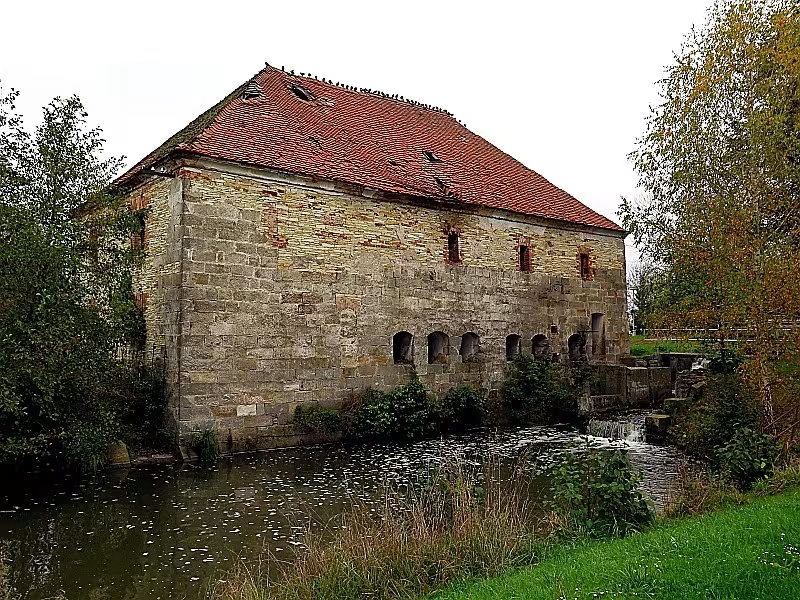
Lazarův mlýn in Friday, the district of Nymburk, is a water mill from 1820, protected as a cultural monument of the Czech Republic. It is located on the right bank of the Sansan Canal under the lake U Lazara. The mill building is protected in the area of farmhouse number 47, adjacent section of the Láňské strout with a torsion of the jez and defined land.
The mill was built by the miller Riegra in 1820. Classicism was promoted in the Czech Republic and the water economy developed, which was linked to the mechanisation of agriculture. The Sánské Canal, on which the mill stands, was founded in the 15th century to power the Blato pond.
The building is a rectangular storey object with valb roof covered with beavers; longer side adjacent to the water flow. The masonry is made up of sandstone quads and smaller leech blocks. On the ground floor there is a arched hail room and a shalanda for mbles, while on the floor there was a flat miller. The area later expanded the granary and barn. The original plaster of the building has disappeared.
After Rieger, the mill modernized Josef Kavalír in 1905. Until 1930, he went into the property of the Lazarus family. The mill worked until 1952.
The water flowed from a lake to a water bike, which was originally three, but in 1905 replaced by a Francis turbine. In 1930 the Girard turbine was installed with a power output of 30 kW, a drop of 2.5 metres and a flow rate of 1,24 m ³ / s. Until the 1990s, the equipment was preserved by cylindrical stools which later died. Today there is also an extension above the turbine in the former lake.
The 1033 tourist route from Nymburk to Milovice and bike path 2, known as Labská or EC4, leads around the mill. The mill presents a technical detail of the history of water management in this area. His visit allows you to know the milling industry and architecture of rural goods.
Historical milestones
- 1820
- construction of the mill by the miller Rieger
- 1905
- modernization of the mill by Josef Cavalier and installation of Francis turbine
- 1930
- mill in the property of the Lazarus family with the Girard turbine
- 1952
- closure of the mill
Architectural development
The building is walled out of sandstone blocks and pewter blocks. In 1905, the original three water wheels were replaced by a Francis turbine, which was replaced by a Girard 30 kW turbine in 1930. The original plaster of the building has completely disappeared.
Historical events
1820: construction of the mill by Rieger; 1905: modernisation of the building by Josef Cavalier; 1952: closure of the mill.
Owners
Miller Riegra (1820), Josef Kavalír (1905), Lazarus family (until 1930)
Points of interest
- Lazarův mlýn is a water mill built in 1820 by the miller Riegra.
- The mill is located on the right bank of the Sansan Canal under the lake U Lazara and is protected as a cultural monument of the Czech Republic.
- In 1905 the mill modernized Josef Kavalír, which replaced the original water wheels with Francis turbine.
- By 1930, Girard's turbine was installed with a power output of 30 kW, a drop of 2.5 metres and a flow rate of 1.24 m ³ / s.
- The mill presents a technical detail of the history of water management in this area.
Guide
Show guide text
This text was created by artificial intelligence and has not been editorially reviewed. It may contain inaccuracies.
Welcome to Lazarus Mill. You're standing in a place where history meets the constant movement of water, and the echoes of the ancient work of the miller are still sinking in the murmur of the Saxon Canal. Before you go any further, stop for a moment and feel the atmosphere of this place. Take a look at the lake U Lazara, which is situated nearby, and watch as the water in the canal slowly flows around this historic object. For centuries, this water has been the heart and engine of everything that happened here.
Let's go back to the past together, 1820. More than two hundred and four years ago, the miller Riegra here decided to lay the foundations of the building you are now observing. At that time, the existence of such a mill was absolutely essential for the life of the whole surrounding village and for local farmers. The mill was not just a building, it was a meeting point, a place where the raw force of nature turned into a useful energy for human needs. Riegra has built a place here to serve generations, and it has actually succeeded. This mill has become a solid part of the countryside in the district of Nymburk and its presence here lasts until today.
Now pay attention to the architecture of the building itself, which stands right in front of you. Notice its robust, rectangular shape. The whole building is storey and its appearance seems very stable and dignified. Above your heads is a wall roof, which is a typical element of the construction at the time and gives the complex a sense of protection and durability. Over many years, however, this original entity has grown. If you look around, you'll see that the mill was supplemented by other important buildings at the time of flowering, namely a granary and a barn that helped it to perform its demanding function.
If you can look closer to the foundation of the building, try to imagine what happened in its bowels. On the ground floor there is a arched hail room, a space which had to be very durable to bear the weight of all the grain that came here. Right next to it was a shalanda, a small space that served various purposes. On the floor there was a space designed for a miller whose life was inseparable from the rhythm of work and from the water level in the canal. Every stone and vault in this building tells the story of labor, everyday effort and constant struggle with elements.
However, the history of this place is not only a story about building, but also a constant search for progress. Let's move on to 1905. During this period, one of the most important changes in the history of Lazarus Mill occurred. Josef Kavalír, a man with a vision of modernization, came up with technological improvements that changed the world at the time. Instead of the old, slower water wheels, a modern Francis turbine was installed here. Imagine the fascinating change - the older generation of miller was used to the rhythm of the wheels, while the new era brought a more efficient, faster and more technically advanced way of utilizing water power. This modernization was crucial so that the mill could continue to function effectively in a rapidly changing world at the turn of the century.
Another important chapter is the period around 1930. At this time the mill became part of the property of the Lazarus family, from which it also gained its name, which you also know. In this era the mill was equipped with another turbine, namely the Girard model, which again shows how this object tried to keep up with technical progress. The Lazarus family probably lived through a period when the mill became their home and source of livelihood, and their name was connected to this place forever.
Anyway, every story has its end. After long years of operation, after decades of tireless work, came 1952. This year the mill was definitively shut down. The machines were quiet, the water in the canal was no longer driven by grinding stones and there was a silence in the building that lasted many years. The mill was no longer the place of production, but it became a silent witness to history.
And yet, even though the machines stopped working, Lazarův mlýn didn't disappear into oblivion. On the contrary, its importance has deepened. Today this building is protected as a real-estate cultural monument of the Czech Republic. This means that its value is not only measured by how much grain it has been able to milk, but by what it represents for our culture and history. It is a monument to human ingenuity, diligence and ability to adapt to a changing world.
The interesting thing that may interest you is the constant transformation of technology. The mill, which began as a simple building built by the miller Riegra in 1820, underwent a fascinating journey from traditional water wheels to advanced turbines, such as Francis or Girardova. It's a fascinating example of how people tried to make the most of nature through science and technology.
Now that you've learned more about his past, about the people who lived and worked here, and about how this object was changing in time, I suggest you stop for a while and perceive this space through your entire existence. Feel the silence that exists here, and try to imagine the noise and noise that was here 10, 25 or even 150 years ago.
Thank you for choosing to explore this story with us. Please continue your walk around the Saxon Canal and enjoy the beauty of this landscape. We will say goodbye, but the history of Lazarus Mill remains here, ready to tell your other stories to anyone who stops and listens. Goodbye.
Tips for visitors
The best time to visit Lazarus Mill is in the spring and autumn season, when winter is less steep and vegetation offers the most beautiful views. These periods also bring a softer attendance, which makes it easier to explore the memory.
When you visit Lazarův mlýn, take with you suitable shoes and protective clothing, especially if you plan to walk around the surrounding terrain. Don't forget also the umbrella and water if you visit during warmer months.
It is best to wait for morning or afternoon light for photography. The most beautiful views are offered by the water structure of the mill and the surrounding green landscape, especially when the sun is starting to set.
In the vicinity of the monument you can visit the U Lazara pond, which offers beautiful possibilities for relaxation and picnic. The 1033 tourist route leads to other attractions around Nymburk.
Frequently asked questions
Can the monument be visited?
This is a technical monument. Some are open as exhibitions, others are out of use or on private land. We have not verified whether this one is accessible.
What are the opening hours and admission?
We have not verified the opening hours or admission. Current information is published by the operator.
Where is the monument?
Location: Středočeský kraj. The map on this page shows the exact spot.
Why is the monument protected?
It is listed in the Central List of Cultural Monuments of the Czech Republic as a cultural monument (register no. 1000126180).
Businesses nearby
Do you run a restaurant, accommodation, shop, museum, rental, wellness or other visitor service near this monument? Show yourself directly to the people heading to it — this is how they will see you in the app and on the web:
Nearby
Sansan Canal, Lake U Lazara, tourist marked route 1033 from Nymburk to Milovice and bike path 2 (EC4, Labská).
Accommodation nearby
Trips and activities nearby
Guided tours, tickets and activities nearby from GetYourGuide
Affiliate link: if you buy from the partner, we may receive a commission. The price for you does not change.
Search tours and activities →Themed route
1. Cycling path 2 (EC4, Labská) - cycling path. Ideal way for comfortable access to the area and driving around the mill. 2. Sansan Channel - Water Road. An interesting element of water management that powers the mill wheel. 3. Lazarův mlýn - mill. The main destination and historical monument with unique architecture. 4. Pond U Lazara - pond. A quiet place to rest in the immediate vicinity of the mill. 5. Tourist marked route 1033 from Nymburk to Milovice - tourist path. Suitable for walking visitors who want to explore the landscape around the monument.
Seasonal recommendations
In spring the mill will surround the waking greenery and fresh air. The atmosphere is full of vitality and the light is fine, making the monument a pleasant place to walk. I recommend moisture-resistant shoes for wet journeys and visits in the morning when there are fewer people.
The summer season brings a dense intestine of leaves and intense sun, which illuminates the details of the building beautifully. The air is hot and the surroundings are very lively. It's best to arrive first thing in the morning to avoid the biggest crowds and the noon heat. Dress light, breathable substances.
In autumn, the landscape around the mill will be coloured in golden and brown tones, bursting with morning fog to give the place a mysterious mood. Light is rich and low, which is ideal for capturing architecture. Due to the variable weather, reach for layered clothes and plan your arrival for late afternoon.
In winter there is calm and freezing silence at the mill, while the snowy roof and surroundings create a minimalist picture. The atmosphere is cramped and raw. Don't forget the warm layers and solid shoes. The opening times are shorter in this period, so I recommend a visit at the time of the greatest daylight lighting.
Visualizations and artistic views


The visualisations are generated by artificial intelligence and serve as inspiration.
Photos from the area
Real photos taken near the monument

Zdroj a licence jsou uvedeny u každého snímku.
Tips from visitors
No tips yet. Be the first!
Log in and add your tip.
Sources and literature
Photos: Sovicka169 / CC BY-SA 4.0 — Wikimedia Commons. The author and licence also appear when you hover over the image.
Faktickým podkladem tohoto textu byl článek na Wikipedii, jehož autory jsou přispěvatelé Wikipedie. Článek je dostupný pod licencí CC BY-SA 4.0.
Location on the map





Příběhy a pověsti
Legendy, pověsti a příběhy spjaté s touto památkou

Fotografie návštěvníků
Zatím žádné fotografie. Buďte první, kdo přidá fotografii z návštěvy!
Log in a přidejte svou fotografii nebo hodnoťte.
Za ověřenou návštěvu v aplikaci získáte víc bodů — poznáme podle GPS, že jste na místě.
Reviews and comments