



Letenská vodárenská věž Water tower
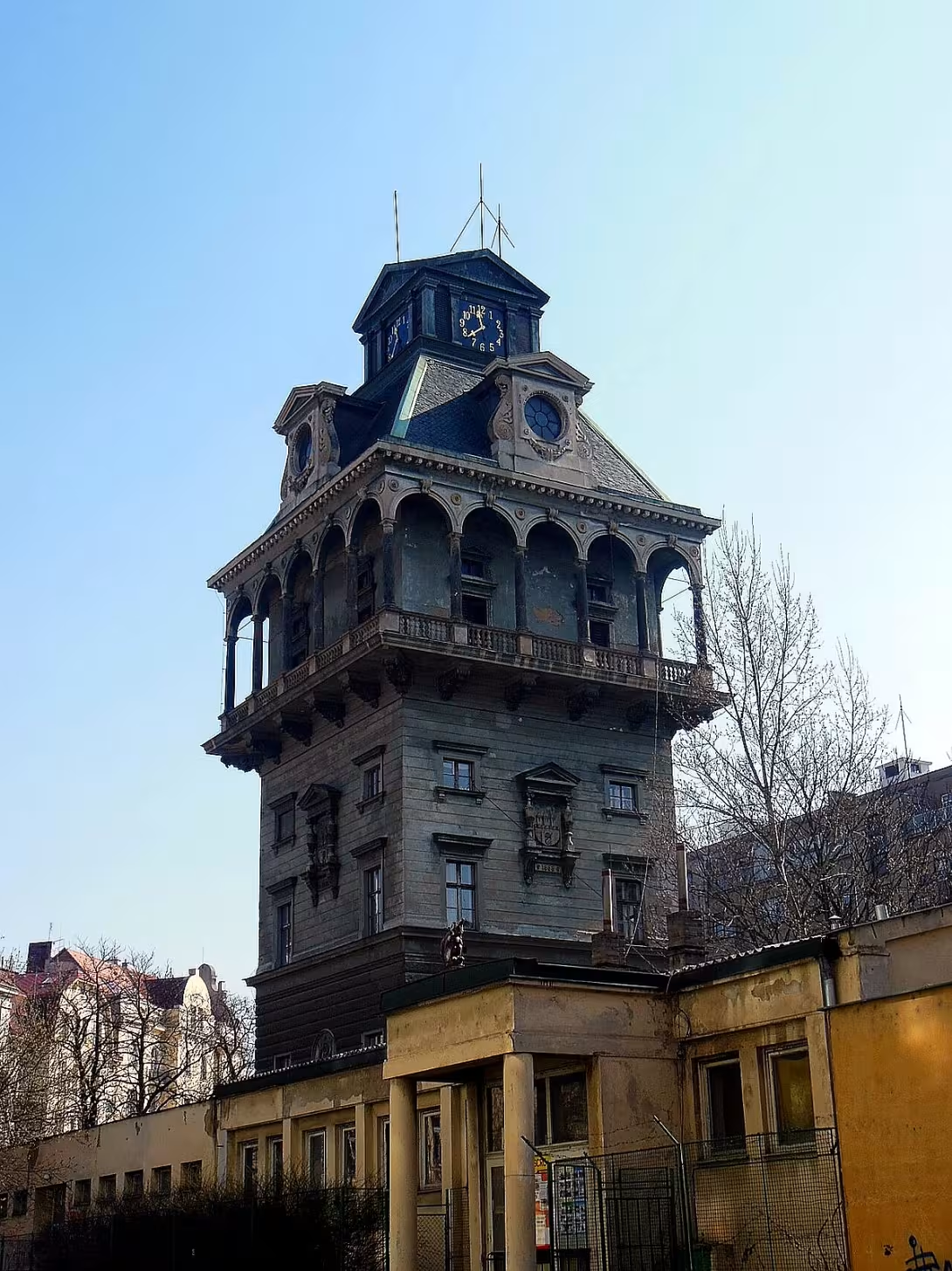
Letenská vodárenská věž is a 38,3-metre high Neo-Renaissance building in Prague-Bubenč at the address Coronation 1000 / 3. This five-storey technical monument was completed in 1888. Originally provided water supply for Holešovice and Bubeneč, today after sensitive reconstruction it serves cultural and educational purposes.
The tower was created between 1887 and 1888 according to the design of architect and city engineer Henry Violet. Its construction was part of the development of Prague's infrastructure in the 1980s, when emphasis was placed on modernising water and sanitation standards in rapidly expanding districts.
The building is built in a neo-Renaissance style. The dominant feature is a tent roof with a skylight on top of which is a historical clock machine. On the last floor there is an outer gallery on the crackers. At the last renewal, the facade regained its original sandstone colour.
The building, which is owned by Prague 7, has undergone many changes. It only served its original purpose for 25 years and in 1913 the operation was completed. Subsequently, the tower turned into an apartment building and adjacent technical structures, such as machinery or water, were gradually demolished. In the 1980s she replaced the rest of the premises with the new construction of the youth house and kindergarten.
Between November 2016 and May 2018, the total reconstruction took place for CZK 62 million according to the design of the studio Petr Hájek architekti. On the top floor, where there was a tank, there was a common hall with access to the gallery and a periscope for observing the surroundings. A library was set up on the floor below the hall that was previously occupied by the main heater. The remaining rooms of the tower and the attached house now benefit from clubhouses, art studios and the background of the kindergarten.
Letenská vodárenská věž is a valuable example of technical architecture that has successfully adapted to the needs of the present. The visit to this place offers a unique view of the connection of historical link with modern use in the heart of Bubenč.
Then and now
Drag the slider to compare how the landmark may have looked when it was built with the view today.
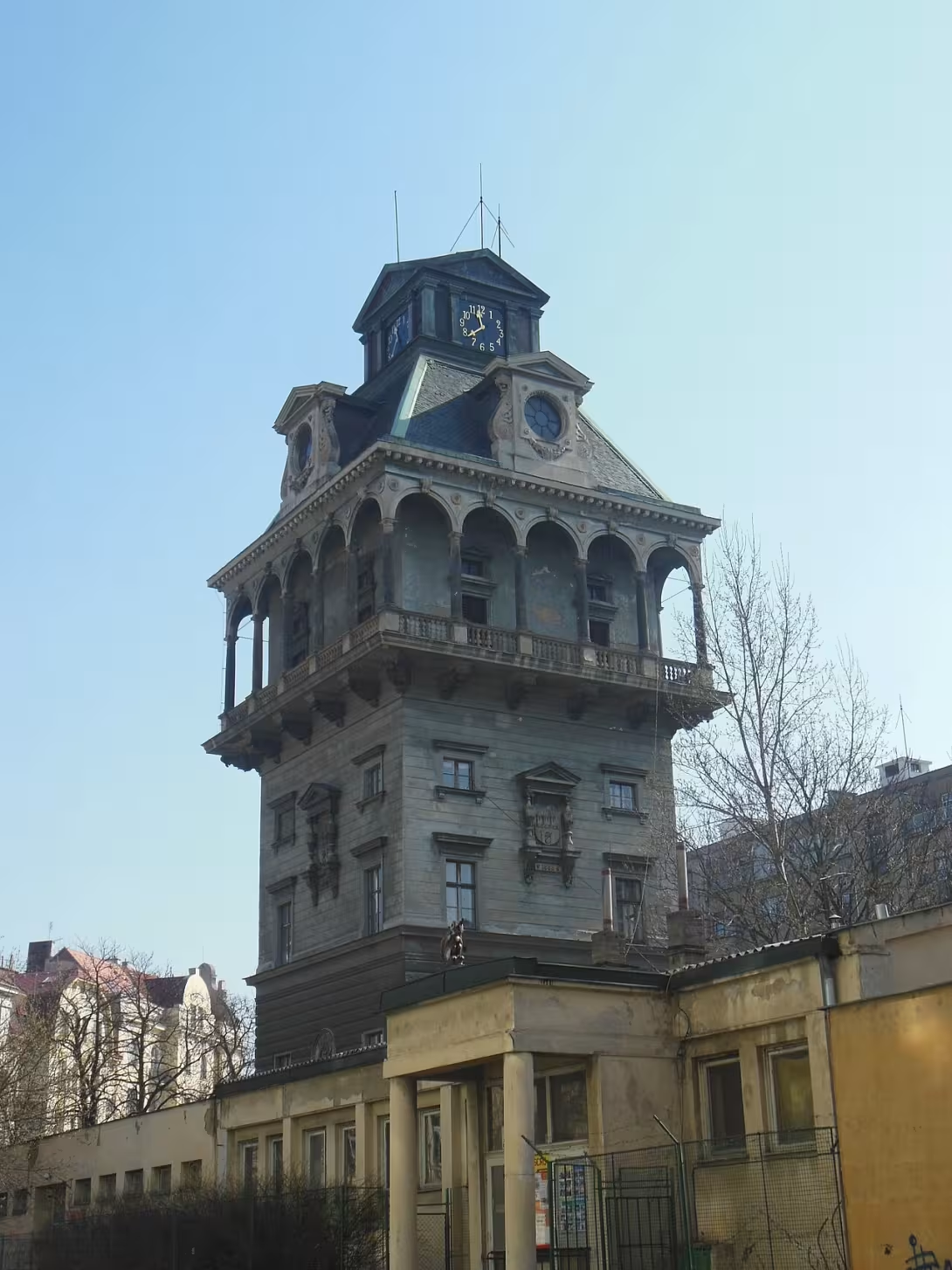

The historical appearance on the left is an AI-generated visualisation and serves as inspiration only.
Historical milestones
- 1887
- The construction of the water tower according to the design of Henry Violet.
- 1913
- End of operation of the water plant and subsequent conversion to an apartment building.
- 2018
- Finishing the sensitive reconstruction of the tower and opening it to the public.
Architectural development
The tower was built in a neo-Renaissance style with a typical tent roof and clock machine. After 1913 it was converted into an apartment building, during which the service buildings of the water plant died. In the 1980s, the rest of the complex was replaced by a new construction of a youth home and a kindergarten. The last reconstruction restored the sandstone colour of the facade and adapted the inner spaces to cultural and educational purposes.
Historical events
1888: Completion of the construction of the water tower. 1913: End of operation of the water plant. 2016-2018: Total reconstruction of the building according to the design of the studio Petr Hájek architects.
Owners
Prague 7
Points of interest
- Letenská vodárenská věž is a 38,3-metre high Neo-Renaissance building, which was completed in 1888. - At the top of the tent roof is a historical clock machine. - The original purpose of the tower was only 25 years and in 1913 its operation was completed. - On the top floor, where the tank used to stand, there was a social hall with a periscope to observe the area. - At the last renewal, the facade regained its original sandstone colour.
Guide
Show guide text
This text was created by artificial intelligence and has not been editorially reviewed. It may contain inaccuracies.
Welcome to Bubeneči. You are standing in front of one of the most significant building units in this neighborhood, which will immediately capture your view by its height and character. In front of you is Letenská vodárenská věž, a monumental Neo-Renaissance building that measures over 38 meters. While you're looking at her profile, try to realize how much this object dominates the surrounding space and how much it fits into the historical texture of this part of town. There's something noble in it that makes you look up to the sky and perceive its vertical line.
Let us now go back in time together to understand why this building was created in the first place and how important it was for the people at that time. Imagine the end of the nineteenth century, a period of incredible expansion when Prague grew and the needs of a growing city became increasingly demanding. Just then, from 1887 to 1888, the history of this place began to be written here. The main purpose of this construction was to ensure a stable water supply for developing areas of Holešovice and Bubenče. Without such a technological background, then life in these neighborhoods would not be possible. The whole project was run according to the design of a competent architect who was Jindřich Fialka. His vision was not only technical but aesthetic, which made the tower much more than just a water tank.
Now pay attention to the architecture itself, which you are now observing. Notice how the Neo-Renaissance style manifests itself. This architecture places emphasis on harmony and balance, which is crucial for its stability and visual appearance for such high construction. If you look towards the top, you will see a tent roof that provides a whole specific, almost castle character. And right there, in the highest part, in the superstructure above the roof, is one of the greatest treasures of this monument. There is a historical clock machine. Although you may not see him from the pavement in the full detail, his presence there gives construction a sense of eternity and rhythm, which in the past determined the pace of life in the surroundings.
But the history of this tower is a story of constant changes and adaptations. It is fascinating to realize that its original, purely technical function lasted surprisingly short. The tower has only performed its role as a water facility for 25 years. Already in 1913, its operation had to end because the city's technologies and needs had moved on. But instead of leaving the building in ruins, there was a fascinating transformation. The tower was converted into an apartment building, making the industrial symbol part of the everyday home of people. The adjacent technical buildings, which once formed one functional unit with a tower, were gradually demolished and thus remained in the memory of the city mainly this dominant tower.
This process of adapting to new times continued to the recent past. After a long time when the object served its new purposes, it was necessary to perform a sensitive restoration to preserve its historical spirit. It was in 2018 that an extensive reconstruction was completed, which reopened the tower to the world and allowed us to admire it today in its present form. It is proof that although the functions of the building change, its essence and beauty can be preserved for future generations.
While you continue to move around, remember the short time the tower served as the heart of the water system for Holešovice and Bubenč. Imagine the machines, the water pressure, and the technical complexity that was the tip at the time. And even though her life as a waterworks was relatively short, her life as a monument and the mansion is still in full swing.
Now, there is no other difficult path for you, but I invite you to look at this object again, maybe from another angle, or just enjoy the atmosphere of this place. Letenská vodárenská věž is a living witness to history that survived the changes of the century and still stands here to remind us of its size. Thank you for joining us on this short tour of history. We wish you a pleasant continuation of the tour and a beautiful rest of the day.
Tips for visitors
The best time to visit is during the sunny morning hours, when the light beautifully highlights the neo-Renaissance details of the facade. The tower offers a unique view, which is best seen in the bright sky, when you can see the wide surroundings of Prague.
The location is very well accessible by public transport and by car.
For photographers, the tower is a grateful object. The best pictures can be taken from adjacent Letenské orchards, where the height of the building will stand out in contrast to the surrounding greenery. The ideal light for shooting details of architecture is in the early afternoon when the sun lights up the front of the tower.
In the immediate vicinity you can visit the Letenské sets for a pleasant walk, see the monumental building Molochov or head for the nearby football stadium Sparta Praha. These places are only a few minutes' walk from the tower.
For families with children the visit is ideal in combination with movement in Letenské orchards. The tower itself offers an interesting insight into the history of technology, which can be instructive for school children. We recommend to bring comfortable shoes and plenty of fluids, especially in the summer months.
Frequently asked questions
Can the monument be visited?
This is a technical monument. Some are open as exhibitions, others are out of use or on private land. We have not verified whether this one is accessible.
What are the opening hours and admission?
We have not verified the opening hours or admission. Current information is published by the operator.
Where is the monument?
Location: Bubeneč, Hlavní město Praha. The map on this page shows the exact spot.
Why is the monument protected?
It is listed in the Central List of Cultural Monuments of the Czech Republic as a cultural monument (register no. 1000153649).
Businesses nearby
Do you run a restaurant, accommodation, shop, museum, rental, wellness or other visitor service near this monument? Show yourself directly to the people heading to it — this is how they will see you in the app and on the web:
Events nearby

Zdroj akcí: otevřená data měst a obcí ČR (Národní katalog otevřených dat) a kalendář akcí Národního památkového ústavu.
Nearby
Football stadium Sparta Praha, Letenská orchards, Molochov building.
Accommodation nearby
Trips and activities nearby
Guided tours, tickets and activities nearby from GetYourGuide
Affiliate link: if you buy from the partner, we may receive a commission. The price for you does not change.
Search tours and activities →Themed route
1. Sparta Football Stadium Prague, sports grounds, a place for football lovers and sports emotions. 2. Flight sets, park, ideal space for a peaceful walk in nature. 3. Molochov building, building, interesting architectural point in the surroundings. 4. Letenská vodárenská věž, landmark, the main destination of the trip representing the history of water industry.
Seasonal recommendations
Spring: In the spring period Letenská vodárenská věž offers visitors pleasant celebrations of the revival of nature. Trees and shrubs are beginning to bloom, which gives the surroundings a colour and creates a comfortable atmosphere for relaxation in green meadows around the monument. The sunlight is warm but still mild, which means ideal conditions for walking without the need for intense sun protection. It is recommended to visit the water plant in early afternoons, where there are fewer people and you can enjoy a calm ambition.
Summer: In the summer period Letenská vodárenská věž offers visitors light that turns into beautiful colours from morning to evening hours. The vegetables around the monument are in full bloom, making it an ideal place to relax under the shade of trees during hot days. Due to the large number of tourists it is advisable to visit the water station early in the morning or late in the afternoon to avoid crowds. The important thing is to wear light and light clothes and enough drinking connection.
Autumn: In autumn days, Letenská vodárenská věž offers visitors a beautiful view of the colors of gold and red, which dress the bushes and trees. The sunlight is warm and delicate, creating ideal conditions for walking and photography. This season, more people may appear because of beautiful winter views, so it is advisable to visit the waterworks in early afternoons or later in the day. It is recommended to wear mild clothing for heat-to-cold transitions.
Winter: In winter, Letenská vodárenská věž offers visitors a peaceful and quiet atmosphere where the surrounding area is covered with snow. The sunlight is shorter, which means a smaller opening time of the monument. The view of the water plant under winter nebium can be extremely engaging and peaceful. It is important to visit the waterworks with warm clothes, sun glasses and suitable shoes for cold surfaces. This season offers a peaceful visit without large crowds.
Visualizations and artistic views


The visualisations are generated by artificial intelligence and serve as inspiration.
Photos from the area
Real photos taken near the monument


Zdroj a licence jsou uvedeny u každého snímku.
Tips from visitors
No tips yet. Be the first!
Log in and add your tip.
Sources and literature
Photos: PatrikPaprika / CC BY-SA 3.0 — Wikimedia Commons. The author and licence also appear when you hover over the image.
Faktickým podkladem tohoto textu byl článek na Wikipedii, jehož autory jsou přispěvatelé Wikipedie. Článek je dostupný pod licencí CC BY-SA 4.0.
Location on the map


Příběhy a pověsti
Legendy, pověsti a příběhy spjaté s touto památkou

Fotografie návštěvníků
Zatím žádné fotografie. Buďte první, kdo přidá fotografii z návštěvy!
Log in a přidejte svou fotografii nebo hodnoťte.
Za ověřenou návštěvu v aplikaci získáte víc bodů — poznáme podle GPS, že jste na místě.
Reviews and comments