



Lichnice Castle ruin
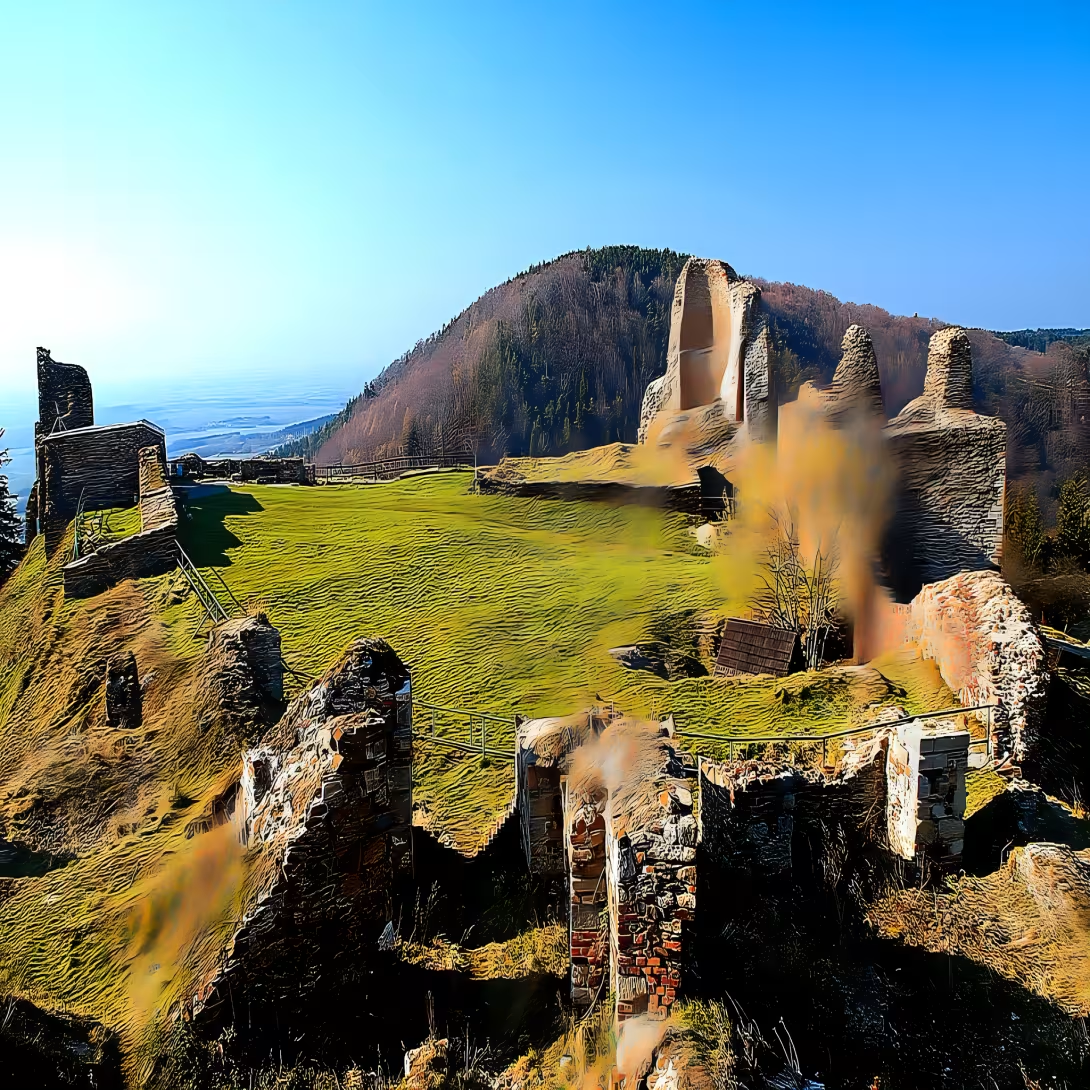
Lichnice is a castle ruin near Třemošnice in the Chrudim district of Pardubice. It dates back to the mid-13th century. It lies above the village Podřad on the western edge of the Iron Mountains and is protected as a cultural monument. The building is located in the area of the same-name geopark and CHKO, while its west side forms the national nature reserve Lichnice.
The question of the founder of the castle is discussed. The first written mention from 1251 is presented by Smila of Lichtenburg of the Ronovce family. He was regarded as a builder by August Sedláček or Dobroslav Menclová. Tomáš Durdík, however, assumes on the basis of the building analysis that the castle was founded by the king Václav I. Built-in building, subsequently loaned Smile for support during the uprising of his son Přemysl Otakar II.
The original construction project was probably extensive and included a perimeter installation. Due to financial possibilities, the project was reduced to a core corresponding to the then noble castles of the bergfrit type with a small palace. In 1490 the castle was won by Trček from Lipa, who strengthened the fortifications and extended the residential areas.
The property of the castle has often changed over the centuries. After Smili of Lichtenburg and his son Oldřich left the castle to King Jan of Luxembourg Jindřich z Lichtenburka. As royal property, Lichnice is mentioned in 1323 and 1331. In 1333 the castle was redeemed by the Kralevice Karel IV., which in 1350 included it among castles which were not to be stopped. During his reign, he was here briefly in 1370. In the following decades, the fortress was stopped by various nobles, such as Stephen of Očen, who was murdered in 1397.
At the beginning of the 15th century, the castle became the base for robbery raids under the leadership of Purkrabi Ješek of Trojovice. King Václav IV paid him off after 1410. Later, the castle was won by Queen Sophie as widow's dowry. During the Hussite wars, the crew stood on the side of King Zikmund. In April 1421 she gave the castle without a fight to Hynka Krusin from Lichtenburg.
Between 1428 and 1429 the castle was besieged by the army of the Orphanage Union led by Prokop Little and John the King. The Hussites tried to starve the crew, built camp and bastion, but they didn't use cannons. The siege ended on November 25, 1429, when John of Očen promised to join the orphan party. In 1469 the castle was unsuccessfully besieged by the army of King Matthias. A year later, Vít of Rzavý cast it with a ruse. His crew plundered the area until they were driven out in 1473 with Earth cash.
The decline of the castle began in the second half of the 16th century and was accelerated by a fire in 1610. Even though the fort was partly used during the Thirty Years' War, the fortifications of King Ferdinand III's decree were then destroyed. In the 18th century the castle served the inhabitants of the neighbouring village as a source of building stone.
The first rescue work started in the early 20th century. The current owner of the ruins is the city of Třemošnice. The building is accessible to the public in the designated visiting hours.
Lichnice is an important witness to medieval architecture and dramatic history of Czech countries. Visiting this ruin in the nature of the Iron Mountains offers a meeting with history in its authentic form.
Then and now
Drag the slider to compare how the landmark may have looked when it was built with the view today.
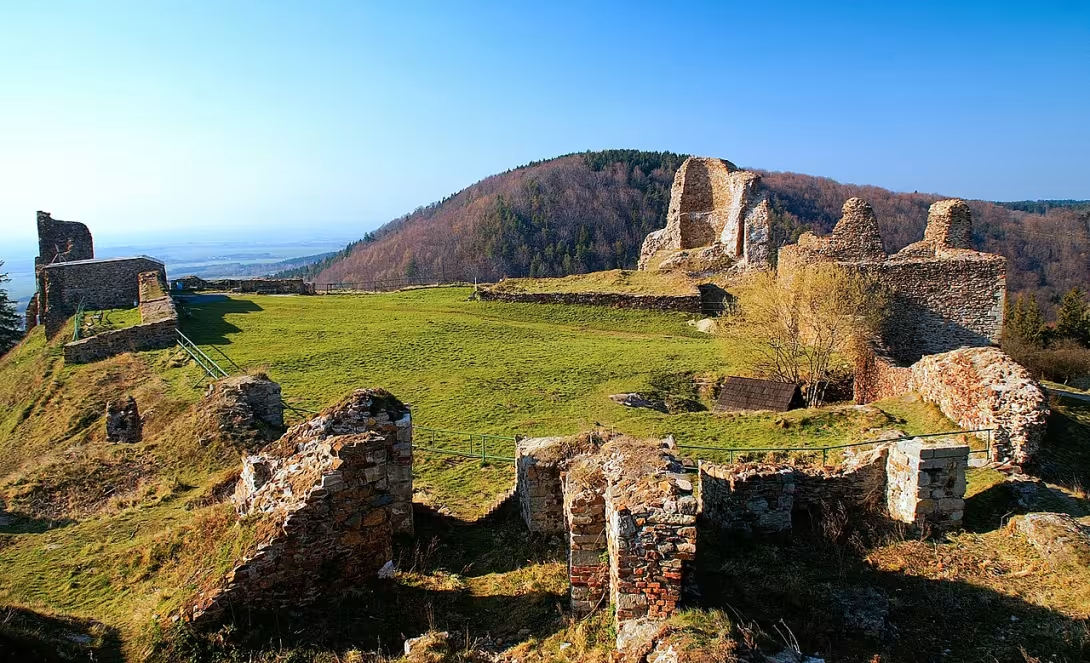

The historical appearance on the left is an AI-generated visualisation and serves as inspiration only.
Historical milestones
- half of the 13th century
- The creation of castle Lichnice
- 1251
- First written mention of the castle
- 1350
- Classification of the castle among castles which were not allowed to be stopped
- 1428-1429
- Siege of the castle by the army of the Orphanage Union
- 1610
- A castle fire that accelerated its decline
- 18th Century
- The castle serves the inhabitants of the village as a source of building stone
Architectural development
The castle was probably founded by King Václav I. and built by Smilo of Lichtenburg, who partially completed it. In the 15th century, the castle was reinforced by fortifications and extended residential areas. After the fire in 1610, the fortifications were destroyed by order of King Ferdinand III.
Points of interest
- The question of the founder of the castle is discussed, and the builder is considered Smil z Lichtenburka or king Václav I. - The original extensive construction project was reduced to a bergfrit-type core with a small palace due to financial possibilities. - At the beginning of the 15th century, the castle served as a base for robbery raids under the leadership of Purkrabi Ješek of Trojovice. During the siege between 1428 and 1429, the Hussites tried to starve the crew, but they didn't use guns. - In the 18th century the castle served the inhabitants of the neighbouring village as a source of building stone.
Guide
Show guide text
This text was created by artificial intelligence and has not been editorially reviewed. It may contain inaccuracies.
Welcome to Lichnice, one of the most famous and historically significant ruins of the castle in the Czech Republic. You are facing a vast area where once there was a stunning fortress high above the valley of the Iron Mountains. Its remains are very much turned off to the sky, offering a view of the vast landscape around Třemošnice.
Lichnice was built in the middle of the 13th century, probably in the reign of King Václav I., although there are discussions about whether it was the founder of Smil z Lichtenburka. The castle is located in an area full of historical tension, where its location was crucial for the protection and strategic supervision of the region.
Let's look at the architectural remains. Its most distinctive element is bergfrit, high wall with almost vertical wall layout. This type of castle was designed to provide not only defence but also a residence for rulers and their cooperative. Although there is now only the rest, the walls of the bergfrit bear witness to the builder's championship of that time.
Over the years, Lichnice has become the center of many historical events. In 1428-1429, the wall was the offensive target of the Orphanage Union, illustrating its strategic importance during the Hussite wars. Later, in 1610, the fire caused another collapse of this fortress.
The interesting thing is that the original plans for a large castle have been reduced due to financial constraints. This refers to the real estate of construction at the time and the political and economic conditions that shaped the history of Lichnice.
In addition, an interesting subject of discussion is the question of the founder of the castle. Although Smil z Lichtenburka and Václav I. are appointed, there is no clear answer, which adds another layer of mystery to the site.
Now look around you and notice the atmosphere of this place. The distant sounds of the forest and the air full of history surround you, reminiscent of the days when Lichnice was a living fortress.
The invitation is to explore other parts of the castle and its surroundings. Every stone here has its own story, which can only be revealed by those who watch out for details and imagine the lives of people who once walked these paths.
Thank you for your visit Lichnice. We hope that this guide inspired you to explore this fascinating place and its rich history. We wish you a pleasant stay in the Iron Mountains!
Tips for visitors
For the best experience we recommend a visit in the early morning or late afternoon when the light for photography is the most suitable and temperatures are more pleasant.
When climbing the ruins, it is recommended to bring comfortable shoes, water and possibly umbrella. For families with children, a walk to the castle and a tour of the ruins alone is an interesting adventure activity in nature, while ensuring security in uneven terrain.
If you are interested in photos, you can get the best views directly from the elevated parts of the castle ruins from where you can capture a vast landscape. The ideal time for landscape images is during the golden watch, when light is soft and color works most intensely.
For nature lovers, the surrounding area offers rich possibilities, as the castle is located in the Protected Landscape Area of the Iron Mountains and within the Geopark Iron Mountains, which allows you to link a historical visit with the discovery of natural formations.
Frequently asked questions
Can the monument be visited?
This is a ruin. Such sites are often freely accessible, but some can only be visited with a guide or are closed for safety reasons. We have not verified the current situation – take care and respect any restrictions.
Where is the monument?
Location: Třemošnice, Pardubický kraj. The map on this page shows the exact spot.
Why is the monument protected?
It is listed in the Central List of Cultural Monuments of the Czech Republic as a cultural monument (register no. 1000460314).
Businesses nearby
Do you run a restaurant, accommodation, shop, museum, rental, wellness or other visitor service near this monument? Show yourself directly to the people heading to it — this is how they will see you in the app and on the web:
Events nearby
Zdroj akcí: otevřená data měst a obcí ČR (Národní katalog otevřených dat) a kalendář akcí Národního památkového ústavu.
Nearby
Protected Landscape Area Iron Mountains
Geopark Iron Mountains
Accommodation nearby
Trips and activities nearby
Guided tours, tickets and activities nearby from GetYourGuide
Affiliate link: if you buy from the partner, we may receive a commission. The price for you does not change.
Search tours and activities →Themed route
1. Geopark Iron Hory, geological area, allows you to recognize fascinating natural processes and composition of local subsoil. 2. Protected Landscape Area Iron Hory, Protected Natural Area, offers visitors beautiful landscape views and diverse vegetation. 3. Lichnice, the ruins of the castle, represents the main destination of the trip and offers a tour of historical remains in the middle of nature.
Seasonal recommendations
Spring: During the spring period, Lichnice in Třemínice is transformed into a special place with new flowering and living nature that comes to life around the ruins of the castle. The sun's rays penetrate the trees, creating magical lighting on ancient mounds, and the intoxicating odor of flowering shrubs spans along the slope. For a visit it is advisable to choose a mild day when opening the sights is full and nature offers its best form. We recommend wearing comfortable shoes for walking on uneven terrain and short coat, because the temperature can be medium with the possibility of sudden cool winds. The best time to visit is early morning or evening when you avoid the crowd and get a quieter walk.
Summer: For years Lichnice offers visitors a warm atmosphere full of life and light, where the ruins of the castle are surrounded by dense trees providing natural shading. Today's visit can be an excellent opportunity for photography, where the lighting is optimal and bright bright light rules the landscape. The main summer season may increase the number of visitors, therefore we recommend coming earlier in the day to be able to explore the memory without excessive crowd pressure. Remember the sun protection - you carry your hat and protective cream as well as sufficient water. Comfortable clothes are necessary for comfort while walking on the terrain.
Autumn: Autumn brings Lichnice to the golden light when tree leaves take on live colors and the whole landscape picture turns to gem. The atmosphere is gentle and calm, which creates ideal conditions for a relaxed walk around the ruins of the castle. This season the number of visitors may be reduced and it is possible to enjoy places without unnecessary distractions. We recommend wearing warm clothes because autumn sun can be surprisingly cold depending on the day and time, and fasten your shoes suitable for unfavourable weather. It is best to visit the memory by starting or late afternoon time, when the light is best captured and the atmosphere is calm.
Winter: Winter visit Lichnice offers a unique view of the ruins of the castle under the cover of snow, creating a romantic and mysterious atmosphere. Sun rays reflect from ice and snow, adding miraculous shine to the landscape image. Moving around places this season requires additional measures - the opening time of the sights is shorter and visitors should be prepared for cold temperatures. We recommend to wear waterproof shoes, warm clothes with top head and hands, as well as wind protection. The best time to visit is during sunny days when you can enjoy the warm light and still keep the quiet visiting space.
Visualizations and artistic views


The visualisations are generated by artificial intelligence and serve as inspiration.
Photos from the area
Real photos taken near the monument

Zdroj a licence jsou uvedeny u každého snímku.
Tips from visitors
No tips yet. Be the first!
Log in and add your tip.
Sources and literature
Photos: Stanislav Dusík / CC BY-SA 4.0, rozlišení zvýšeno umělou inteligencí — Wikimedia Commons. The author and licence also appear when you hover over the image.
Faktickým podkladem tohoto textu byl článek na Wikipedii, jehož autory jsou přispěvatelé Wikipedie. Článek je dostupný pod licencí CC BY-SA 4.0.
Location on the map

Příběhy a pověsti
Legendy, pověsti a příběhy spjaté s touto památkou
Fotografie návštěvníků
Zatím žádné fotografie. Buďte první, kdo přidá fotografii z návštěvy!
Log in a přidejte svou fotografii nebo hodnoťte.
Za ověřenou návštěvu v aplikaci získáte víc bodů — poznáme podle GPS, že jste na místě.
Reviews and comments