



Liteňský vodní mlýn Water mill
Liteňský vodní mlýn in Slatina near Chudenice in Klatovy district is a protected cultural monument built on the river Polenka. This Baroque object is important in its history, which dates back to the end of the 17th century, preserved technical equipment and architectural elements documenting various periods.
The history of the mill dates back to 1698, when the miller was Jan Jelínek, son of Václav Jelínek from Línna. The building belonged to the Black House. The oldest parts of the current state date back to 1773. Between 2016 and 2022 the entire area was renovated.
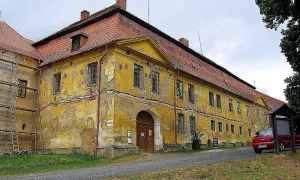
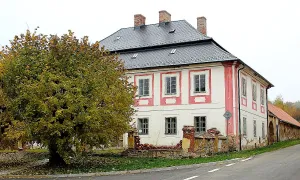
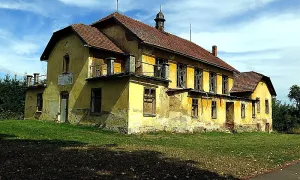
The mill buildings are surrounded by a slightly sloping yard on three sides. On the east side there is a residential building with a grinder, on the south side there is a former stable boy and on the west side there is a barn with similar use. A saw stands separately east of the residential building. There is a stone cellar in front of the front face in the slope. A memorial cross is located north of the mill, where the access roads are raced.
In the main building are preserved baroque spaces in the residential area with valed vaults and lunettes as well as the space of the former black kitchen with kiln. On both floors of the residential part there are mainly classicist door fillings with period fittings. The complete equipment of the mill comes from the first third of the 20th century.
For operation, water was delivered from the Lithuanian pond with a drive about 200 metres long. The building also preserved the production of electricity with Francis turbine.
Today Liteňský vodní mlýn is protected as a real-estate cultural monument of the Czech Republic. This object represents a well-preserved whole that links the history of the economic estate to the technical progress of the industrial era and is a valuable goal for interested people in the history and architecture of this area.
Historical milestones
- 1698
- First mention of the mill and miller Jan Jelínek.
- 1773
- Dating the oldest parts of the original mill composition.
- 2016- 2022
- Reconstruction of the mill.
Architectural development
The oldest parts of the mill composition dates back to 1773. In the interior are preserved baroque rolled vaults with lunettes and classicist door fillings with period fittings. The mill equipment comes mainly from the first third of the 20th century.
Historical events
1698: First mention of the mill with miller Jan Jelinek. 2016-2022: Complete reconstruction of the complex.
Owners
Rod Černín (owners of the estate), miller Jan Jelínek (documented by 1698).
Points of interest
- Liteňský vodní mlýn is a protected cultural monument built on the river Polenka. - The mill has a history dating back to the end of the 17th century and the oldest parts date back to 1773. - The building belonged to the Black House, with the first known miller Jan Jelín in 1698. - The mill underwent reconstruction between 2016 and 2022. - The building has preserved the production of electricity with Francis turbine.
Guide
Show guide text
This text was created by artificial intelligence and has not been editorially reviewed. It may contain inaccuracies.
Welcome to the Lithuanian Water Mill in Slatina near Chudenice! This historical object awaits you with a rich past and beautiful architecture. If you look around, you'll see a residential building with a mill, which is part of this picturesque complex, along with the chamberlain. Note also the separate saws and barns which decompose around a slightly sagging yard. No wonder this complex is a protected cultural monument.
Liteňský vodní mlýn has its origin dating back to the end of the 17th century. The first mention of this place dates back to 1698, when Jan Jelínek appeared as the first known miller. The mill was then part of the Black House and served as an important economic point in the region. The oldest parts of the original mill composition date back to 1773, allowing us to imagine how this object evolved and expanded over the years.
Look up at the sky where the memorial cross is located. This place has many stories you'd like to see. Note also the stone cellar, which provides another historical depth and tells us about the lifestyle of people who once worked here.
Among the key personalities connected to the site is Jan Jelínek, who was the first miller. His heir Václav Jelínek also contributed to the history of this place. Their work and life's journey are part of a long tradition that is preserved here.
The fact that the mill underwent reconstruction between 2016 and 2022 is interesting. This renewal not only preserved the original architectural elements, but also ensured that this historical object could continue to be valued by future generations.
Let's move on and explore other parts of this fascinating area. Notice how every detail is added to the overall atmosphere and tells its own story.
Thank you for visiting the Lithuanian Water Mill. We hope you enjoyed this guide and gained new knowledge of this beautiful monument. If you have time, explore other attractions around Chudenice. When we meet here again, we'll be glad!
Tips for visitors
The best time to visit is morning or late afternoon. At this time the light is the softest, which is ideal for capturing details of historical structures and reflections on the water surface.
You can reach the monument by car or public transport.
With us we recommend taking comfortable shoes that can handle the terrain around the creek and pond to make the walk pleasant.
For the best photos we recommend to focus on a self-standing saw and main mill buildings near the Polenka stream, where they create a beautiful contrast with nature.
In the surroundings we recommend visiting the village Chudenice, taking a walk along the Poleňka stream or near the Lithuanian pond. For families with children it is fascinating to watch the water mill run and explore the area.
Frequently asked questions
Can the monument be visited?
This is a technical monument. Some are open as exhibitions, others are out of use or on private land. We have not verified whether this one is accessible.
What are the opening hours and admission?
We have not verified the opening hours or admission. Current information is published by the operator.
Where is the monument?
Location: Chudenice, Plzeňský kraj. The map on this page shows the exact spot.
Why is the monument protected?
It is listed in the Central List of Cultural Monuments of the Czech Republic as a cultural monument (register no. 1755580376).
Businesses nearby
Do you run a restaurant, accommodation, shop, museum, rental, wellness or other visitor service near this monument? Show yourself directly to the people heading to it — this is how they will see you in the app and on the web:
Events nearby
Zdroj akcí: otevřená data měst a obcí ČR (Národní katalog otevřených dat) a kalendář akcí Národního památkového ústavu.
Nearby
Obec Chudenice, potok Poleňka a Liteňský rybník.
Accommodation nearby
Themed route
Thematic cruise route around the Lithuanian Water Mill
1. Liteňský vodní mlýn (mill) This historic mill is the largest and best preserved rest of the original three mills that once stood in this place. It is an important monument that reminds us of the earlier times and the technique of landscape renewal.
2. Cod The Poleňka stream is a key part of this section because it provided energy for the mill. By walking along its shores, you can enjoy the natural environment and sounds of flowing water, an ideal place to relax and relax.
3. Lithuanian pond This pond was once part of a system for power mill. Today it serves as a natural space where you can enjoy a quiet moment or even try to swim and fish. It's a place full of peace and beauty.
4. Walk around the Lithuanian pond A short walk around the pond allows you to enjoy the view of the greenery and perhaps some animals. This circuit is ideal for families with children or for those looking for a place to relax in nature.
5. Visit of the village Chudenice After visiting the sights and surrounding areas, we will return to the village Chudenice itself, where you can see its historic buildings and perhaps visit the local market or restaurant. This place serves as a cosy conclusion to our cruise route.
This route offers a combination of history, nature and peace, making it ideal for anyone seeking rest in Central Europe.
Seasonal recommendations
What is specific: in Chudenica, the teardrop landscape around the mill is filled with bush pipes and birds sing while the river comes to the carrier, creating a cool fresco. Practical advice: night lighting is minimal, so best comes to visit in the noon when it is warm and the surroundings are still full of life.
What is specific: the full sun and hot temperatures are covered by the mill, its wooden stairs are polished and the water reflects the gold radiation. Practical advice: maximum lighting can be seen, which is why a regular visitor is suitable in the early noon or after noon when heat shifts to water and the crowd drops.
What is specific: the colours that are different in trees and the neck of the mill change, and the wind brings light breath and aroma from outdoor gardens. Practical advice: Determine your calcined cocoon and durable shoes, and the ideal is a visit in the late day when the colors go off and the temperature is still acceptable.
What is specific: the surface of the mill is covered with ice, the steam rises from the water pot and the surrounding area is in the middle of snow. Practical advice: wear isolated platform, hands cover the decorative platform and start the journey in the morning to avoid a larger tourist gathering.
Visualizations and artistic views

The visualisations are generated by artificial intelligence and serve as inspiration.
Tips from visitors
No tips yet. Be the first!
Log in and add your tip.
Sources and literature
Faktickým podkladem tohoto textu byl článek na Wikipedii, jehož autory jsou přispěvatelé Wikipedie. Článek je dostupný pod licencí CC BY-SA 4.0.
Location on the map



Příběhy a pověsti
Legendy, pověsti a příběhy spjaté s touto památkou
Fotografie návštěvníků
Zatím žádné fotografie. Buďte první, kdo přidá fotografii z návštěvy!
Log in a přidejte svou fotografii nebo hodnoťte.
Za ověřenou návštěvu v aplikaci získáte víc bodů — poznáme podle GPS, že jste na místě.
Reviews and comments