



Lštění Fortress
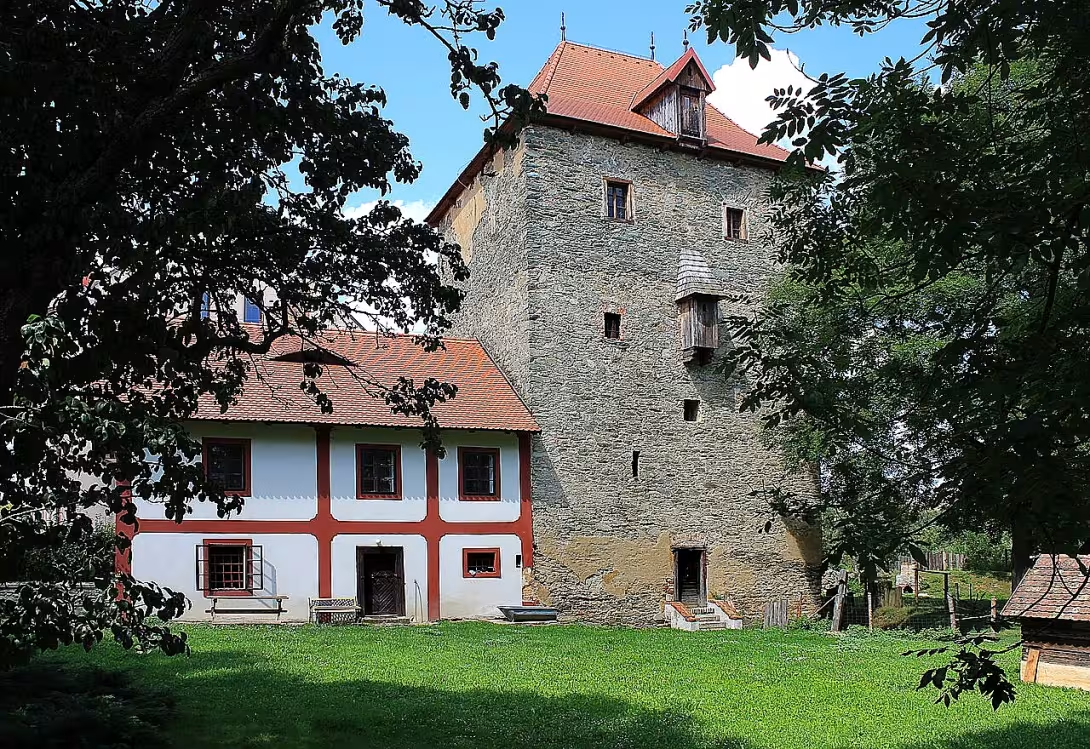
Lštění is a Gothic fortress in the municipality of Lštění u Blížejova in the district of Domazlice. The dominant and core of the complex is the residential tower. Since 1964, the building has been protected as a cultural monument along with an adjacent residential building.
The first written mention of the village and the fortress dates back to 1367, when it was owned by Half from Lštění. Between 1367 and 1379, Pelhřim ze Lštění appears in historical sources, which shared the village with Jesek and Doběst Mělnický. After 1408 the farmhouse was connected to the chateau of Lacembok; at this time the fort was probably significantly rebuilt.
The architecture of the building is defined primarily by a three-storey tower with almost square ground plan with a width of ten meters. The walls are about eight inches thick. The entrance to the tower was later broken into the elevated ground floor. The lower floors, originally illuminated only by the shooting rooms, served as chambers. The living quarters were located on the two highest floors. A Renaissance chateau was added to the original Gothic part, which was later demolished. In the 19th century another residential house was built by the tower.
The possession of the fort has changed many times over time. In 1513, Jan Bohuchval z Hrádku, the owner of the chateau of Lammon, was based here, although the chateau itself was already desolate. After his death around 1519 Lštění took over sister Eliška Bohuchvalová z Hrádku, married to Divis Černín of Chudenice. The Black Fortress was then adapted to the Renaissance Chateau. After 1593 he sold the farm Humprecht Černín z Chudenic Václav to younger Koc from Dobrše. In 1603 he sold it to the city of Domazlice for 15600 kicks of Míšín grosches. After the Battle of the White Mountain, Lštění was confiscated from the city, but in 1626 it was recovered. In 1638 the farm stopped Kašpar Rogir and in 1665 it was bought by Count Jaroslav Kunat z Bubna, who joined it to the Serbian estate. Because of the debts of Leopold Maximilian of the Drum, Innocent Ferdinand of the Drum. Later, Markéta from Valdštejn and Count Franz Joseph Černín from Chudenice were shared by Lštění. After Černín bought the farm Jan Maxmilián Kyšperský z Vřesovic and connected it to the port estate; further housed here by Dohalsky of Dohalic. In 1895 a lawyer Josef Starck purchased the building, who built a chateau in the village, which was later made a school.
In the 17th century, the fort was desolate. In 1769 a major reconstruction took place: the water moats were buried, the tower was adapted to the granary and the Renaissance chateau was torn down. The last renovation of the buildings took place between 2002 and 2006, while the water moat was partially restored.
Today, Lštění is a unique historical monument that links Gothic foundations with later modifications. It is worth visiting anyone who is interested in the architecture and history of medieval and early modern nobility.
Then and now
Drag the slider to compare how the landmark may have looked when it was built with the view today.
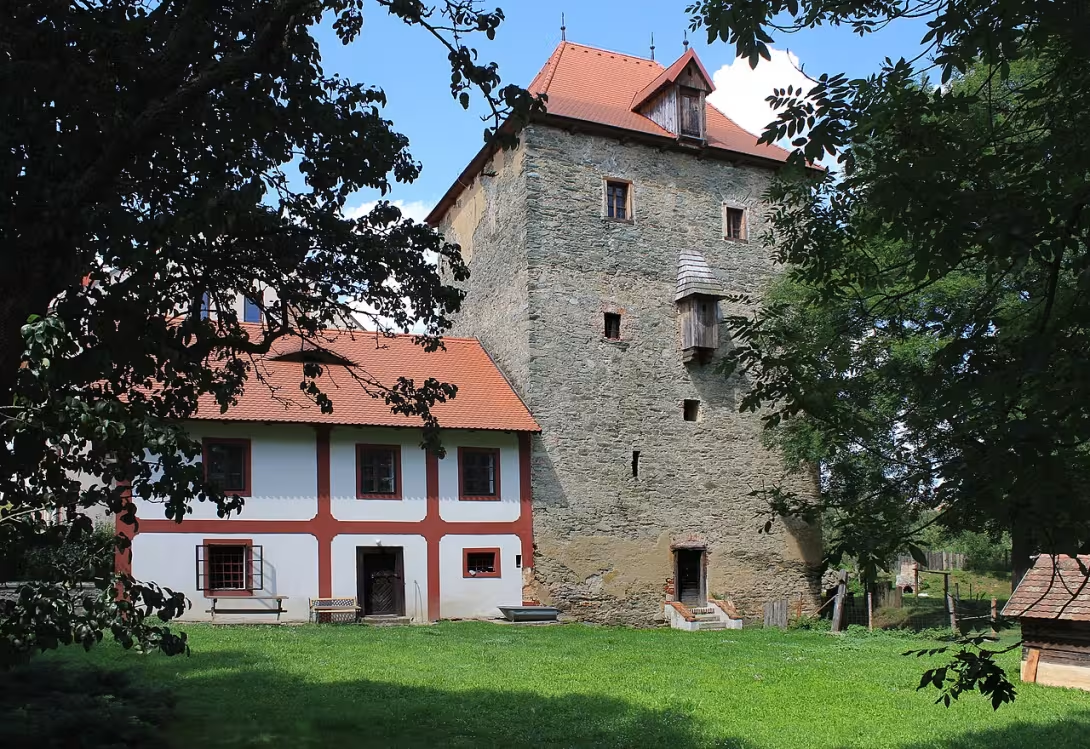
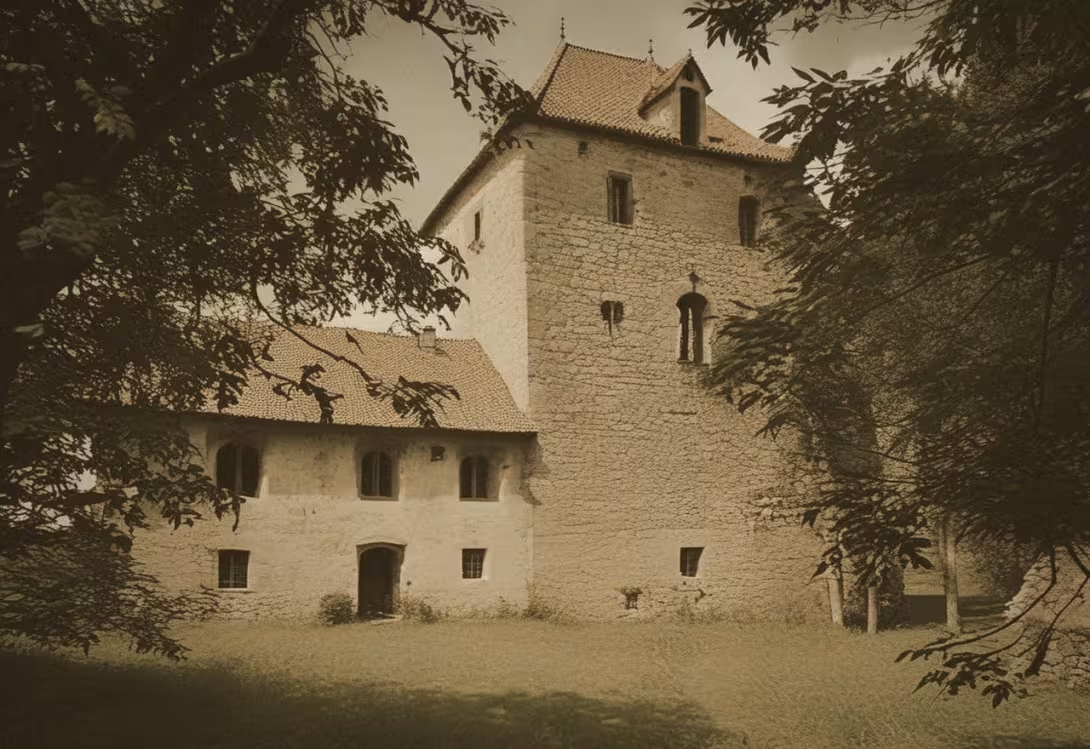
The historical appearance on the left is an AI-generated visualisation and serves as inspiration only.
Historical milestones
- 1367
- First written mention of the village and the fort.
- 1513
- Jan Bouchval's residence from Hrádek.
- 1603
- Sell the estate to the city of Domazlice.
- 1626
- Getting the farm back to the city of Domazlice.
- 1665
- The sale of the estate to Count Kunat Jaroslav of Bubno.
- 1769
- Sprinkled water ditches and a tower for a granary.
- 1895
- Buying the farm by attorney Joseph Starck.
- 1964
- Listing the fort and residential house to the list of cultural monuments.
- 2002
- The beginning of the last building renewal.
Architectural development
The original Gothic fortress was later converted into a Renaissance chateau. In the 18th century the chateau was demolished and the tower was adapted to the granary. In the 19th century, a residential part was added to the tower.
Historical events
1367 - first written mention of the fort, 1603 - sale of the estate to the town of Domažlice, 1769 - filling of water ditches and conversion of the tower to granary, 1964 - declaration of the building as a cultural monument.
Owners
Půta ze Lštění (1367), Pelhřim ze Lštění (1367- 1379), Jan Bohuchval z Hrádku (1513), Eliška Bohuchvalová z Hrádku and Diviš Černín z Chudenic (after 1519), Václav mladší Koc z Dobrše (after 1593), the city of Domazlice (1603- 1626), Kašpar Rogir (1638), Jaroslav Kunat z Bubna (1665), Jan Maxmilián Kyšperský z Vřesovic, Dohalstí dohalic, Josef Starck (1895).
Points of interest
- The whole complex is dominated by a tower with thick walls approximately 130 centimeters wide. - The first written mention of the village and the fort dates back to 1367. - A Renaissance chateau was added to the original Gothic part, which was later demolished. - In the 18th century, there was a major reconstruction, where the moats were buried and the tower was adapted to the granary. - The building has been protected since 1964 as a cultural monument along with an adjacent residential house.
Guide
Show guide text
This text was created by artificial intelligence and has not been editorially reviewed. It may contain inaccuracies.
Welcome to the Lštění fort. You're standing in a place where history touches the ground and where every stone trail tells the story of power, defense, and the brimstone of time. Before your eyes, the most important part of the complex is the dominant living tower, which has been watching the Blížejova area for centuries. Although the space around you may seem calm, believe me, this view of the tower is just a fragment of a much richer and more dynamic past that has taken place here.
Now let's go back deep into the past to understand why this place was created and how it became an important point in the landscape. The first written mention of this village and of the fortress itself dates back to the year 13-37. Imagine that time when security was a top priority and the fort served as a necessary refuge. Lštění was not only a common residence, but a part of a variety of noble mansions that changed over time. The whole area was seen as a strategic point that had to be controlled by important generations.
Now pay attention to the construction itself, which is right in front of you. Although the view of the tower may seem simple, its design is fascinating. If you look at her massive body, realize it's not a normal building. These walls are incredibly thick, because they are approximately one hundred and thirty centimeters tall. This incredible thickness was deliberate - the tower had to be able to withstand attacks and remain firm even in the most difficult times. Originally, this building was Gothic, leaving a permanent mark in its nature. In later times, however, the style changed and the Renaissance reconstruction gave rise to a chateau. Even though this chateau complex was later demolished and today we see especially the tower and its newer residential parts, we still feel in architecture the lineage of different epoch. In the nineteenth century, another residential part was added to the tower, which gave it a new dimension, and in recent years the object has undergone a total renewal to serve the people again.
The history of this place is also a history of many names and families that have left their mark. We can name here, for example, Půta from Lštění or Pelhrm from Lštění, who worked here in the early stages of the existence of this headquarters. Later, in the year 15, the 13th Jan Bohuchval z Hrádku settled here, along with his wife Eliška Bouchval. Their names are firmly linked to the bloom of this place. Later, however, the fate of the farm began to change. In the year sixteen-three the statk was sold to the city of Domazlice, which a few years later, in the year sixteen-six, regained it. It followed the era of Count Kunata Jaroslav of Bubno, who lived here in the middle of the seventeenth century. More and more people like Diviš Černín z Chudenic, Humprecht Černín z Chudenic, Václav mladší Koc z Dobrše, Kašpar Rogir, Jan Maxmilián Kyšperský z Vřesovic and Josef Starck have appeared in history. Each contributed to the fact that Lštění was a place where political interests and noble ambitions clashed.
You may now wonder how such a robust and defensive object has changed in time. Here is one of the most interesting things you can realize here. Imagine a fortress that was surrounded by moats that served as the first line of defense. But in the eighteenth century, there was a fundamental change. In 17-26-9, the water moats were buried and the tower itself underwent a major adjustment. The dreaded defense tower became a practical granary. This transformation from military and noble residence to a purely economic object is a fascinating proof of how society's needs change and how architecture adapts to new, more peaceful times.
You are standing in front of a place that has survived centuries, although its functions and appearance have changed many times. From the Gothic fortress to the Renaissance chateau to the practical granary and today's renewed monument. The tower you're watching is a silent witness to all these events.
I hope this view of Lštění's past has helped you better understand its meaning. Please continue your search and feel the atmosphere of this place. Every corner and every stone here has a story waiting to be rediscovered. I wish you a pleasant continuation of the neighborhood.
Tips for visitors
For the best experiences we recommend a visit in late afternoon hours, when sunlight best highlights the architecture of the dominant residential tower and creates interesting shadows on its walls. Autumn season offers very beautiful colors around the monument.
You can reach the fort by car and public transport; the current timetables and connections are best checked in the internet search engine.
During the tour we recommend taking drinking water and comfortable shoes, because the terrain of the historical building can be uneven. The tour is very interesting for families with children thanks to the unique tower, but it is necessary to adjust the pace to families with smaller children.
In terms of photography, the best angles for capturing the entire tower are obtained from lowlands or from surrounding elevated points during the golden hour. After the tour you can go to the nearby Blížejova or explore the historic estate of Lacembok, which is located in close proximity.
Frequently asked questions
Can the monument be visited?
Some buildings of this kind are open for guided tours, others serve another purpose or are privately owned. We have not verified whether and when this monument is open – please ask the operator.
What are the opening hours and admission?
We have not verified the opening hours or admission. Current information is published by the operator.
Where is the monument?
Location: Blížejov, Plzeňský kraj. The map on this page shows the exact spot.
Why is the monument protected?
It is listed in the Central List of Cultural Monuments of the Czech Republic as a cultural monument (register no. 1000125292).
Businesses nearby
Do you run a restaurant, accommodation, shop, museum, rental, wellness or other visitor service near this monument? Show yourself directly to the people heading to it — this is how they will see you in the app and on the web:
Events nearby

Zdroj akcí: otevřená data měst a obcí ČR (Národní katalog otevřených dat) a kalendář akcí Národního památkového ústavu.
Nearby
The village Blížejov and the historic estate of Lacembok are nearby.
Accommodation nearby
Themed route
1. Blížejov, municipality. This village serves as a starting point for the entire route. 2. Lštění (fortress), a monument. The main destination of the trip, which represents a key historical object in this area. 3. Lacembok, historical estate. The trip ends with a visit to this historic estate.
Seasonal recommendations
Spring: In the spring season, the fortress Lštění in Blížejov is transformed into a shining refuge, where the shining sun rays illuminate medieval walls and nature awakens from dreams. Flowers in nearby meadows create a rich floral carpet, which gives the atmosphere a mild temperature and livelihood. Visit the fort around noon when the sun most illuminates the historic building, but prepare for a few other visitors who enjoy spring heat. Put on comfortable and a little warm clothes, because it can get colder in the morning.
Summer: In summer the fortress Lštění is the best place to relax in a pleasant and quiet atmosphere. Long sunny days allow a long visit, but due to the high summer season it is advisable to arrive early morning or late afternoon to avoid the crowd. The high sun illuminates every angle of the fort and at the same time brings warm air, so it is important to have a protective head and sunglasses with you. Don't forget enough drinking material, because in summer it can be warm even inside the fort.
Autumn: In the autumn period the Lštění fortress offers a unique atmosphere with colorful landscape leaves that turns into a living carpet. The sun lights up the walls of the fort in softer light and the shadows on the ground add a romantic nature to the view. Visit the monument around noon when sunlight is the most beautiful, but take warmer clothes with you because autumn can bring cool winds. Visiting is usually lower than summer, which means more peace and opportunity to enjoy the fort without disturbing crowds.
Winter: In winter, the Lštění fortress offers an escape to a peaceful world with a freezing air and a quiet atmosphere. Sun rays illuminate medieval architecture in fine radiation, adding something magical to the view. Visit the fort quickly in the morning or late in the afternoon because the opening time is usually shorter and temperatures can be very low. It is important to prepare warm clothes, including fur and gloves, and perhaps an umbrella or protective cover for shoes, because the freezing conditions can be challenging.
Visualizations and artistic views


The visualisations are generated by artificial intelligence and serve as inspiration.
Photos from the area
Real photos taken near the monument


Zdroj a licence jsou uvedeny u každého snímku.
Tips from visitors
No tips yet. Be the first!
Log in and add your tip.
Sources and literature
Photos: This file is available under Creative Commons BY-SA license. Basically: You can use this picture for any purpose, provid / CC BY-SA 3.0 — Wikimedia Commons. The author and licence also appear when you hover over the image.
Faktickým podkladem tohoto textu byl článek na Wikipedii, jehož autory jsou přispěvatelé Wikipedie. Článek je dostupný pod licencí CC BY-SA 4.0.
Location on the map
More monuments – Blížejov
Show all in the municipality




Příběhy a pověsti
Legendy, pověsti a příběhy spjaté s touto památkou
Fotografie návštěvníků
Zatím žádné fotografie. Buďte první, kdo přidá fotografii z návštěvy!
Log in a přidejte svou fotografii nebo hodnoťte.
Za ověřenou návštěvu v aplikaci získáte víc bodů — poznáme podle GPS, že jste na místě.
Reviews and comments