






Mahenovo divadlo Theatre building
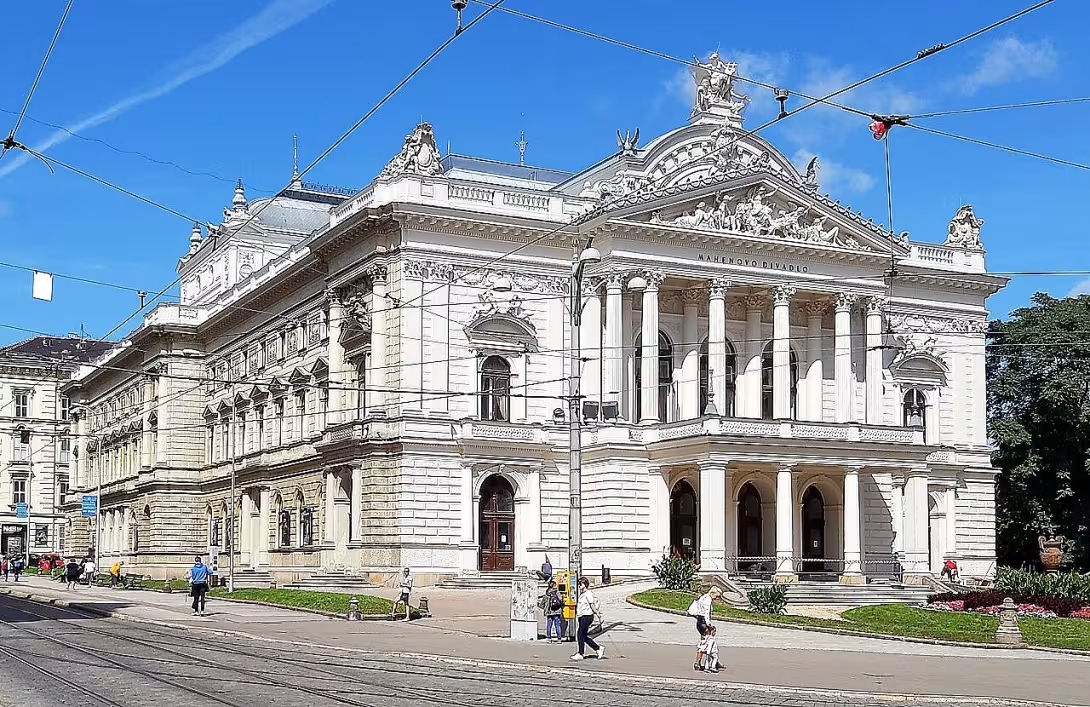
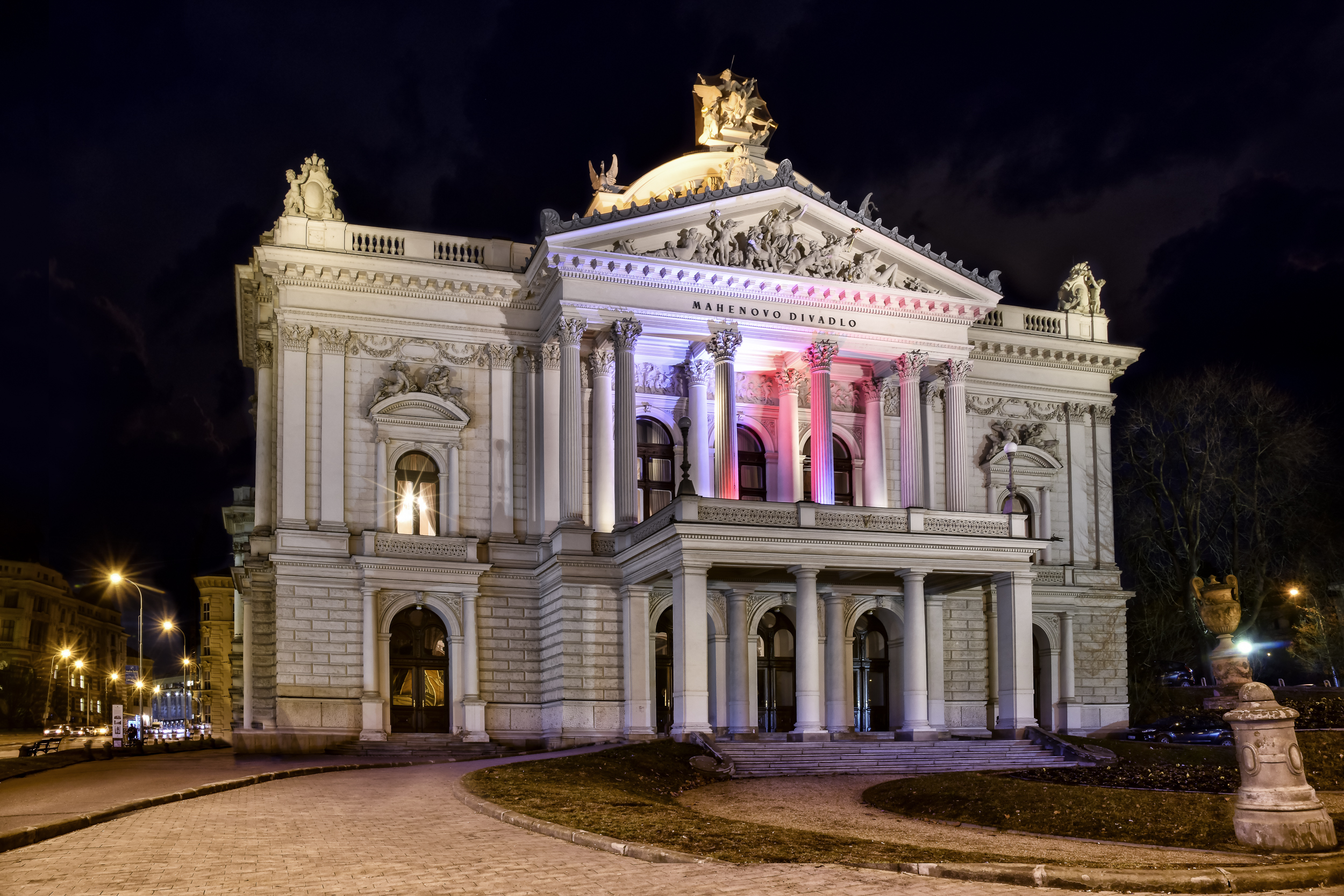
Mahenovo divadlo in Brno on Malinovsky Square is a significant historical building from 1882, protected as a cultural monument of the Czech Republic. The building is world famous as the first theatre on the European continent, which has been equipped with electrical lighting since the opening. Today it serves as the main scene for the National Theatre Brno.
The need for a new building arose after the fire of the City Theatre Reduta on the Zelné market in 1870. The construction of the new German Municipal Theatre on the walls was completed in less than 17 months. During the work the builders had to respond to the tragic fires of theatres in Nice, Prague and Vienna. This led to modifications of plans, adding new exits and two side staircases. The operation was festively launched on 14 November 1882 with the introduction of Beethoven's foreplay and scenic music by Egmont.
The architectural plans were supplied by the famous Vienna firm Fellner and Helmer, the construction was carried out by Brno city builder Josef Arnold under the guidance of architect J. Nebehosteny. The building is built in an eclectic style that combines elements of neo-Renaissance, neo-Baroque and neoclassical. Brno sculptor and stonemason Franz Dressler participated in the sculpture exterior and interior. The original capacity of 1195 seats has been adjusted over the years to the current 572 seats.
After the creation of Czechoslovakia in 1918 the theatre went into Czech hands under the name Theatre on the walls. The first dramaturist became writer and playwright Jiří Mahen whose name the building has been carrying since 1965. In 1936 the stage underwent extensive reconstruction by Českomoravská Kolben- Daněk. By installing heavy stage cars, divided floors and bridges, the scene became technically the most modern in Czechoslovakia.
The unique technical interest is electrical lighting, the project was developed directly by Thomas Alva Edison and its laboratory in New Jersey. Since there was no flat electricity network in Brno at the time, the theatre had to build its own power plant. Parts of this original wiring are now exposed in the foyer. The interior is decorated with a chandelier originally made for the last Shah of Iran, Muhammad Reza Pavlavi. Until 1965, when Janáček's theatre was opened, the building served mainly the opera ensemble. He introduced here six operas of Leoš Janáček and world premiere ballet Romeo and Juliet Sergei Prokofyev.
Today Mahenovo divadlo is the mother scene of the National Theatre in Brno and represents a key element of Brno cultural history. Visitors can admire the historical architecture as well as the technical ones that passed their time. The tour offers a unique insight into the development of European theatre culture and technical progress of the end of the 19th century.
Then and now
Drag the slider to compare how the landmark may have looked when it was built with the view today.
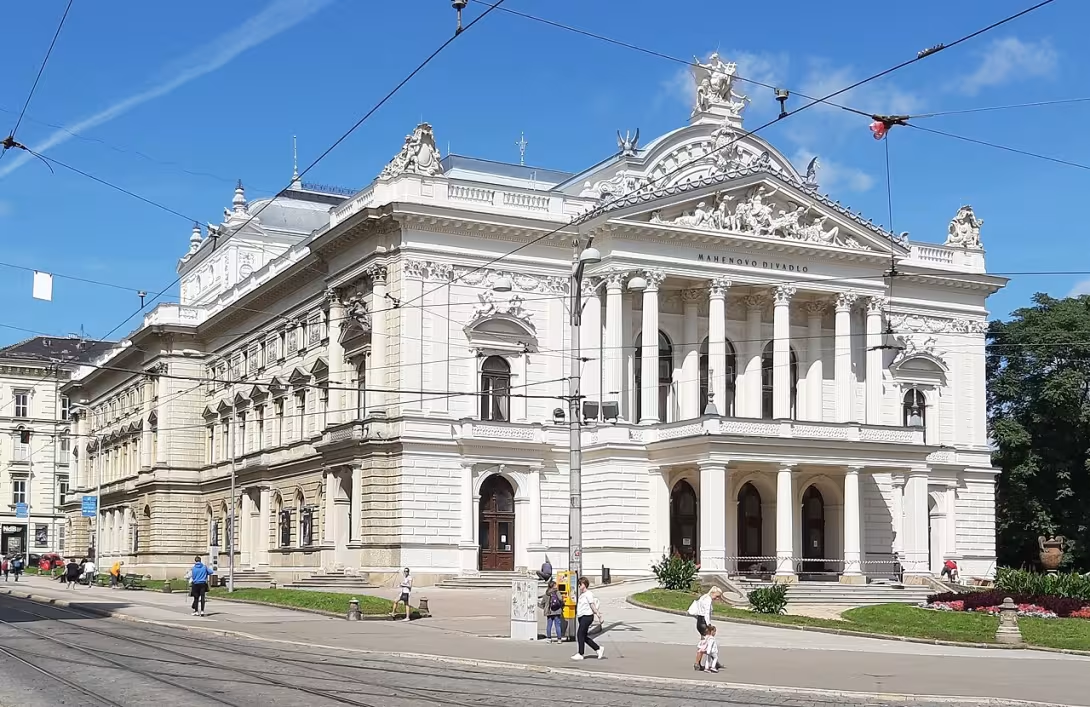
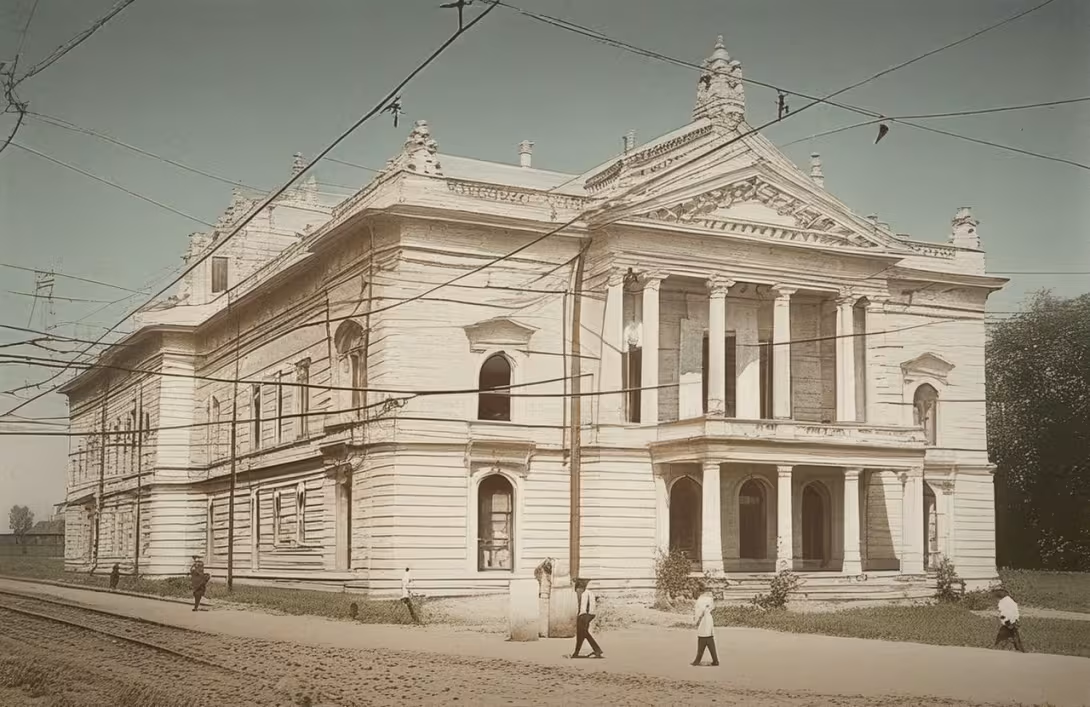
The historical appearance on the left is an AI-generated visualisation and serves as inspiration only.
Historical milestones
- 1882
- Completion of construction and start of theatre operation.
- 1918
- The theatre passes into Czech hands under the name Theatre on the walls.
- 1936
- Installation of modern stage technology by Českomoravská Kolben- Daněk.
- 1965
- The theatre receives the current name Mahenovo divadlo and becomes a drama scene.
Architectural development
The theatre was built according to the plans of Vienna's company Fellner and Helmer Brno builder Josef Arnold. During construction, escape routes and staircases were added due to fires of other European theatres. In 1936 the stage underwent a major reconstruction during which modern stage cars and bridges were installed.
Historical events
1882: Festive opening of the theatre with electric lighting. 1918: The transition of the theatre to Czech hands and renaming to the Theatre on the walls. 1936: Extensive modernization of stage technology by Českomoravská Kolben- Daněk.
Owners
City of Brno
Points of interest
- This theatre was the first on the European continent to have electrical lighting since it opened. Due to the absence of the electricity network in Brno, the building had to be built its own power plant. The electric lighting project was developed directly by a man named Tomas Alva Edison in his lab. Parts of this original installation are now visible in the lobby. The construction of the new building was completed in less than 17 months. The reaction to theatrical fires in other cities was the addition of new exits and two side staircases. The interior is decorated with a chandelier that was originally made for the last Iranian monarch Muhammad Reza Pahlavi. - The original capacity of the theatre was one thousand and ninety-five seats, which was adjusted over time to the current five hundred seventy-two seats.
Guide
Show guide text
This text was created by artificial intelligence and has not been editorially reviewed. It may contain inaccuracies.
Welcome to the heart of Brno, a place where history, art and technological progress meet. Legally, you are now standing in front of a building that is one of the most important symbols of Brno culture. The Mahenovo divadlo stands before you. Just stop for a second, take a deep breath and feel the atmosphere of this place. In front of you, you see a monumental structure that, both in size and appearance, emits dignity and certain expectations. It's a place where for more than a hundred years dreams meet reality and thousands of viewers experience the strongest emotions.
Let us now return together in time to understand why this building was created. Imagine Brno in the second half of the nineteenth century. The city grew, developed, and its inhabitants desired a high level of culture. At that time, the Municipal Theatre Reduta worked here, but it was tragically burned. The loss was huge, but it also became an impulse to create something completely new and modern. It is this need that has created the construction that you are facing today. The year one thousand eight hundred eighty-two was the key moment when the construction was completed and the theatre started its operation. From the very beginning, however, the builders did not only address aesthetics. After experience with Reduta's fire, extreme emphasis was placed on security measures so that such a tragedy would never happen again.
Now pay attention to the architecture itself. Look at the front of the building. What you see is an example of the so-called eclectic style. This means that architects did not choose to hold just one style, but masterfully combined elements from several different periods. Notice the effects of neo-Renaissance, neo-Baroque and neoclassical. This mixture creates a harmonious whole that is both noble and dynamic. The recognised architects Ferdinand Fellner and Hermann Helmer, helped by Josef Arnold and J. Nebehosteny, are responsible for this visual experience. Look at the line of the building, its rhythm and the way it dominates the surrounding space. It is an architecture intended to express the strength and ambition of Brno at the time.
If we go further in time, we will find that political and social conditions have changed with the building. The big change was the year one thousand nine hundred and eighteen. At the time of the creation of the independent Czechoslovakia the theatre passes into Czech hands. At that time it was named Theatre on the walls. It was a symbol of a new beginning and national confidence. The theatre became a place where the Czech word and the Czech drama could fully develop.
Over the years, the building has been constantly modernised to keep up with the times. In the year one thousand nine hundred thirty-six, there was a significant improvement in the inner space. The company Českomoravská Kolben- Daněk has installed a modern stage technique that has made it possible to perform much more complex and visually richer performances. And if you ask why the theatre is called Mahenova's, the answer comes in a thousand nine hundred and sixty-five. That's when the building got its current name in honor of the great writer and theatre Jiří Mahen. Since then, this scene serves primarily as an action theatre where the most important dramatic games are played.
The names of the real greats are linked to this place. In addition to Jiří Mahen, the creation of Leoš Janáček or Sergei Prokofyev left a trail. Imagine all the voices, all the tones and the tense moments of silence that have hosted these spaces over decades.
And now we come to the part that makes Mahen's theatre a real world unique. I want to invite you to imagine the world of the late nineteenth century. Most people still use candles or gas lamps. The light was expensive, weak and often dangerous. And at that time, in the year one thousand eight hundred eighty-two, something incredible happened. Mahenovo divadlo was the first theatre on the entire European continent, equipped with electric lighting since its opening.
Try to realize what a shock it must have been, and at the same time, an astonishment for the first visitors, when the entire hall suddenly lit up without a single flame. But here's another fascinating detail. There was simply no electricity network in Brno at the time. The city wasn't ready for that kind of technology. So what did the builders do? In order for the theatre to shine, they had to build their own power plant for the building. That was an unprecedented investment and courage at the time.
And who was behind this? The project of this electrical lighting was developed directly in the laboratory by a man whose name is known to the whole world, Thomas Alva Edison. Imagine the connection that one of history's greatest inventors personally helped with the technical solution to the building you're facing right now. Mahenovo divadlo was not only a cultural centre, it became a true technological beacon throughout Europe.
If you look at this building today, you don't just see walls and ornaments. You see the courage of people who wanted to be first. You see history that survived wars and regime changes. You see where the genius of the architect, the vision of politicians and the ingenuity of Thomas Alvo Edison came together. Mahenovo divadlo is proof that Brno has always been forward and not afraid to experiment with a new one.
Now that you know the story of this building, I suggest you examine it closely. Feel her majesty and perhaps imagine what it was like to enter the hall for the first time lit by electric light in the year one thousand eight hundred eighty-two. Whether you're drawn into art or fascinated by technical history, this place will certainly give you a lot of inspiration.
Thank you for coming through the short history of Mahen Theatre with me. I wish you a pleasant rest of the day in our beautiful city and enjoy the further discovery of Brno monuments. Goodbye.
Tips for visitors
We recommend planning the tour for an evening performance where the building excels thanks to its historic lighting and festive atmosphere. Interiors are an architectural gem, which is best enjoyed in peace before the game begins.
We recommend the use of public transport, whose stops are in the immediate vicinity. Find the current connection in travel applications.
To the theatre we recommend to choose a social garment that matches the meaning and beauty of this historic building. Take only small personal items with you, it is not advisable to take large luggage to the auditorium.
The best exterior images are taken from Malinovsky Square, where the overall architecture stands out. In the interior it is advisable to take pictures during breaks when there is plenty of light and space is freely accessible for admiring the details of the decoration.
Within 30 minutes' walk there is a historical centre, Zelný Market and Janáček Theatre. For families with children the visit is suitable within the morning performances for schools or families, while the surrounding square offers plenty of space for walking.
Frequently asked questions
Can the monument be visited?
Some buildings of this kind are open for guided tours, others serve another purpose or are privately owned. We have not verified whether and when this monument is open – please ask the operator.
What are the opening hours and admission?
We have not verified the opening hours or admission. Current information is published by the operator. Official website: https://www.ndbrno.cz
Where is the monument?
Location: Brno-město, Jihomoravský kraj. The map on this page shows the exact spot.
Why is the monument protected?
It is listed in the Central List of Cultural Monuments of the Czech Republic as a cultural monument (register no. 1000151262).
Businesses nearby
Do you run a restaurant, accommodation, shop, museum, rental, wellness or other visitor service near this monument? Show yourself directly to the people heading to it — this is how they will see you in the app and on the web:
Events nearby




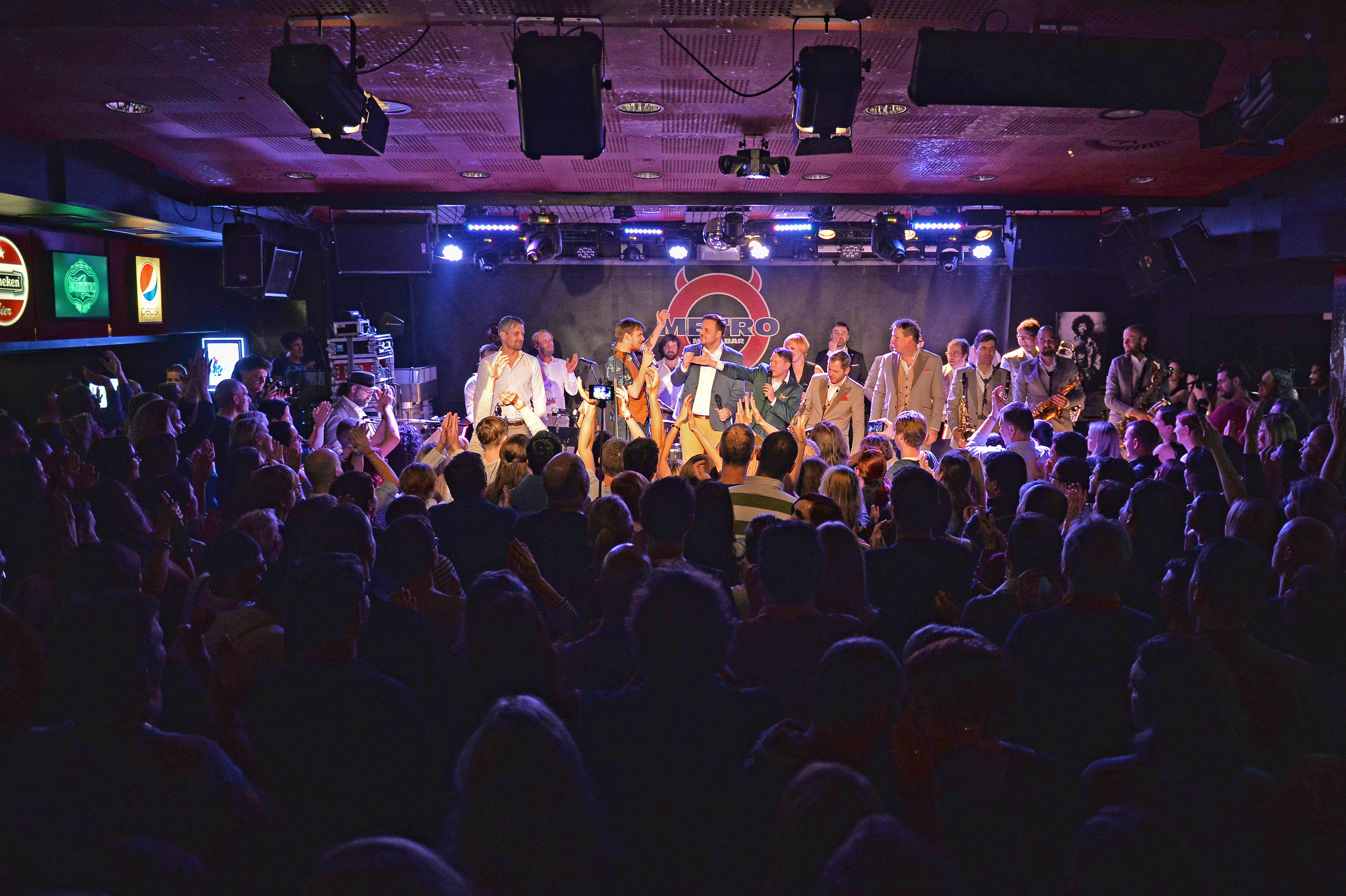


Zdroj akcí: otevřená data měst a obcí ČR (Národní katalog otevřených dat) a kalendář akcí Národního památkového ústavu.
Nearby
Malinovského náměstí, historické centrum města Brna, Zelný trh, Janáčkovo divadlo.
Accommodation nearby
Trips and activities nearby
Guided tours, tickets and activities nearby from GetYourGuide
Affiliate link: if you buy from the partner, we may receive a commission. The price for you does not change.
Search tours and activities →Themed route
Malinovsky Square - square, historical heart of Brno. Why is it worth a visit: picturesque cafes and architecture from the 19th century, an ideal starting point for walking.
Historical centre of Brno - district, set of preserved Baroque and Art Nouveau buildings. Why is it worth a visit: the atmosphere of old streets, the possibility to soak up local culture and history during a short walk (about 300 m from the previous point).
Green market - market, traditional market with fresh products and craft stands. Why is it worth a visit: lively atmosphere, tasting local specialties and the possibility of buying souvenirs (about 200 m from the historical centre).
Janáček's theatre - theatre, important cultural institution. Why is it worth a visit: an architectural gem and an opportunity to look into Brno's theatre tradition (about 150 m from Zelný market).
Mahenovo divadlo - theatre, main destination of the route. Why is it worth a visit: the first Czech theatre with electric lighting, rich history and excellent performances in historical interior (about 100 m from Janáček Theatre).
Seasonal recommendations
Spring: Mahenovo divadlo in the spring season offers a unique atmosphere where the sun's rays intersect with foggy air and flowering trees on the surrounding squares. At this time, it is particularly attractive to watch nature wake up and take on life, giving the theatre environment a unique character. It is recommended to leave with light clothes for a visit, because temperatures may be medium and may appear colder in the morning or evening. Best to visit the theatre in the middle of the day when the sun shines most, which increases the attractiveness of the outdoor spaces around.
Summer: The Mahenovo divadlo is surrounded by a lively and full energy urban atmosphere. The sunny days offer ideal conditions for walking around the surrounding squares where various outdoor events and events are often held. The warm air and long dawn mean that it is advisable to visit the theatre earlier in the day to prevent the midday heat and possible crowds. The good idea is also to bring sunglasses and UV protection.
Autumn: In autumn, Mahenovo divadlo offers a view of the city in colour shades of trees that are preparing for winter. The sunny days are warm and short, which creates a mild and welcoming atmosphere for visiting. At this time it is advisable to leave with light clothes on sunny days and a little warmer in the evening when temperatures decrease. Moreover, autumn is ideal for observing urban life without excessive crowds.
Winter: The winter visit to Mahen Theatre offers a unique view of Brno covered with snow, when the city is revived by light from the outside and internal lighting. Hot clothes are necessary due to low temperatures and shorter days. The theatre can also be visited in the evening during this season when the lights in the surrounding buildings become even more attractive.
Visualizations and artistic views


The visualisations are generated by artificial intelligence and serve as inspiration.
Photos from the area
Real photos taken near the monument


Zdroj a licence jsou uvedeny u každého snímku.
Tips from visitors
No tips yet. Be the first!
Log in and add your tip.
Sources and literature
Photos: GALAXY 2018 A7 / CC0 — Wikimedia Commons. The author and licence also appear when you hover over the image.
Faktickým podkladem tohoto textu byl článek na Wikipedii, jehož autory jsou přispěvatelé Wikipedie. Článek je dostupný pod licencí CC BY-SA 4.0.
Location on the map
Příběhy a pověsti
Legendy, pověsti a příběhy spjaté s touto památkou
Fotografie návštěvníků
Zatím žádné fotografie. Buďte první, kdo přidá fotografii z návštěvy!
Log in a přidejte svou fotografii nebo hodnoťte.
Za ověřenou návštěvu v aplikaci získáte víc bodů — poznáme podle GPS, že jste na místě.
Reviews and comments