



Mariánský sloup (Drnholec) Marian column
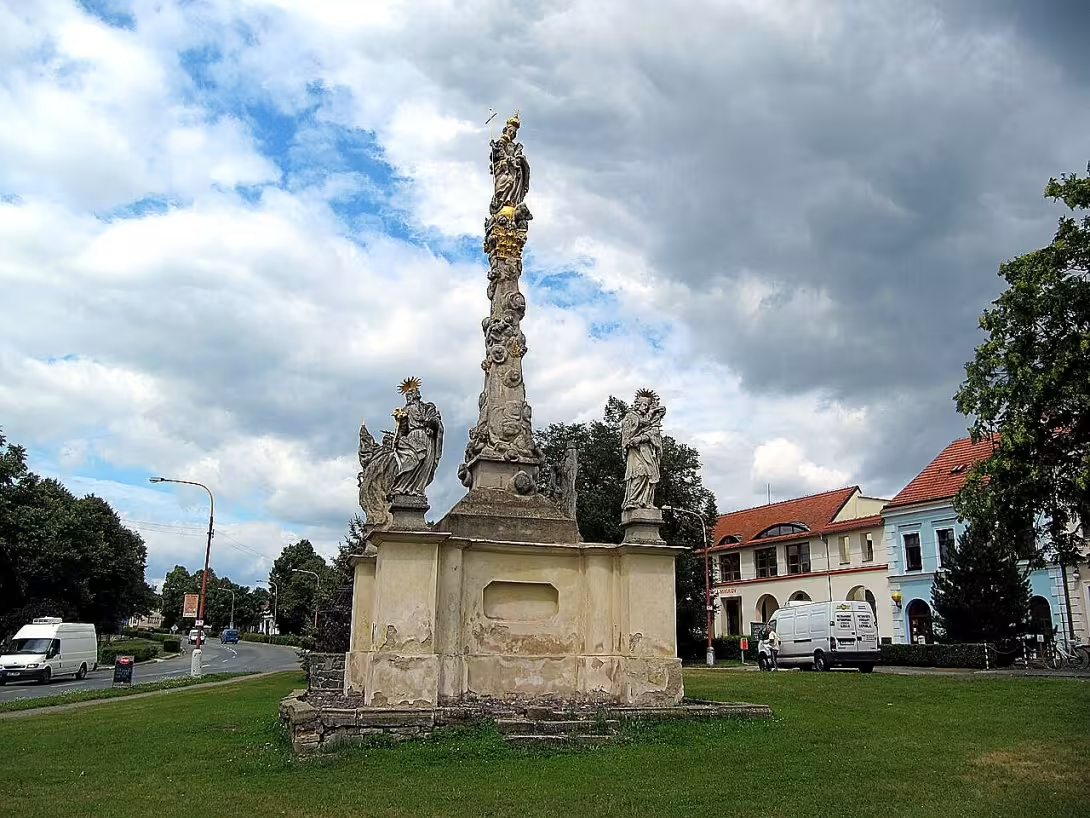
The Marian column in Drnholci in Břeclav is a Baroque sacral monument from 1714 to 1718, which decorated the local square. The work of sculptor Štěpán Pagan was created as a thank you for protecting the village from the plague epidemic and represents an important element of the historical nature of the town.
The construction of the column took place in the early 18th century, at the time of the peak Baroque in Czech countries. This period has strongly influenced counter-Reformation and the pursuit of a visual expression of religious godliness. At the time, the plains became a common element of urban architecture as an expression of thanks for the disappearance of the epidemics that plagued Europe at the time. The DrnholecKý monument was erected on the market at the time as a reaction to the plague, which the municipality marginally intervened between 1714 and 1715.
It is an architectural Baroque composition whose central part is Madonna in a cape with a crown on its head and a child in its arms. This statue stands on a gold ball placed on a four-sided stone obelisk decorated with clouds and heads of angels. Jesus in the arms of the Virgin Mary holds a gilded Latin cross, which is a specific iconographic detail. The obelisk is set in a walled pedestal on whose corner pillars are the statues of St. Florian, St. Shebestian, St. John Nepomuk and St. Joseph. The sculpture is carved out of mussel limestone, while the pedestals are lined up with bricks. The whole object is surrounded by balustrados and the entrance to it is possible by a goal with three steps. The decoration also includes paintings on sheet with religious motifs.
After World War II, the column was designed to be removed, but the local priest František Vašek saved it from destruction. In 1946, the monument was cleaned. In 1992, a copy of the statue of St. John Nepomuk, which had been missing on the ground for over 20 years, was placed on the stand. There was another repair in 1994.
The last complete restoration and restoration of the monument were completed in 2014. During these works, the experts repaired the plaster, moldings and the base wall under the balustrade. The stone was cleaned and reinforced, with the necessary copies of the original balustrada and tin paintings.
Today, the Marian Pillar in Drnholc is a fully restored monument, which is easily accessible to visitors due to its location in the town hall square. For those interested in Baroque art and the history of the region, it is a valuable proof of period piety and craftsmanship. Visiting this place offers the opportunity to look at a detailed sculpture, which remains the natural center of the historical core of the village after centuries.
Historical milestones
- 1714
- Starting the construction of the column as a thank you for protecting us from the plague.
- 1946
- Cleaning up the post after World War I.
- 1992
- Putting a copy of the statue of St. John Nepomuk on the stand.
- 2014
- Completion of total restoration and restoration of the monument.
Architectural development
The sculpture is carved out of mussel limestone, while the pedestals are lined up with bricks. Architecturally, it is a Baroque composition with obelisk on a walled pedestal, supplemented by balustrad and paintings on sheet metal. In 1992, a missing copy of the statue of St. John Nepomuk was added.
Historical events
Construction of the column as a plague thank you in 1714-1718. Rescue of monuments from removal after World War II by priest Franz Vasek. Complete restoration and restoration completed in 2014.
Points of interest
- The monument was created as a thank you for protecting the village from the plague epidemic, which hit the site between 1714 and 1715. - The author of the work is sculptor Štěpán Pagan and the sculpture is carved out of mussel limestone. - Santa in the arms of the Virgin Mary holds a golden cross, which is a specific detail. - After World War II, the column saved the local priest František Vašek from destruction. - In 1992, a copy of the statue of St. John Nepomuk was placed on the stand, which had been missing for over 20 years.
Guide
Show guide text
This text was created by artificial intelligence and has not been editorially reviewed. It may contain inaccuracies.
Welcome to Drnholc. You're standing right in front of one of the most important symbols of this place, in front of the Marian column, which stands in the middle of the local square. Before you continue your walk, stop for a moment and feel the atmosphere of this space. This Baroque whole is not just a stone piece, it is a living testament to the faith, hope and deep gratitude that ruled here hundreds of years ago. Look at his shapes, his ascending line, which naturally leads you up to heaven. Feel how this monument dominates the surroundings and becomes the center around which the life of the village revolves.
Let us now return together to the time when this column was formed. Imagine the atmosphere of a thousand seven hundred fourteen. The whole community was in suspense and fear. The plague epidemic, the terrifying disease that at those times afflicted mankind and brought only sadness, struck this place in the thousands of seven hundred fourteen to thousand seven hundred fifteen. People were looking for protection, looking for direction, and looking for the strength to survive this extremely difficult period. That is why, as a token of their deep thanks for protecting the community and for finally leaving, they decided to build this monument. The construction lasted several years, from a thousand seven hundred fourteen to a thousand seven hundred eighteen. It was a gift for heaven, a symbol of survival and an expression of a strong link between the local community and divine protection. So this column is not just an ornament, it is a monument to the victory of life over death.
Now pay attention to the work itself and its architecture. Notice how the column is built and how it works. The main creator of this sculpture was sculptor Štěpán Pagan. That's a name to remember, for his hands breathed life into this material. The whole piece is carved out of mussel limestone. This stone has a special beauty and texture that resembles nature itself and gives the whole piece an organic, almost living look. Look at the middle part, the tall obelisk. It is decorated with angels and clouds that create a sense that this monument is touching the sky itself and that celestial forces are moving in it. At its peak there is a central group, the Virgin Mary with a little Jesus in her arms. It's a moment of peace and maternal love in the midst of all the religious excitement.
And now, please pay attention to one of the most beautiful details if you come any closer. Notice what little Jesus is holding in his mother's arms. He holds a golden cross in his hands. This bright, shiny element in the middle of a stone work is absolutely exceptional. The contrast between the matte limestone and this golden detail is breathtaking and immediately captures your vision. It's a symbol that shines for centuries.
Now look down on the pedestal. There you will find other important characters that complement this whole religious story. They're statues of saints standing here as guardians. You'll see St. Florian, St. Sebastian, St. John Nepomuk and St. Joseph. Each of these characters bears its own meaning and complements the overall narrative of this monument. Their presence on the pedestal gives the whole part stability and depth.
The history of this column is not only about its origin, but also about its duration and how people took care of it in different times. This object has gone through many stages of care to stay as well as you see it today. In the year one thousand nine hundred forty-six, the column was cleansed after the trials brought about by the First World War. Later, in the year one thousand nine hundred ninety-two, a new element was placed on the pedestal - a copy of the statue of St. John Nepomuk. And in order for the column to serve future generations, two thousand and fourteen total restoration and restoration took place in the year. Thanks to this constant care we can admire Stephen Pagan's championship in his Baroque glory today. There are other important personalities in the history of this place, such as František Vašek, which has been associated with the history of this area.
There's something fascinating about all this, that this stone, this shell limestone, has been able to cope so well with time. Every trace on his surface tells us the story of the people who lived here, their fear of illness and their joy of protection. It's like the stone is learning with the people in Drnholc.
I hope this view of the Marian Column has enriched you and that you have tasted a piece of the history of this place. Before you go on your journey, take another look at this monument from a distance and see how beautifully it fits into the overall picture of the local square. We wish you a nice walk by Drnholc and other interesting discoveries waiting for you in this village. We'll say goodbye and wish you a pleasant rest of the day.
Tips for visitors
The best time to visit the Marian Column in Drnholci is during spring or autumn months when the weather is mild and the column is illuminated by the sun.
You can also get to Drngirl by public transport, check the connection in the search engine.
When you visit the Marian Column, remember to bring a camera to capture beautiful pictures of this Baroque monument. The best places for shooting are secured areas in front of and around the column.
In the vicinity of the Mariánské pole in Drnholci is worth visiting the protected landscape area of Pálava, where you can walk through beautiful forests and admire local fauna and flora.
For families with children, the Marian column in Drnholci is a great choice for a trip. Children will be able to play on secured areas in front of the column and parents will be able to see the beautiful Baroque architecture.
Frequently asked questions
Can the monument be visited?
This is a structure in a public space that can usually be seen from outside free of charge. We have not verified that this particular one is freely accessible.
Where is the monument?
Location: Drnholec. The map on this page shows the exact spot.
Why is the monument protected?
It is listed in the Central List of Cultural Monuments of the Czech Republic as a cultural monument (register no. 1000149992).
Businesses nearby
Do you run a restaurant, accommodation, shop, museum, rental, wellness or other visitor service near this monument? Show yourself directly to the people heading to it — this is how they will see you in the app and on the web:
Nearby
Obec Drnholec se nachází v okrese Břeclav v Jihomoravském kraji, v blízkosti vodního díla Nové Mlýny a chráněných krajinných oblastí Pálavy.
Accommodation nearby
Themed route
Thematic cruise route around the Marian Column (Drnholec)
1.Mariánský sloup (Drnholec) - Type: Historical landmark - Why is it worth visiting: This column is an important spiritual and historical symbol, built in the 18th century as a thank you for overcoming the plague. Its architecture and location on a higher location offer beautiful views of the surroundings.
2. Pálava Protected Landscape Area - Type: Protected landscape - Why is it worth visiting: This area is known for its unique vegetation and diversity of fauna. It is an ideal place for relaxation in the society of nature, with the possibility of short walks between the bushes and forest platforms.
3. Water Works New Mill - Type: Water construction - Why is it worth visiting: This water work is not only a technical monument, but also a natural sanctuary. Its swimming pools and surrounding green spaces offer a peaceful atmosphere for relaxing and observing local bird species.
4. The tank of the Marian Column - Type: Historical area - Why is it worth visiting: The tank around the pole is an ideal place to stop and think about the history of the village. Its peaceful atmosphere and architectural elements add authenticity to the path.
This route offers a combination of spiritual, cultural and natural experiences in the picturesque South Moravian region.
Seasonal recommendations
Spring: In the spring period, the Marian Pillar in Drnholc opens up a new light and green, which contributes to a lively atmosphere full of hope. The sun illuminates the statue in the afternoon with long rays that highlight its details. Nature is in full bloom and surrounding forests are transformed into a flood of colors. For a visit it is advisable to prepare light clothes but also have a jacket available for a cooler afternoon. The best time to visit is in the noon hours when the sun illuminates the memory and nature is in its most beautiful radiation.
Summer: Summer on the Marian Column brings long days full of sunshine, allowing you to explore the memory in the best lighting. The atmosphere is charged with heat and the sounds of nature, where the birds influence calm. When planning a visit, it is advisable to go out early or in the evening to avoid the midday warm days and crowds of tourists. The important thing is to bring sun protection and plenty of drinking water.
Autumn: In autumn, the Marian Column offers an incredible atmosphere where golden tree leaves make a beautiful background for a memorial. The sun sets early and the nights come faster, which creates a quieter environment for walks. This season it is advisable to choose warmer clothes because of cold evenings and the immense beauty of November colors. The best time for a tour is in the early afternoon, when light is getting brighter and nature is in its most beautiful radiation.
Winter: During the winter season, the Mariana pillar has a unique atmosphere where snow covers the surrounding landscape and illuminates the statue with its white coats. The sun sets early and the nights are long, creating a calm and quiet environment. It is important to have warm clothes and suitable shoes for snow. The best time for a tour is in the early afternoon when the light is still bright enough and nature offers unique winter beauty.
Visualizations and artistic views

The visualisations are generated by artificial intelligence and serve as inspiration.
Photos from the area
Real photos taken near the monument


Zdroj a licence jsou uvedeny u každého snímku.
Tips from visitors
No tips yet. Be the first!
Log in and add your tip.
Sources and literature
Photos: palickap / CC BY 3.0 — Wikimedia Commons. The author and licence also appear when you hover over the image.
Faktickým podkladem tohoto textu byl článek na Wikipedii, jehož autory jsou přispěvatelé Wikipedie. Článek je dostupný pod licencí CC BY-SA 4.0.
Location on the map



Příběhy a pověsti
Legendy, pověsti a příběhy spjaté s touto památkou
Fotografie návštěvníků
Zatím žádné fotografie. Buďte první, kdo přidá fotografii z návštěvy!
Log in a přidejte svou fotografii nebo hodnoťte.
Za ověřenou návštěvu v aplikaci získáte víc bodů — poznáme podle GPS, že jste na místě.
Reviews and comments