






Mariánský sloup (Klášterec nad Orlicí) Marian column
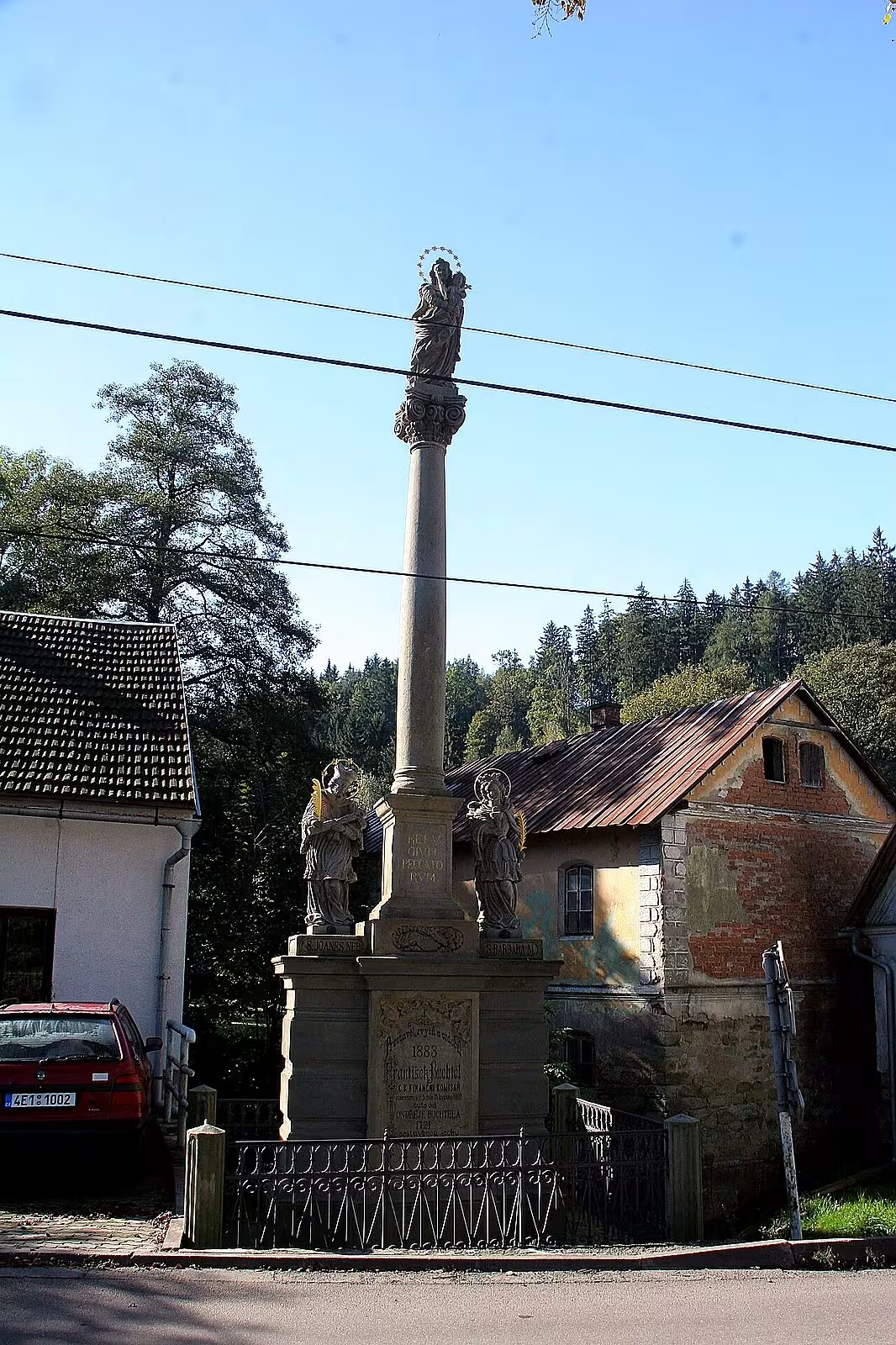
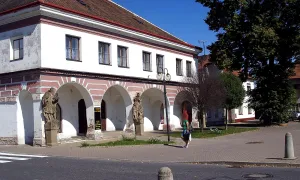
The Marian column in Monasterc nad Orlicí is a Baroque pestilence column built in 1721 near the house No. 89. This monument, located in Ústí nad Orlicí district, represents an important part of local history and culture. Its creation is linked to the miller Ondrej Buchtl, who made the original statue of Saint Mary Immaculata as a symbol of faith and thanks for overcoming the epidemics. In 1883, the column was rebuilt by František Buchtl into a pestilence column, adding statues of St. John Nepomuk and St. Barbara. This change reflects the development of local traditions and then beliefs.
The architecture of the work is characteristic of Baroque style, which is manifested by rich decorations and emotional expression. The whole object is made from sandstone, which was common material for similar monuments at the time. A reconstruction took place in 1934, which ensured its preservation for future generations.
The history of the memorial is closely linked to the House of Buchtel. Ondřej Buchtel was the first owner and initiator of the original statue. His grandson, František Buchtel, expanded it in 1883 with other statues. This family tradition reflects the deep devotion of the local community. Key events, such as milestones from 1721, 1883 and 1934, underline the lasting importance of this monument for the inhabitants of the Monasteries of Orliche.
Today, the Marian Column is well maintained and accessible to visitors. Its historical value and architectural features make it an interesting destination for those interested in local heritage and Baroque art. The visit offers an opportunity to learn more about the history of the city and its inhabitants. The column is not only a monument to local importance, but also a witness to the rich culture of this part of Bohemia. Maintaining it is reminiscent of the importance of cultural heritage care and is an essential part of the journey for anyone who wants to explore the past and traditions of this area.
Historical milestones
- 1721
- The status of the original statue of Saint Mary Immaculata.
- 1883
- Rebuilding into a pestilence column with the addition of other statues.
- 1934
- Reconstruction of the Marian pole.
Architectural development
The original simple statue was rebuilt into a pestilence column in 1883 with the addition of the statues of St. John Nepomuk and St. Barbara. The column was reconstructed in 1934.
Historical events
- 1721
- The status of the original statue of Saint Mary Immaculata.
- 1883
- Rebuilding into a pestilence column with the addition of other statues.
- 1934
- Reconstruction of the Marian pole.
Points of interest
- Baroque pestilence was built in 1721 at the house No. 89. - The miller Ondřej Buchtel made the original statue of the Virgin Mary Immaculate as a thank you for overcoming the epidemics. - In 1883 František Buchtel rebuilt it and added statues of St. John Nepomuk and St. Barbara. - The entire object is made of sandstone. - A reconstruction took place in 1934, which ensured the preservation of the monument.
Guide
Show guide text
This text was created by artificial intelligence and has not been editorially reviewed. It may contain inaccuracies.
Welcome to the Monasteries of the Eagle. You have just stopped before one of the most important and most spiritual symbols of this city. In front of your eyes stands the Marian Column, a monument that is not only a stone building, but above all a living witness to human faith, fear and deep gratitude. You're standing in a place where history meets everyday life, right next to house number 80, and it's this space that's intersected with a story that goes back centuries. Please feel the atmosphere of this place, the calm that exists here, and try to look at this object not as a mere memory, but as an expression of the human spirit that sought protection in times of greatest uncertainty.
Now let's go back deep into the past together to understand why this column is even standing here. Imagine the year one thousand seven hundred twenty-one. The world around you is quite different from what you know today. People live in a constant neighborhood with an invisible enemy who was an epidemic. Diseases that affected humanity at the time were not only physical diseases, but they represented deep terror and tension that affected every aspect of life. In this context, an idea was born that was supposed to be protective.
The main figure of this beginning was a man named Ondřej Buchtel. He was not a nobleman or a powerful ruler, but a miller, a hard-working man, and firmly rooted in the local community. It was Ondřej Buchtel who felt such a strong need to express his gratitude for his family and his entire village coping with the devastating arrival of the plague. In the year of the thousand seven hundred twenty-one he made a statue of the Holy Virgin Mary Immaculata. At that time, it wasn't the extensive column you see now, but it was a simple, but extremely important statue that was meant to serve as a spiritual guardian and a reminder of survival.
Now pay attention to the very form of the monument that surrounds you. Even though its appearance has changed over the years, you still feel a strong touch of baroque style. The Baroque was not only about beauty, but above all about emotion, about drama, and about trying to connect the earthly world to the celestial one. Now, if you look at the column, notice its overall structure and how its composition expanded over time.
The original, simple statue of the Virgin Mary was transformed in the later century. In the year of a thousand eight hundred eighty-three, there was a major reconstruction, which made the original work what we now call a pestilence pillar. This process was not random. At that time, the monument was already part of the local landscape and needed to be expanded to better match the religious monument's ideas. Thanks to this reconstruction, the column became much richer and more complex.
Please note the characters that will now decorate this object. Apart from the central figure of the Virgin Mary, there are now other saints that were added in the eighteenth years of the nineteenth century. One of them is Saint Jan Nepomucký, a figure who is deeply honored in our countries and which symbolizes protection and loyalty. Next to him is Saint Barbora, whose presence is of profound importance in the context of the plague column, because she was often sought out as a protector against sudden death. It is this combination of characters that creates a strong spiritual entity that is to address visitors and locals immediately with its sanctity.
But this story is not just the story of one man or one family. It's a story of continuity. It is fascinating to see how care for this monument has been transmitted from generation to generation. While Ondřej Buchtel laid the foundations of this tradition with gratitude, his successor, František Buchtel, decided to develop this tradition and deepen the monument. František was the one who contributed in the year one thousand eight hundred eighty-three to the fact that the original statue became this very impressive pestilence column. By adding more sculptures, not only has he aesthetically enriched the object, but he also added a new layer of meaning to it. In this way, the Buchtel family has entered their name in the history of the Monasteries of the Eagle through this stone.
If you look at the state of the monument now, you might notice that its history does not end in the nineteenth century. In order for this object to serve future generations, it needed to be cared for even in modern times. In the year one thousand nine hundred and thirty-four there was an important reconstruction, which ensured that the Marian pillar remained stable and maintained its dignity despite the rotation of years and environmental influences.
Perhaps now you can think of all that this column has experienced. Imagine all the human destinies that passed by him. He saw the joy of surviving the disease, he saw the sadness of leaving, he saw the changing faces of the city and the advancing age of people who admired him. There is a mystery in it - how is it that in such a small town one family has managed to maintain such a strong link to this place for so long? It is the invisible force of faith and gratitude that still resonates in this stone work.
When looking at the column, remember that every detail of it, every added statue and every repair was motivated by the desire to preserve a memory of what was most important for people at the time - life and protection. That is the true essence of the baroque pestilence. It's not just decoration, it's a prayer carved in stone.
Now that you have adopted the basic history and understood the importance of this place, I suggest you stop for a while and just observe this monument quietly. Try to see how light changes on its surface and how its presence floats over the surrounding street. It's the moment when history becomes present.
We hope that this brief view of the past has enriched you, and that this Marian column will now be perceived in a slightly different way than when you came to it. Klášterec nad Orlicí has many other hidden treasures and stories waiting for you. So continue your walk and let the beauty of this city take you. Thank you for your attention and we will wait you out for another historic monument. Goodbye.
Tips for visitors
The best time to visit the Marian Column in the Monasteries of Orlici is autumn when the surrounding forests are coloured and provide a beautiful background for photography. This time of year also offers mild weather compared to sunny summer days.
Parking can be found near the sights, but due to limited capacity we recommend using public transport. The best way to get to the Monastery over Orlici is to use a train connection or bus line that can be easily found online.
When you visit, remember a suitable suit and shoes. It may happen that you will walk on stony roads or through lawns so that the legs and the tight shoes are always a good idea. Also remember the sun cream.
Photography of the Marian Column is the most beautiful at noon, when the direct sun shines and illuminates the statue. For wonderful shots also try to find perspective with the background of the forest mountains.
In the vicinity of the Monasterce nad Orlicí it is possible to visit the historic castle, which is nearby. It is an ideal place for families with children to enjoy beautiful nature and visit the castle park.
Businesses nearby
Do you run a restaurant, accommodation, shop, museum, rental, wellness or other visitor service near this monument? Show yourself directly to the people heading to it — this is how they will see you in the app and on the web:
Nearby
🏰 Historic sites (77)
- Gedenken an Rudolf Weiss 4.1 km
- _ 4.1 km
- K-S 38 4.2 km web
- K-S 37 4.4 km web
- Ruina house sudeckiego 4.6 km
- Ruina barokowej kaplicy 4.6 km
- Monument to the victims of the world war 5.1 km
- ruiny dworu obronnego 6.0 km
- Military Museum Lichkov 6.6 km web
- Busta T.G. Masaryka 6.9 km
- Marian Columns 6.9 km
- Museum of old machinery and technology 7.1 km + 420737239065 web
- Memorial to victims of World War I 7.2 km
- Municipal Museum Žamberk 7.2 km
- memorial of Gen. Knop and victims of the Second World War 7.3 km
- Memorial to the fallen in World War I 7.7 km
- Domek Prokopa Divishe 8.0 km Bethlehem 326 + 420 608 427 064 web
- Family home Prokopa Diviše 8.0 km
- Boden Mühle 8.1 km
- Railway Museum of Rokytina in the Orlicke Mountains 8.3 km Silver top
🍽️ Restaurants and dining (87)
- Restaurant U Mostu 2.1 km
- Formanka 3.3 km
- Restaurant on the road 3.7 km
- Restaurant Na Statku 3.8 km
- Orlická cottage U Rampušák 4.0 km web
- Na Hrazi 4.0 km
- Bistro Na Salashi 5.4 km
- hsičárna 5.4 km
- Janulenka 5.5 km
- Guesthouse Hruška 5.7 km
- U Nás 5.8 km
- U mostu 6.1 km
- Pizza on kole 6.2 km + 48730010668
- BatA 6.3 km + 420 608 356 665 web
- Kavarna 6.9 km
- Pizzeria Men's House 6.9 km Masaryk Square 6 web
- Buffet in the Deep 7.0 km Deep 143 + 420776186722 web
- Nón La 7.0 km Masaryk namesti 144
- Pizza Edi 7.0 km Deep 92 + 420775061237 web
- Not only caffe at Páji 7.0 km Railway station 764 + 420776186722 web
🏨 Accommodation (58)
- U Capsules 2.7 km + 420 777 087 811 web
- Guesthouse Pastviny 3.4 km
- BatA 3.5 km
- ATC Nobility palouk 3.5 km + 420724147317 web
- ATC Nobility palouk 3.5 km + 420724147317 web
- Bobík 3.5 km
- Still life 3.6 km
- Petro palouk 3.8 km
- Chata 4.1 km
- Adamk 4.3 km
- Chalupa pod Adamem 4.9 km
- Earth Gate 5.7 km
- Gościniec u Dany 6.0 km + 48 74 811 91 90 web
- Autocamping Under Black Lesem 6.2 km + 420 465 614 755 web
- Widokowa Osada 6.5 km + 48 601506596 web
- Agroturystyka Michałówka 7.0 km + 48 731741271 web
- OtmarkA 7.2 km
- Samota u Hadince 7.9 km + 420 602 245 921 web
- Lesovna 7.9 km
- Taboriste under the water tent 8.1 km web
🚲 Rentals and sport (9)
- Natural swimming pool 3.5 km
- TOSK Žamberk 6.3 km
- Viktor Bike Sport 6.9 km Under Town Hall 153 + 420724738658 web
- Sport Milena Bulíčková 7.0 km Railway station 554
- Club Biathlon Letohrad, p.s. 8.1 km
- Outdoor Sport, s.r.o. 8.7 km
- Cyklo sport Mach 9.8 km
- Sport 9.8 km
- Outdoor swimming pool 14.0 km
🥾 Hiking and nature (188)
- ZZzstav 0.6 km
- Nad Kasárnami 1.0 km
- Nade 1.4 km
- Above the image 1.5 km
- Jerábska 1.9 km
- U Public 2.1 km
- Bučina 2.1 km
- Potoký kopec 2.4 km
- Orlička 2.7 km
- _ 3.0 km
- Top 3.0 km
- Adam 3.5 km
- Na Cheerleaders 3.8 km
- Kostels 4.0 km
- Na Ice cream 4.1 km
- Krejsová kopec 4.5 km
- Cold 4.8 km
- Raseliniště pod Přečem 4.9 km
- Homole 5.2 km
- Kamyk 5.3 km
Accommodation nearby
Themed route
1. Marian Column (Memorial) - The main objective of the tour, which represents an important religious symbol. Admire the artistic processing of the statue and its historical significance. 2. Pillar base (Architectural detail) - Detailed view of the bottom of the monument. Here you can take a closer look at the craftsmanship and inscriptions carved in stone. 3. The immediate area of the monument (surrounding area) - The space directly next to the monument used to explore the entire work from different angles. It's an ideal place for a peaceful observation of the monument.
Seasonal recommendations
In spring, the pillar surrounds the waking green and fresh air, creating a sense of renewal. Soft spring light is ideal for capturing details of baroque processing. We recommend to wear more layers of clothing because the morning temperatures may still be low, and visit the place in the morning when it is quiet.
In the summer months the surrounding area is dominated by green and intense sunlight, which highlights the whiteness of the stone. The atmosphere is full of energy but accompanied by higher traffic. It is advisable to come very early in the morning to avoid the largest groups of people, and not forget light, breathtaking clothes and sun protection.
Autumn brings golden leaves and frequent morning fog to the landscape, which give the monument a mysterious and melancholy touch. The light is golden and milder in this period. Practical is to choose waterproof shoes due to moisture in the grass and plan a visit to the late afternoon when the colors are most saturated.
In winter, the Marian pillar is very sober and majestic, especially if the landscape is covered with snow, which creates a sharp contrast with the material. There is a deep peace and quiet here. It is necessary to wear warm and waterproof clothes and count on a short day, so it is best to leave immediately after sunrise.
Visualizations and artistic views

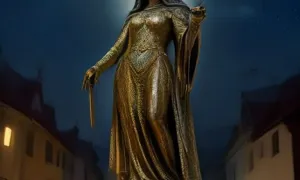
The visualisations are generated by artificial intelligence and serve as inspiration.
Photos from the area
Real photos taken near the monument


Zdroj a licence jsou uvedeny u každého snímku.
Tips from visitors
No tips yet. Be the first!
Log in and add your tip.
Sources and literature
Photos: Petr1888 / CC BY-SA 4.0 — Wikimedia Commons. The author and licence also appear when you hover over the image.
Faktickým podkladem tohoto textu byl článek na Wikipedii, jehož autory jsou přispěvatelé Wikipedie. Článek je dostupný pod licencí CC BY-SA 4.0.
Location on the map
More monuments – Klášterec nad Orlicí
Show all in the municipality

Příběhy a pověsti
Legendy, pověsti a příběhy spjaté s touto památkou
Fotografie návštěvníků
Zatím žádné fotografie. Buďte první, kdo přidá fotografii z návštěvy!
Log in a přidejte svou fotografii nebo hodnoťte.
Za ověřenou návštěvu v aplikaci získáte víc bodů — poznáme podle GPS, že jste na místě.
Reviews and comments