






Městské opevnění (Horšovský Týn) Town walls
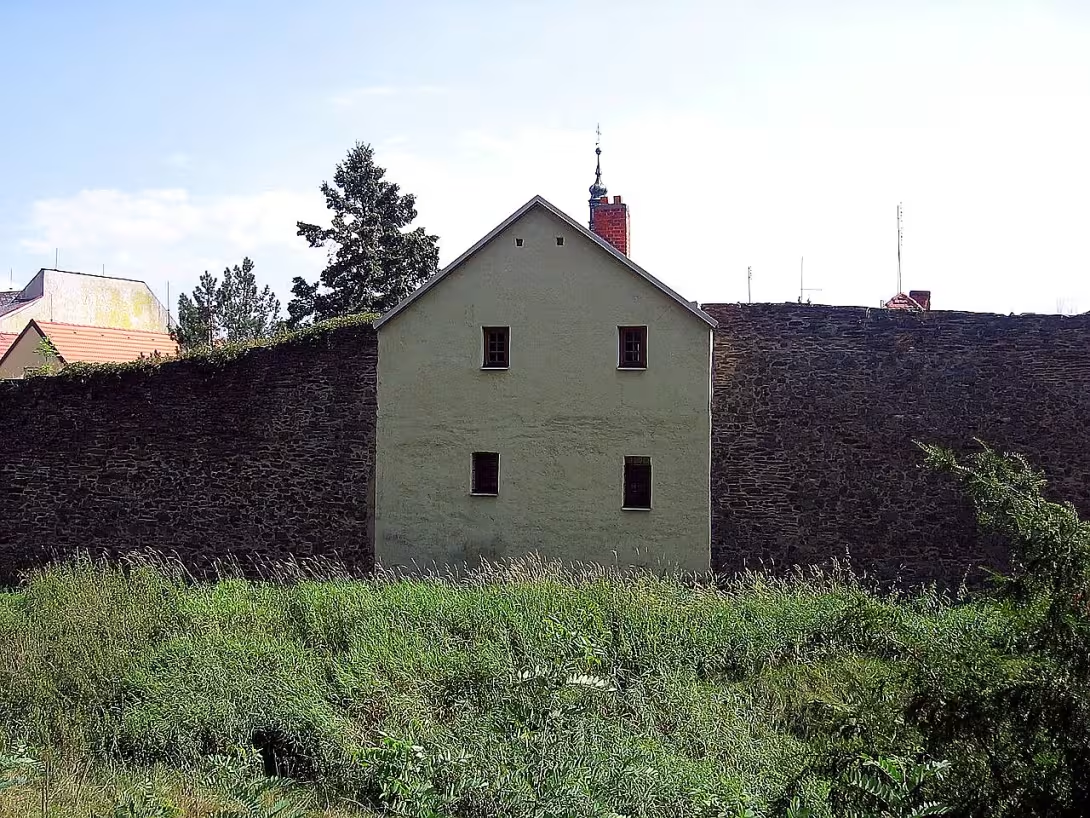
The town fortification in Horšovský Týn in the Pilsen region consists of partially preserved medieval walls of the city. It was probably built in the 14th century. Their remains are protected as a cultural monument. This fortification system includes walls, trenches and two main gates, Lower and Upper. In the past, they have played a fundamental strategic and military role.
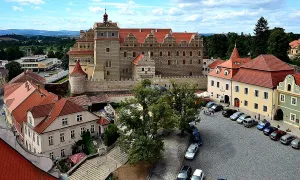
The historical centre of the city has an area of approximately 4.4 hectares. From the south it is defined by the flow of Radbuza and in the west by the Křakov stream. There is a castle in the western part of the island. The terrain is sloping south into the river valley and rising northeast. Horšovský Týn was founded in the thirteenth century at the forefront of the castle there. It was connected to an older estate, which was partly located on the right bank of Radbuza. In the 1940s, Horshov Týn was a city with the right to collect customs duties. The chronicler Beneš Krabice z Veitmile considered Archbishop Arnošt of Pardubice as the founder of the city fortification. The construction itself probably took place in the middle of the 14th century in the context of urban development and security and business privileges in Czech countries.
The fortification system consisted of a wall about 150 centimeters thick and approximately eight meters high in the best preserved section. There was a moat outside the wall and a wall in some places. The moat is best preserved in the north. Here it was 20 meters wide and in preserved form is six meters deep. It was separated from the wall by a wide berma in this section. The moat was only missing on the southeast side where it was probably replaced by a drive. In the west, the wall connected to the outer fortification of the castle, which was separated from the city by a moat. The most threatened northern section of the wall was reinforced by a single tower or bastion. The second, inside an open round tower or bastion stood according to iconographic springs in the southeast corner. In the section near the castle, the wall is closed by a Renaissance preprandial wall with key shooting sites. Two gates entered the city. The lower gate, also called Domažlická or Bavarian, stood in the low south of the castle. Originally it took the form of a passage tower, from which only part of the southern wall was preserved. The upper gate was closed on May 5th. It was formed by an elongated passageway building with a saddle roof, which significantly ascended into the trench space. There was a higher prism tower in the north. Before the moat, there was an even outer gate, probably built for the Adventure of Ronnivek. From there, it led to a ditch a curling corridor formed by a pair of walls. From the passage of this outer gate, a north wall with a pallet portal and a pocket for a door barrier was preserved. The perimeter wall was preserved mainly on the north side. There is also a clear Western and Eastern section with the remains of the gates. There are also two short sections on the south side protected by the monument.
During the Hussite wars he was the Purgrave Castle Zdeněk z Drštky. He made the city stand on the Catholic side. Between 1459 and 1506, the town belonged to Dobrohov of Ronzměřík, who used it as a support point in his small neighboring wars.
The basic historical milestones and events define the year 1422, when the city resisted the first failed attempt by the Hussites to conquer. The year was followed by 1431 and another failed attack by the Hussites. In 1459, the city became a backstop to the Adventures of Ronništek. In 1547, there was a fire that destroyed the southern part of the walls.
Today, partially preserved medieval walls are accessible as an important cultural monument to medieval fortification construction. The visit to this place offers a direct view of the preserved sections of medieval walls, trenches and remains of the gates in the historical environment of Horšovský Týn.
Historical milestones
- 1422
- A failed attempt by the Hussites to conquer the city.
- 1431
- Another failed attack by the Hussite on the city.
- 1459
- Město becomes a back-up point to the Adventure of Ronjrejík.
- 1547
- A fire that destroyed the south side of the walls.
Architectural development
The system formed a wall about 150 cm thick with an accompanying moat which was 20 metres wide in the north. The north section strengthened the tower and there was a round bastion in the southeast corner. In the section near the castle, the wall is closed by a Renaissance preprandial wall with key shooting sites.
Historical events
Between 1422 and 1431, the city resisted Hussite attacks due to fortification. In 1547, a fire broke down the southern part of the walls.
Owners
In the years 1459-1506 the town belonged to Dobrohost of Ronvěřík.
Points of interest
- The urban fortifications in Horšov Týn form partially preserved medieval walls, which were probably built in the 14th century. - The founder of the city fortification is the chronicler Beneš Krabice z Veitmile, Archbishop Arnošt of Pardubice. - The formal system included a wall about 150 centimetres thick, which was about eight meters high in the best preserved section. - The city used to be entered by two main gates called Lower and Upper.
Guide
Show guide text
This text was created by artificial intelligence and has not been editorially reviewed. It may contain inaccuracies.
Welcome to Horshov Týn. Legally, you are now standing in front of a place that keeps the echoes of centuries, the remains of the city fortification. If you look around you, you will see partially preserved medieval walls that once formed an impenetrable ring around the city. They may seem like silent stone ruins to you today, but in times of their greatest glory, they were a symbol of power, security and strategic importance to the region. Feel the atmosphere of this place and try to imagine what the city looked like at a time when these walls were fully functioning and guarding anyone who tried to get here.
Let us now return together in time many hundred years back, namely to the mid-14th century. It is at this time that the walls were probably built. At the time, it was not just a stone building, but a major investment in the survival of the city. In order to understand who was behind this monumental work, we need to look at the chronicler's records called Beneš Krabice z Veitmile. He said in his notes that the Archbishop Arnošt z Pardubic was the founder of the city fortification. So imagine the influence and ambition that had to be associated with such a project. Archbishop Arnošt did not only build a wall, but created a safe space for the development of the city, trade and crafts, putting the stamp of an important centre in Horšovský Týn.
Now pay attention to the architecture itself and to what you can observe around here. Even though the walls are only partially preserved today, they still tell us about the premeditation of medieval military engineering. The whole fortification system wasn't just about the walls themselves. The walls were accompanied by deep trenches that were designed to make it impossible for the enemy to easily access the foundation of the wall. Note that access to the city has been strictly controlled. The system included two main gates, Lower and Upper, which served as the only entry points. Legally here, it was decided who could enter the city and who had to stay outside. If you think about the mass of these structures, you'll find a fascinating detail. The wall was about an inch thick in its time. Imagine this thickness of stone and mortar, which was meant to withstand attacks, rams, and first cannons. This mass was not random, it was necessary for survival in troubled times.
And it is those troubled times that bring us to the most exciting chapters in the history of this place. The town fortification in Horšov Týn was not only a decoration, but a real test of courage and endurance. The city felt most strongly during the Hussite wars. Imagine a year of four hundred twenty-two. There is dust in the air, a roar of troops and a metal of weapons. The Hussites have tried to conquer the city, but the walls you see before you have fulfilled their role. The attack was unsuccessful and the city resisted. But that wasn't all. Nine years later, in the year four hundred thirty-one, Hussite fighters returned to another attempt to conquer. Once again, however, they encountered a relentless barrier to stone walls and failed to invade the city. These events show how the walls played a key role in the protection of the people and how strategically important Horšovský Týn was throughout the region.
The history of this place is linked to other important personalities who have left their mark. In addition to the archbishop Arnošt of Pardubice and the chronicler Benes Boxes of Veitmile, names such as Zdeněk z Drštky or Beneš Krabice z Veitmile appear here at different times. A special chapter, however, consists of the period of work of the Honorary of Ronništek. In the year four hundred fifty-nine, the city became its back point. The benevolence was a man of influence and ambition, and for him these walls were the cornerstone of his power in this area. Under his influence, the city became a strategic centre where the walls served as a basis for its military and political plans.
However, if you look at the current state of the fortification, you may notice that some parts are missing or in worse condition. This is not only a consequence of time, but also tragic events. One of the most important wounds for urban fortification was five hundred forty-seven. At that time, the city hit a devastating fire that didn't just describe houses, but destroyed the southern part of the walls. The fire, which at that time was the greatest enemy of the cities, changed the face of the fortifications and erased part of its original glory. That is why today we see walls in this fragmental state, which paradoxically adds some melancholy charm to the place and reminds us of the fragility of human structures before the power of nature and coincidences.
Perhaps now you're wondering if there's any mystery left in these walls. Even though the walls seem calm today, they still raise questions in us. Who were all the unknown architects who were able to design such a robust system in the 14th century? What kind of conversations were held at the Lower and Upper gates when buyers, soldiers or nobles went through them? And how did the people of the city feel when they watched the approaching Hussite troops from the walls and knew that their lives depended on the thickness of the stone wall, which is 150 centimeters? This unknown is part of the magic of every historical monument.
Today, these remains are protected as a cultural monument so that future generations can, like you now, feel the connection with the past. The town fortification in Horšov Týn is not just a pile of stones, it is an open book about medieval architecture, the fight for survival and the people who lived here ruled and made history.
We now invite you to slowly walk along the preserved parts of the walls. Try to stop, touch the cold stone and let your imagination work. Look at the space where there used to be moats, and imagine how hard it was to get here in times of siege. Explore the surroundings and see how the walls defined the boundary between the city's safe internal space and the unknown world of the outer walls.
Thank you for spending time with us with this fascinating witness in history. We hope this short trip to the past has helped you better understand the importance of the city fortification in Horšov Týn. We wish you a pleasant further tour of the city and many new discoveries. Goodbye.
Tips for visitors
To visit the remnants of the city fortification in Horšov Týn, choose ideally spring or autumn months, when surrounding nature and historical buildings create a unique atmosphere without summer crowds tourists. The morning clock offers a quiet walk along the walls and a pleasant light for discovering details of medieval fortification.
Město is easily accessible by car and public transport; Check the exact and up-to-date connection in the regional traffic search engine.
For a tour of the remains of the fortifications and surrounding surrounding area, take with you fixed shoes, as the movement around the ruins and remains of the medieval walls can lead to an uneven surface. Since it is a freely accessible exterior monument in the urban environment, snacks and drinking water, or a camera to capture the historic atmosphere, are also useful.
For photography lovers it offers the best shots of the western part of the city, where the castle is on the edge, which can be perfectly integrated into images with historical walls. The best light for photography is during the golden watch before sunset, when the sun rays beautifully depict the structure of the old masonry.
If you travel with children, you will appreciate a low-flow route defined by the flow of the Radbuza River and the Křakov River, which will offer children enough space to move. In the immediate vicinity of the sights in the western part of the city you can also visit the local castle, which will perfectly complement the trip to the history of the region.
Frequently asked questions
Can the monument be visited?
This is a structure in a public space that can usually be seen from outside free of charge. We have not verified that this particular one is freely accessible.
Where is the monument?
Location: Město, Plzeňský kraj. The map on this page shows the exact spot.
Why is the monument protected?
It is listed in the Central List of Cultural Monuments of the Czech Republic as a cultural monument (register no. 1000158405).
Businesses nearby
Do you run a restaurant, accommodation, shop, museum, rental, wellness or other visitor service near this monument? Show yourself directly to the people heading to it — this is how they will see you in the app and on the web:
Events nearby

Zdroj akcí: otevřená data měst a obcí ČR (Národní katalog otevřených dat) a kalendář akcí Národního památkového ústavu.
Nearby
There is a castle in the western part of the city on the island. Město is defined by the flow of Radbuza and Křakov stream.
Accommodation nearby
Themed route
1.Městské opevnění (Horšovský Týn) Type: Historical construction Why is it worth a visit: The impressive walls define the historical core of the city, which is surrounded by the flow of Radbuza and Křakov stream. A walk along this ancient fortification offers a unique view of the defence architecture of the past.
2. Castle Type: Mansion Why is it worth a visit: It is located in the western part of the city on the island over the watercourse. Its location dominates the whole area and forms a natural dominant place.
Seasonal recommendations
Spring brings awakening nature, when the ancient stones of the city fortification in Horšov Týn grow fresh green grass and first spring flowers. Lighting is very soft due to low sun inclination, which creates long shadows ideal for shooting ruins. During this period you will not meet large crowds of tourists, so you will enjoy the atmosphere of the old walls in complete peace. The practical advice for a visit is to wear fixed shoes with anti-slip soles, because local pavement can be wet and slippery after spring snow and occasional rain. The best time for walking is in the morning, when the morning mist gives the ruins a mysterious touch.
Summer sounds the surrounding walls of lush vegetation and full of crown trees shade the crumbling masonry. Light in the noon hours is usually sharp, but late afternoon and late evening offer warm golden rays perfectly illuminating the western part of the fortifications. In the main summer season you can count on a higher incidence of visitors who will head to the city for monuments. To avoid the biggest heat and crowds of people, plan a tour for early morning hours. Don't forget to bring with you a supply of drinking water, a sunroof and an effective repellent, as more insects are present in the surrounding green.
Autumn covers the torso of urban fortification into a colorful palette of yellow, orange and red colors falling leaves, creating a melancholy and very photogenic atmosphere. The daylight is already slightly muted and occasional fog gives old walls a hint of mystery. The crowds of tourists from the summer months have already fallen, so you can go through the ruins undisturbed alone. From the point of view of clothing, layering is worth it, because autumn wind weather can get pretty cold with old stone walls, and a waterproof jacket is also useful. The best time to visit is around noon, when the sun at least warms the cool air for a while and lights up the colored trees.
Winter shows the urban fortification in its raw form, when the snow cover covers the walls and surrounding landscape. The light is sharp, the days are very short and the sun sets already in late afternoon, which significantly limits the time for daily visit. The atmosphere is quiet, thoughtful and completely different from the busy summer months. In Advent Time, snow-covered walls seem very romantic. The tour requires really warm, winter clothes, hat, gloves and high-quality shoes with rough samples, because the walls and icy steps are at risk of slipping. The ideal time for arrival is around noon, when outdoor temperature is highest and visibility is best.
Visualizations and artistic views


The visualisations are generated by artificial intelligence and serve as inspiration.
Photos from the area
Real photos taken near the monument

Zdroj a licence jsou uvedeny u každého snímku.
Tips from visitors
No tips yet. Be the first!
Log in and add your tip.
Sources and literature
Photos: Jik jik / CC BY-SA 4.0 — Wikimedia Commons. The author and licence also appear when you hover over the image.
Faktickým podkladem tohoto textu byl článek na Wikipedii, jehož autory jsou přispěvatelé Wikipedie. Článek je dostupný pod licencí CC BY-SA 4.0.
Location on the map


Příběhy a pověsti
Legendy, pověsti a příběhy spjaté s touto památkou

Fotografie návštěvníků
Zatím žádné fotografie. Buďte první, kdo přidá fotografii z návštěvy!
Log in a přidejte svou fotografii nebo hodnoťte.
Za ověřenou návštěvu v aplikaci získáte víc bodů — poznáme podle GPS, že jste na místě.
Reviews and comments