



Městské opevnění (Kolín) Town walls
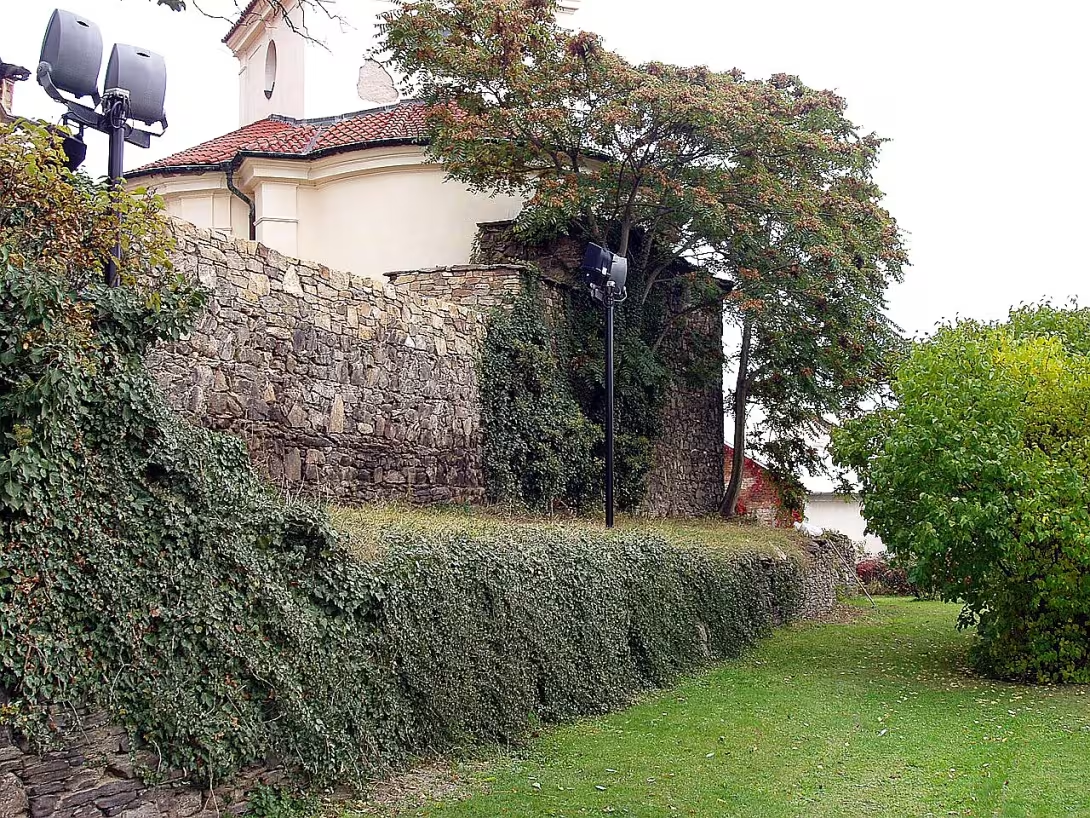
The city fortification in Kolín is a national cultural monument. It includes the remains of medieval walls, park walls, moat and bastion. The system was built in the second half of the 13th century as evidence of the strengthening of the royal cities under the rule of the Přemyslíkovs.
King Přemysl Otakar II gave the order to build the fortification. According to the documents from the period after 1253, the monarch demanded the defence of the royal city and supported it by forgiving its tax, customs and myth payments for four years. The construction probably took place between 1253 and 1261. Kolín walls served as a model for other cities such as Čáslav, Česká Kamenice, Ústí nad Labem, Vysoké Mýto, Jaroměřice nad Rokytna and Jihlava.
The building system matched the shape of the original city. The longest side led over the steep cliff of the Elbe River. The main wall of the castle was ten to twelve meters high, two metres wide, reinforced with half-cylinder baskets and ended with a battlements. For the construction was used roula and svor, the wall profile narrowed upwards. The fortification was completed by a park eight to eleven meters wide with an outer wall five meters high and a moat almost twelve meters wide.
The gate system included four main inputs. On the south side there was a smoking gate or a Pojny gate, decorated with a city emblem. In the west there was a monastery gate, probably named after a nearby Dominican monastery. Máslav or Mountain Gate led east and after the fire in 1734 it was rebuilt baroque by Josef Jedlička. The northern path consisted of the Elbe, Zálázská or Wrocław gates leading to the wooden bridge over the Elbe.
The fate of the fortifications was influenced by reconstructions and natural influences. In the middle of the 15th century, the north fortification was strengthened by the Tower of Laundry. At the beginning of the 16th century, Vojtěch of Pernštejn started rebuilding the castle into a castle, which led to the integration of the Monastic Gate into the castle building and the construction of the New or Prague Gate. At that time, the fireplaces and semi-circular bastions were added to the walls. The walls were damaged by fires and rain; in the 19th century they gradually stormed out, mainly because of the railway (1842- 1844) when the north wall was demolished. After the fire in 1796 they continued to dissipate, but between 1877 and 1878 he repaired a part of the walls on the Bartholomew Suites by Dean Jan Nepomuk Svoboda, which led to the creation of a parish garden.
Today the preserved parts of the fortifications are registered as a cultural monument. These include a wall between the streets of Kouřimská and Kutnohorská, a moat in the street Na Valech and an outer wall with a bastion from the 16th century. There is also a Vinohrad connection in Na Valech Street. The back of the houses between the streets of Na Valech and Smořimský show the remains of the main wall wall with shooting rooms.
The preserved sections allow you to see the history of urban defence and architecture of medieval Kolína. Visiting these places offers an understanding of an earlier extensive system that has shaped the city's face for centuries.
Historical milestones
- 1958
- Registration of the section of the city walls into the Central list of real cultural monuments of the Czech Republic
- 1995
- Declaration for National Cultural Heritage
Architectural development
Originally, the castles were built out of rula and rust, with half-cylinder bastions and battlements. In the middle of the 15th century, the fortification of the Fortress Tower was strengthened. At the beginning of the 16th century the castle was rebuilt into a castle.
Historical events
- 1253-1261
- Building city walls according to the order of Resychl Otakar II.
- 15th Century
- Strengthening fortifications on the north side
- 1844
- The demolition of walls along the entire length of the north side in connection with railway construction
Points of interest
- Kolín walls served as a model for other cities such as Čáslav, Jihlava and Ústí nad Labem. - King Přemysl Otakar II supported construction by forgiving the city for four years of tax, customs and myth. The main wall of the wall was ten to twelve meters high and reinforced with half-cylinder baskets. - The gate system included four main inputs, from which the Cháslav Gate was rebuilt baroque after the fire in 1734. - In the 19th century, the walls gradually stormed, with the northern wall being demolished because of the railway between 1842 and 1844.
Tips for visitors
The best time to visit the city fortification Kolína is autumn or spring when the weather is pleasant and mild. During these periods there are also fewer visitors compared to the summer period, which allows a better examination of historical structures.
Kolín has good networks of public transport vehicles that can take you close to the sights.
When visiting the city fortifications, take a sun guard coat or jacket with you because autumn and spring weather can be variable. It is also advisable to bring shoes or comfortable shoes that allow you to walk safely through historical paths and elevated places.
Photography on the city fortification offers several best places, especially from the view of the walls with respect to sunlight. The best times for photography are morning and evening when light is lighter and shadow effects are more pleasant. The bell tower in the area also offers beautiful views of the city.
In the surroundings you can visit the church of St. Bartholomew, which is famous for its historical architecture and location in the city centre. There is also an old parish school whose history attracts many visitors. These places are ideal for further exploring cultural and historical attractions near fortifications.
For families with children, visiting the city fortification is a fun opportunity to learn more about history and architecture. Many parts of the fortifications are safe and suitable for walking, allowing children to move with parents. In addition, photography is a fun activity that can be interesting for children.
Frequently asked questions
Can the monument be visited?
This is a structure in a public space that can usually be seen from outside free of charge. We have not verified that this particular one is freely accessible. According to the heritage register restoration is under way, so access may be restricted.
Where is the monument?
Location: Kolín, Středočeský kraj. The map on this page shows the exact spot.
Why is the monument protected?
It is listed in the Central List of Cultural Monuments of the Czech Republic as a cultural monument (register no. 1000143415).
Businesses nearby
Do you run a restaurant, accommodation, shop, museum, rental, wellness or other visitor service near this monument? Show yourself directly to the people heading to it — this is how they will see you in the app and on the web:
Nearby
Church of St. Bartholomew
Bells
Old parish school
Accommodation nearby
Trips and activities nearby
Guided tours, tickets and activities nearby from GetYourGuide
Affiliate link: if you buy from the partner, we may receive a commission. The price for you does not change.
Search tours and activities →Themed route
Thematic cruise route around the city fortification Kolína
1. Městské opevnění (Kolín) - walls Type: Historical monument Why is he worth a visit? Visit these historic walls, which are one of the best examples of Gothic defence buildings in Bohemia. When walking along their edge, you will enjoy a view of the city's panoramic image and learn about the history of Kolína.
2. Church of St. Bartholomew Type: Church Why is he worth a visit? This church is not only a spiritual centre, but also an architectural pearl with rich historical elements. Its interior offers beautiful Gothic decorations and impressive atmosphere.
3. Bells Type: Bells Why is he worth a visit? Visit the bell tower, which is not only a symbol of the city, but also provides an excellent view of the Kolín. Its architecture and history are fascinating for every traveler.
4. Old parish school Type: Historical object Why is he worth a visit? This building is a witness to the history of the local educational tradition and offers interesting information about the history of education in the city. It is an ideal place for those interested in cultural heritage.
This route allows you to discover not only the City Fortress Kolína, but also other historical and cultural monuments of the city.
Seasonal recommendations
Spring: During the spring season, the city fortifications in Kolín are transformed into a living bed of flowering roses that decorate the walls and add colored lightness to the atmosphere. The sun lights up roofs and walls in fine light, creating ideal conditions for photography. For a visit it is advisable to come early in the morning or later in the afternoon to avoid the peak heat and weather with a wind that may be typical of this time of year. It is recommended to wear clothes suitable for mild temperature and bring a hat or sunglasses.
Summer: During the summer months, the atmosphere around the Cologne walls is full of energy when the city develops in full power. The sun illuminates every detail and brings warm days that are ideal for long walks along the fortification. In the main summer season can happen very hot, so it is good to visit the memory in the early morning or later in the evening to avoid long queues and overcrowding. Hot clothes with short sleeves, umbrella and plenty of drinking is important for a comfortable stay.
Autumn: Autumn visit to the city fortification offers a unique atmosphere where leaves on trees turn into golden and red colors. The sun illuminates the walls in a quiet light, creating ideal conditions for relaxing and enjoying beautiful views. There are fewer visitors this season than in summer, so you can enjoy calm and mild temperatures. It is recommended to wear clothes suitable for colder weather with the possibility of adding layers as needed.
Winter: In the winter months, the Cologne city fortification of the atmosphere becomes mysterious and peaceful when the walls are shaded in snow or illuminated by an ice light. Short days mean shorter opening times of the monument, so it is advisable to visit it in time. Hot clothing with high-quality insulation material and protective items such as a blanket or cap are key to the comfort of the visit. On advent days, the fortification may be illuminated by a special light effect, adding romance and mystery to the atmosphere.
Visualizations and artistic views


The visualisations are generated by artificial intelligence and serve as inspiration.
Photos from the area
Real photos taken near the monument


Zdroj a licence jsou uvedeny u každého snímku.
Tips from visitors
No tips yet. Be the first!
Log in and add your tip.
Sources and literature
Photos: Jstojanov / CC BY-SA 3.0 — Wikimedia Commons. The author and licence also appear when you hover over the image.
Faktickým podkladem tohoto textu byl článek na Wikipedii, jehož autory jsou přispěvatelé Wikipedie. Článek je dostupný pod licencí CC BY-SA 4.0.
Location on the map


Příběhy a pověsti
Legendy, pověsti a příběhy spjaté s touto památkou

Fotografie návštěvníků
Zatím žádné fotografie. Buďte první, kdo přidá fotografii z návštěvy!
Log in a přidejte svou fotografii nebo hodnoťte.
Za ověřenou návštěvu v aplikaci získáte víc bodů — poznáme podle GPS, že jste na místě.
Reviews and comments