






Městské opevnění v Chomutově Town walls
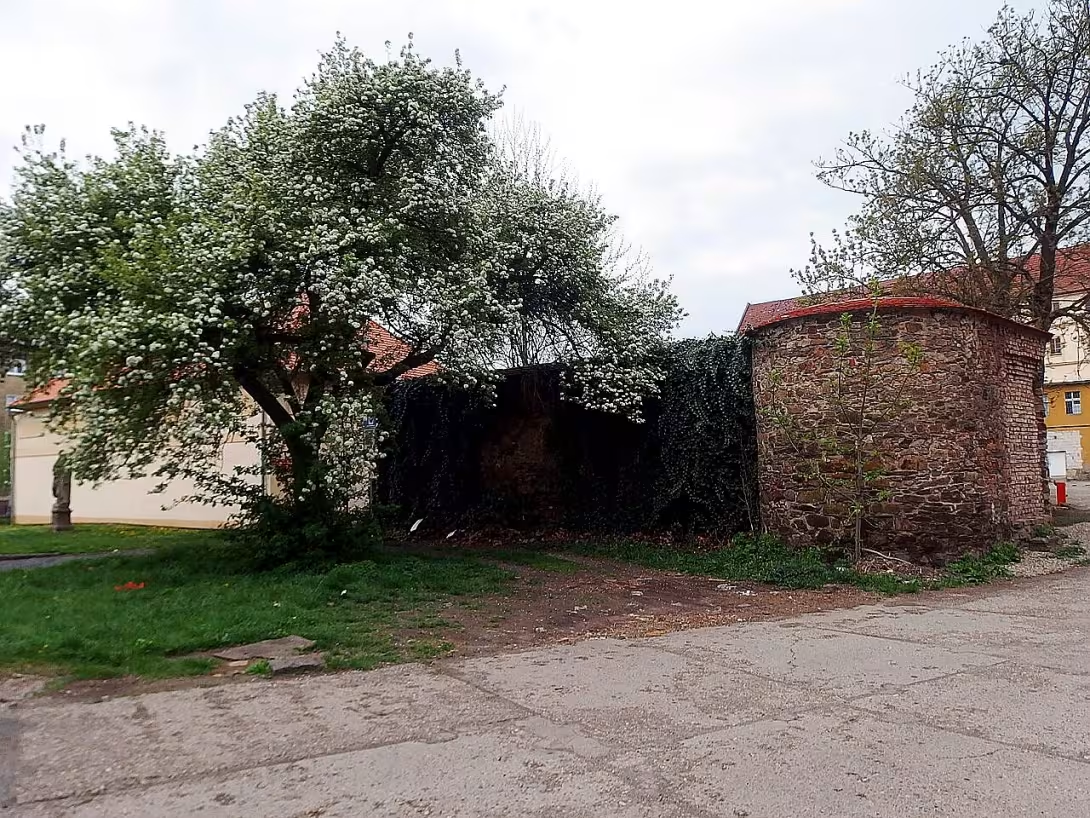
Městské opevnění v Chomutově was a nearly completely extinct system of medieval walls. Today, only remnants of this fortification unit have been preserved, such as wall fragments in the Jesuit Gymnasium building or a short section of a ditch on the northeast side of the city.
There are few written sources about the oldest history of fortification. Records suggest that in 1404, there was work on the city ditch. The existence of walls is confirmed by a report on the conquest of the city of Hussite in 1421. Evidence of city gates doesn't appear until the end of the 16th century.
The main wall was approximately 140 centimetres wide according to archaeological findings. The plan from the first third of the eighteenth century shows that it was reinforced by French towers or bastions, while there was a park on the north and east side. In today's doorways of Manes Street houses there is an obvious section of a ditch with a contrescarpus. The upper gate had a gothic masonry on the ground floor, but its floor and annex are probably from the Renaissance. Bread gate was a tower with a passage, shooting windows and a valb roof. It stood on the island between the mill drive and the Chomutov trough. On her wall were fixed inscription boards resembling the conquest of the city of Hussite in 1421 and the attack in 1547 during the Šmalkalda War.
The city gates were gradually demolished in the nineteenth century. The upper gate stood at the intersection of Puchmajerov and Táborite Street in the area of Žižkov Square. It allowed access to the western suburbs towards Blatn and the Saxon Rübenau; was demolished in 1837. The lower gate was closed by Russian street and was removed in 1838. This tower contained hours until the fire in 1598 and was the only entrance to the city for Jews. The fires damaged it in 1598, 1638 and 1642. The north gate (Vinohradská or Mostecká) stood at the crossing point of Mostecký and Mánes street. It was demolished in 1837 after being shot by the Swedish army in 1639 during the Thirty Years' War. In the 14th century, the Bread Gate was closer to the Stargazer Tower. It was moved to Chelčická Street after the removal of the trench and fortification of the Chomutov commendation.
It is assumed that the core of the Starry Tower of Jesuit Gymnasium is part of the walls, which would be related to the mention of the 1591 Watchtower. The Fortification System used natural elements such as a mill drive between the streets of Jakoubka from Silver and Chelčický or small flows feeding ponds north of the city. Two short walls with a half-circle bastion are protected on Rieger Street. They were probably part of the border of the Jesuit area, not the walls themselves.
The current state of fortification is fragmental. In addition to the above mentioned parts in the Jesuit Gymnasium building and Mánesova Street, the walls in Riegrov Street are protected as part of the historical care.
Although most of the system has disappeared, preserved remains and historical data allow you to see the past of a fortified city. For people interested in history, walking through these places is an opportunity to understand the former Chomutova arrangement.
Then and now
Drag the slider to compare how the landmark may have looked when it was built with the view today.
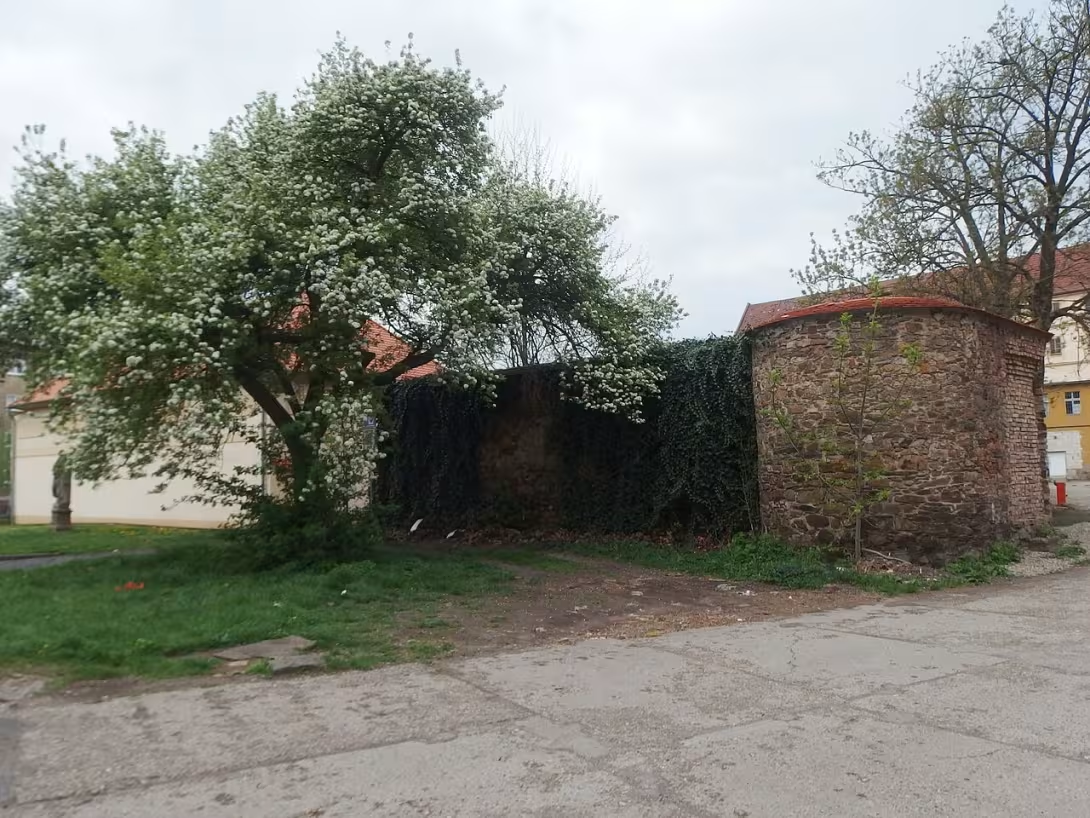
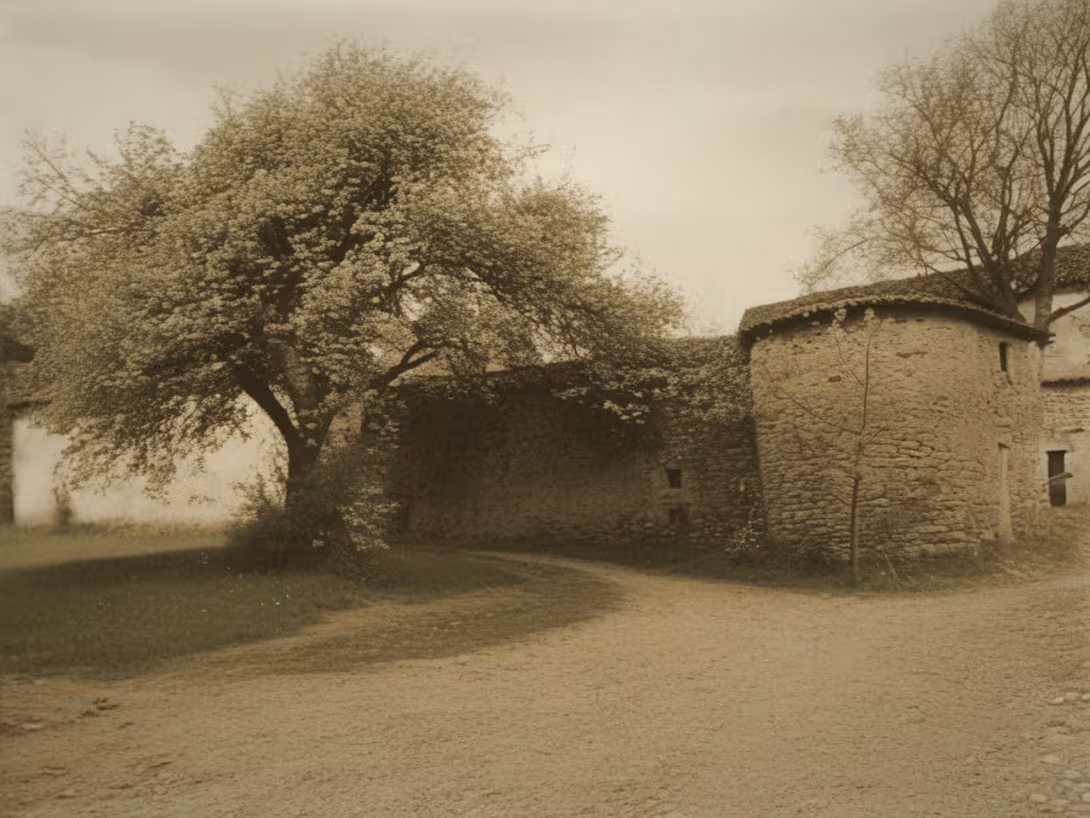
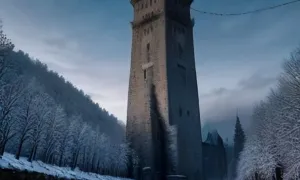
The historical appearance on the left is an AI-generated visualisation and serves as inspiration only.
Historical milestones
- 1404
- Working on the city ditch.
- 1421
- Conquest of the city of Hussite.
- 1837
- The demolition of the Upper Gate.
- 1838
- The demolition of the Lower Gate.
Architectural development
The main wall was approximately 140 centimetres wide and was amplified by prism towers according to plans from the eighteenth century. The ground floor of the Upper Gate was made up of gothic masonry, while its palate and tributary were probably of Renaissance origin. The whole system has been gradually demolished over the centuries.
Historical events
In 1404 there was work on the city ditch. In 1421, the city was conquered by the Hussites. The upper gate was demolished in 1837 and the lower gate was demolished in 1838.
Points of interest
The main wall was approximately 140 centimeters wide according to archaeological findings. - Bread gate stood on the island between the mill drive and the Chomutov trough. - The lower gate was the only entrance to the Jewish city. - The North Gate was demolished in 1837 after being shot by Swedish troops during the Thirty Years' War in 1639. For example, the wall fragments in the Jesuit Gymnasium building are preserved from the fortification unit.
Guide
Show guide text
This text was created by artificial intelligence and has not been editorially reviewed. It may contain inaccuracies.
Welcome to Chomutov. Stop for a moment, take a breath and try to feel the atmosphere of the place you're standing on right now. You might wonder at the first moment where the promised walls are actually located. If you're looking for a monumental wall that stands high above your heads and separates the city from the outside world, you might be disappointed. But that's the secret of this place. You're standing in front of the remains of an urban fortification that once formed an impenetrable ring around the city. Today they are no longer seen in full beauty, but they are here, hidden in detail, in the foundations of buildings and in the very layout of the streets. It's a history that's largely erased, but its echoes still smell.
Let us now return together in time, deep into the Middle Ages. Imagine Chomutov over 600 years ago. At that time, fortifications were not only a question of prestige, but above all a question of survival. In 1404, intensive work started on the city ditch. The moat was a key element of defense, a deep blow in a country that was supposed to make it impossible for the enemy to access the walls. At that time, the city was seen as a safe haven, a fortress that protected citizens, their property and trade routes. However, history teaches us that no wall is absolutely inpenetrable. This manifested itself dramatically in 1421, when the city was conquered by the Hussites. Imagine the confusion, the noise of battle, and the feeling of uncertainty that must have existed in the streets at that time, when it turned out that even a carefully prepared system of fortification could be broken.
Now please focus on what you see around you. Since most of the walls are gone, we need to become a little detective. Notice the buildings surrounding you. One of the most important places where you can feel the presence of the past is the sections of the wall integrated directly into the Jesuit Gymnasium building. It's the fascinating way the city evolved. Instead of tearing down the old walls, they became the basis for new buildings. Look carefully at the facades and walls in this area. That's where the fragments of the medieval system are hidden. If you imagine how deep beneath your feet still exist parts of the old ditch, you begin to perceive the depth of the layers that Chomutov consists of.
Speaking of the architecture of these walls, we don't have to rely only on what we see, but also on what the archaeological findings have told us. Try to reconstruct the main wall in your mind. According to scientific evidence, it was approximately four inches wide. That's more than a metre of solid material. Imagine the mass, the sense of security that such a wall had to raise in the hearts of the people, and at the same time the sense of hopelessness that anyone who looked at the city from the outside wanted to get into it by force.
Now let's move on to places that have been the key points in the past, the gates. The gates were much more than entrances and exits. They were checkpoints, meeting points, but also symbols of power and separation. The Upper and Lower Gate played a crucial role in Chomutov. Unfortunately, the nineteenth century brought about changes that were not kind to the historical memory. In 1837 the Upper Gate was demolished and only a year later, in 1838, the same fate met the Lower Gate. It was a period when cities began to expand, walls began to defend natural growth, and modern times saw medieval fortifications as an obstacle rather than a treasure.
Each gate was linked to its own story. Pay particular attention to the Lower Gate. This gate had a very specific significance in history because it was the only official entry into the city for the Jewish community. This tells us how strictly organized society has been in the past and how clearly the boundaries have been defined, not just the stone ones, but also the social ones.
And if you're interested in something really unusual, let me take you to the Bread Gate. It was unique in its position. Imagine an island that originated between the mill drive and the river bed Chomutov. It was on this island that the Bread Gate stood. It's a painting that we won't find in the landscape today, but in our minds, we can imagine it as a picturesque yet strategic place where the water was pouring around the entrance roads to the city.
Another interesting, albeit sad, story is the North Gate. Her end came in 1837, but her decline began much earlier. Even in 1639, during the devastating struggles of the Thirty Years' War, this gate suffered considerable damage. It is a reminder of how powerful the war of Central Europe has hit and how the reflections of these conflicts have been pressed into the stone and architecture of our cities.
If you look around today, you may only see fragments, a few meters of wall, or an empty space where once the gate stood. But in this incompleteness there is a certain spell. It makes us think, imagine, and look. Městské opevnění v Chomutově is not a dead museum, but a living part of the city that blends with it. It is a reminder of a time when the world was smaller, more dangerous and when the borders between the interior and the outside were clearly defined by a stone mur.
Now that you know what lies beneath the surface of the current streets and the foundations of the old buildings, I invite you to another walk. Try looking around with a new look. Look for traces of old walls, see a line of streets that once followed the outline of the walls, and think about the people who entered the city through these gates centuries ago. The history of Chomutova is like a book from which some pages have been ripped out, but from the rest we can still compile a fascinating story about courage, protection and constant change.
Thank you for coming through the pieces of this invisible fortress with me. I wish you a pleasant continuation in discovering the secrets of this city. Say goodbye to the silence of the walls and continue to explore the other beauty Chomutov offers you. Goodbye.
Tips for visitors
For the best experience we recommend a visit in late afternoon, when the sun creates interesting shadows on the stone structures and the light is ideal for photography. It is also the time when the surroundings are most peaceful for observing historical details.
You can easily reach the monument by city transport or by car. We recommend checking the current traffic connections and parking options nearby in the internet search engine or on the official city website.
Take comfortable shoes suitable for uneven terrain and we recommend that you carry drinking water. For the best photos, look for places where the wall fragments are most noticeable in natural light.
You can visit the Jesuit Gymnasium, St. Wolfgang's Church in the cemetery suburb or walk along the Chomutovka River. For families with children, this route is suitable as a thematic walk along the historical footsteps of the city.
Businesses nearby
Do you run a restaurant, accommodation, shop, museum, rental, wellness or other visitor service near this monument? Show yourself directly to the people heading to it — this is how they will see you in the app and on the web:
Events nearby
Zdroj akcí: otevřená data měst a obcí ČR (Národní katalog otevřených dat) a kalendář akcí Národního památkového ústavu.
Nearby
Chomutovka, Jesuit Grammar School, cemetery suburb with St. Wolfgang Church.
Accommodation nearby
Themed route
1. Crucible suburb with St. WolfgangaxZ1ZX church (sacral monument): The church presents a spiritual centre with long history. Jesuit Gymnasium (historical building): An architectural unique reminiscent of the educational tradition of the city. 3. Chomutovka (local monument): A building with a characteristic appearance that complements the image of the old town. 4. Městské opevnění v Chomutově (defence architecture): The remains of the walls reveal how the city has been protected in the past.
Seasonal recommendations
Spring brings fresh greenery to the city and emerging parks, which today surround places of former walls. The atmosphere is full of hope and fine light that highlights the remains of old structures in the landscape. I recommend visiting the location in the morning when the air is the cleanest, and wearing a light jacket for possible morning cold.
The summer season offers sharp sun and rich green trees that provide shade in places where walls once stood. The environment looks playful and energetic, which is ideal for walking with family. In order to avoid the greatest heat and summer crowds, it is best to leave early in the morning in light of the clothes and breathable materials.
Autumn in Chomutov bets on the golden colours of leaves and frequent fogs, which give the idea of disappearing fortification a mysterious and nostalgic mood. The evening shadow underlines the emptiness of the broken walls. The practical recommendation is to wear moisture resistant shoes and to plan the journey for late afternoon, when the light hits the terrain the most.
Winter turns the surroundings of former walls into a quiet, freezing space, where snow covers modern surfaces and creates the illusion of ancient times. The atmosphere is calm and cramped with a short day. In this period it is necessary to choose warm, layered clothes and assume that due to darkness it is advisable to head out into the field in the noon hours.
Visualizations and artistic views


The visualisations are generated by artificial intelligence and serve as inspiration.
Photos from the area
Real photos taken near the monument


Zdroj a licence jsou uvedeny u každého snímku.
Tips from visitors
No tips yet. Be the first!
Log in and add your tip.
Sources and literature
Fotografie: Palickap / CC BY-SA 4.0 — Wikimedia Commons. The author and licence also appear when you hover over the image.
Faktickým podkladem tohoto textu byl článek na Wikipedii, jehož autory jsou přispěvatelé Wikipedie. Článek je dostupný pod licencí CC BY-SA 4.0.
Location on the map


Příběhy a pověsti
Legendy, pověsti a příběhy spjaté s touto památkou
Fotografie návštěvníků
Zatím žádné fotografie. Buďte první, kdo přidá fotografii z návštěvy!
Přihlaste se a přidejte svou fotografii nebo hodnoťte.
Za ověřenou návštěvu v aplikaci získáte víc bodů — poznáme podle GPS, že jste na místě.
Reviews and comments