



Městské opevnění ve Vysokém Mýtě Town walls
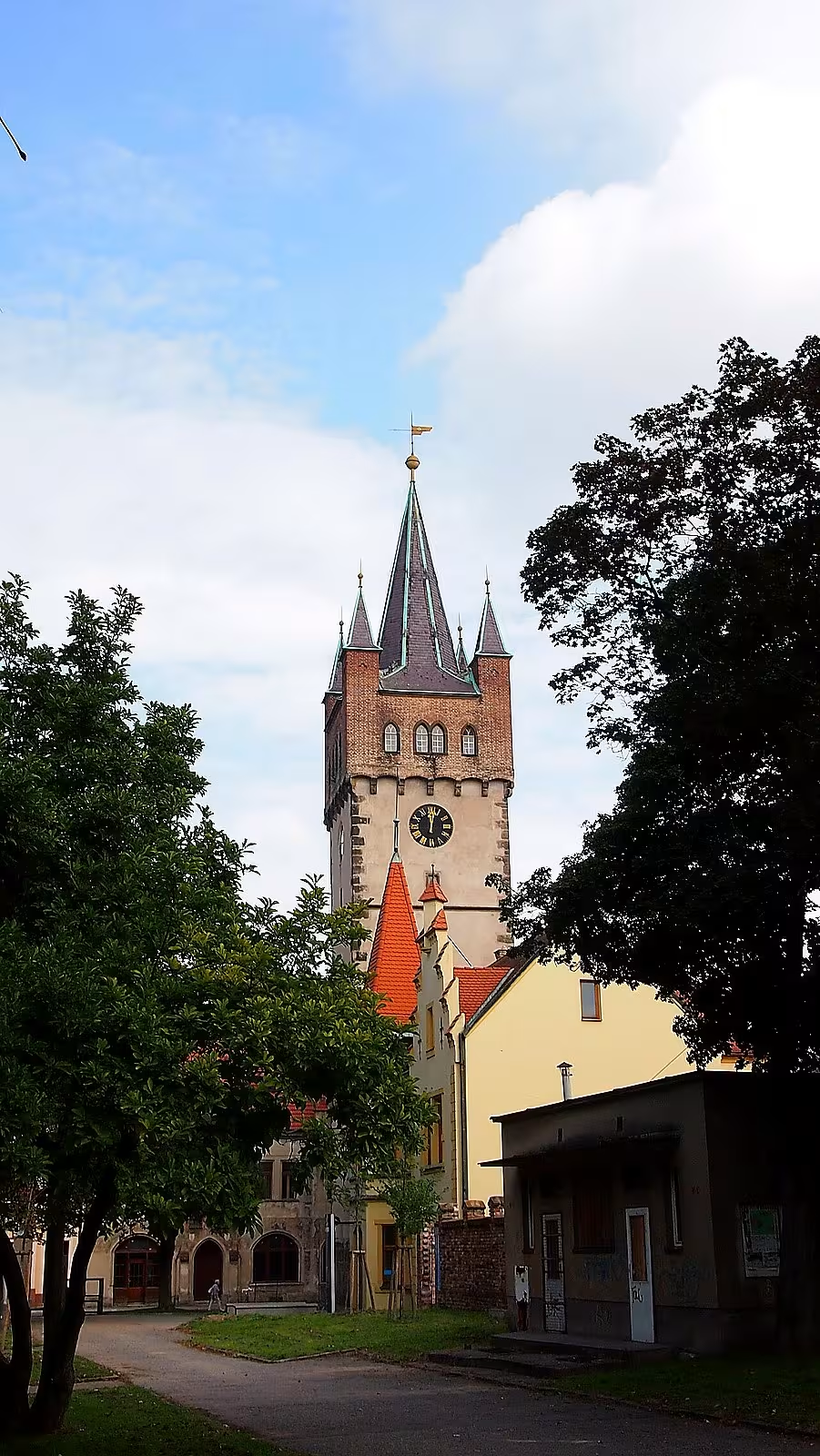
Městské opevnění ve Vysokém Mýtě in the village Vysoké Mýto-Město represents one of the best preserved and integrated medieval city walls of Czech cities. This fortification system, the construction of which began in the mid-1970s, served to protect the city and is now an important example of the construction technique at the time.
The founder of the city was King Přemysl Otakar II., who designed it as a fortified center. In order to speed up the construction of strong walls with parks, he freed townspeople for three years from paying interest and taxes to the royal chamber, including customs throughout the kingdom. The model for the wall system was the fortification system of the town of Cologne. The first walls from the pre-1265 period left three gates with passages. In the first half of the 14th century, a continuous part of the walls on the north, east and south-east side of the city was established, while the final form of fortifications was completed only in the second quarter of the 14th century.
The main wall of the wall was built out of opposites, reaching a height of ten metres and a thickness of two metres, and ending with cimburies. It was amplified in irregular intervals by polo towers that were open inside and above the wall by three to four metres. A lower parking wall led by a distance of approximately 10 metres, before which there was a deep, surrounded moat with a wall. Natural protection on the north side was the river Loučná and the Mlyn stream, while on the east side the Kniřovský stream.
Three gates led to the city, and there was a fortress on the north side. Today the gates of Chocenská (known as Karaska), Litomyšl and Prague (known as Vratislavská) are preserved. The Prague Gate consists of two towers, one of which is smaller and the other more powerful, connected on the floor above the gate by the fortification. There is also a water tower and a monastery bastion with a well-preserved entrance.
In 1602, Emperor Rudolf II. authorised the city to organise three cattle markets every year, from whose revenues the walls were repaired. One such repair took place between 1617 and 1618. The fortification remained intact until 1844. In the 19th century, local revivals took care of the wall system, thanks to which the original walls now surround roughly half of the historical core of the city.
The current walls are made up of discontinuous remains. The higher preserved part was built of quarry stone with pillars; Three orifices are visible in the wall under the bastion for the shooting range and three armrests. From the water tower to the Prague gate, the walls of the quarry stone are preserved with bricks, which today serve as walls of houses or fence gardens. The park was mostly turned into a garden, where the park wall forms terraces. In the Jungmann orchards, on the former Chocey Park, commemorative boards are placed in the walls reminiscent of the city's important events.
The city fortifications are valuable evidence of building development and technical maturity of medieval crafts. This monument offers a unique view of the urban landscape of the Přemyslíkovs. It is recommended to visit preserved gates and walk around the perimeter of the historical core of the city.
Historical milestones
- 1265
- Building the first walls of the imaginary period.
- 1602
- Authorisation to organise livestock markets to finance wall repairs.
- 1617
- Correction of walls lasting until 1618.
- 1844
- End of the period when the fortifications were completely intact.
Architectural development
The original walls from the 13th century were built from spillover, while higher preserved parts are made of quarry stone with pillars. The formal system was inspired by the pattern of the town of Cologne. Some parts of the walls are later fixed with bricks and are now made up of walls of houses or fence gardens.
Historical events
In 1602, Emperor Rudolf II. authorised the holding of cattle markets to finance repairs of walls. In 1617-1618 there was another repair of the fortifications. By 1844, the wall system had been completely intact.
Points of interest
- Městské opevnění ve Vysokém Mýtě is one of the best preserved and integrated medieval city walls of Czech cities.
- The founder of the city was King Přemysl Otakar II., who designed it as a fortified center. In order to speed up the construction of strong walls with parks, he freed townspeople for three years from paying interest and taxes to the Royal Chamber.
- The main wall of the wall was built from opposy, reaching a height of ten metres and a thickness of two metres, and it was finished with the battlements. At irregular intervals, it was amplified by polo towers.
There were three gates to the city, and there was a fortress on the north side. Today the gates of Chocenská (known as Karaska), Litomyšl and Prague (known as Vratislavská) are preserved.
The fortification remained intact until 1844. In the 19th century, local revivals took care of the wall system, thanks to which the original walls now surround roughly half of the historical core of the city.
Guide
Show guide text
This text was created by artificial intelligence and has not been editorially reviewed. It may contain inaccuracies.
Welcome to the High Myth, a city that keeps fascinating stories from the depths of our history. Right now, you're standing in front of a place that is not just an ordinary wall, but a real monument to human efforts, strategic thinking and the need for security. In front of you stands the city fortifications, which belong to the best preserved and most integrated medieval walls in all Czech countries. Stop for a moment, take a breath and feel the atmosphere of this place. Imagine how the landscape around you changed centuries ago and how these walls formed an impenetrable boundary between the safe interior of the city and the unknown world of outer space. What you see is not just a pile of rocks, but a silent witness of centuries who survived wars, fires, and times.
Now let's go back in time together to make it clear why these walls are here and how they were created. It all began in the mid-1930s, in the 1970s. That's when the founder of the city, the mighty king of Přemysl Otakar the Second, was here. The king had a clear vision and designed the High Myto as a fortified centre, which was to serve not only as an administrative hub, but above all as a safe harbor. The construction of the first walls in the pre-thought period began in the year two hundred and sixty-five. It wasn't just aesthetics at the time, it was a question of survival. The city had to be able to resist attacks and protect its citizens and commercial goods. King Premysl Otakar The second was an experienced strategy and knew that the construction of such a large system required huge resources and speed. To speed up the construction of strong walls with parks, he came up with a very interesting solution. He freed the townspeople for three years from paying taxes. This motivation obviously worked because the city started to enrich quickly and its defense system began to take its final form.
Now that you know the history of creation, pay attention to the very architecture that surrounds you. Look carefully at the material from which the walls are built. The dominance here is opaka, a specific stone that gives fortification its characteristic appearance and strength. Notice the upper parts of the wall where the cimbura is located. These dental ends of the walls were not only an ornament, but they served as cover for the shooters who could track the enemy from the safety of the walls and attack it. If you look around, you'll also see the polo towers. Their shape was not random, because it allowed a better view of the surroundings and eliminated blind spots where the enemy could sneak in.
A key element that you should not miss is the system of a deep, surrounded ditch. Imagine what an obstacle the attackers had to overcome before they even got to the main wall. This moat was supplemented by a park wall, which was essentially a lower outer wall, which formed the first line of defense. The whole complex created a layered system of protection that made the city a real fortress. Feel this mass and imagine how much work and how many hands have been cast into carrying these heavy stones and their precise composition.
When we move on in time, we run into a period where the walls required care and repairs. Maintaining such an extensive work was extremely costly. An interesting story takes us to a thousand six hundred and two. At that time, the holding of livestock markets was allowed, which was a very lucrative activity at that time. The money collected from these markets did not go to the royal treasury, but was earmarked directly to finance the repairs of the walls. It is fascinating to see how closely the city's economy has been linked to its security in the past. Without the cattle trade, the walls could start to crumble at that time. Another major repair took place in the year one thousand six hundred seventeen and lasted until one thousand six hundred eighteen. It was a period of tension and uncertainty when it was necessary to have a defense system in perfect condition. In connection with this time and with the development of the city, the name of Rudolf the Second appears in history, who did not build the walls directly, but his era left a mark in the overall prestige and flowering of the cities in the region.
Now I want to impress you with one interesting thing that may not be visible at first sight, but it gives us an understanding of the uniqueness of this place. Městské opevnění ve Vysokém Mýtě is now considered one of the best preserved and most integrated medieval city walls in the whole Czech Republic. Most cities over the centuries have either demolished their walls to gain more space for building houses, or let them destroy wars. But here we can see the system almost in its original logic. It's like an open book on medieval military engineering.
The end of the era of absolute integrity of fortification came in the year one thousand eight hundred forty-four. That was the moment when the times changed, the defensive walls lost their primary military significance thanks to more modern weapons and the city began to view its walls differently. Yet they remained preserved for us so that we could stand in the same place today as the guards at the time and feel the same cold stone under our fingers.
Now try to imagine what it must have been like to have two hundred and sixty-five of you in the year of a thousand and sixty-five been one of the first inhabitants to see these walls grow out of the country. The feeling of security they brought you must have been unimaginable. And at the same time, a sense of pride for living in the city that King Přemysl Otakar the Second built as a strategic center.
Now I encourage you to take your own path along these walls. Go through their perimeter, touch the epistle and examine the details we discussed. Notice how the walls adapt to the terrain and how dominant they influence the space around them. Let yourself be guided by your curiosity and explore every corner of this historic system.
Thank you for coming through the short history of the city fortification in the High Myth. I hope that this view of the past has helped you to see better the beauty and importance of this unique place. I wish you a pleasant continued tour of the city and many other discoveries. Goodbye.
Tips for visitors
For best experiences we recommend a visit in late afternoon hours, when the sun at a low angle beautifully highlights the structure of the historical stone. It is ideal for photography to find places where walls create interesting shadows, which will give your pictures depth and authentic medieval feel.
You can easily transport to the monument by car and public transport. Always check the current traffic situation before travelling.
When walking around the fortifications, it is recommended to wear comfortable shoes suitable for uneven terrain and historical surfaces. For example, take drinking water and protective cream if you choose to stay longer outside.
Families with children can use the proximity of nature to relax and move freely. For children, walking around historic walls is an interesting opportunity to discover history in the natural environment.
In the vicinity of the walls, you can explore the course of the Mlyn creek, the Loučná River and the Knířovský creek. These watercourses offer a pleasant and peaceful environment for a short rest during your trip.
Frequently asked questions
Can the monument be visited?
This is a structure in a public space that can usually be seen from outside free of charge. We have not verified that this particular one is freely accessible.
Where is the monument?
Location: Vysoké Mýto-Město, Pardubický kraj. The map on this page shows the exact spot.
Why is the monument protected?
It is listed in the Central List of Cultural Monuments of the Czech Republic as a cultural monument (register no. 1000137090).
Businesses nearby
Do you run a restaurant, accommodation, shop, museum, rental, wellness or other visitor service near this monument? Show yourself directly to the people heading to it — this is how they will see you in the app and on the web:
Nearby
The Mill River, the Loučná River and the Kniřovský River.
Accommodation nearby
Themed route
Thematic cruise route: Městské opevnění ve Vysokém Mýtě
1.Městské opevnění ve Vysokém Mýtě (walls) - Type: Historical landmark - Why is it worth a visit: Visit the unique city walls that represent a significant part of the cultural heritage of the High Myth by their architecture and history. It's the perfect place to know the history of the city.
2. Mill stream - Type: Natural element - Why is it worth a visit: A short walk from the walls will get you to the Mill stream, which is an ideal place to relax and admire the natural beauties. Its peaceful flow offers a comfortable place to relax after exploring historical monuments.
3. Loučná River - Type: Water flow - Why is it worth a visit: Follow your way to the river Loučná, which can become a beautiful background for another walk. It's an opportunity to explore the water landscape and enjoy the quiet surroundings.
4. The Kneřovský brook - Type: Natural element - Why is it worth a visit: The end of your route may be near the Knířovský creek, where you can look at other natural beauties and perhaps discover local animals. It's the perfect place to close the trip with peace and sight of nature.
This route offers a combination of historical and natural attractions that allow for deeper knowledge of the High Myth and its surroundings.
Seasonal recommendations
Spring: In the spring period of the city fortification in Vysoký Mýta offers visitors a unique atmosphere where the walls turn into live floral wallpaper. Sunshine days and warm evenings are the perfect time for walking through historic places where it is possible to enjoy green paradise around fortification. At this time nature is awakening and open places are gaining new beauty. It is recommended to visit the walls in the early afternoons when there are fewer people and the temperature is pleasant for walks. It is appropriate to dress with the possibility to postpone something for winter, because the weather can change quickly.
Summer: Summer in the High Myth is an ideal time to explore fortifications due to long and sunny days. The walls offer beautiful views of the sky, which at this time is changing from bright blue beautiful Greek wests. In the main summer season it is recommended to visit the memory earlier in the day to avoid large crowds and stress from heat. The important thing is to have a sunflower and enough drinking hazelnut. Short shoes or feet are suitable for more comfortable walks on walls that take up life in summer.
Autumn: In autumn, the fortifications in the High Myth turn into a room with melancholy and calm atmosphere. The November leaves of trees that fall around the walls provide areas of unique colour spectrum. Sunshine days are an ideal time to visit when the temperature is pleasant and fewer people go for walks. It is recommended that clothing suitable for mild cold weather such as long gloves and blanket. At this time it is possible to enjoy a quiet day with a view of the city from the walls, which is transformed in autumn light.
Winter: Winter visit to the High Myth fortification offers a unique view of the city covered with snow. The atmosphere is calm and quiet, which allows you to enjoy a historical memory without large crowds. Warm clothes are essential for comfort during cold days as well as protective shoes and hat. In the winter light, the fortifications turn into a place full of peace and mystery, offering a different view of the historical memory.
Visualizations and artistic views


The visualisations are generated by artificial intelligence and serve as inspiration.
Photos from the area
Real photos taken near the monument


Zdroj a licence jsou uvedeny u každého snímku.
Tips from visitors
No tips yet. Be the first!
Log in and add your tip.
Sources and literature
Photos: Honza chodec / CC BY-SA 3.0 — Wikimedia Commons. The author and licence also appear when you hover over the image.
Faktickým podkladem tohoto textu byl článek na Wikipedii, jehož autory jsou přispěvatelé Wikipedie. Článek je dostupný pod licencí CC BY-SA 4.0.
Location on the map
More monuments – Vysoké Mýto-Město
Show all in the municipality

Příběhy a pověsti
Legendy, pověsti a příběhy spjaté s touto památkou

Fotografie návštěvníků
Zatím žádné fotografie. Buďte první, kdo přidá fotografii z návštěvy!
Log in a přidejte svou fotografii nebo hodnoťte.
Za ověřenou návštěvu v aplikaci získáte víc bodů — poznáme podle GPS, že jste na místě.
Reviews and comments