






Městský dům U Tří mečů House
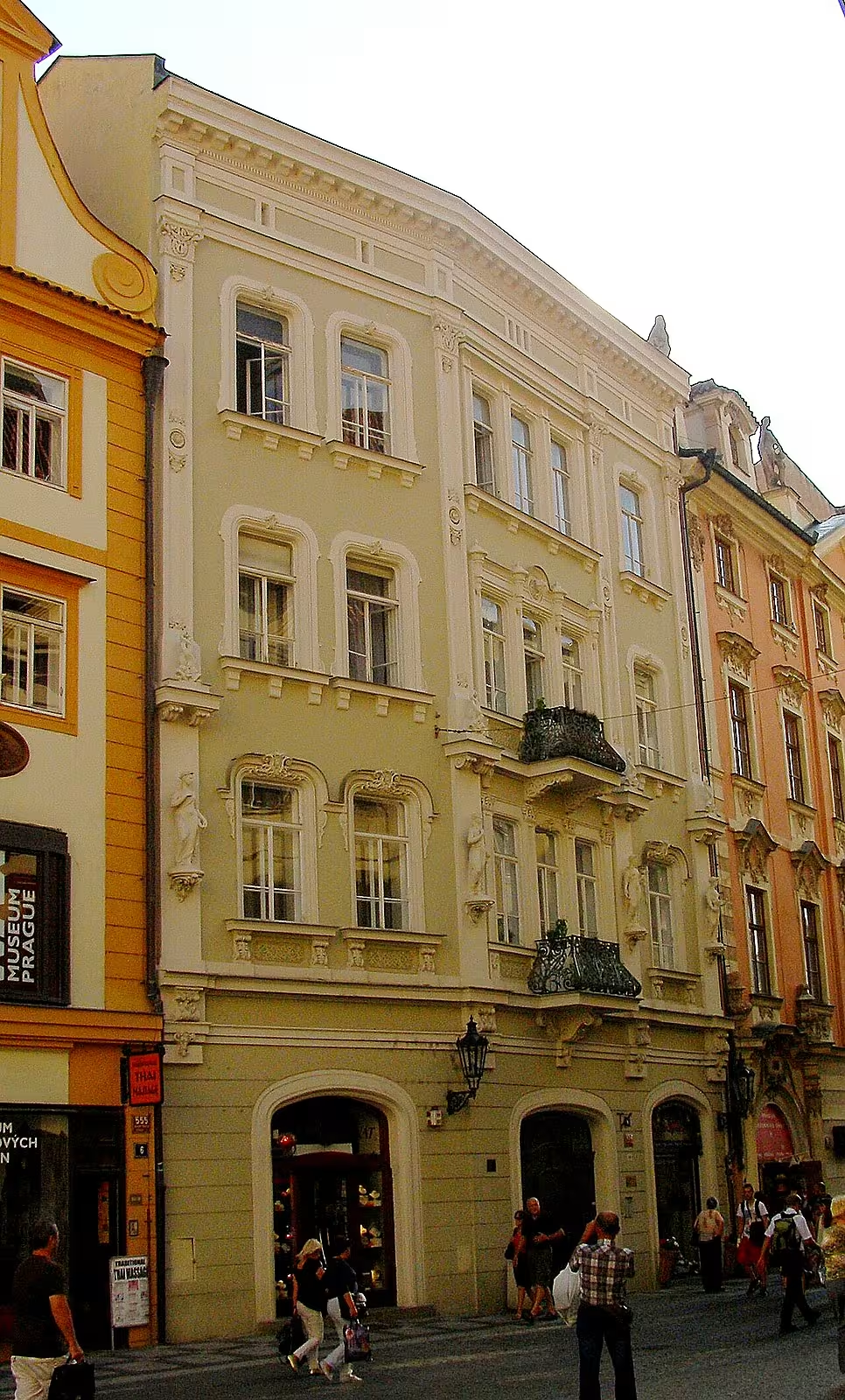
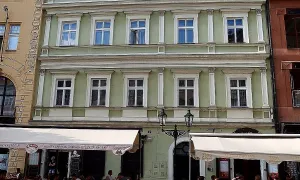
Městský dům U Tří mečů, also known as U Srpa, is an ordinary historic building in Celetná Street in Prague's Old Town. The building has been registered as a cultural monument since 1964. It represents a remarkable combination of Gothic foundations and a romantic facade from 1867.
The history of the place goes deep into the Middle Ages. The original Gothic house has been baroque and classicically modified over the centuries. The important milestone in the history of the building was the year 1389, when the house was married by Jan Parléř, son of the famous builder Peter Parlér, after he married the widow of Mincmaster Jan Rotlevo. The first written mention of the name U Srpa dates back to 1407, while the name U Three Gold Swords is documented to 1652.
The current form of the house is the result of a new construction from 1867, which was carried out by the architect and builder Alexander Hellmich according to his own plans. This reconstruction took place during the Austrian-Hungarian settlement period, when historism dominated architecture, a return to forms of past styles. In spite of the fundamental transformation in the 19th century, older Gothic structures were preserved in the building, especially in the basements and parts of the masonry.
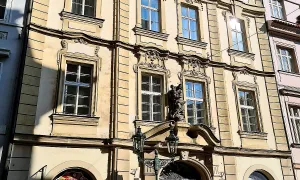
The front of the house to Celetná Street is three storey and six storey. It carries elements of a secondary-horococcal and gotifying style. The facade consists of pilasters which highlight the middle axes and edges of the construction. The windows are supplemented by rich stucco decor. On the first and second floors there are balconies with metal railing. A remarkable detail is the stucco sculptures of four allegorical women placed in pilaster sculptures. The yard consists of a main building with wings, which has preserved the classicist stacks with original crackers and railing.
House U Three swords are located in a location with a high concentration of monuments, in the immediate vicinity of Old Town Square, Dust Gate, Municipal House and Karolina. The building serves today as a reminder of the development of the Prague Centre. Thanks to its architectural stature, it offers a unique view of the transformation of urban buildings. A visit to Celetná Street thus allows you to perceive the historical value of this house in the context of the entire protected area.
Historical milestones
- 1389
- Jan Parléř has taken out the original house after the mincmaster Jan Rotlevo.
- 1407
- The first documented name of the House of August.
- 1652
- The house is named Three gold swords.
- 1867
- New building of the house according to plans of architect Alexander Hellmich.
- 1964
- Object declared a cultural monument.
Architectural development
The original Gothic object has been baroque and classicically modified over the centuries. In 1867, a major rebuilding took place in the spirit of historism. The court wings were preserved by the classicist stacks with the crackers.
Historical events
In 1389 the house was taken out by Jan Parléř, son of famous builder Peter Parlér. In 1407, the name U Sýrů is documented, while in 1652 the house was already referred to as U three gold swords.
Points of interest
- The house has been registered as a cultural monument since the year one thousand nine hundred sixty-four. In the year three hundred and eighty-nine the house was taken out by Jan Parléř, son of the famous builder Peter Parlér. - The first written mention of the name U Serpa dates back to a thousand four hundred seven, while the name U Three Gold Swords is evidenced to a thousand six hundred fifty-two. - The current form of the house is the result of a new building from the year one thousand eight hundred sixty-seven which was realized by architect and builder Alexander Hellmich. - On the facade there are stucco sculptures of four allegorical women placed in pilaster sculptures.
Guide
Show guide text
This text was created by artificial intelligence and has not been editorially reviewed. It may contain inaccuracies.
Welcome to the heart of old Prague. You are standing in one of the oldest and rarest streets of our city, right on Celetná Street, which will guide you through the very center of the historic act. Before your eyes is a townhouse known today as the Three Swords. Feel the atmosphere where every cube of stone and every detail of the facade tells stories hundreds of years ago. This house is not just an ordinary building in a series of houses, it is a living witness to history, standing here watching the changing world around it. Look at his appearance, the harmony he carries, and try to imagine how many people have walked before you on this street and how many views of this building have changed over the centuries.
To understand what you're seeing right now, we need to go back deep into the past. The history of this place goes far beyond the memory limits of one generation. To understand its roots, we must move on to a time when Prague has only just built its size. In the year one thousand and three hundred and eighty-nine there were major events. At that time, the house was owned by a man with a very important status, Mint Master Jan Rotlev. That's when the house started to change because Jan Parléř got married. It may sound like a simple name to you, but Jan Parléř was the son of the most famous and most important builder of the time, Peter Parlér. Imagine the incredible continuity of craft and construction that is being carried from hand to hand in this place. Jan Parléř here, after its predecessor, took the road that connected the house with the highest layers of the society at the time and left a trail that still persists today.
Now pay attention to the construction itself and to what you see right in front of you. Although the house may seem to you as a whole from one piece, in fact it's like a book with many layers that follow each other. If you look at his current appearance now, you will see the work of architect Alexander Hellmich. The house was rebuilt in a thousand eight hundred and sixty-seven, according to his plans. His style is very specific and interesting, it's a romantic style that is deliberately inspired by old goth. Notice the details on the facade that evoke the ancient past and give the house a noble look. These shapes and decorations are designed to give the visitor a sense of historical dignity. But watch out, what you see on the surface is just one of many layers. This house has much older secrets in it that can't be seen at first sight. This object integrates in itself much older, original Gothic foundations. These old parts are still a solid part of the house, and are particularly visible in its cellars and in the very wall. It is a fascinating connection where the more modern work of architect Hellmich is based on solid foundations that have lasted for centuries.
Now let's think about what this place was called over time, because in ancient times, names were the main way to tell people in the streets where they were. The first written mention of the name U Serpa dates back to a thousand four hundred and seven. Imagine those period residents moving on this street, and how they perceived it. Later, in the year one thousand six hundred fifty-two, another name appears in the record, which sounds much more noble and richer: for three gold swords. This change of name reflects not only changes in perception, but perhaps changes in the very spirit of the house and its importance to the city. Today we know the house under the name Three Swords, which is a simplified form of those older, rich names.
It's very interesting how this house became part of our common heritage. Since the year one thousand nine hundred sixty-four, this object has been declared a cultural monument. This means that its value is not only in its beauty, but in what it keeps in itself for future generations. It is to protect what is important to us as citizens of this city.
When you look at the house now, try to see not only the stones and plaster in its details, but also the people who made it. You see the work of the medieval masters, you see the vision of the 17th century architect and the planning of the nineteenth century architect. All this has become a beautiful whole.
I hope that this short journey through this house has attracted you and helped you see more than just decorating in his facade. This house is just one of many wonderful pages of the book, which is Prague. So continue your journey along Celetná Street, view the next corner and let yourself drift through the atmosphere of this magical city. Thank you for spending some time at this very monument, and we will wait you out for another survey of our historical treasures. Goodbye.
Tips for visitors
The best time to visit is early in the morning or in the evening when you avoid the biggest crowds of tourists on Celetná Street and you can enjoy the neoRenaissance facade of the house.
The location is located in the historic centre where the entrance of cars is restricted. We recommend to use public transport and get off at the nearest stop from where you can walk to the house; Search for the exact connection in the transport application.
For photography we recommend to use the morning light that illuminates the front of the house. The best pictures are taken directly from the street, where detailed decoration and historical character of the building stands out.
The surrounding area is located Old Town Square, Powder Gate, Municipal House and Karolinum, which are just a few minutes' walk away, which is ideal for a short walk through Prague history.
The location is suitable for families with children thanks to a pedestrian zone where children can move safely. We recommend taking comfortable shoes with us, because historic paving blocks can be more difficult for strollers and small feet.
Businesses nearby
Do you run a restaurant, accommodation, shop, museum, rental, wellness or other visitor service near this monument? Show yourself directly to the people heading to it — this is how they will see you in the app and on the web:
Events nearby

Zdroj akcí: otevřená data měst a obcí ČR (Národní katalog otevřených dat) a kalendář akcí Národního památkového ústavu.
Nearby
Staroměstské náměstí, Prašná brána, Obecní dům, Karolinum.
Accommodation nearby
Trips and activities nearby
Guided tours, tickets and activities nearby from GetYourGuide
Affiliate link: if you buy from the partner, we may receive a commission. The price for you does not change.
Search tours and activities →Themed route
Thematic cruise route: Historical center of Prague
1.Městský dům U Tří mečů (others) - Type: historical building, administrative headquarters - Why it is worth a visit: The city house is an example of Baroque architecture and served as the management of the capital city of Prague. Its history is closely intertwined with the political events of the Czech country.
2. Old Town Square - Type: historical square - Why is it worth a visit: The square is the heart of the Old Town and home to important monuments like the Old Town Hall. It is famous for its history, which dates back to the Middle Ages, and beautiful Baroque fountains.
3. Dust gate - Type: historical goal building - Why is it worth a visit: This Gothic Gate was an important element of the Old Town defense. Today it is a symbol of local culture and history, especially after its recovery after the 2002 flood.
4. Municipal House - Type: administration building - Why is it worth a visit: The Municipal House is a modern centre of local administration and hosts various cultural events. Its architecture combines historical appearance with current functionality.
5. Carolinum - Type: university building - Why is worth a visit: Karolinum is the oldest part of the Charles University and serves as a seat of various academic institutions. Its history dates back to the 14th century, making it an important place in scientific and cultural life.
This route offers a view of the rich history and architecture of Prague 1, each location has its own unique story.
Seasonal recommendations
Spring: In spring there is a pleasant freshness in the surroundings of Prague 1 and the sun's rays begin to illuminate the historical facades gently. Nature begins to bloom again in the nearby streets, which gives the place a fresh atmosphere. I recommend wearing layered clothes because the weather can be variable. It's a great time to visit, because crowds of tourists aren't as big as summer.
Summer: Summer season brings intense sun and high temperatures to the old town. The atmosphere is very lively, busy and full of people. Due to the great crowds in the center, I suggest you come as early as possible in the morning so you can enjoy the memory in peace. Dress lightly and don't forget the drinking mode because the heat in the narrow alleys can be very strong.
Autumn: Autumn moons offer a quiet and a little melancholy atmosphere with soft, golden light that highlights the details of the buildings beautifully. The color transformation of the surroundings creates beautiful sets for photography. It is advisable to carry a warmer layer of clothing and scarf. In this period, people's movement in the streets is more balanced and pleasant.
Winter: In winter, the days are short and the light is weak, which creates a cozy but cold atmosphere. In Advent time, the number of people in the area may increase, although the frost may reflect some visitors. The need is very warm clothes, including hat and gloves. Before visiting, I recommend checking opening hours, which may be shorter in the winter months.
Visualizations and artistic views

The visualisations are generated by artificial intelligence and serve as inspiration.
Photos from the area
Real photos taken near the monument

Zdroj a licence jsou uvedeny u každého snímku.
Tips from visitors
No tips yet. Be the first!
Log in and add your tip.
Sources and literature
Photos: Michal Kmínek / CC BY-SA 3.0 — Wikimedia Commons. The author and licence also appear when you hover over the image.
Faktickým podkladem tohoto textu byl článek na Wikipedii, jehož autory jsou přispěvatelé Wikipedie. Článek je dostupný pod licencí CC BY-SA 4.0.
Location on the map
Příběhy a pověsti
Legendy, pověsti a příběhy spjaté s touto památkou
Fotografie návštěvníků
Zatím žádné fotografie. Buďte první, kdo přidá fotografii z návštěvy!
Log in a přidejte svou fotografii nebo hodnoťte.
Za ověřenou návštěvu v aplikaci získáte víc bodů — poznáme podle GPS, že jste na místě.
Reviews and comments