



Milštejn Castle ruin
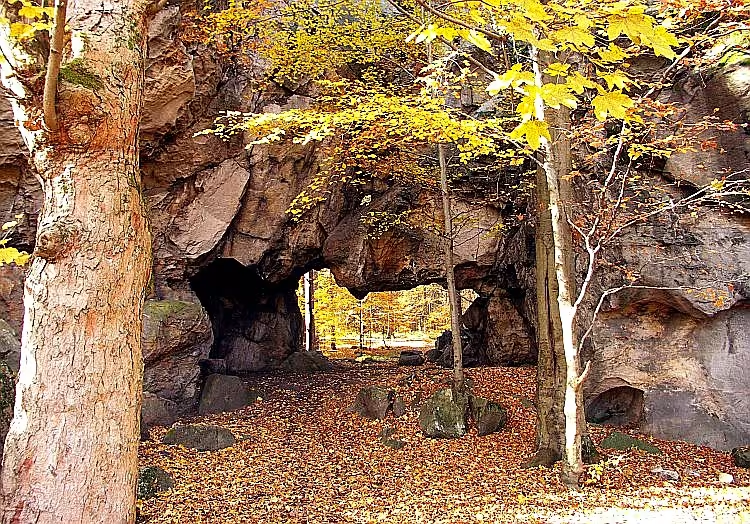
Milštejn is a ruin of the castle in the Lusatian Mountains on the top of Nounov (544 m above sea level), about 3.5 km north of Trekkov in the district of Česká Lípa. The castle was founded in the second half of the 13th century to protect the Earth's path from Lipé to Zitava. It is remarkable by its gradual demise, which caused the intensive extraction of sandstone.
It was created when the lords of Vartenberk and Ronovci built fortified settlements in the north of Bohemia, such as Pláp, Vartenberk, Lemberk, Lipý or Frýdlant. Archaeological findings confirm that Milštejn was built on communication between the Pillar and the Ojvina.
The first written mention of the castle dates back to 1343 from the chronicle of John of Guben. It describes the heinous spree of the Mishans in the vicinity of Zitava and Ojvin. In the books of the Prague Archbishop he is appointed owner of the estate Jindřich Berka z Dubé between 1362 and 1379. After his death in 1404, the castle master became the son of Hynek Dubský, who was the first of the Berk family to accept the name Hynek of Milštejna. Subsequently, the castle was owned by Jindřich Berka z Milštejna and after 1444 by his son of the same name. But he lived in Česká Lípa. In Milštejn he maintained a crew of 12 to 16 gunmen who collected tolls and customs and accompanied the merchant cars on their way from Zitava to Prague.
In the 15th century the castle experienced the greatest boom, yet in 1456 it was conquered by the Lusatian army. In 1545, it was called the Milsstaain Castle. In the 16th century, the ownership took place between Václav, Petr and Zdislav Berka from Dubé. At the end of the century, the mansion was already fading, which is confirmed by the 1588 theft records. Around 1590 only one guard remained and in 1634 the castle was destroyed by the Swedish army General Banner.
Originally it was a fortified medieval mansion, from which today remained a dominant rock formation with tiny remnants of masonry. The analysis of the castle caused the extraction of quartz sandstone for the production of millstones, from which also the name of the monument came. The mining culminated in the 18th and 19th centuries and hit the very foundations of the building. The large castle tower was demolished around 1685 because the demolished building threatened workers in the quarry below it. Another tower collapsed in 1726 and the last remains of the towers were shot down in 1793. At the end of the 19th century, Istrael brothers from Dresden rented the quarry. There were about 100 workers and millstones worked in the Hope settlement were sold to a number of European countries. The mining was completed around 1910.
At present, several buried underground spaces are visible in the substation, which are mainly due to the mining of sandstone. The ruin is available after the red tourist mark from the Svor train stop (the journey is 4.5 km long), then leads to the Milštejn green mark. There is a silver well and a dam of the former pond about 200 metres from the building.
Milštejn represents a unique example of a monument whose demise was not only caused by war, but also by industrial activity. It is a place suitable for all who seek the union of medieval history and the history of mining.
Then and now
Drag the slider to compare how the landmark may have looked when it was built with the view today.
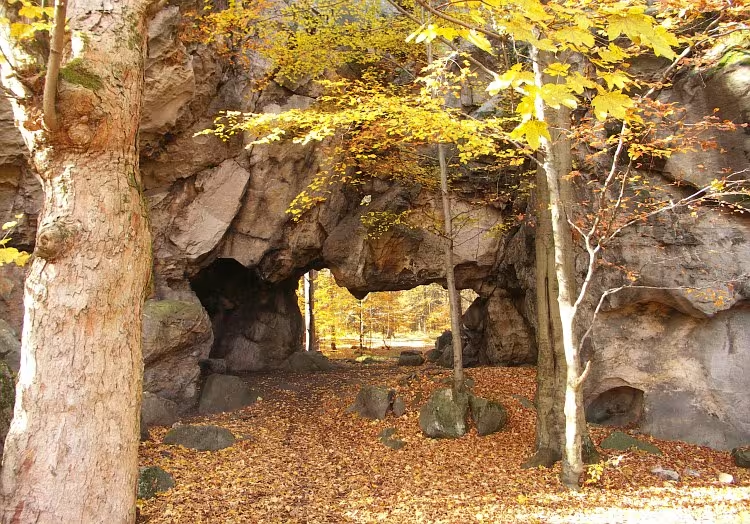
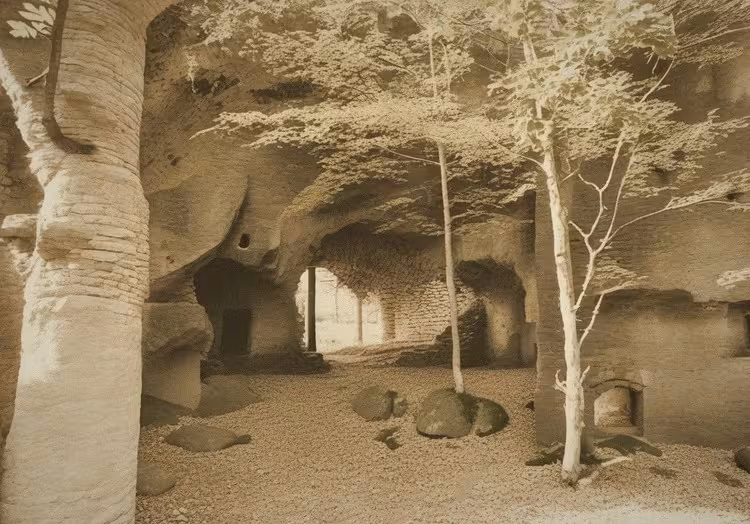
The historical appearance on the left is an AI-generated visualisation and serves as inspiration only.
Historical milestones
- 1343
- First written mention in the chronicle of Jana of Guben
- 1456
- The castle was conquered by the Lusatian army
- 1545
- The castle was called the Milsstaain Castle
- 1634
- The castle was damaged by General Banner's Swedish army
- 1793
- The tower remains have been shot
Architectural development
Originally fortified medieval mansion, which was gradually destroyed by the extraction of quartz sandstone in the surrounding area. In the 18th and 19th centuries there was a gradual degradation and collapse of castle towers. It is currently a rock formation with minimal remnants of the original building.
Historical events
1343 first written mention of the castle, 1456 conquest of the castle by Lusatian troops, 1634 destruction of the castle by Swedish troops, 1793 shooting of the remaining towers
Owners
Berk from Dubé (13th century), Jindřich Berka z Dubé (1362-1379), Hynek Dubský (after 1404), Jindřich Berka z Milštejna (after 1433), Václav Berka from Dubé (1502), Petr Berka from Dubé (1504), Zdislav Berka z Dubé (after 1518 / 1532)
Points of interest
- The castle was founded in the second half of the 13th century to protect the Earth trail from Lipé to Zitava. - The gradual demise of the castle caused intense sandstone mining. - In Milštejn, the crew maintained 12 to 16 gunmen who collected tolls and tariffs. In 1634, the castle was destroyed by General Banner's Swedish army. - The great castle tower was demolished around 1685 because it threatened workers in the quarry below.
Guide
Show guide text
This text was created by artificial intelligence and has not been editorially reviewed. It may contain inaccuracies.
Welcome to the ruins of Castle Milštejn. Now you're standing on the lawn, in the silence of the Lusatian Mountains, and before you are standing the remains of a once powerful building at the top of Mount Nunov. Stop for a moment, take a breath and feel the atmosphere of this place. What you see in front of you is not just a pile of old stones, but a silent witness to centuries of strategic ambitions, military clashes and gradual demise. Take a look at these ruins and try to imagine what this place looked like at the time of its greatest glory, when order and discipline ruled and the castle proudly guarded the surrounding countryside.
Let us now return together in time, deep into the second half of the 13th century. It was during this period that Milštejn was founded. However, it was not a castle built only for representation or as a family seat, but it had a very specific and practical purpose. His position at the top of Núnov was chosen with precision to serve as an inaccessible protection of the trade path which led from Lipé to Zitava. At that time, trade routes were the arteries of the economy, and those who controlled the path also controlled wealth. The first written mention of the castle appears in the year three hundred forty-three in the chronicle of John of Guben, which confirms to us that the building was already firmly anchored in the landscape and administration of its time.
Now pay attention to what you see around you. Even though the masonry is down today, note the material from which the walls were raised. It's a quartz sandstone that was widely available in this area. Look at the surfaces of the walls and see their texture. The architects who designed the castle remained anonymous in the annals of history, but their work was effective. The castle was designed to use the natural terrain of the hill, making it a strategic fortress. Note how the ruins naturally intersect with the surrounding nature. Even though there are no more roofs or whole halls, the very schedule of the remnants tells you how the castle had to be organized in order to effectively fulfil its function as a watchpoint.
When you say Milštejn, we can't ignore the people who lived here and ruled. The castle was closely associated with important personalities, especially the Berk family of Dubé. Names such as Jindřich Berka z Dubé, Hynek Dubský, Jindřich Berka z Milštejna or Zdislav Berka z Dubé are linked to this place in written records. Imagine life in the fifteenth century, which was the era of the flowering of this castle. Milštejn was not only an administrative centre at the time, but a real military base. The castle was maintained by a strong crew of armourers whose number ranged between 12 and 16 men. These gunmen weren't just officers, they were basically customs officers of their time. Their main task was to collect duties and tolls from all buyers and passengers who passed the route from Lipé to Zitava. You can imagine the constant excitement, the arguments about the amount of fees and the constant vigilance of the men in the armour who watched from the walls every movement in the valley.
But the history of Milštejn is also a history of violence and falls. In a thousand and four hundred and fifty-six, the castle was conquered by the Lusatian army, which was the first major break in its existence. Yet the castle tried to adapt to new times. In the year a thousand five hundred forty-five was even called the Milsstaain Castle, suggesting an attempt to change its character from a purely military fortress to a more representative mansion. But peace in these mountains was not permanent. The biggest blow came in a thousand six hundred thirty-four during the devastating struggles of the Thirty-Year War. The castle was attacked and destroyed by the Swedish army under the command of General Banner. The Swedes didn't take prisoners at the time, leaving nothing but fireplaces and debris. It is generál Banner that has become the symbol of the end of the gold era Milštejn. Even though the castle still existed in the form of remnants after this disaster, his fate was sealed. The last blow came in a thousand seven hundred ninety-three, when the remains of the towers were shot to no longer threaten the surroundings or to recover material.
And here we come to one of the most fascinating and sad attractions of this place. You may have noticed that the ruins are very deep in some places or that large parts of the masonry that should still stand are missing. The demise of the castle was not only caused by war and time. Milštejn has become an important quarry in a later period. The quartz sandstone from which the castle was built was so high-quality and desirable that people began to essentially dismantle the castle alive. Instead of naturally eroding the castle, it was systematically extracted as a building material for other buildings nearby. It is a strange irony of fate that the material that once provided the castle with its strength and impartiality became the cause of its final demise. The castle has basically turned into a quarry.
Now, if you look around, try to connect all these pieces of the puzzle. You see the lawn, you see the ruins of sandstone walls and you feel the calm of the Lusatian Mountains. But beneath this layer of peace lies the history of the gunmen collecting tolls, the ambition of the Berk family of Dubé, the thunder of the Swedish works of General Banner and the rhythmic blows of the stone chisels, which slowly erased the castle from the map. Milštejn is no longer a formidable fortress or luxury castle, but it is a place to think about the fleeting power and material values.
Now invited to further explore. Go through the surrounding space slowly, feel the silence and try to complete the images of what once existed. Walk among the remaining walls, touch sandstone stones and let yourself be filled with the atmosphere of this mysterious place. Milštejn will not tell you its history out loud, but if you follow closely the details and listen to the wind in the trees, you will surely find answers to questions about the past of this region.
Thank you for spending some time with us at the ruins of Castle Milštejn. We wish you a pleasant further journey and an inspiring discovery of the beauty of the Lusatian Mountains. Goodbye.
Tips for visitors
The best time to visit is late afternoon, when the sun hits the ruins at an angle, creating ideal conditions for shooting details of castle walls. For the best pictures we recommend looking for sightseeing places on the surrounding slopes, which offer panoramic views of the entire area.
Due to the terrain we recommend footwear with fixed soles and plenty of drinking water. Families with children appreciate snacks and light clothes suitable for hiking up the hill, which makes visiting the castle a pleasant common adventure.
In the vicinity of the castle you can visit the Peak of Urnov, the town of Trekkov, the Silver well or the remains of the pond. All these places are located at a short distance from the ruins and complement the overall experience of the trip to the Lusatian Mountains.
Frequently asked questions
Can the monument be visited?
This is a ruin. Such sites are often freely accessible, but some can only be visited with a guide or are closed for safety reasons. We have not verified the current situation – take care and respect any restrictions.
Where is the monument?
Location: Trávník, Liberecký kraj. The map on this page shows the exact spot.
Why is the monument protected?
It is listed in the Central List of Cultural Monuments of the Czech Republic as a cultural monument (register no. 1000124666).
Businesses nearby
Do you run a restaurant, accommodation, shop, museum, rental, wellness or other visitor service near this monument? Show yourself directly to the people heading to it — this is how they will see you in the app and on the web:
Events nearby
Zdroj akcí: otevřená data měst a obcí ČR (Národní katalog otevřených dat) a kalendář akcí Národního památkového ústavu.
Nearby
Peak of Urnov, city of Trekkov, train station Svor, Silver well and remains of the pond
Accommodation nearby
Themed route
Milštejn (ruins) - historical fortification on the outskirts of the village Trávník. The remains of the castle offer views of the surrounding landscape and are ideal for lovers of history and photography.
Peak of Urnov - nature hike approximately 2 km from Milštejna. At the top, a panoramic view of the forests and valleys is spread, ideal for resting and watching birds.
The silver well and the remnants of the pond - lies about 1.5 km from Peak Nunov. The natural spring with historical traces of silver mining and remains of the old pond provide a quiet place to refresh and a short walk.
Trekkov - town about 3 km from the well. The picturesque historical centre offers refreshments, a short walk along the main street and an introduction to the local atmosphere.
Svor (train stop) - the last point of the route, about 2 km from Trekkov. The bus stop is suitable for returning by train, while a short walk to the station will allow you to refuel before departure.
Seasonal recommendations
Spring brings to the vicinity of the castle the awakening of nature and fresh greenery, which gently covers stone walls. The atmosphere is full of hope and light is soft, which creates a picturesque picture from the ruins. I recommend moisture-resistant shoes because lawns can be muddy after a frosted ground. It is best to visit the memory in the morning when the air is the cleanest.
In the summer months the castle is dominated by thick crowns of trees and intense sun, which highlights the texture of the old stone. The air is hot and the space is live. Due to the high season and large groups of visitors, please come immediately at the opening to avoid clusters. Choose light, breathable clothes and don't forget enough fluids.
Autumn season turns the surroundings into a sea of colors, when red and yellow leaves contradict the grey ruins. The fog in the valley gives the place a mysterious and melancholy touch. The ideal time for visiting is late afternoon, when the low sun lights up the walls beautifully. Due to the variable weather, reach for layered clothes and light jackets.
Winter reveals the strict architecture of the castle, which is partially covered by leaf during other periods. The snow on the walls creates a quiet and quiet space with a freezing atmosphere. At this time visitors are at a minimum, but watch out for shortened opening times. Hot shoes, gloves and hats are essential, and the most appropriate is a visit around noon.
Visualizations and artistic views


The visualisations are generated by artificial intelligence and serve as inspiration.
Photos from the area
Real photos taken near the monument


Zdroj a licence jsou uvedeny u každého snímku.
Tips from visitors
No tips yet. Be the first!
Log in and add your tip.
Sources and literature
Photos: Lutz Maertens Trendy64 17:24, 13 January 2007 (UTC) / CC BY-SA 3.0 — Wikimedia Commons. The author and licence also appear when you hover over the image.
Faktickým podkladem tohoto textu byl článek na Wikipedii, jehož autory jsou přispěvatelé Wikipedie. Článek je dostupný pod licencí CC BY-SA 4.0.
Location on the map
Příběhy a pověsti
Legendy, pověsti a příběhy spjaté s touto památkou
Fotografie návštěvníků
Zatím žádné fotografie. Buďte první, kdo přidá fotografii z návštěvy!
Log in a přidejte svou fotografii nebo hodnoťte.
Za ověřenou návštěvu v aplikaci získáte víc bodů — poznáme podle GPS, že jste na místě.
Reviews and comments