



Molochov Block home
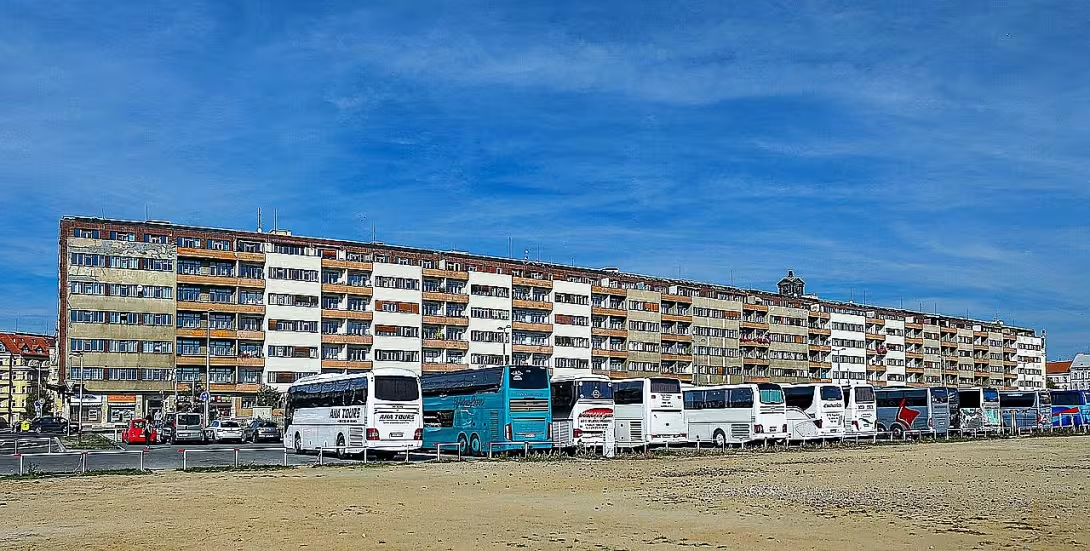
Molochov is a functionalist block of thirteen luxury rental houses in the Prague part of Bubeneč on Letná, which was completed in 1938. The object is remarkable by its power, a united facade and history associated with the political elite of the communist regime.
This monument was created in 1936-1938 during the period of top functionalism. Originally, houses were to be built separately by various architects, but later it was decided to unite the building with a common facade. The construction was carried out by Ing. Jaromír Bečka.
The building is dominated by Milady Horáková, who at the time of construction was named Belcredi's class. It's a set of 13-story apartment buildings with concrete and in one case an iron concrete skeleton. The whole block measures 252 meters in length and 16.5 meters in width. The building has a flat roof with a receding last floor and is covered with ceramic tiles. The most luxurious entrance is lined with Carrarian marble from the Italian mines. In the interior and exterior are visible quality metal elements, from the railings to the mailboxes to the parts of the door. The apartments are of different size, from the smallest one-room rooms for the concierge to the ten-room areas across the whole floor.
A team of architects was responsible for the project. Josef Havlíček united the facade and designed houses with numbers described 852 and 853. The Otto and Karel Kohn brothers designed the original project and the fringe houses. Both brothers had to flee from the advancing Nazi troops to Ecuador in 1938; Otto Kohn was the biological father of Milos Forman. Ernst Mühlstein and Victor Fürth, František Votava and Leo Lauermann participated in the internal solution of individual houses.
The popular name Molochov is likely to be a pejorative indication of the building's potency, which was used by construction workers at the time of construction. Before World War II, rich businessmen dominated this place. During the war, they were replaced by a Nazi elite and employees of the Reich film industry. After 1948, representatives of the Communist regime settled there, with pressure from the nearby Ministry of Interior to change tenants. The population included, for example, Ministers Bohuslav Chňoupek and Karel Hoffman, Chief of State Security Colonel Osvald Závodský, Prosecutor General Jan Bartuška, KSČ Lumír Čivrný, officials Jozef Lenárt and Čestmír Císař, Prague Mayor Adolf Svoboda or journalist Vojtěch Dolejší.
An important meeting took place in the apartment of Prime Minister Ladislav Adamce on 19 November 1989 with Michael Horáček and Michael Kocáb on the initiative of Most. This meeting was facilitated by government negotiations with the Opposition Charter 77 and the emerging Civil Forum.
The building has been protected as a cultural monument since 1 January 1964. It is currently partly neglected, which is due to the complex property structure of individual houses and apartments, which complicates the overall reconstruction. As of September 2021, the facade headed towards Letna was repaired at nine of the thirteen houses and at four houses and the facade to U Letenské vodárny.
Molochov presents a unique example of Prague functionalism and a silent witness to political change in the Czech Republic. It is a place where architecture meets the dramatic history of the 20th century and is therefore worth visiting.
Then and now
Drag the slider to compare how the landmark may have looked when it was built with the view today.
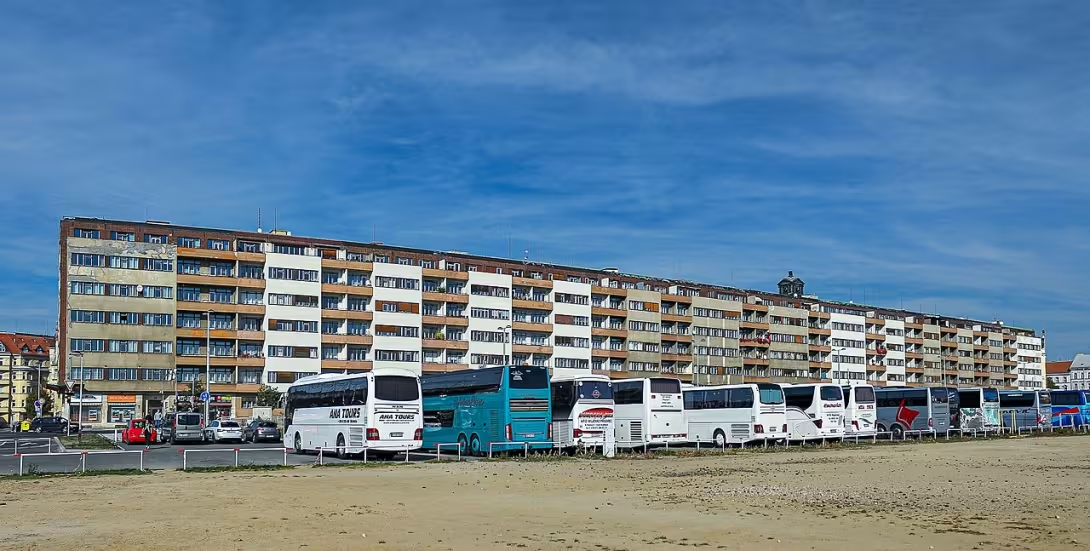

The historical appearance on the left is an AI-generated visualisation and serves as inspiration only.
Historical milestones
- 1938
- Finishing the block building.
- 1964
- The object is registered as a protected monument.
Architectural development
It is a set of 13 six-story houses with concrete and iron concrete skeleton with a total length of 252 meters. The facade is covered with ceramic tiles and the most luxurious entrance is covered with Carrarian marble. The building has a flat roof and a receding final floor.
Historical events
19. 11. 1989: In the apartment of Prime Minister Ladislav Adamce, a meeting took place with the initiative of the Bridge, which facilitated negotiations of the government with the Opposition Charter 77 and the Civil Forum.
Points of interest
- Molochov is a functionalist block of thirteen luxury rental houses completed in 1938. The object is linked to the political elite of the Communist regime. - The project was the responsibility of architect Josef Havlíček and brothers Otto and Karel Kohn who fled from the Nazis to Ecuador. - A meeting took place in the apartment of Prime Minister Ladislav Adamce on 19 November 1989 with Michael Horáček and Michael Kocáb on the initiative of Most, which contributed to the government's negotiations with Charter 77. The building has been protected as a cultural monument since 1 January 1964.
Guide
Show guide text
This text was created by artificial intelligence and has not been editorially reviewed. It may contain inaccuracies.
Welcome to Prague's Bubeneč district, where history combines with architectural bravery. Right now, you're standing in front of a construction site, which is likely to interest you immediately with its size and rigor. Look ahead. You see this monumental block of houses that stands over the street of Milady Horáková and dominates the whole area with its presence. It's a place that carries layers of history, luxury and political tension. What you see is Molochov. This name is not official, it's a folk name that came from the astonishing power that you see at the moment. It's a building that basically controls the entire space around it with its massive capacity and acts as an impenetrable wall that separates different parts of the neighborhood.
Let us now look at how this building was built and in what context it was built. Molochov was completed in 1938, at a time when the whole world was in suspense before a great conflict. The whole complex consists of 13 luxury rental houses which are connected to one large, continuous unit. Notice the uniform facade that stretches ahead of you. It is a typical expression of functionalism, a direction which, at that time, emphasized the practicality, purity of lines and the absence of unnecessary ornaments. The architects who participated in this ambitious project, among them Josef Havlíček, the brothers Otto and Karel Kohn, Ernst Mühlstein, Victor Fürth, František Votava or Leo Lauermann, wanted to create something modern and representative that would correspond to the highest standards of the present housing.
Now if you look away from the building, you realize why this location was chosen right here. From these apartments there is a beautiful view of Prague Castle and Letenská plaza. Imagine what it must have been like in 1938 to enter these spaces for the first time and look out the window on the capital skyline. This location of the houses made some of the most desirable addresses in Prague, a place for people who sought peace, space and prestige.
Now pay attention to who lived in these premises, because Molochov is not just about concrete and architecture, it is primarily a place connected with power. In times of communist regime, this address became a home for senior officials and ministers. Imagine the long corridors and the quiet staircases that were walked by people deciding the fate of thousands of people. It was a closed community of power where people from the highest levels of the government were adjacent. These included Bohuslav Chňoupek, Karel Hoffman, Osvald Závodský, Jan Bartuška, Lumír Čivrný, Jozef Lenárt, Čestmír Císař, Adolf Svoboda, Vojtěch Dolejší or Ladislav Adamec. This connection with the political elite has given the building a certain aura of secrecy and unavailability. For a common citizen, Molochov was a symbol of unattainable luxury, and at the same time, a place where behind closed doors was decided on the direction of the country.
Speaking of the creators of this work, there is a story that is very moving and gives us insight into the tragedy of that time. The brothers Otto and Karel Kohn, who were key architects of this project, had to face the horrors of Nazism at the time of completion of the construction. Their journey from Prague to Ecuador, where they fled to save their lives. It is fascinating and at the same time sad to think that the work that helped create in the heart of Prague remained a permanent monument to their talent and vision, while they themselves had to start a whole new life at the opposite end of the world. This combination of architectural triumph and personal tragedy makes Molochov a place with a deep human dimension.
But times have changed, and so have the residents of these luxury apartments. In later years there were also names such as Michal Horáček or Michael Kocáb, which shows how the character of this place transformed from a strictly political residence to space for people in the fields of culture, art and entrepreneurship. The building was recognized as a protected monument in 1964, which ensured that its unique appearance and functionalist character would be preserved for future generations. Look at that facade again. Feel the stability and serenity that radiates from it, and the hidden dynamics of the stories that took place behind these walls.
Maybe you're wondering why the building got the popular name. The word Moloch came from ancient myths and marked the deity to which precious things or human lives were sacrificed. In the transferred sense, this term began to be used for something huge, absorbing and crushing. So Molochov reflects by its name the way people looked at it. For them, it was not just a set of houses, but a huge, almost terrifying organism made of stone and concrete, which, with its size, drowned out everything else around it. It's a fascinating contrast to how subtle and thoughtful the interior details of these luxury apartments were.
Molochov remains one of the most significant traces of modern architecture in Bubeneči. It is a building that teaches us how space can become the mirror of the time in which it originated and how it can change with the arrival of new regimes and new people. You stand before a witness to history that survived changes in governments, wars, and social upheavals. It is a reminder of a time when it was believed in purity in shape and in a future that was meant to be rational and modern.
I hope that by looking at this massive block of houses, you were able to imagine not only its physical form, but also the people who lived here, loved, schemed and created the history of our city. Feel the atmosphere of this place where the state's powers met with a vision of architects who had to leave their country. Now invited to another walk around to discover other hidden corners of this beautiful neighborhood and perhaps find further traces of Prague functionalism. Thank you for your attention and I wish you a pleasant rest of the day to discover the secrets of Prague.
Tips for visitors
The best time to visit Molochova is in the spring or autumn season when the weather is pleasant and offers a beautiful view of Prague Castle. In these months, light is also ideal for shooting architectural details.
Search for the current connection in the previous planning visit.
When visiting Molochova take a suitable suit with you because you can be out longer for viewing and shooting. The photos are particularly bright in sunlight, so taking a quality camera with you can be a good decision.
In the vicinity of Molochova there is a possibility to visit the Letenska Plain, which offers beautiful walks and places for relaxation. For families with children it can also be interesting to visit Prague Castle, where there are various educational programs.
Frequently asked questions
Can the monument be visited?
We have not verified whether this monument is accessible. Please ask the owner or operator, or the local municipal office.
Where is the monument?
Location: Bubeneč, Hlavní město Praha. The map on this page shows the exact spot.
Why is the monument protected?
It is listed in the Central List of Cultural Monuments of the Czech Republic as a cultural monument (register no. 1000152669).
Businesses nearby
Do you run a restaurant, accommodation, shop, museum, rental, wellness or other visitor service near this monument? Show yourself directly to the people heading to it — this is how they will see you in the app and on the web:
Events nearby

Zdroj akcí: otevřená data měst a obcí ČR (Národní katalog otevřených dat) a kalendář akcí Národního památkového ústavu.
Nearby
Letenská pláň, Pražský hrad.
Accommodation nearby
Trips and activities nearby
Guided tours, tickets and activities nearby from GetYourGuide
Affiliate link: if you buy from the partner, we may receive a commission. The price for you does not change.
Search tours and activities →Themed route
Thematic cruise route from Bubeneče
1.Molochov (others) - Type: Historical site, monument. - Why is it worth visiting: Molochov is a historically important location with a rich past. Visit this local jewel by exploring its architectural and cultural monuments, which represent important chapters of the history of the village Bubeneč.
2. The Fleet Plain - Type: Public park. - Why is it worth a visit: The Letenské plaza is an ideal place to relax and walk. The park offers beautiful green areas where you can enjoy your peace of mind when walking under old trees or move on its travels. It is also a place of historical value that was previously associated with scientific and cultural events.
3. Prague Castle - Type: Historical fortress. - Why is it worth a visit: Prague Castle is an icon of Czech history and culture offering a view of the whole metropolis. Visit this monumental complex by exploring its towers, the temple of St. Vitus and other historic buildings. The castle is not only a cultural centre, but also a place with rich stories from the past.
Route order: - Start at Molochov (others), where you will immerse yourself in the history of the village. - Then you will move to the Letenské plains for relaxation and a walk in the green. - Take your day by visiting Prague Castle, where you will enjoy the views and historical meanings of this iconic place.
This route offers a combination of cultural experiences and an opportunity to relax in green, making it an ideal choice for every traveler.
Seasonal recommendations
Spring: During the spring season Molochov (others) in Bubeneči is strangely attractive because of its blooming surroundings where the first flowers are opened and the trees are starting to sprout. Sun rays illuminate architecture in a new light, which contributes to a unique atmosphere. For a visit it is advisable to go to a memorial at noon so that it is possible to take full advantage of spring sunshine and mild temperatures. Clothes should be medium-warm, because the temperature can change rapidly from morning to evening.
Summer: In summer Molochov (others) is full of life and energy. The sunny dawn underlines historical architecture, while heat makes the visit more topical during the early hours of the day. Summer attracts the most tourists, so it is advisable to go out early in the morning to save crowds while enjoying a quieter environment. It is recommended to wear light clothes and not forget the sun protection such as a hat and cream with high SPF.
Autumn: During autumn Molochov (others) becomes melancholic charm. Leaves are colored in golden and red shades, which adds a distinctive colour palette to the historical environment. Sunshine days are still common, but the temperature is gradually decreasing, which means it is advisable to prepare slightly warmer clothes. A visit in between hours can be ideal because this period often offers a calmer experience without large crowds.
Winter: In the winter months, Molochov (others) is covered with snow or ice, which adds to its historical appearance a wonderful clean shine. Sunshine days are rare and temperatures are low so you need to equip yourself with warmer clothes such as hat, scarf and insulated shoes. The monument can be opened for a shorter time, so it is advisable to check the current times before visiting. Winter offers a quiet atmosphere experience with less crowd and the possibility to enjoy a mild light during the sun days.
Visualizations and artistic views


The visualisations are generated by artificial intelligence and serve as inspiration.
Photos from the area
Real photos taken near the monument


Zdroj a licence jsou uvedeny u každého snímku.
Tips from visitors
No tips yet. Be the first!
Log in and add your tip.
Sources and literature
Photos: autor neuveden / CC BY-SA 4.0 — Wikimedia Commons. The author and licence also appear when you hover over the image.
Faktickým podkladem tohoto textu byl článek na Wikipedii, jehož autory jsou přispěvatelé Wikipedie. Článek je dostupný pod licencí CC BY-SA 4.0.
Location on the map


Příběhy a pověsti
Legendy, pověsti a příběhy spjaté s touto památkou
Fotografie návštěvníků
Zatím žádné fotografie. Buďte první, kdo přidá fotografii z návštěvy!
Log in a přidejte svou fotografii nebo hodnoťte.
Za ověřenou návštěvu v aplikaci získáte víc bodů — poznáme podle GPS, že jste na místě.
Reviews and comments