



Morávkův vodní mlýn Water mill
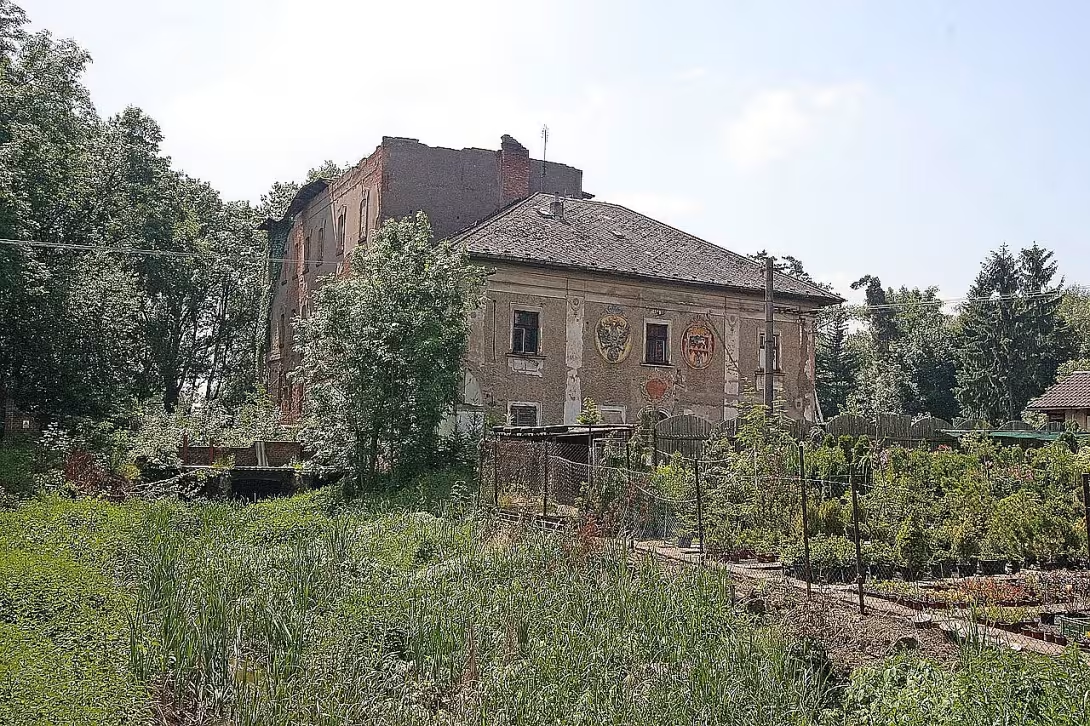
Morávkův vodní mlýn also known as Lower Mill, is a classic water mill standing in the northeast part of the village Opatovice nad Labem in the district of Pardubice on the Opatovice Canal. This monument from 1804 is protected as a real cultural monument value of the Czech Republic. Its construction form and association with the history of the defunct Opatovice monastery takes an important position.
The original mill was probably part of an already extinct Opatowice monastery, whose remains of the masonry were still in the area in the 18th century. A record of Czech historian and priest Bohuslav Balbín from 1656 appears in historical sources. He captured the story of the then miller about the event of around 1570, when the mill wheels stopped suddenly at midnight due to sudden water loss in the Elbe. The new Classicist building was built in 1804 right in the places of former monastery buildings. During the construction period, the Czech countries were located in the Habsburg monarchy responding to the ongoing Napoleonic wars. In the 17th century, they went through a difficult period for visiting Bohuslav Balbino after a 30-year war associated with reCatholisation.
A single-storey object on a rectangular floor plan with a valb roof stands the longitudinal front of the access communication and the side part of the drive. There is a stone well in front of the front. The building is walled mainly from bricks, where mixed masonry appears especially in corners. Sandstone blocks are used in the plinth when driving, while plaster is rough with polished white architectural cells. The entrance facade carries a portal with plaster shampoo. Above it is a cartouche in a yellow wreath with a mussel and residues of polychromia, supplemented by an illegible inscription with a chronogram referring to the period of Austrian cisarianism and the person of the builder Dear Václav Skala. On the floor on the second and fourth axis there are large embossed characters in laurel wreaths with decorative red ribbon. The left character shows a black double-headed eagle with a golden fleece, sword and scepter, and the right half shield with a gate, a blue tree and a white lion in a jump. In 1930, modern miller technology was incorporated into the building in the form of a Francis turbine with a flow rate of 2,815 cubic meters per second, a fall of 3.1 meters and an output of 88.5 horsepower.
As of 1840, the mill was evidently owned by the family of the regional MEP František Morávka. Several archaeological discoveries have been made in the mill in the past. For example, between 1740 and 1741, it was two arched dunes in the building and in 1774, a 16-metre arching in the scaffold near the drive. For a long time, there was also a large gothic key with the ornament of the nun's flame, which Morávek the miller donated to the Pardubice Museum.
The key written events include the mention of Bohuslav Balbín from 1656, the construction of a new classical mill in 1804, documented by the ownership of the František Morávka family in 1840 and the installation of the Francis turbine in 1930. It is also remarkable that the old miller's reputation for the sudden exit of the Elbe into the abyss around 1570, which Balbino recorded.
Today, this protected cultural monument serves as a reminder of the old mill and building development on the Opatovice Canal. Visiting this place in the village Opatovice nad Labem offers a view of the preserved classical architecture and technical history associated with the legacy of the former monastery.
Historical milestones
- 1656
- The mill mentioned Czech historian and priest Bohuslav Balbín in his records.
- 1804
- A new classical mill was built in the places of the former monastery buildings.
- 1840
- The mill was clearly owned by the family of the regional MEP František Morávka.
- 1930
- The building operated a Francis turbine with a flow rate of 2,815 m ³ / s.
Architectural development
The building is walled mainly from bricks, with mixed masonry appearing in places and sandstone blocks in the base of the drive. The entrance facade is decorated by a portal with plaster champagne, cartouche with mussel and embossed characters with two-headed eagle and city coat of arms. In 1930, a modern Francis turbine with 88.5 horsepower was incorporated into the mill technology.
Historical events
In 1656 the historian Bohuslav Balbín mentioned in writing. Around 1570, there was a rarity of bicycle stops due to a sudden drop in water in the Elbe. In 1804 a new classical mill was built. A Francis turbine was installed in the building in 1930.
Owners
In 1840 the family of the regional MEP František Morávka owned the mill.
Points of interest
- Morávkův vodní mlýn from 1804 stands in the northeast part of the village Opatovice nad Labem on the Opatovice Canal and is protected as a cultural monument. - The original mill was probably part of the extinct Opatovice monastery and Czech historian Bohuslav Balbín wrote a story about stopping the mill wheels at midnight around 1570 due to the loss of water in the Elbe. - The entrance front of the building is carried by a portal, cartouche with an unreadable inscription and embossed on the floor with a two-headed eagle and a half shield. - In 1930, modern miller technology in the form of Francis' turbine was incorporated into the building. - In the past, archaeological discoveries have been made in the mill, and there was a great Gothic key that Morávek the miller donated to the museum for a long time.
Guide
Show guide text
This text was created by artificial intelligence and has not been editorially reviewed. It may contain inaccuracies.
Welcome to Opatovice nad Labem. Right now you are facing a remarkable historical monument, which is Morávkův vodní mlýn, also known as the Lower Mill. You are located in the northeast part of the village and under your feet or just next to you flows the water of the Opatovická Canal, which is inherent to this place. Look around you and try to see the unique atmosphere this place has been radiating for centuries. You can see in front of you the classic building of this mill that breathes history and secrets of past times upon you.
Let's look into the deeper past to understand how important this place was. The original mill, which used to stand here, was probably part of the already completely extinct Opatovice monastery. The remains of this famous monastery were still found in the eighteenth century, indicating how deeply this territory is linked to the church and building history of our nation. The importance of this place is also underlined by the fact that already in 16 hundred and fifty-six the local mill was mentioned in its rare records by Czech historian and priest Bohuslav Balbín. This alone shows that the mill was not an ordinary building, but an important point in the landscape that attracted the attention of the scholars already in the Baroque period.
Now pay attention to the construction itself that you are facing. This current form of the mill dates back to the year eighteen hundred and four, when a new classical building was built on the site of the former monastery buildings. It is a single-storey object on a rectangular plan. Look at its peaceful facade and see the proportions of this building, which has been designed with the typical building moderation of its epoch. We do not have the names of specific builders or architects, but the craftsmanship of creators from the early nineteenth century is evident at every step. Try to stop for a moment, look at the details of the facade and imagine what it was like when the craftsmen were finishing the latest modifications to this classic mansion.
With this mill are also connected important historical figures and people who shaped his fates. The already mentioned Bohuslav Balbín was not only a passive observer, but left us with written testimonies of the strange phenomena here. Two centuries later, in the year eighteen hundred forty, the mill was proven to belong to the family of the regional MEP František Morávka. Imagine the excitement that existed here in the nineteenth century, when the mill served its economic purpose and when people connected with high policy and everyday hard work came through. Industrial development has not shunned this place either, as evidenced by the 19-hundred and thirty record. At that time, the modern Francis turbine was successfully operated in the building with a respectable flow rate of two whole eight hundred fifteen thousand cubic metres per second, indicating a gradual modernization and transition to more efficient use of the water power of the Opatowice Canal.
Now listen to the interesting thing that gives the whole place a mysterious touch. Bohuslav Balbín kept in his notebooks a remarkable storytelling that ties to the mill. He recorded rumors about how the mill wheels stopped here at midnight. Try to imagine. You're standing on the shore of the Opatovice Canal, there's a silence of the night, the water is quiet, and there are old stories in your mind about the unexplained phenomena that people told about hundreds of years ago. It is these stories that make the ordinary technical monument a place full of hidden meanings and ancient secrets waiting to be discovered.
Morávkův vodní mlýn is today rightly protected as a valuable cultural monument, which combines the history of a defunct monastery, traces of famous Czech scholars, classical architecture and development of miller craft and modern turbines. I hope you enjoyed this stop. You can continue to walk along the Opatovice Canal and discover further traces of the past in this picturesque landscape. Thank you for your attention and I wish you the rest of the day.
Tips for visitors
The best time to visit Morávkov Water Mill is early in the morning or late in the afternoon, when the sunlight beautifully draws the historical atmosphere of the Opatovická Canal and the midday tourism is moderate. Take with you comfortable shoes suitable for walking in nature along the water channel, drinking and repellent, especially if you go for a longer walk to the water. The best place for photography is the bank of the Opatovice Canal in the immediate vicinity of the mill, where the morning or evening light best highlights the technical details of the construction and surrounding water level. In the wider area of the northeastern part of the village Opatovice nad Labem is worth mentioning the historical location, where in the past there was a significant Opatovice monastery. Families with children appreciate a peaceful walk around the Opatovice Canal, which is easy and suitable for carriages and smaller children, who can observe nature here.
Frequently asked questions
Can the monument be visited?
This is a technical monument. Some are open as exhibitions, others are out of use or on private land. We have not verified whether this one is accessible.
What are the opening hours and admission?
We have not verified the opening hours or admission. Current information is published by the operator.
Where is the monument?
Location: Opatovice nad Labem, Pardubický kraj. The map on this page shows the exact spot.
Why is the monument protected?
It is listed in the Central List of Cultural Monuments of the Czech Republic as a cultural monument (register no. 1999997471).
Businesses nearby
Do you run a restaurant, accommodation, shop, museum, rental, wellness or other visitor service near this monument? Show yourself directly to the people heading to it — this is how they will see you in the app and on the web:
Events nearby


Zdroj akcí: otevřená data měst a obcí ČR (Národní katalog otevřených dat) a kalendář akcí Národního památkového ústavu.
Nearby
The mill is located directly on the Opatovice Canal in the northeastern part of the village Opatovice nad Labem in the Pardubice district, in places where there was a significant Opatovice monastery in the past.
Accommodation nearby
Themed route
1. Opatogical monastery Type: Historical site Why it is worth a visit: In the past there was an important monastery whose history was deeply linked to the whole area and formed the character of the area.
Morávkův vodní mlýn Type: Technical monument and main destination Why is it worth a visit: This mill stands right on the Opatovice Canal in the northeast part of the village and represents a unique example of historical water construction and milling.
3. Opatogical Channel Type: Water work Why is it worth a visit: The artificial water flow flowing in the immediate vicinity of the mill connects the entire location and forms a picturesque backbone of the local landscape in Opatovice nad Labem.
Seasonal recommendations
Spring at the Morávko water mill in Opatovice nad Labem brings a growing nature, when the surrounding banks of the drive and mill grates grow fresh green grass and the first spring flowers. The atmosphere is peaceful, ideal for the perception of the sound of flowing water and the singing of birds, while the low sun creates fine shadows on the historic brick facade. During this period you will not meet crowds of tourists, so you will enjoy the tour in complete silence. We recommend to wear fixed shoes because the field roads in the surrounding area can be drenched on the tidal and spring rains, and a light waterproof jacket. The best time to visit is in the morning when the morning fog above the water gives the place a mysterious touch.
Summer at the abattovice mill is characterized by lush vegetation, which partly frames the building into green corners, and intense sunlight reflecting from the water level. The atmosphere is alive, the air smells of warm soil and flowers in adjacent gardens, which attracts lovers of natural scenery. During the main summer season, it is a little more lively around the monument, so it is reasonable to come first thing in the morning after opening to avoid the midday heat and afternoon hikes. Wear breathtaking summer clothes, don't forget your headgear and sunglasses. You can enjoy walking around the mill with a cold drink, which you will appreciate in sunny weather.
Autumn turns the surroundings of Morávkov's water mill into a colourful palette of shades of yellow, orange and red, which are picturestively reflected in a calm water surface of the drive. The lighting is soft and golden throughout the day thanks to the low sun, creating absolutely great lighting conditions for photography of historical architecture surrounded by fallen leaves. Visiting in this period has fallen significantly, so you will enjoy a quiet melancholy atmosphere. Practical advice includes the choice of warmer, layered clothes and wind-resistant jackets, because cold air is often drawn from the water. The best time for a tour is around noon, when the rays of the sun will warm the colder autumn air for a while.
Winter gives Morávko's water mill a fairy tale, especially when the landscape is covered with a layer of snow and glitter ice crystals on the frozen water surface. The atmosphere is quiet, mysterious and directly encourages contemplation over the history of old grinding in the silence of winter nature. In advent time and during winter weekends, holiday hikers come here for a short walk, otherwise there is a deep calm. Warm winter clothes, hats, gloves and solid winter shoes with anti-slip soles are essential because the surrounding pavement and shores can freeze. The best time to visit is early afternoon, before it closes quickly and early winter twilight falls.
Visualizations and artistic views


The visualisations are generated by artificial intelligence and serve as inspiration.
Photos from the area
Real photos taken near the monument


Zdroj a licence jsou uvedeny u každého snímku.
Tips from visitors
No tips yet. Be the first!
Log in and add your tip.
Sources and literature
Photos: Petr1888 / CC BY-SA 3.0 — Wikimedia Commons. The author and licence also appear when you hover over the image.
Faktickým podkladem tohoto textu byl článek na Wikipedii, jehož autory jsou přispěvatelé Wikipedie. Článek je dostupný pod licencí CC BY-SA 4.0.
Location on the map
Příběhy a pověsti
Legendy, pověsti a příběhy spjaté s touto památkou

Fotografie návštěvníků
Zatím žádné fotografie. Buďte první, kdo přidá fotografii z návštěvy!
Log in a přidejte svou fotografii nebo hodnoťte.
Za ověřenou návštěvu v aplikaci získáte víc bodů — poznáme podle GPS, že jste na místě.
Reviews and comments