



most Táborské ulice přes Vrchlici Road bridge
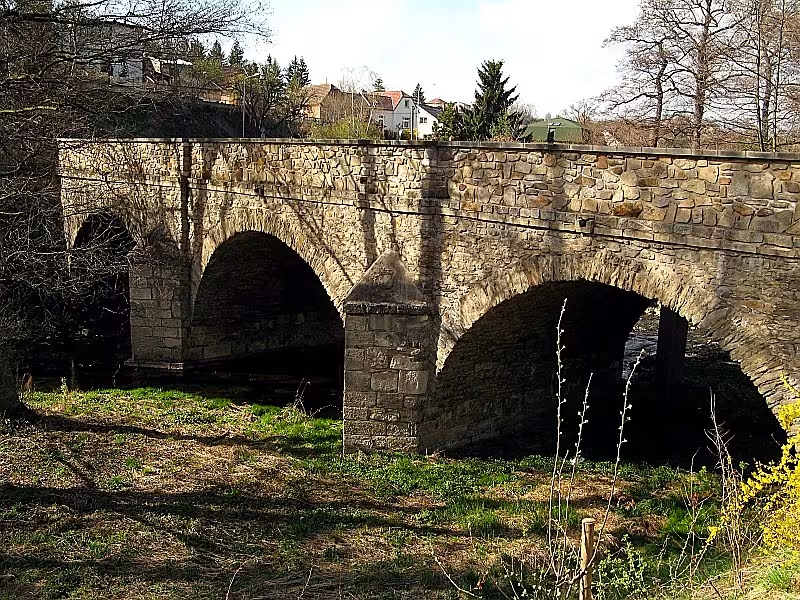
The stone road bridge in Táborská Street in Kutna Hora is a technical monument from the first half of the 19th century. It crosses the river Vrchlici and connects the towns of Vrchlice and Žižkov. The building is protected as a real cultural monument of the Czech Republic. It is a valuable document of period engineering construction and it excels at the use of secondary material from extinct sacral structures.
The bridge was created when the road network developed in connection with the industrialisation and modernisation of the infrastructure. The stones from the walls of the demolished church of St. Philip and James in Sedlce were used in the construction. This explains the presence of sub-worked elements in block parts of the construction.
The construction of a total length of 34,5 metres consists of three semicircular arcs, each having a range of 8,4 metres. The main material is a quarry stone. The backs are lined with sandstone blocks with quarry stone. The bridge stands on two pillars with double-sided backrest, which have a floor plan of a rectangular triangle and are closed with a half-needle cap. The technical detail is the groove placed in the slotted ledge above the arches, which takes the water from the road.
The current form includes modern walls at both ends of the bridge, which replaced the original structures. These parts form a variety of carved blocks with upper edges covered by granite plates. Here too there are secondary used stones that maintain visual continuity with the historical core.
The second stone bridge from the same period, which is part of the same cultural monument, is more north of the city centre. This smaller object brightens the flow of Bylanka, measures 16.4 metres and consists of two different size semi-circular arches. It conforms constructively to a larger bridge over the Vrchlice, including the use of quarry stone and a pillar with triangular supports.
The bridge in Táborská Street remains a functional part of the urban infrastructure and shows a high level of craftsmanship of stone in the 19th century. For visitors to Kutná Hora is an interesting example of historical engineering, which thanks to the material from the defunct peasant church keeps fragments of even older history of the city.
Historical milestones
- around 1790
- The demise of the church in Sedlce as well as the preparation of the stone for construction.
- about 1830
- The creation of a stone bridge over the river Vrchlici in Táborská Street.
- around 1835
- Construction of a smaller bridge over the river Bylanka in the nearby neighbourhood.
- 1958
- Classification of the building among protected cultural monuments.
- around 2000
- Modern wall treatment and granite plate laying.
Architectural development
The bridge was built in the first half of the 19th century and its construction included the use of stones from the walls of the demolished church of St. Philip and James of Sedlce. The modern parts of walls are made of carved various blocks, which adds a moving visual effect.
Points of interest
- In the construction of the bridge, the stones from the walls of the demolished church of St. Philip and James in Sedlce were clearly used. Therefore, secondary-treated elements are visible in the block parts of the structure. - An interesting technical detail of the construction is the groove placed in the recessed ledge above the arches, which takes the water from the road. - The construction of a total length of 34,5 metres consists of three semicircular arcs, each having a range of 8,4 metres. - Part of the same cultural monument is also the second smaller stone bridge on the same street, which measures 16.4 metres and crosses the river Bylanka.
Guide
Show guide text
This text was created by artificial intelligence and has not been editorially reviewed. It may contain inaccuracies.
Welcome to one of the very interesting and solid buildings of our city. You are standing right in front of the stone bridge in Táborská Street, which rises above the river Vrchlice and connects the city parts Vrchlice and Žižkov. When you look around you, you see a sturdy work built of quarry stone, reinforced with sandstone support. This bridge measures to a length of 30 and a half metres and carries a total of three semicircular arches, each having a span of eight and a half meters. It is a place that carries the silent power of the past and connects the banks of the river for a long time.
Let's go back in time together and see how this building came into being and what it's done. Her story began in the first third of the nineteenth century. Around the year eighteen hundred and thirty, this solid stone bridge across the river Vrchlici grew, with several years later, around eighteen hundred and thirty-five, another one in the nearby neighbourhood, a slightly smaller structure that bridged the river Bylanka. But the very origin of the building material is interesting. Around seventeen hundred and ninety died the church in Sedlce and the stone, which was originally intended for him, did not remain without use. It is this material that has been prepared and later proven to be used to build the bridge that you are now facing. The time of creation of the bridge follows directly the events connected with the demise of the said shrine.
Now pay attention to the architecture itself and the details that are right in front of your eyes. When you look at the construction in more detail, notice the modern parts that are made up of carved various blocks. These parts are covered by solid granite plates, which were added here during modern wall modifications around the year two thousand. The sandstone blocks forming the backrest give stability and seriousness to the whole structure. A particularly interesting technical detail, which is worthy of your attention, is the groove placed in the slotted ledge above the arches. This smart element serves an important function because it reliably drains precipitation water away from the structure.
When we think about the people behind this work, the names of the architects themselves and the specific historical personalities associated with this place have not been preserved and remain unknown until today. But the material itself speaks to us more strongly. Old builders used stones from the walls of the demolished church of St. Philip and James in Sedlce when building the bridge. If you look closely at the block parts of the structure, you can see the secondary components. These stones bear traces of their former presence in another sacred place and now form the basic building blocks of the bridge, which humans cross daily. It's a fascinating example of how old things can become the basis for new purposes without losing their essence.
This building carries its value across centuries. Its importance was officially confirmed in nineteenth hundred and fifty-eight, when it was included as a protected cultural monument, which guarantees that this historic building will also be protected for the coming generations.
Thank you for your attention to this place. I firmly believe that the view of the stone arches above the Highlands and the knowledge of the moved history of the building materials here has enriched your walk. You can now continue to explore the surrounding beauties of Kutná Hora and discover other stories that this picturesque city offers its visitors. Goodbye.
Tips for visitors
A tour of the stone bridge in Táborská Street across the river Vrchlici I recommend planning for the morning hours, when the sunlight ideally illuminates the old quarry stones and sandstone supports. You can use your own car or local public transport for your trip to the monument, and check the specific connections in the respective timetable search engine. Take with you especially comfortable shoes for walking around and a camera to capture the historic building connecting the city areas. The best shots will be taken from the watercourse bank, where the contrast of the historical masonry and the newly modified parts of the bridge will stand out.
Frequently asked questions
Can the monument be visited?
This is a structure in a public space that can usually be seen from outside free of charge. We have not verified that this particular one is freely accessible.
Where is the monument?
Location: Žižkov. The map on this page shows the exact spot.
Why is the monument protected?
It is listed in the Central List of Cultural Monuments of the Czech Republic as a cultural monument (register no. 1000145632).
Businesses nearby
Do you run a restaurant, accommodation, shop, museum, rental, wellness or other visitor service near this monument? Show yourself directly to the people heading to it — this is how they will see you in the app and on the web:
Nearby
🏰 Historic sites (214)
- Jaroslav Vrchlický 0.9 km
- sv. Juda Tadeáš 0.9 km
- sv. Karel Veliký 0.9 km
- sv. Anna 0.9 km
- sv. František Borgia 0.9 km
- sv. Florián 0.9 km
- sv. Alois Gonzaga 1.0 km
- sv. František Xaverský 1.0 km
- sv. Ludmila 1.0 km
- GASK 1.0 km Barborská 51 +420725377433 web
- sv. Václav 1.0 km
- sv. Ignác z Loyoly 1.0 km
- sv. Vít 1.0 km
- sv. Josef 1.0 km
- sv. Isidor 1.0 km
- sv. Ferdinand Kastilský 1.1 km
- sv. Barbora 1.1 km
- sv. Jan Nepomucký 1.1 km
- František Josef I. 1.1 km
- Kamenná koule 1.1 km
🍽️ Restaurants and dining (211)
- Kiosek u Saláků 0.2 km
- Kafírnictví v GASK 1.0 km
- Bistro&Pub Barbora 1.0 km
- Bistro Skleník 1.1 km
- Barborska Bar 1.2 km
- Petr Polívka China Restaurant 1.2 km
- Restaurace V Ruthardce 1.2 km Dačického náměstí 15 +420607286298 web
- Restaurace Dačický 1.2 km web
- Kavárna na Kozím Plácku 1.2 km Dačického náměstí 10 +420776018607 web
- Cafe Dačický 1.2 km Komenského náměstí 42/25 +420 603 434 367 web
- Bakalářská 1.2 km
- Café 21 1.2 km
- Kozlovna Barborský dvůr 1.2 km Barborská 37/4 +420 607 612 333 web
- Stop Cafe 1.2 km
- MUJ FALAFEL bistro 1.3 km Komenského náměstí 22/15 +420777665336 web
- Blues café 1.3 km web
- Restaurace Na Valech 1.3 km Husova 16 +420 720 442 051
- Dobrá čajovna 1.3 km Havlíčkovo náměstí 84/7 +420 777 028 481 web
- Bar Pod Schody 1.3 km
- Bistro Husova 1.3 km +420 776 891 940
🏨 Accommodation (38)
- Elvíra 0.8 km Kremnická 91/15
- Vista Apartments 0.8 km Kremnická 43/13 +420 601 355 466 web
- Restaurant a Penzion Barbora 0.9 km +420 327 316 327 web
- U Varhanáře 1.1 km web
- U Babky Bylinkářky 1.2 km +420 702 279 992 web
- Hotel Opat 1.3 km
- Pension Bed & Breakfast 1.3 km
- Elim 1.3 km
- Penzion Havlíček 1.3 km web
- Hotel U Vlašského Dvora 1.4 km
- Zlatá Stoupa 1.4 km
- Hotel Mědínek 1.4 km
- Hotel U Kata 1.6 km web
- Hotel Anna 1.6 km
- Barbora Kemp 1.9 km Tyršova 988 +420704737747 web
- Hotel Kréta 2.1 km
- Autokemp Malešov 2.2 km web
- Penzion Dana Karásková 2.2 km
- Penzion Kutna 2.3 km
- Ubytovna Lorecká 2.3 km
🚲 Rentals and sport (37)
- TJ Sparta Kutná Hora, oddíl tenisu 0.8 km
- Tenisový klub 0.8 km
- Ice Pool 1.2 km
- Sportovní hala Klimeška 1.4 km web
- Kutnohorská plovárna 1.4 km web
- Sport šampion 1.4 km Václavské náměstí 162/5 +420327513846
- Kutnohorská plovárna 1.4 km
- Sokol Kutná Hora 1.4 km
- TJ Sparta Kutná Hora 1.5 km
- SKP Olympia 1.6 km
- Hala BIOS 1.6 km
- Petr Kamenář 1.8 km +420 724 032 945
- Sparta Kutná Hora a.s. 2.3 km
- SKImania 2.5 km
- Sportisimo 2.6 km
- TJ Sokol Malín 4.8 km
- Letní koupaliště Vodranty 8.8 km
- Městké lázně Čáslav 8.9 km web
- KOLÍNOKRÁM 9.5 km Havlíčkova 261
- Trojka 9.8 km Polepská 667 +420602100555;+420603545616 web
🥾 Hiking and nature (65)
- Geologická expozice Čížkova skála 0.1 km web
- View of the church 0.8 km
- Vorlíčkovy sady 0.8 km
- Park GASK 1.0 km
- důl Osel 1.1 km
- Breüerovy sady 1.1 km
- Altán v Breüerových sadech 1.2 km
- hradiště Denemark 1.2 km
- Hororové sklepení 1.2 km +420737566569 web
- Sady Dr. Bedřicha Pacáka 1.2 km
- Kašna ve Vlašském dvoře 1.3 km
- Kamenná kašna 1.3 km
- svatý Jan Nepomucký 1.3 km Husova 121 +420 327 314 958 web
- Městské sady 1.3 km
- Kašna na Havlíčkově náměstí 1.3 km
- Superb wall painting 1.3 km
- menhir 1.4 km
- Sad JUDr. Milady Horákové 1.4 km
- Park u pomníku 1.6 km
- Park u Kostela Nanebevzetí Panny Marie 1.6 km
Accommodation nearby
Trips and activities nearby
Guided tours, tickets and activities nearby from GetYourGuide
Affiliate link: if you buy from the partner, we may receive a commission. The price for you does not change.
Search tours and activities →Themed route
Tábor Street Bridge via Vrchlici Type: Historical bridge Why is it worth a visit: This monument-protected bridge represents an important building connected with the history of transport and architecture. It offers an interesting view of the technical art of its creators and bridges the valley of the creek.
Bridge area Type: The immediate area Why is it worth a visit: In the vicinity of this building you can see the characteristic nature of the landscape in the valley of the water stream. The location allows a peaceful walk in the immediate vicinity of the main destination of the trip.
River banks by the bridge Type: Natural shore Why is it worth a visit: This part near the monument complements the overall character of the place. Provides a view of the water flow that the building brightens.
Seasonal recommendations
Spring brings the awakening nature around the deep valley of the creek, where the pages below the old stone building in Táborská Street in Žižkov grow fresh green bulls and bushes, while the low spring sun creates sharp shadows on the historical wall and reveals details of old blocks without leaf-shade. For the outdoor tour of this urban building work in the spring season, solid waterproof shoes are suitable due to the muddy paths on the slopes and a light windbreaker, the best light for photography is then the morning when the rays irradiate the front of the arches.
The summer months turn the surrounding countryside into a lush belt full of tall leaves, which partially obscures the side views of the technical monument, but gives the whole place a picturesque atmosphere of an overgrown ravine in the middle of the building, where at dusk they play warm colors of setting sun on the west side of the bridge. In warm weather you will appreciate walking around in breathtaking clothes and with insect repellent in a humidified valley, with the ideal time for quiet contemplation and taking pictures is early in the morning, when the sun still does not bake directly into the eyes and the streets are untouchable.
Autumn plays a game of colours where the leafy trees on the sides around Vrchlice turn yellow and red, creating a color contrast to the grey stone of the bridge in Žižkov, and the morning fog rising from the water stream supplies the entire public area with a mysterious, melancholy touch with muted light. With the arrival of dry weather, do not forget a warm waterproof jacket, scarf and fixed footwear with anti-slip sole on wet fallen leaves, the most suitable time for visiting is around noon when fog falls and daylight enters deep into the valley.
Winter covers the entire area in silence, and if it attacks snow, the surrounding area turns into a purely white scenery where massive arches and dark outlines of the railing against the grey sky, with early twilight lighting up the surrounding street lights and creating a specific evening atmosphere.
Visualizations and artistic views

The visualisations are generated by artificial intelligence and serve as inspiration.
Photos from the area
Real photos taken near the monument

Zdroj a licence jsou uvedeny u každého snímku.
Tips from visitors
No tips yet. Be the first!
Log in and add your tip.
Sources and literature
Photos: Sovicka169 / CC BY-SA 3.0 — Wikimedia Commons. The author and licence also appear when you hover over the image.
Faktickým podkladem tohoto textu byl článek na Wikipedii, jehož autory jsou přispěvatelé Wikipedie. Článek je dostupný pod licencí CC BY-SA 4.0.
Location on the map





Příběhy a pověsti
Legendy, pověsti a příběhy spjaté s touto památkou

Fotografie návštěvníků
Zatím žádné fotografie. Buďte první, kdo přidá fotografii z návštěvy!
Log in a přidejte svou fotografii nebo hodnoťte.
Za ověřenou návštěvu v aplikaci získáte víc bodů — poznáme podle GPS, že jste na místě.
Reviews and comments