



Mšené Castle
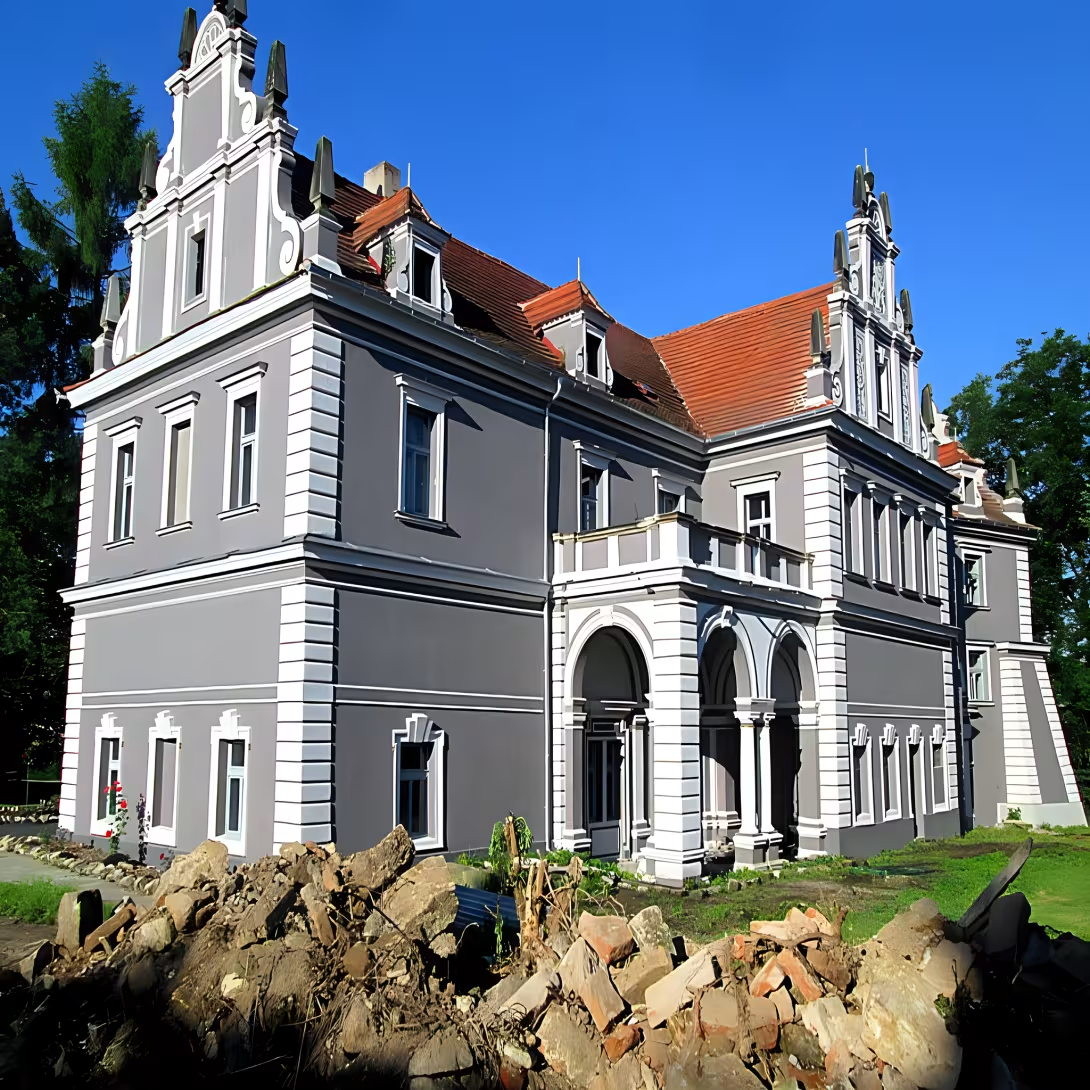
Castle Mšené, located in the picturesque village of Mšené-lázně within the Ústecký kraj region, stands as a testament to architectural evolution from medieval fortress to Renaissance castle. First mentioned in 1262, this historical monument has undergone significant transformations over the centuries, reflecting cultural and political shifts in Bohemia during its time under the Holy Roman Empire. Today, it is recognized as a cultural monument due to its rich history and architectural significance.
The origins of Castle Mšené trace back to an earlier medieval fortress, later transformed into a Renaissance structure by Jan Zbyněk Zajíci z Hazmburka in 1599. The Illburkové family, who acquired the village at the start of the fifteenth century, likely renovated an existing fortification rather than building anew. This castle's history is marked by ownership changes and architectural modifications that mirror broader historical trends in Bohemia.
Architecturally, Castle Mšené showcases a blend of styles, with its initial Gothic elements evolving into Renaissance features over time. The transformation initiated by Jan Zbyněk Zajíci z Hazmburka included the addition of frescoes to the first floor, enhancing its artistic appeal. Later modifications in the late 19th century further refined its appearance, incorporating new Renaissance elements that are evident today.
Ownership of Castle Mšené has seen a succession of notable families and individuals. The Illburkové were early stewards, followed by Jan Zajíc z Hazmburka in the mid-16th century. Subsequent owners included Jan Zbyněk Zajíci z Hazmburka, who initiated its Renaissance transformation, and later, Jan David Boryně ze Lhoty, who acquired it for twenty thousand kop míšeňských grošů in 1607. The castle eventually passed through the hands of Jetřich Malovec, Karel Jakerdovský, Leopold Sauer, and several others before becoming a property of the Kinští family from 1765 until 1866. Each owner left their mark on its structure and history.
Throughout its existence, Castle Mšené has witnessed significant events that reflect its importance in regional history. The transformation into a Renaissance castle under Jan Zbyněk Zajíci z Hazmburka marked a pivotal moment, aligning with broader cultural developments of the time. Its sale to Jan David Boryně ze Lhoty and subsequent ownership by the Kinští family further illustrate its enduring value.
Today, Castle Mšené stands as a well-preserved monument that offers visitors a glimpse into Bohemia's rich architectural heritage. The castle is accessible for those interested in exploring its historical significance and enjoying its unique blend of Gothic and Renaissance styles. Its cultural importance makes it a worthwhile destination for anyone keen to delve into the region's past.
Castle Mšené invites history enthusiasts and curious travelers alike to explore its storied halls and appreciate its architectural beauty, serving as a bridge between medieval fortifications and Renaissance elegance.
Then and now
Drag the slider to compare how the landmark may have looked when it was built with the view today.
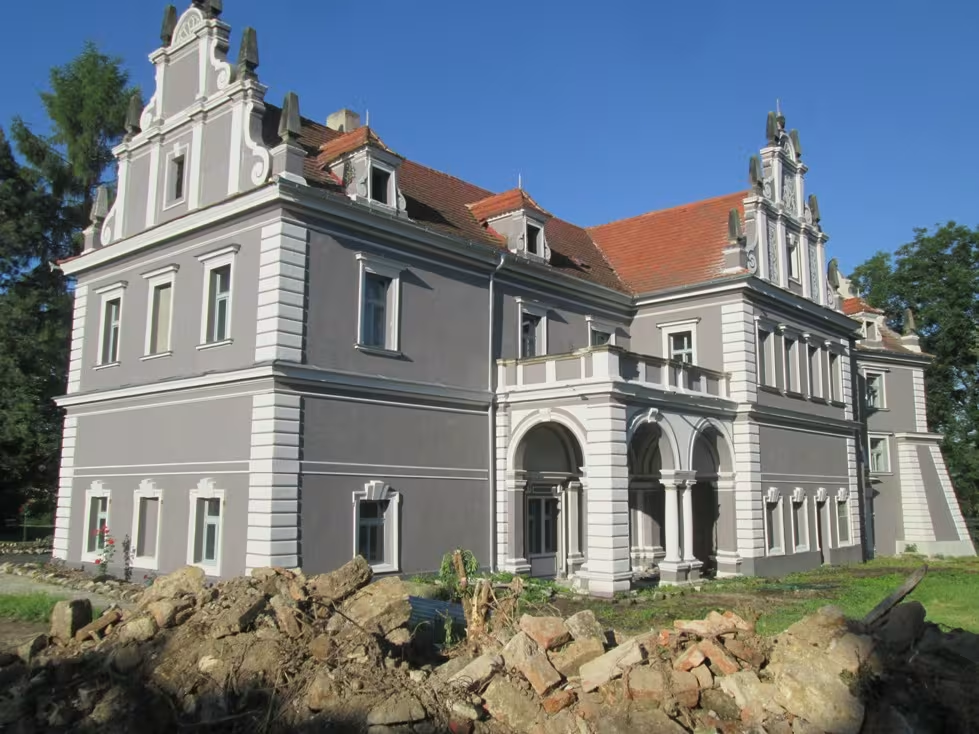
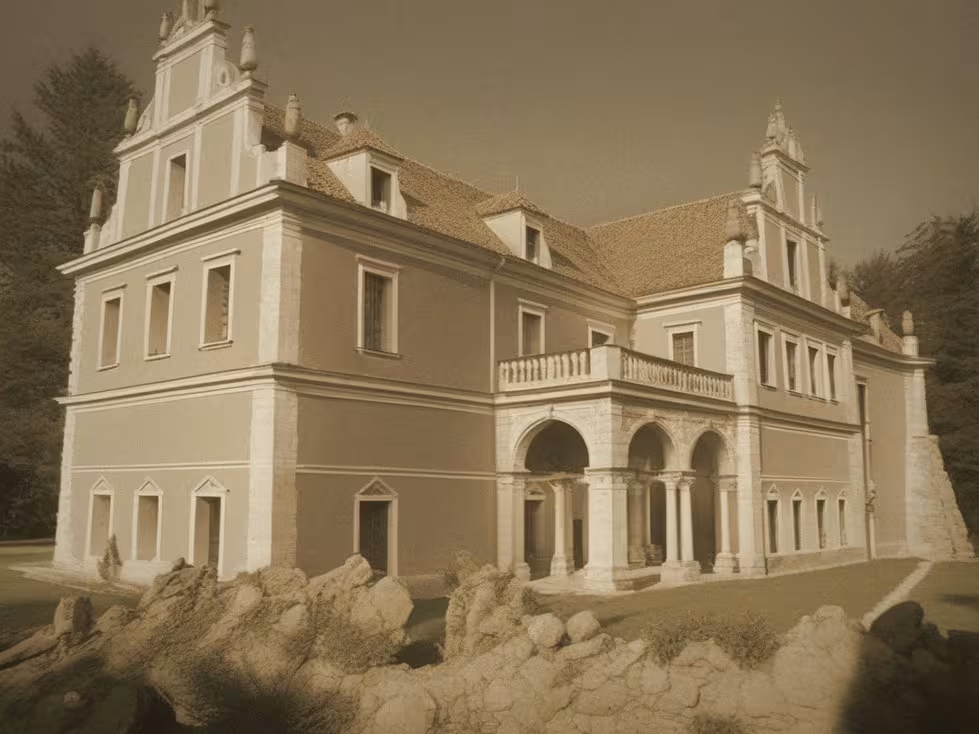
The historical appearance on the left is an AI-generated visualisation and serves as inspiration only.
Historical milestones
- 1262
- Castle Mšené first mentioned in historical records.
- kolem 1400
- Illburkové family acquires the village and likely renovates fortification.
- 1599
- Jan Zbyněk Zajíci z Hazmburka transforms it into a Renaissance castle.
- 1607
- Jan David Boryně ze Lhoty purchases the castle for twenty thousand kop míšeňských grošů.
- 1765
- Kinští family acquires ownership of Castle Mšené.
- 1866
- End of Kinští family's ownership period.
Architectural development
Zámek Mšené evolved from a medieval fortress into a Renaissance castle, with significant renovations in the late 20th century. The structure features elements of Gothic architecture and was adorned with frescoes during its transformation under Jan Zbyněk Zajíci z Hazmburka. A southern wing was added in 1798 by the Kinští family.
Historical events
The castle was first mentioned in 1262 and underwent significant transformation into a Renaissance structure by Jan Zbyněk Zajíci z Hazmburka in 1599.
In 1607, the property was sold to Jan David Boryně ze Lhoty for twenty thousand kop míšeňských grošů.
The Kinští family owned the castle from 1765 until 1866.
Owners
Lords of Illburk (early 15th century)
Jan Zajíc z Hazmburka (1543-1580)
Jan Zbyněk Zajíci z Hazmburka (1599-1607)
Jan David Boryně ze Lhoty (1607-1628)
Jetřich Malovec z Malovic a na Kundraticích (1628-1681)
Karel Jakerdovský ze Sudlic (1681-1705)
Leopold Sauer (1705-1717)
Martinicové
Counts of Kinsky from Zlonice (1765-1866)
Oldřich Kinský (until 1866)
K. Mautner (after 1866)
Banker Brandeis, J. Kirpal, František Toman starší
Points of interest
- Despite its transformation into a Renaissance castle, Castle Mšené retains some of its original medieval fortification elements, offering a rare glimpse into the layered history of Bohemian architecture.
- Legend has it that during Jan Zbyněk Zajíci z Hazmburka's time, secret passages were constructed within Castle Mšené to facilitate discreet movements between rooms and potentially escape routes, reflecting the intrigue and political maneuvering of the era.
- An interesting anecdote involves a hidden chamber discovered in the late 19th century during renovations, which contained artifacts from various periods of the castle’s history, suggesting it may have served as a private archive or treasure trove for its owners over centuries.
- The frescoes added by Jan Zbyněk Zajíci z Hazmburka are said to include depictions of mythical creatures and allegorical scenes that were considered avant-garde at the time, hinting at the owner's interest in contemporary artistic trends and possibly secret societies.
- It is rumored that during its tenure under the Kinští family, Castle Mšené served as a meeting place for influential figures discussing matters of regional importance, making it an unassuming yet pivotal site in Bohemian political history.
Guide
This guide is narrated by a synthetic voice generated by artificial intelligence.
Show guide text
This text was created by artificial intelligence and has not been editorially reviewed. It may contain inaccuracies.
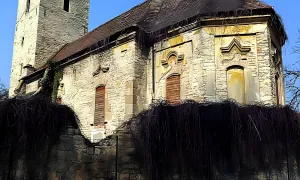
Mšené Castle stands in the village of Mšené-lázně in the Litoměřice district. It originated from a Renaissance reconstruction of an older fortress, and its current appearance comes from Neo-Renaissance modifications. It is protected as a cultural monument.
The first written mention of Mšené dates from 1262. The fortress was founded by one of the lords of Illburk, whose family acquired the village in the early fifteenth century. However, it is possible that the Illburks only rebuilt an older fortress of the lords of Mšené. The last of the family was Wilhelm of Illburk, who died in 1538. But Mšené could have been acquired before his death by Jan Zajíc of Hazmburk. His estate was inherited by his sons in 1543, and the fortress with its manor and villages in the Budyň region fell to Jiří Zajíc of Hazmburk, who held it until his death in 1580.
Jiří's son pawned the estate and sold it in 1599 to Jan Zbyněk Zajíc of Hazmburk. He had the fortress rebuilt as a Renaissance castle. Under the Zajícs, a high first floor with two projections on corbels was built, and Jan Zbyněk probably had the floor decorated with wall paintings. He was in debt, however, so in 1607 he sold Mšené for twenty thousand Meissen groschen to Jan David Boryň of Lhota.
The Boryňs held the estate only briefly. After dividing the property among his sons, it was soon bought for 78 thousand Meissen groschen by Jetřich Malovec of Malovic. After the Malovcels, in 1681 came Karel Jakerdovský of Sudlice, then Baron Leopold Sauer, the Martinics, and from 1765 the counts Kinský of Zlonitz. The Kinskýs had the south wing added in 1798, and the castle belonged to them until 1866, when Oldřich Kinský sold it to K. Mautner.
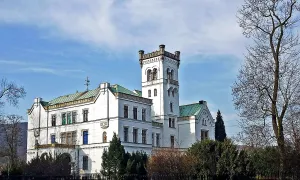
In the second half of the nineteenth century, the owners continued to change. The castle was owned by banker Brandeis, J. Kirpal, and finally František Toman the Elder, who had it renovated in the Neo-Renaissance style. According to depictions from the nineteenth century, the castle building was created by successive additions, some of which had Gothic character. In the sixties of the nineteenth century, however, the north wing with the oldest building phases was demolished, and apartments were created in the rest of the castle. The preserved building has Neo-Renaissance gables and projecting sections, and the facade bears the date 1797.
Tips for visitors
The best time to visit Zámek Mšené is during the late spring or early autumn months, from May to September. During these periods, the weather is typically pleasant, allowing you to fully enjoy the castle's gardens and surrounding landscapes without the discomfort of extreme temperatures. Additionally, visiting in this timeframe often means fewer crowds, providing a more serene experience as you explore the historical site.
It's advisable to check the latest schedules online or at your departure point to ensure a smooth journey.
When planning your visit, consider bringing comfortable walking shoes as exploring the castle and its grounds involves some walking. A camera is also recommended, particularly for capturing the stunning architecture of the Renaissance castle and the picturesque landscapes surrounding it. Don't forget to bring water and perhaps a light jacket, as weather can change unexpectedly.
For photography enthusiasts, the best spots are around the main entrance and the gardens where natural lighting enhances the beauty of the castle's structure. Early morning or late afternoon is ideal for softer light conditions that highlight the intricate details of the architecture. Additionally, the surrounding landscapes provide excellent backdrops for capturing the historical essence of Zámek Mšené.
Nearby attractions within a 30-minute drive include other historical sites and natural landmarks in the Ústecký kraj region. These offer further exploration opportunities for visitors interested in history or nature. For families with children, consider bringing along some snacks and perhaps a map of the area to make the visit more engaging and enjoyable.
Frequently asked questions
Can the monument be visited?
Some buildings of this kind are open for guided tours, others serve another purpose or are privately owned. We have not verified whether and when this monument is open – please ask the operator.
What are the opening hours and admission?
We have not verified the opening hours or admission. Current information is published by the operator.
Where is the monument?
Location: č.p. 1, Mšené-lázně, Ústecký kraj. The map on this page shows the exact spot.
Why is the monument protected?
It is listed in the Central List of Cultural Monuments of the Czech Republic as a cultural monument (register no. 25111/5-2195).
Businesses nearby
Do you run a restaurant, accommodation, shop, museum, rental, wellness or other visitor service near this monument? Show yourself directly to the people heading to it — this is how they will see you in the app and on the web:
Events nearby

Zdroj akcí: otevřená data měst a obcí ČR (Národní katalog otevřených dat) a kalendář akcí Národního památkového ústavu.
Nearby
Zámek Mšené is situated in the picturesque village of Mšené-lázně, surrounded by natural landscapes and other historical sites within a five-kilometer radius.
Accommodation nearby
Themed route
Thematic Tour Plan Featuring Mšené Castle
1. Zámek Mšené
- Type: Historical Castle - Why Visit: Begin your journey at the heart of Mšené-lázně with a visit to Zámek Mšené, a stunning example of Renaissance architecture nestled in a picturesque village setting. The castle offers insights into its rich history and provides beautiful views of the surrounding landscapes, making it an ideal starting point for exploring this charming area.
2. Church of St. John the Baptist
- Type: Historical Church - Why Visit: A short walk from the castle leads you to the Church of St. John the Baptist, a significant historical and architectural landmark in Mšené-lázně. This church is renowned for its beautiful baroque interior and intricate frescoes, offering visitors a glimpse into the religious heritage of the region.
3. Municipal Park
- Type: Public Park - Why Visit: Just a short stroll from the church, the Municipal Park provides a serene environment perfect for relaxation after exploring historical sites. The park features well-maintained gardens and walking paths that offer peaceful views of nature, making it an ideal spot to unwind and reflect on your visit.
4. Mšené-lázně Spa
- Type: Wellness Center - Why Visit: Conclude your tour at the Mšené-lázně Spa, known for its therapeutic mineral springs and wellness treatments. This spa offers a chance to relax and rejuvenate, taking advantage of the natural healing properties of the local waters in an elegant setting.
This thematic tour provides a balanced experience of history, architecture, nature, and relaxation within the charming village of Mšené-lázně.
Seasonal recommendations
Spring: Visiting Mšené Castle and its surroundings during spring offers a unique experience as nature awakens with vibrant blooms of wildflowers and lush greenery, creating an enchanting backdrop for exploring the historical site. The gentle warmth of the season often brings clear skies, perfect for capturing picturesque views of the castle against the rejuvenated landscape. Visitors should consider wearing comfortable layers to accommodate fluctuating temperatures throughout the day. While spring typically sees fewer tourists than summer, it's still wise to arrive early in the morning to enjoy a more tranquil visit and avoid any potential crowds.
Summer: Summer at Mšené Castle is characterized by its lively atmosphere, with extended daylight hours allowing for longer exploration of both the castle grounds and nearby Mšené-lázně. The lush gardens are in full bloom, providing a stunning setting that complements the historical architecture. However, this season also attracts more visitors due to favorable weather conditions, so it's advisable to arrive early or visit during weekdays to avoid crowds. Comfortable walking shoes and light clothing are recommended to stay cool under the sun, along with bringing water and sunscreen for protection.
Autumn: The autumn months at Mšené Castle present a magical experience as the foliage transforms into vibrant shades of red, orange, and yellow, offering a picturesque setting that enhances the historical charm of the site. This season is ideal for photography enthusiasts looking to capture the castle amidst the rich tapestry of fall colors. Cooler temperatures make it a comfortable time to explore without the summer heat, though visitors should be prepared with warmer layers as the days progress. The visitor numbers tend to decrease compared to summer, providing a more serene environment.
Winter: Winter at Mšené Castle offers a mystical and serene atmosphere, with snow-covered grounds creating a fairy-tale-like setting that adds an enchanting dimension to the historical site. While some areas might be less accessible due to weather conditions, the castle itself can still provide a captivating experience under its winter cloak. Visitors should dress warmly in layers, including hats, gloves, and waterproof boots, as temperatures can drop significantly.
Visualizations and artistic views


The visualisations are generated by artificial intelligence and serve as inspiration.
Photos from the area
Real photos taken near the monument


Zdroj a licence jsou uvedeny u každého snímku.
Tips from visitors
No tips yet. Be the first!
Log in and add your tip.
Sources and literature
Photos: Ing. Hans Ramp / CC BY-SA 4.0, rozlišení zvýšeno umělou inteligencí — Wikimedia Commons. The author and licence also appear when you hover over the image.
Faktickým podkladem tohoto textu byl článek na Wikipedii, jehož autory jsou přispěvatelé Wikipedie. Článek je dostupný pod licencí CC BY-SA 4.0.
Location on the map

Příběhy a pověsti
Legendy, pověsti a příběhy spjaté s touto památkou
Fotografie návštěvníků
Zatím žádné fotografie. Buďte první, kdo přidá fotografii z návštěvy!
Log in a přidejte svou fotografii nebo hodnoťte.
Za ověřenou návštěvu v aplikaci získáte víc bodů — poznáme podle GPS, že jste na místě.
Reviews and comments