



Náhrobek Jakuba Jana Ryby Tombstone
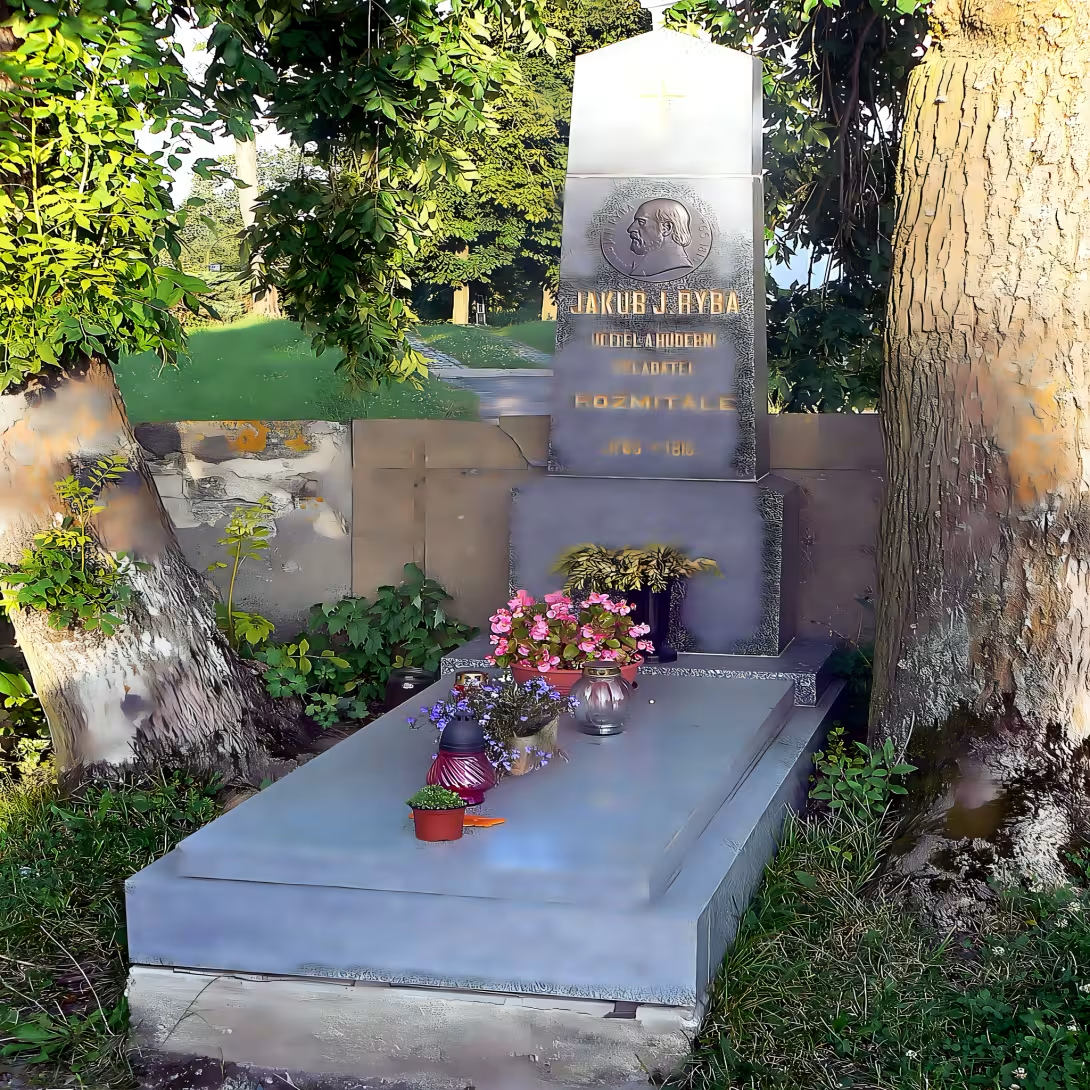
Náhrobek Jakuba Jana Ryby is a monument with an obelisk of polished granite, which stands at the cemetery at the Church of the Elevation of the Holy Cross in the Old Rožmitál. There is the body of a composer and a teacher who lived in 1765- 1815. Since 1958 this building has been registered as a cultural monument of the Czech Republic.
After his death in 1815, Jakub Jan Ryba was buried in a remote plague cemetery northwest of the Old Rožmitál. Because it was suicide, there was probably a funeral without a minister present. The remains were transported to the cemetery in Old Rožmital in 1855. This move was taken care of by priest Jan Fähnrich at the initiative of Ryb's son, Josef Arnešt Ryba, who worked as a university professor and eye doctor.
The contemporary appearance of the monument dates back to 1953- 1955. It's a grave with a classic obelisk made of dark polished granite. In the 1960s, the building was supplemented by a medallion with a portrait of the composer, which was created by Marie Uchytilová Kučová at the initiative of the local carver Václav Kotrbátý. This portrait is fictional. The first monument on site was erected in 1888 by the local Literary Association under the direction of Adolf Růžička.
In the vicinity of the grave also lies the son of the composer, Josef Arnešt. Another object in the forest above Voltuší is connected to the fate of the musician, where Jakub Jan Ryba took his own life. There in 1854 forest workers built a stone cross, which was supplemented by a mound in 1933.
The memorial forms part of the cemetery at the Church of the Elevation of the Holy Cross and represents an important place reminiscent of the personality of a musician. It is recognised as a national cultural monument and is accessible to visitors.
Visiting this place offers insight into the dramatic fate of an important artist and his family. The memorial is an important point for anyone interested in the history of the Old Rochmital.
Historical milestones
- 1855
- The transfer of remains from the pestilence cemetery to the cemetery in the Old Rožmitál.
- 1888
- The elevation of the monument by the local Literary Society.
- 1953
- The beginning of the construction of the present tomb with obelisk.
- 1958
- Entry into the list of cultural monuments of the Czech Republic.
Architectural development
In 1888, the first monument was erected on the grave. The present grave with obelisk from polished granite was created in 1953- 1955. In the 1960s it was supplemented with a medallion with a portrait.
Historical events
1855 transfer of remains to the cemetery to the Old Rožmitál, 1958 declaration of cultural monument of the Czech Republic.
Points of interest
- The monument consists of an obelisk of polished granite and since 1958 it has been registered as a cultural monument. - Jakub Jan Ryba was first buried in a plague cemetery because it was suicide. - His remains were transported to the cemetery in the Old Rožmital in 1855. - The portrait of the composer on the monument is fictional and was supplemented in the 1960s. The first monument to this place was built in 1888 by a local Literary Society.
Guide
Show guide text
This text was created by artificial intelligence and has not been editorially reviewed. It may contain inaccuracies.
Welcome to the quiet corner of Old Rochmital. Right now, you're facing a place that carries deep sadness, but also a great respect for the musical genius. The tombstone of James John Fish stands before you. The first thing your eyes will capture is this distinctive, dark and polished stone in the shape of a high pillar with a tip that we call obelisk in the professional language. Its dark color and smooth granite surface create a strong contrast with the surrounding greenery of the cemetery at the Church of the Ascension of the Holy Cross. It is a place where time has stopped and where today the remains of a man who has left an irreversible mark in our history.
Let us now look together at how this current form of the monument came to be, because the journey of James John Fish to this place was not easy at all. The history of this grave is full of breakthroughs and social prejudice of the time. Jakub Jan Ryba was a respected composer and teacher, but its end was tragic. Due to the circumstances of his death, which were perceived as suicide at the time, he could not originally be buried in the sanctified land of the cemetery at the church. It was therefore placed in a so-called plague cemetery, a place reserved for those who died in the threats of the disease or in circumstances which the Church at that time did not consider appropriate for the grave in the centre of the village.
However, this situation lasted several decades. As time progressed, the view of composers changed and its importance for culture became perceived with greater seriousness. In a thousand and eight hundred and fifty-five, there was an important act. His remains were inaugurated from the Pestilence Cemetery right here, to the Old Rožmital, so that he could rest in a more dignified society. That was the first step to raising the monument you see today. In the year of the thousand eight hundred eighty eight, the local Literary Society decided that the memory of this great musician was not worthy, and had the first monument erected here.
Now pay attention to the details you see right in front of you. The current shape of the grave you're exploring is not from that century, but it comes from the mid-20th century. The construction of this particular tomb with granite obeliskie began in the year one thousand nine hundred fifty-three. Notice the precision of working dark granite. The Obelisk is going up as if to combine earthly tranquility with the celestial music that the Fish created. It's a sober but very dignified monument. It was this aesthetic quality and historical importance that the monument was officially registered as a cultural monument of the Czech Republic in the year one thousand nine hundred fifty-eight.
When you look around this place, think about the personalities involved. In addition to James John Fish himself, the name of Josef Ernest Fish appears here. It's fascinating how people's destinies, their creation and their pain intersect in this small space. Jakub Jan Ryba was a man who carried a huge talent, but also internal contradictions, which eventually led him to a tragic end. This grave is a symbol of reconciliation. It is a place where society finally admitted that the artistic contribution of man is more important than the way it left this world.
And now let me interest you in one interesting thing, which may not be visible at first sight, but which gives this place a certain mysterious touch. If you look at the portrait of the composer, which is part of the memorial, I must draw your attention to one thing. This painting is not a real libeness, so it is not an accurate representation of his real face. It's a fictional portrait. At the time, there were no photographs to tell us exactly what Jakub Jan Ryba looked like, so his appearance was created based on ideas and period ideas about what such a musician and teacher should look like. It's a little strange that at the grave of the man we so honor, we see a face that may never have existed in this form in reality, but at the same time symbolically shows that his music and spirit are superior to mere physical form.
Stop by this obelisk for a while. Feel the silence of this cemetery and imagine the music that is in this spirit. It's a place of peace that teaches us that even after years of oblivion or discarding, recognition and respect can come. This granite pillar stands here as a guardian of the memory of one of our great musicians.
Thank you for coming with me to this memorial. I hope you are interested in the story of James John Fish and that you perceive the depth of this place. We now invite you to explore the surroundings of the Old Rochmital. Go through the rest of the cemetery, see the atmosphere of this historic place and be guided by the sounds of the surrounding nature. I wish you a pleasant continuing journey and a profound experience of discovering our common roots. Goodbye.
Tips for visitors
The best time to visit is the late spring or autumn when the colors of the surrounding nature are consistent with the dark granite monument. Transport to the municipality is possible by car or public connections; Check the exact routes in the current timetables. When visiting, we recommend to take your shoes suitable for the cemetery area and, if necessary, a pocket flashlight if you come in a mess. For the best photos we recommend morning or afternoon light, which will highlight the shine of granite obelisk and details of inscriptions. Close to the tomb you can visit the Church of the Holy Cross, the grave of Josef Arnošt Fish or go to the forest above Voltuší to the stone cross with the mound. Families with children can use the path to the monument as an opportunity to tell about the life of a famous musician and teacher.
Frequently asked questions
Can the monument be visited?
Cemeteries and graves are usually accessible; please respect the dignity of the place. We have not verified the opening hours of this cemetery.
Where is the monument?
Location: Starý Rožmitál. The map on this page shows the exact spot.
Why is the monument protected?
It is listed in the Central List of Cultural Monuments of the Czech Republic as a cultural monument (register no. 1000125294).
Businesses nearby
Do you run a restaurant, accommodation, shop, museum, rental, wellness or other visitor service near this monument? Show yourself directly to the people heading to it — this is how they will see you in the app and on the web:
Events nearby
Zdroj akcí: otevřená data měst a obcí ČR (Národní katalog otevřených dat) a kalendář akcí Národního památkového ústavu.
Nearby
Kostel Povýšení sv. Kříže ve Starém Rožmitále, hrob Josefa Arnošta Ryby, kamenný křížek s mohylou v lese nad Voltuší.
Accommodation nearby
Themed route
Here is the design of the thematic route:
1. Church of the Holy Cross Ascension in the Old Rožmitál (sanctuary) - the starting point of the journey where one can admire the architecture of the local temple. 2.Náhrobek Jakuba Jana Ryby (memorial) - The main objective of the visit, which reminds us of the important personality of this village. 3. The tomb of Josef Ernest Fish (tomb) - A place of rest for another family member that complements the overall picture of local history. 4. Stone cross with a mound in the forest above Voltuší (memorial) - Final stop in nature, which offers peace and space to think about.
Visualizations and artistic views

The visualisations are generated by artificial intelligence and serve as inspiration.
Photos from the area
Real photos taken near the monument


Zdroj a licence jsou uvedeny u každého snímku.
Tips from visitors
No tips yet. Be the first!
Log in and add your tip.
Sources and literature
Photos: P.matel / Public domain, rozlišení zvýšeno umělou inteligencí — Wikimedia Commons. The author and licence also appear when you hover over the image.
Faktickým podkladem tohoto textu byl článek na Wikipedii, jehož autory jsou přispěvatelé Wikipedie. Článek je dostupný pod licencí CC BY-SA 4.0.
Location on the map
More monuments – Starý Rožmitál
Show all in the municipality
Příběhy a pověsti
Legendy, pověsti a příběhy spjaté s touto památkou
Fotografie návštěvníků
Zatím žádné fotografie. Buďte první, kdo přidá fotografii z návštěvy!
Log in a přidejte svou fotografii nebo hodnoťte.
Za ověřenou návštěvu v aplikaci získáte víc bodů — poznáme podle GPS, že jste na místě.
Reviews and comments