






Kostel Povýšení svatého Kříže s farou a kaplankou Church
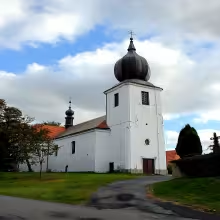
The Church of the Ascension of the Holy Cross stands at the west end of the Old Rožmitál in a place where archaeological research proves settlement in prehistoric times. It is the oldest preserved cultural monument in this territory.
The exact beginning of its creation is unknown. It is assumed, however, that a pagan altar used to stand at the place, which was gradually replaced by a Gothic church, older than the chateau itself and the city below it. The early Gothic church had the shape of a cross, a separate bell tower, a side entrance and was surrounded by walls with two gates. Around it was a settlement called Old Town, a gradually growing cemetery, and later there was a parish and a skeleton - now called the chaplain.
The parish covered at least 14 surrounding villages and settlements. In ancient times, the Earth's trade path from the Czech border to Moravia led this way. In the 16th century, the congregation was an important church center. In 1526 Václav Hájek of Libočan became a priest, but he left the parish for the following year and carried many church equipment with him. The locals sued him; He had to return everything and pay the legal expenses.
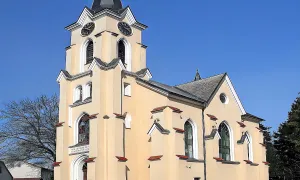
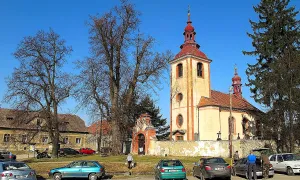
In the early 1930s, vicar Václav Vavřinec Hoffmistr Přeštický made extensive modernization. From 1729 to 1731 the church underwent Baroque reconstruction. The bark was expanded, the side entrance was removed and a new tower was added to the temple ship, ending with onion fighting. The Gothic shape of the cross and the remains of the rib arch with the Chapel of St. Wenceslas remained preserved. From Hoffmaster's time comes the original altar and altar paintings by Bedřich Kamarit.
The church was expecting a hard test. On May 5th, 1794, he was struck by lightning and set fire to the adjoining rectory. The bells dissolved and the roof burned, but the organ from 1750 - built under the priest Antonín Planýr - was miraculously protected. This instrument was played by the teacher and composer Jakub Jan Ryba, who wrote his Czech Christmas Mass. In March 1933, the church was hit by a second fire, formed in the adjoining carriage with straw. The fire spread across the barn to the roof and the pit of the church. All he left were bare walls.
The original equipment left the Gothic stone baptist, returned to the church in the 1990s, and the tin baptist from 1596, created by Prague's victor Andrew Marík. Under the church ship there is a closed crypt with cast iron plate from 1759, where the priests Václav Vavřinec Hoffmistr Přeštický and Antonín Planýř are buried. At the church stands a chaplain from 1795, originally a skeleton, and a statue of Jan Nepomuk from 1729. In 1882 a new staircase was built from the north side, composed of eight stairs, each eight steps long and eight steps wide. Since 1958, the entire complex has been protected as a cultural monument.
Then and now
Drag the slider to compare how the landmark may have looked when it was built with the view today.
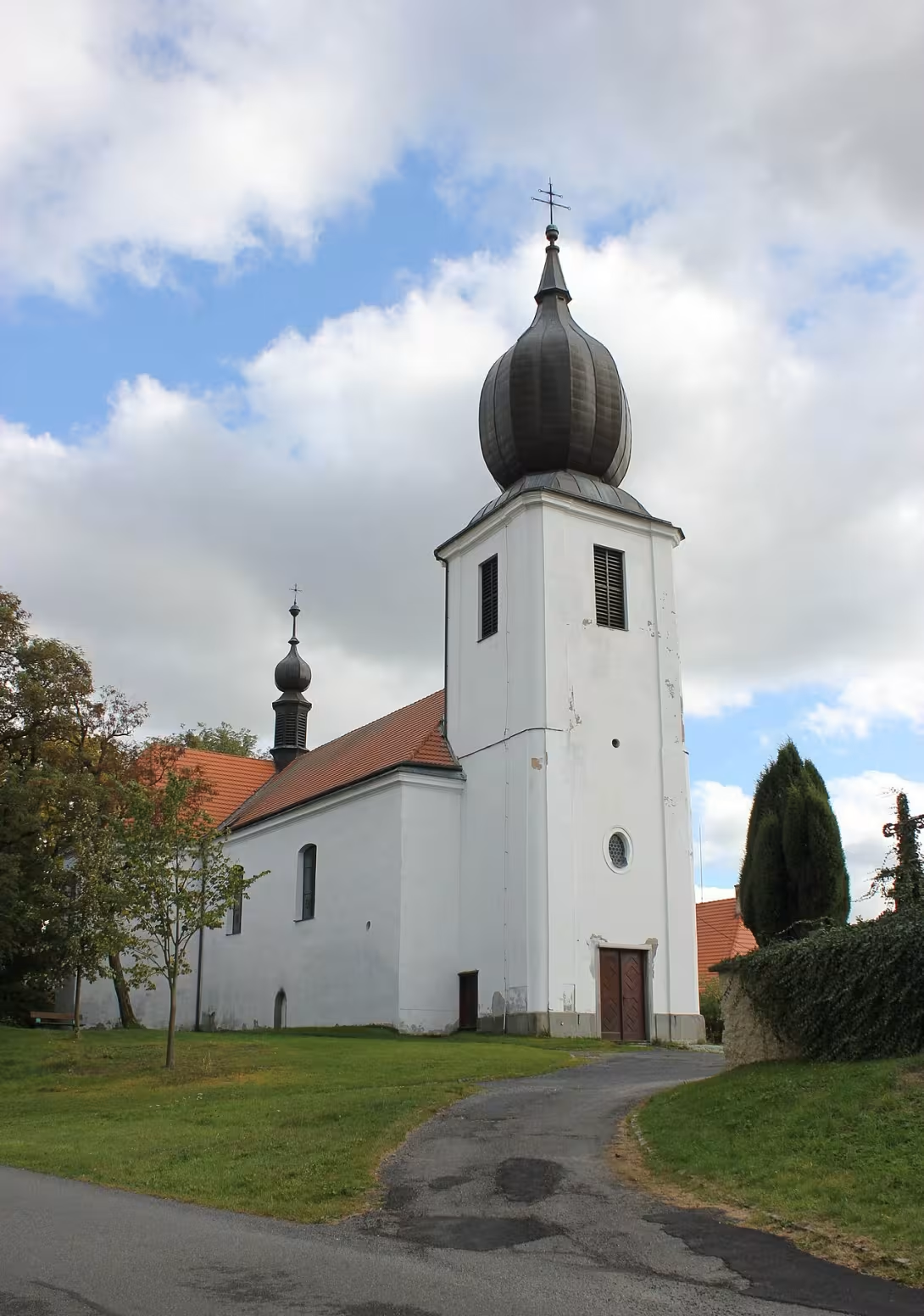

The historical appearance on the left is an AI-generated visualisation and serves as inspiration only.
Historical milestones
- before 13th century
- Archeologically documented prehistoric settlement and the probable existence of a pagan luncheon on the site of the church.
- 1347
- The expansion of the church's core after 1347, which is the last documented building change before the Baroque reconstruction.
- 1729-1731
- Baroque reconstruction of the church, in which the bark was extended and the tower with onion end was added.
- 1933
- The second church fire, with only bare walls left.
Architectural development
The original church of the second 13th century was built in the shape of a cross with Gothic elements, such as a bell tower and a side entrance. After 1347 he passed the enlargement. In 1729-1731, it was rebuilt baroque, keeping only the rib arch and chapel of St. Wenceslas. The tower ended with onions. After the fire in 1794 and 1933 only bare walls remained. The Gothic elements, such as the stone baptizer and tin from 1596, were preserved.
Historical events
- before 13th century
- Likely to establish a pagan luncheon at the site of today's church, later replaced by an early Gothic church.
- 1729-1731
- Baroque reconstruction of the church for the vicar Václav Vavríc Hoffmár Preštice, during which the bark was extended and the tower was added.
- 1794
- The church fire and the priest caused by the lightning that burned down the rectory, but the organ from 1750 was saved.
- 1958
- Registration of the church and the premises in the li
Owners
Choir Roudno
Points of interest
- The Church of the Ascension of the Holy Cross is the oldest preserved cultural monument of Old Rožmitál, with a settlement on site already in prehistoric times.
- In his place, first stood the pagan altar, which was replaced by an early Gothic church older than the chateau and the city below.
- In the 16th century the parish belonged to important church centres, but the priest Václav Hájek of Libočan left the place in 1526 and had to return the stolen church equipment.
Guide
This guide is narrated by a synthetic voice generated by artificial intelligence.
Show guide text
This text was created by artificial intelligence and has not been editorially reviewed. It may contain inaccuracies.
Welcome to a place where epochs meet and every stone tells a story thousands of years ago. You're standing on a platform right now that's a lot more than just a space for construction. Beneath your steps is a land that was sacred long before the Christian word was first spoken here. In front of you is the Church of the Ascension of the Holy Cross, the oldest preserved cultural monument of the Old Rožmitál. Feel this atmosphere of peace and nobility surrounding you. Behold this complex, which forms a harmonious whole with a rectory, a caplar and a cemetery. It is a place that has survived for ages, war and destructive elements, and yet still stands here to testify to human faith and tireless efforts to build.
To understand why this place is so special, we need to go back deep into the past to the very roots of the human settlement. By the time the first stone wall was built here, this was already a home for people. Archaeological findings tell us that there was a significant settlement here in prehistoric times. But it is even more fascinating to think that this place probably served as a pagan offering. Imagine the ancient rituals, the prayers to the unknown forces of nature that took place in this very place. This spiritual power of the place was so strong that even when Christianity came, there was no need to seek a new place. The place where the pagan altar used to stand began to stand a new symbol of faith.
The first church that originated here was early Gothic and dates back to the mid-13th century. It is a fascinating thought that this building was older than the chateau itself and the city, which later developed under this design. At that time, the church was the cornerstone of the whole neighborhood. In 1347 there was its first significant enlargement, which was the last big change before the architecture of the church began to change under the influence of new styles. This Gothic foundation was made up of the church of the skeleton, which later was followed by other layers of history.
Now pay attention to the architecture you're observing right now. Although you can smell dust in the church for centuries, its present appearance is the result of a Baroque reconstruction that took place between 1729 and 1731. At this time the church turned into a building that seemed much more monumental and harmonious. Please look up at the tower. Its onion finish is a typical characteristic of the Baroque period and gives the whole whole its characteristic, noble profile. In this reconstruction, the crust also expanded so that the building could better serve the believers and that its inner space corresponded to the need for space and light at that time.
If you look around, you'll see that the church is not a lonely element in the landscape. Part of this sacred grounds is the rectory and chaplain. This chaplain, however, has a very specific and a little mysterious history as it originally served as a skeleton. It is a reminder of the fragility of human life and respect for those who no longer sleep here. The whole area is then supplemented by a cemetery which forms an integral part of this spiritual space. All of these elements together form one whole, which now surrounds you.
However, this region and this place are not just empty buildings. They are inextricably linked to human destinies and the great names that left their mark in this neighborhood. Although the names of the architects who invented these buildings have been lost in history, the spirit of this place has always been inspired by people with great talent and feeling. In the vicinity of this place were also names that belong to the history of our culture. Here we can remember Jakub Jan Rybu, Václav Vavríc Hoffmač Preštice or Bedřich Kamarít. Although their lives may not be directly linked to every stone block of this church, their presence in this region gives the whole area cultural depth and reminds us that this place has always been part of a wider stream of human creative and spiritual life.
However, the history of this church was not just a way of flourishing and expanding. It was also a way of overcoming tragedy. The church had to face the destructive forces of the fire that threatened its existence many times. The first big fire hit the site in 1794. At that time, people had to restart the restoration of this center of faith with great effort. But the greatest test of resistance had to face the church much later, in 1933. At that time, the second fire was so devastating that only bare walls were left of the beautiful building. Imagine the horror and sadness of people who saw their spiritual home turn into ruins. Yet, as many times in history, a new force has risen from these ruins. What you see today is proof of the incredible persistence and ability to recover. These walls, which you are now observing, bear not only the trace of baroque work, but also the traces of the invisible will that refused to let this place perish.
Here we could stop and think about what we just heard. You are standing in front of a monument that is much more than just a historical object. It is the fickle story of mankind - from the pagan victims on this hill, to the Gothic fortress of faith, to the baroque nobility and tragic fires that made it a symbol of resistance. It is a place where time does not flow linearly, but where all these moments intersect in one space.
But now I will no longer hold you in my escort. I suggest you go through the entire area slowly. Take a closer look around the chaplain, feel the peace of the cemetery and try to stop by the rectory. Let yourself be carried away by the atmosphere of this place and try in your mind to imagine what everything here looked like hundreds of years ago. Maybe by looking at the tower with its onion end, you'll see something you missed before. Thank you for spending this moment right here at the Holy Cross Church. I wish you a beautiful and inspiring walk around the Old Rožmitál. Goodbye.
Tips for visitors
{'text': 'The best time to visit the Church of the Holy Cross is in spring or autumn when the weather is pleasant and the ruin is not as covered with fog as in winter. In summer the place is often visited, so avoid hot noon hours. Ruina offers interesting views and a quiet environment that is ideal for walking and shooting without disturbing crowd.'}
{'text': 'The memory can be reached by car on local roads leading to the surfaces. Parking is possible in the open area near the church, but may be limited in the summer months. It is recommended to use public transport where possible. Find out the current connection and traffic options in the traffic search engine.'}
{'text': 'When visiting, wear a comfortable shoe because the church terrain is uneven and stone steps can be slippery. It is also appropriate to take a map or GPS with you, because orientation in the surroundings can be difficult. If you are planning to photograph, don't forget your sunglasses and hat, because the sun can be very strong in open places.'}
{'text': 'The best places for photography are especially from outside ruins where a general view of the church and its surroundings is captured. Sunlight is an ideal morning or evening when you avoid hard shadows. The inside of the church is already in ruins, but some parts of the wall and portals can offer interesting details. Always respect the protection of the monument and do not lean against the wall.'}
{'text': 'In the vicinity of the monument is worth visiting the Chateau of Rožmitál, only about two kilometers away. This Gothic chateau from the 13th century offers a fascinating view of the past and beautiful views of the landscape. Another interesting thing is the Brno Monument, which is located about three kilometres from the church. These are archaeological sites with preserved remains of ancient settlement.'}
{'text': 'For families with children a visit to the Holy Cross Church is a great opportunity to explore history and nature. Children can see the ruins and talk about their past. There is also an opportunity to explore nature and find interesting stone formations or plants. It is recommended that you take with you any game or working sheets that children can fill out during the visit.'}
Frequently asked questions
Is Kostel Povýšení svatého Kříže s farou a kaplankou open to the public?
Yes, the church is open to the public. The tour can be completed during the opening hours.
How do I get to the place by car / public transport?
The nearest parking lot is near the village and you can continue from it on foot to the church. The public transport is only available to the village where you will have to continue to the church on foot.
How much is the entrance fee and is it paid on the spot?
Payment takes place in the cash register inside the church.
Is the tour suitable for children and seniors?
Yes, the tour is also suitable for families with children and seniors. The church offers a quiet environment and interesting historical information.
How long does the tour take?
The tour can be done within 30-60 minutes, depending on your interests and the speed of walking.
What are the opening times and booking is required?
The church opening hours are from 9: 00 to 5: 00. Reservation is not necessary, but we recommend it in case of larger group or special requirements.
What's interesting in the immediate vicinity?
In the immediate vicinity of the church there is a forest and a field offering a quiet environment for walking and observing nature.
For kids
Imagine going back to a time when villages and cities were much smaller and less illuminated. Imagine you're a little knight with a sword in your hand and you want to discover the secret of the Old Church of the Holy Cross.
How did it look here? The church stood in a place where the rectory and the chapel stand today. But the first building was completely different. It was made of stone and had two towers that seemed like two great knights guarding the church from dangerous monsters.
Businesses nearby
Do you run a restaurant, accommodation, shop, museum, rental, wellness or other visitor service near this monument? Show yourself directly to the people heading to it — this is how they will see you in the app and on the web:
Events nearby
Zdroj akcí: otevřená data měst a obcí ČR (Národní katalog otevřených dat) a kalendář akcí Národního památkového ústavu.
Nearby
- A Gothic chateau from the 13th century, located above the town of Rožmitál under Tremšín. It is famous for its period interior and views of the surroundings.
- Archaeological sites with preserved remains of medieval settlement and chateau.
- The highest peak of the Brdské lobe with a panoramic view of Středočeský kraj.
Accommodation nearby
Themed route
Thematic cruise route: Gothic and medieval tracks in Rožmitál
1.Kostel Povýšení svatého Kříže s farou a kaplankou * Type: * Sacral monument with historical area. * Why visit? * A unique baroque church from the 17th century, which stands in the place of an older Gothic temple. The Chaplain and the rectory keep valuable artistic and architectural details, including preserved fresco and mobility.
2. Castle Rožmitál * Type: * Gothic chateau with period interior. * Why visit? * One of the best preserved medieval forts in Bohemia, known for its valuable vaults and views of the surrounding countryside. The interior offers a view of medieval architecture and history of the family Rožmberk.
3. The Brno Monument * Type: * Archaeological site of medieval settlement. * Why visit? * The preserved remains of the chateau and villages from the 13th to 15th century reveal the lives of people in the time of Hussite wars. The site is important for the study of the Brno history and medieval way of life.
4. * Type: * Natural reservation with sightseeing point. * Why visit? * The highest peak of Brd (815 m) offers panoramic views of the surroundings and is ideal for a short tourist excursion. In the past, there was a guard tower that reminded us of the strategic importance of the site.
Seasonal recommendations
Spring: In the spring period, the Church of the Elevation of the Holy Cross in the Old Rožmitál is transformed into a living painting, when the newly blooming trees and shrubs come to life in a diverse green dress. Sun rays illuminate the ruins of the church, which adds a romantic touch to its historical character. At this time the weather may be variable, so it is advisable to equip yourself with clothes according to temperature. Visiting at dawn or evening can help prevent midwinter crowds and provide a more peaceful experience.
Summer: In summer Starý Rožmitál is surrounded by living nature, which celebrates full sun days. The church at this time offers the best conditions for photography when the length of the day allows to capture different angles of light and shadows on its ruins. Summer comes with more visitors, so it is recommended to visit the memory early in the morning or later in the evening to avoid long fronts. Don't forget the sun protection and enough drinking water.
Autumn: Autumn brings gold and red colors to the landscape of the Old Rožmital, which makes the Church of the Holy Cross a unique photographic location. The quieter weather allows long walks around the monument and its surroundings, while the mild cold is pleasant to find. This season, a snow blanket may occur, which will further enrich the atmosphere. We recommend wearing warmer clothes and considering visiting on Sunday or evening when there are usually fewer people.
Winter: Winter Starý Rožmitál offers a peaceful atmosphere with the possibility to see the Church of the Holy Cross Ascension under the snow blanket, which gives its ruins a romantic and mystical look. Winter visit requires warm clothes, including hat and gloves, especially if you intend to walk around. The monument can be limited to a shorter period of openness due to difficult conditions, so it is advisable to inform yourself before visiting and plan your time accordingly. Winter calm can be ideal for quiet thinking and relaxation in the historic environment.
Visualizations and artistic views


The visualisations are generated by artificial intelligence and serve as inspiration.
Photos from the area
Real photos taken near the monument


Zdroj a licence jsou uvedeny u každého snímku.
Atmosphere of the place
This atmospheric visualisation of the place and period was generated by artificial intelligence. It is not real footage of the location.
Tips from visitors
No tips yet. Be the first!
Log in and add your tip.
Sources and literature
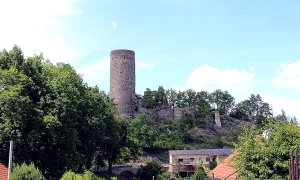
Fotografie: Halfirien / CC BY-SA 4.0, rozlišení zvýšeno umělou inteligencí — Wikimedia Commons. The author and licence also appear when you hover over the image.
Faktickým podkladem tohoto textu byl článek na Wikipedii, jehož autory jsou přispěvatelé Wikipedie. Článek je dostupný pod licencí CC BY-SA 4.0.
Location on the map
Příběhy a pověsti
Legendy, pověsti a příběhy spjaté s touto památkou
Fotografie návštěvníků
Zatím žádné fotografie. Buďte první, kdo přidá fotografii z návštěvy!
Přihlaste se a přidejte svou fotografii nebo hodnoťte.
Za ověřenou návštěvu v aplikaci získáte víc bodů — poznáme podle GPS, že jste na místě.
Reviews and comments