



Pieta z Jihlavy Church
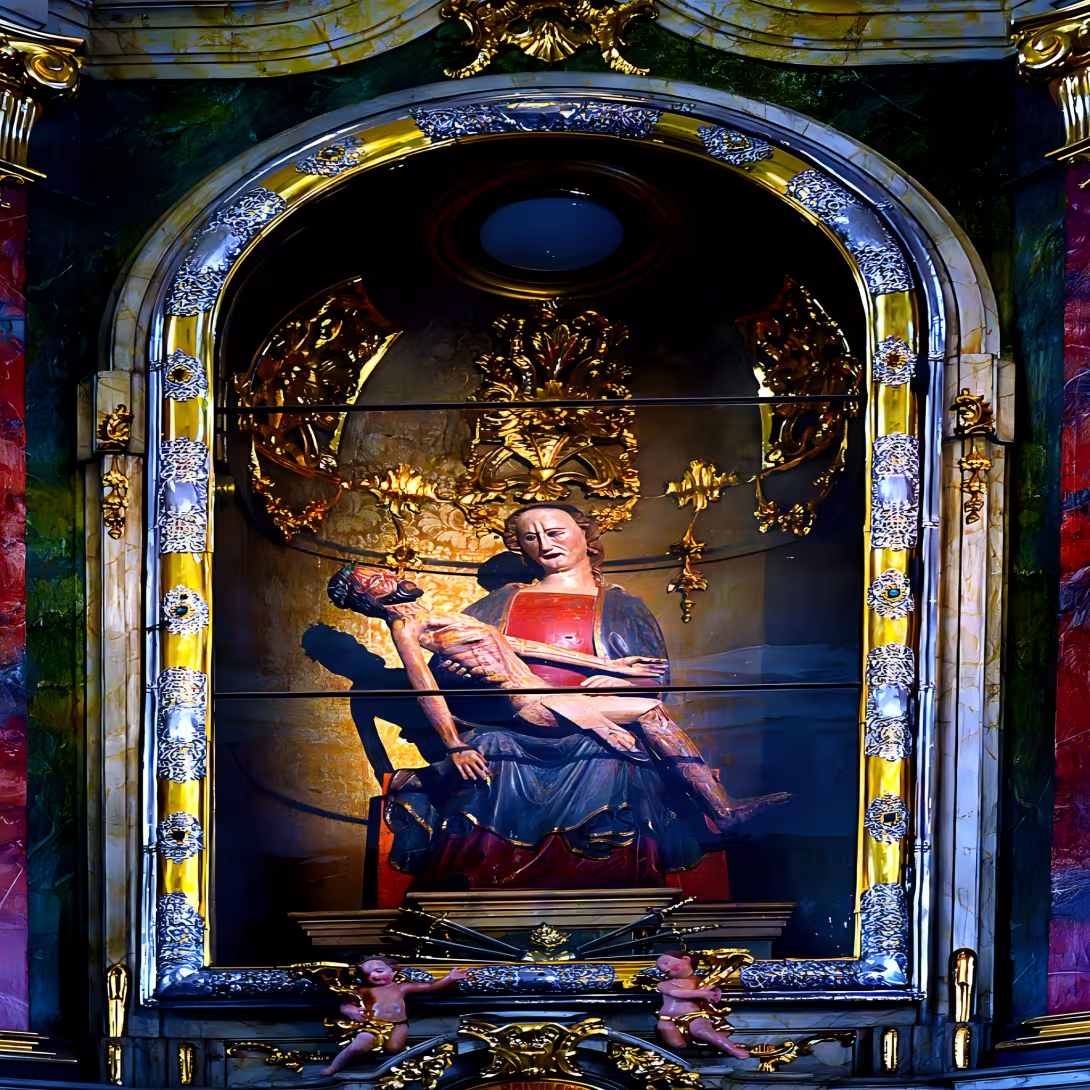
Pieta z Jihlavy is a gothic woodcarving carved around 1330 from lime wood, attributed to sculptors from the circle of the court of Emperor Louis IV. Bavaria, Munich. Today it is located in a chapel near the parish church of St. James in Jihlava, where there are no direct written reports of the circumstances of origin. According to the assumption it was drawn up for the Franciscan Church of the Mother of God, with its quality and style indicating that it could be a royal gift, although this consideration does not reveal anything.
The statue measures 167 centimeters in height, 99 inches in width and 40 centimeters in depth. Interestingly, the figure of Christ was carved and painted separately from the figure of Mary and postiormente attached to it by three wooden pins in the area of the lap and hand. The back of the sculpture is gouged out and covered with edible plates. The oldest layer of colour, made in a glue tempera with an oil mixture, is still perfectly preserved. The wounds of Christ and his tears are very finely modeled and painted. The hair of the Virgin Mary was originally decorated with lustrous gold, its dark vermilion dress decorated with regularly dispersed painted lilies. The blue coat, painted with azurite and atacamite, had gilded edges.
Piety's history changed dramatically after Hussite wars. It was transferred from the Franciscan church to the cemetery chapel at the parish church of St. James, where it became an instrument of the town's recatharisation. Around 1600 she received a new polychromia and gradually became the subject of intense popular godliness. At the end of the 17th century, there was a report of a miracle when the figure of the Virgin Mary was supposed to turn away from a priest serving mass in a sinful state. This event only solidified her exceptional position in the religious life of Jihlava.
At the beginning of the 18th century, a new, larger chapel was built for Pieta and a richly decorated Baroque altar was set up in which the statue was repainted with dark paint with highlighted traces of Christ's blood. In 1784 there was a further change of surface treatment to polychrome. The 20th century brought further restoration interventions; The modern restaurant took place in 2005 when Pieta was briefly exhibited in Strahov monastery in Prague and then returned to its original place.
Then and now
Drag the slider to compare how the landmark may have looked when it was built with the view today.
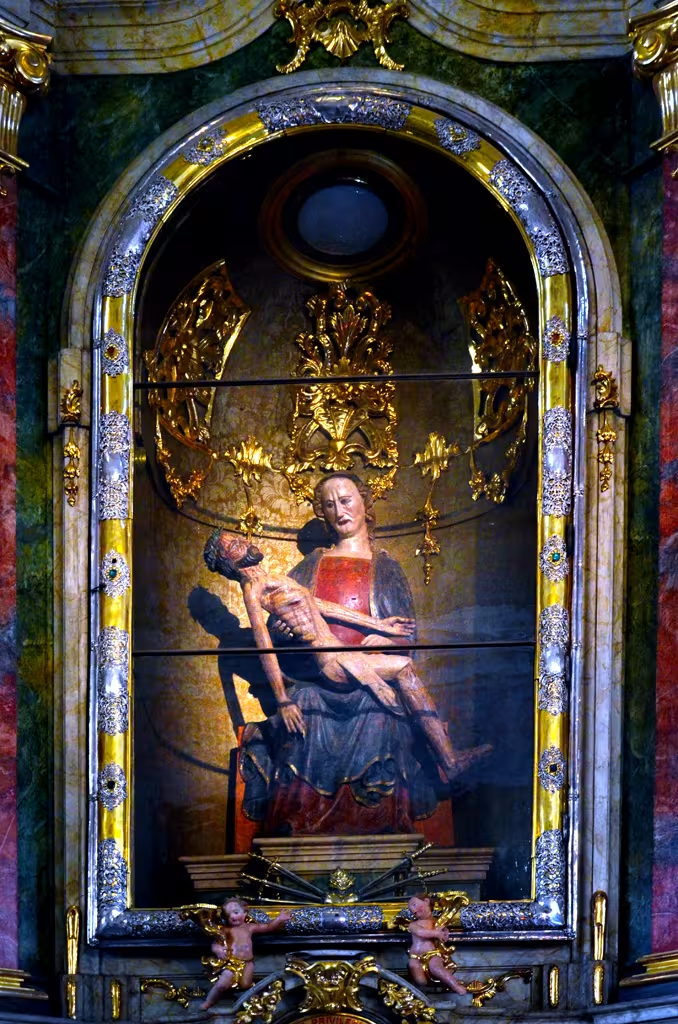
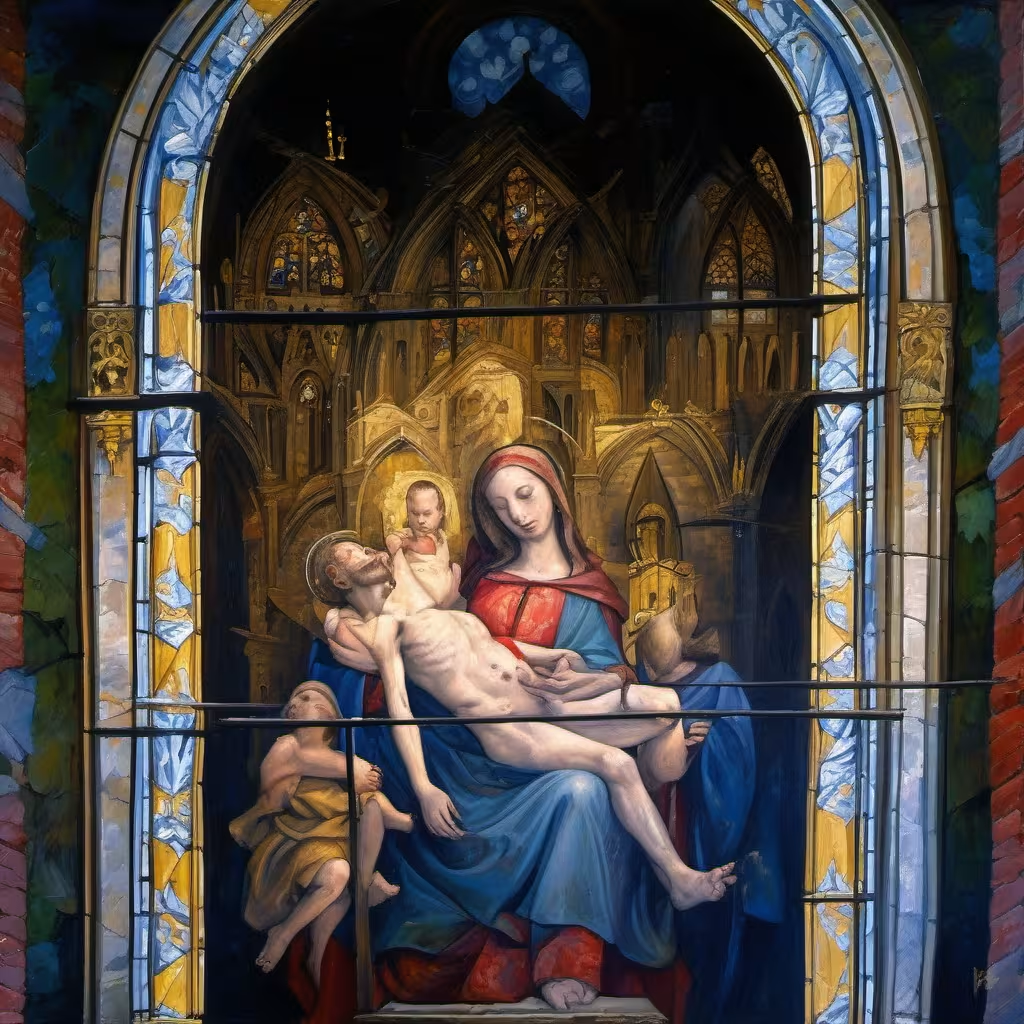
The historical appearance on the left is an AI-generated visualisation and serves as inspiration only.
Historical milestones
- 1330
- The creation of the Gothic woodcarving Pieta, probably within the circle of the court of Emperor Louis IV Bavaria.
- early 17th century
- Moving the statue to the cemetery chapel at St. James's church and beginning of her religious cult.
- End of the 17th century
- A record of a miracle associated with a statue that strengthened its cultural significance.
- 1784
- Change the surface finish of the statue to polychrome.
Architectural development
Pieta is the only plastic of its kind, without significant building modifications. The material is lime wood with edible plates on the back. The figure of Christ was separately carved and attached to the figure of the Virgin Mary by three pins. Polychromia has passed through several layers - the original glue tempera with oil, medieval layer and Baroque finish from the 17th century. The last important restaurant was held in 2005.
Historical events
- early 17th century
- Pieta was transferred to the cemetery chapel at St. James's parish church and became the subject of intense folk godliness.
- End of the 17th century
- A miracle was noted when the figure of the Virgin Mary was to turn away from the priest serving mass in the state of mortal sin.
- 1784
- The surface finish of the statue was changed to polychrome, which significantly affected its appearance.
Owners
Parish church in Jihlava
Points of interest
- The statue was carved from lime wood and dates back to approximately 1330.
The figure of Christ was carved and painted separately, then attached to Mary by three wooden pins.
- The back of the statue is gouged out and covered with edible plates.
- The original painting in the glare tempera with oil is still in good condition, including the gently modeled wounds of Christ and his tears.
- At the end of the 17th century, there is a report of a miracle where the Virgin Mary was to turn away from the priest who served in a sinful state.
Guide
This guide is narrated by a synthetic voice generated by artificial intelligence.
Show guide text
This text was created by artificial intelligence and has not been editorially reviewed. It may contain inaccuracies.
The Pieta from Jihlava is a Gothic wooden sculpture dating from around 1330. Today it is preserved in the Church of Saint James in Jihlava. The work is attributed to a sculptor from the circle of the court of Emperor Louis the Fourth of Bavaria in Munich. Direct written records about the circumstances of its creation have not survived.
The sculpture is carved from linden wood and measures a total of 167 by 99 by 40 centimeters. The figure of Christ itself is 140 centimeters tall. The sculptor carved it and painted it separately and attached it to Mary with three wooden pegs in the area of the drapery and hand. Whether these joints are original cannot be documented with certainty.
The color scheme is reconstructed according to the oldest and second, still medieval layer. The oldest layer has survived very well across its entire surface. Christ's wounds and tears are delicately modeled and painted. The hair of the Virgin Mary was originally gilded. Her dress has a dark red ochre tone and is decorated with small painted lilies. The cloak is blue and the hems of the garments were also gilded.
The Pieta was most likely created for one of the churches of mendicant orders. Local tradition mentions the Franciscan Church of the Mother of God. Based on its style, it could be a royal gift, though no records confirm this.
After the Hussite Wars, which fundamentally transformed religious relations in Jihlava, the sculpture took on new significance. It was moved to a cemetery chapel near the Church of Saint James and became part of the city's return to Catholicism. Around 1600 it received a new color scheme and gradually a strong popular piety developed around it.
In the late 17th century a report of a miracle is associated with it. The Virgin Mary allegedly turned away from a priest who was saying Mass in a state of mortal sin. This event further strengthened the position of the Pieta in the city. At the beginning of the 18th century a new, larger chapel was built for it with a richly decorated Baroque altar. The sculpture was then repainted in a dark color and the traces of Christ's blood were emphasized on it.
In 1784 it received a new color scheme. In the 20th century its appearance was significantly influenced by further restoration work. Modern restoration took place in 2005. The Pieta was then briefly exhibited at Strahov Monastery in Prague and then returned to the chapel near the Church of Saint James, where it remains today.
Frequently asked questions
Can the monument be visited?
Religious buildings are usually open mainly during services; at other times a visit is normally arranged with the parish or the operator. We have not verified specific times.
Why is the monument protected?
It is listed in the Central List of Cultural Monuments of the Czech Republic as a national cultural monument. It is protected as part of a larger listed ensemble.
For kids
Imagine coming back 696 years, until the amazing statue of Pieta z Jihlavy was created. That was the time when the church of St. James stood and people lived in the neighborhood.
It was like a game where heroes walked the path that led to the city. This is how people lived in Jihlava, who were merchants, craftsmen and priests. The church of St. James was their heart, place of prayer and holiness.
Businesses nearby
Do you run a restaurant, accommodation, shop, museum, rental, wellness or other visitor service near this monument? Show yourself directly to the people heading to it — this is how they will see you in the app and on the web:
Nearby
Pieta is located in the chapel at the parish church of St. James in Jihlava. In the area there is a historical core of the city with other monuments such as Jihlava Chateau or Renaissance Town Hall. Natural elements include nearby parks and green areas in the city centre.
Accommodation nearby
Themed route
Thematic cruise route: Pieta z Jihlavy and its surroundings
1. St. Jacob's Chapel with Pieta * Type: * Sculpture monument and sacral space * Why? * The unique Gothic Pieta from the 15th century, carved out of lime wood, is the peak of Jihlava's art. The chapel offers a quiet environment to admire and reflects the medieval spiritual atmosphere.
2. Jihlava Chateau * Type: * Historical Fortress Why? Approximately 1 km from the chapel is a chateau with a rich history since the 13th century. Its chateau tower and exhibition on the ground floor will bring about the development of the city and region, ideal for comparing sacral and military heritage.
3. Renaissance Town Hall * Type: * Architectural landmark * Why? * In the city centre (about 300 m from the chateau) there is a town hall with typical Renaissance elements such as coats of arms and shields. It is a symbol of the Jihlava boom in the 16th century and a demonstration of the city's self-government.
4. Park at St. Jacob's Church * Type: * Green area Why? The small park at the chapel offers a rest after a walk through the historical center. Its location at the church and town hall creates a continuous space for relaxation with a view of the surrounding sights.
* Recommended order: * Chapel → Jihlava Chateau → Renaissance Town Hall → Park near the church. The route is compact designed for walking, all targets are within walking distance.
Seasonal recommendations
Spring Jihlava * Pieta * in the spring months experiences a change of light and color that makes it even more pronounced. The sunny days reveal fine details of the statue, while the morning mist and blooming trees on the surrounding areas create a mild, almost mystical atmosphere. In April and May nature awakens to life - meadows are green, the first flowers (spring onions, spring garden) provide a pleasant, refreshing aroma. It is convenient to visit the memory at sunny but not too hot weather, ideally in the morning, when the light is pleasant and the crowds are still not disturbed. Dress light but protective clothes against the wind because spring weather is unpredictable - bring a raincoat or sweater. If you want to escape crowds, avoid Saturdays and do not share when local and tourists often visit the sights.
Summer In the summer months, * Pieta * becomes the center of attention thanks to long days and intense sunlight, which highlights contrasts between white marble and dark details of the statue. The atmosphere is lively, full of the sounds of birds and the roaring of leaves, but also busy - thousands of visitors come here in the main summer season. The best time to visit is early in the morning, before the sights open, or in late afternoon hours when the sun no longer burns and the crowds disperse. Dress up in light but protective clothing - a hat or a shawl against the sun and comfortable shoes, because traveling around the city on hot days can be strenuous. Take plenty of water and possibly even sunglasses, as bright light can be tiring for a long observation of the statue.
Autumn Autumn * Pieta * offers unique, melancholic beauty - golden and red leaves on trees and grass create contrast with white marble, while cool, scattered light softer details of the statue. The atmosphere is quieter, as the tourist crowds are shrinking, but nature is preparing for winter - the winds blow with leaves and the air is saturated with the scent of fallen chestnuts and needles. The best time to visit is in October when the weather is still pleasant but no longer as hot as in summer. Wear warmer layers - sweater or long-sleeved sweater, as autumn days are variable and cold evenings. The morning is ideal when the light is soft and the monument looks like a fairy tale. Avoid rainy days when the surface of the statue can be slippery.
Winter Winter * Pieta * is surrounded by a quiet silver light that reflects from snow and ice crystals on trees. The atmosphere is calm, almost spiritual - silence breaks only the rustling of snow and distant sounds of the city. In December there are short days, so it is best to visit the memory in the morning when the light is sufficient. Dress up in warm but comfortable clothes - in winter it is cold in Jihlava and therefore wear warm jackets, gloves and hat. Snowflakes give the place a magical atmosphere, but watch out for slippery walkways - solid, anti-slip shoes are suitable.
Visualizations and artistic views


The visualisations are generated by artificial intelligence and serve as inspiration.
Tips from visitors
No tips yet. Be the first!
Log in and add your tip.
Sources and literature
Photos: NoJin / CC BY-SA 3.0, rozlišení zvýšeno umělou inteligencí — Wikimedia Commons. The author and licence also appear when you hover over the image.
Faktickým podkladem tohoto textu byl článek na Wikipedii, jehož autory jsou přispěvatelé Wikipedie. Článek je dostupný pod licencí CC BY-SA 4.0.
Příběhy a pověsti
Legendy, pověsti a příběhy spjaté s touto památkou
Fotografie návštěvníků
Zatím žádné fotografie. Buďte první, kdo přidá fotografii z návštěvy!
Log in a přidejte svou fotografii nebo hodnoťte.
Za ověřenou návštěvu v aplikaci získáte víc bodů — poznáme podle GPS, že jste na místě.
Reviews and comments