



Podlešínský viadukt Railway bridge
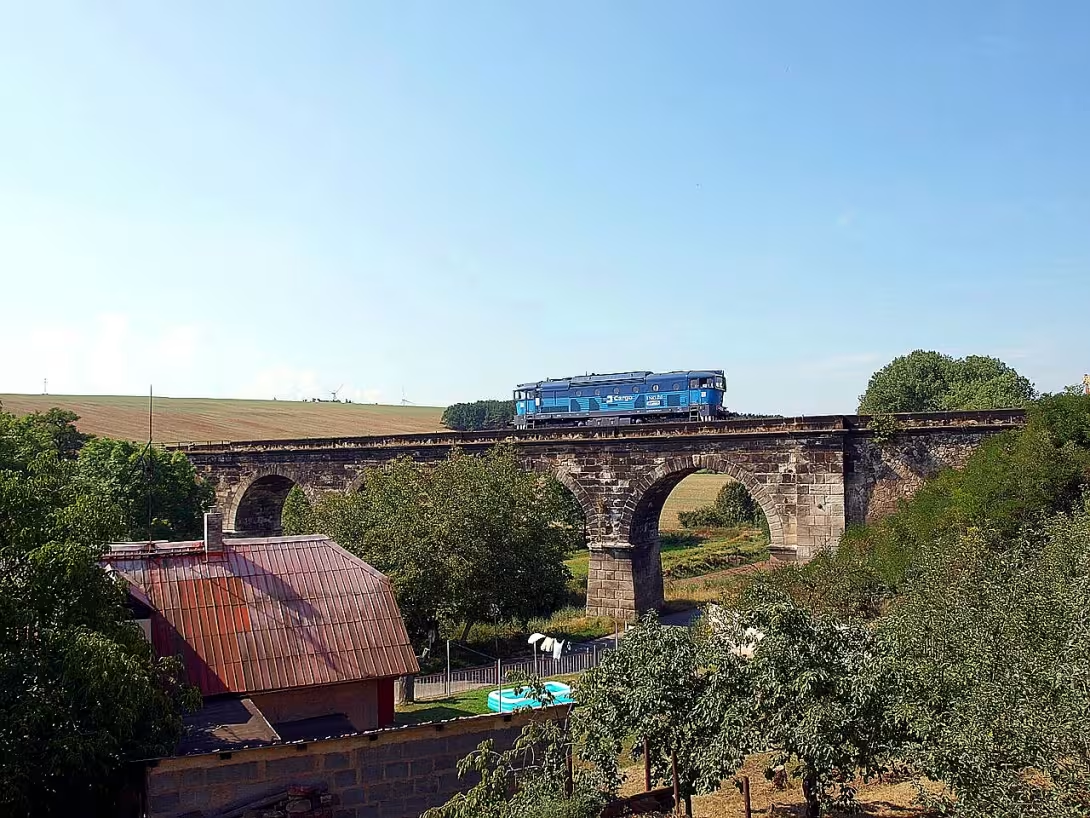
Podlešínský viadukt is a railway bridge in the cadastral area of Podlesín in the Central Bohemian Region. It surpasses the valley of the Knoviz creek and is protected as a cultural monument of the Czech Republic. It was created between 1872 and 1873 as part of the Prague-Duchy Railroad, which connected Smíchov with the Louny through the Midboys and Slané. The construction is excellent using local carbon sandstone.
Its creation was linked to the intensive development of the European rail network at the end of the 19th century, which was essential for the industrial revolution and economic growth. In the Czech Republic, it contributed to a better connection between major cities and industrial centres when the railway was becoming an essential part of transport and the economy.
Architecturally, the bridge is built of stone masonry with pillars lined with blocks of this material. It's 95 meters long and 17.7 meters tall. It is characterized by semicircular arches with a span of 10 meters, which lie on conical prism pillars with profiled ledge. This style and the use of local stone represented technical progress at the time.
Since its inception, the viaduct has undergone several events that have affected its transport significance. In 1884 he formed an off-level crossing with the local railway Kralupa nad Vltava suburb - Vinařice. In 1922 a link was built between the two routes from Zvoleněves to Podléšín, which led to traffic from Kralup to viaduct. However, in 1982 the operation of the local runway was stopped and the tracks were taken down, although the rest of the groove under the bridge remained visible.
During World War II, the viaduct suffered aerial attacks. On 22 and 26 April 1945, British deep flyers attacked the locomotives on it, which they then destroyed. These events are an important part of his history and reflect the role of the object in times of war conflicts.
Today, Podlešínský viadukt survived in its original state without major modifications, making it a valuable historical monument. It is accessible to visitors and is worth a tour not only for architecture but also for the rich history of the place. The construction resembles technological and transport changes of the 19th century; It is possible to look into the past that shaped the current infrastructure.
Visiting the viaduct offers an opportunity to explore not only its architectural beauty, but also the history of the region. The monument recalls an important period of development of rail transport and its role in economic growth. It is a place where history and technology are harmoniously intertwined, which makes the visit not only informative, but engaging.
Then and now
Drag the slider to compare how the landmark may have looked when it was built with the view today.
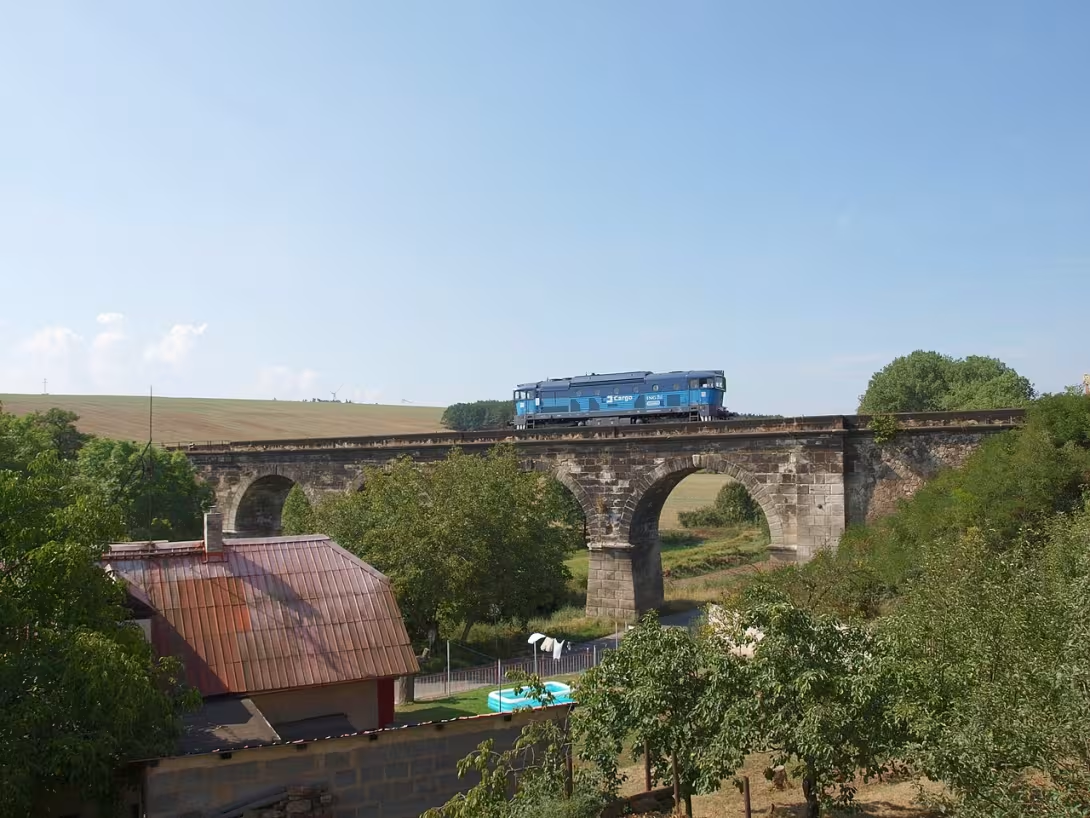

The historical appearance on the left is an AI-generated visualisation and serves as inspiration only.
Historical milestones
- 1872
- The beginning of the viaduct construction.
- 1945
- Air strikes on the viaduct during World War II.
Architectural development
The Viaduct is built of stone masonry with pillars lined with blocks of carbon sandstone. It is 95 metres long and 17.7 metres high, with half-circle arches of 10 metres on conical prism pillars.
Historical events
- 1884
- The Viaduct consisted of a cross-level cross-border with the local expensive Kralupy over the Vltava suburb - Vinařice.
- 1922
- A link between the two routes from Zvoleneves to Podlešín was built, which brought traffic from Kralup.
- 1945
- On 22 and 26 April, the viaduct was attacked by British deep flyers during World War II, leading to the destruction of locomotives.
Points of interest
- Podlešínský viadukt is protected as a cultural monument of the Czech Republic. - It was created between 1872 and 1873 as part of the Prague-Duchy Railroad, which connected Smíchov with the Louny through the Midboys and Salané. - Viaduct went through several events, including air strikes during World War II on 22 and 26 April 1945. - Today the viaduct is accessible to visitors and is worth a tour due to architecture and rich history of the place. - Construction resembles technological and transport changes of the 19th century; It is possible to look into the past that shaped the current infrastructure.
Guide
Show guide text
This text was created by artificial intelligence and has not been editorially reviewed. It may contain inaccuracies.
Welcome to one of the most important construction sites in the area. You're standing right in front of the Underground Viaduct. Raise your head and look at those massive stone structures that stand high above the valley of the Knoviz creek. It is fascinating how this building dominates the whole surrounding landscape and how firmly the earth holds on, although it seems to be floating above the abyss. Can you feel the weight of history written in every stone? This railway bridge is not just a simple path for trains, it is an eternal witness for many years that have passed by us, and a symbol of human efforts to overcome natural obstacles.
Let us now return together to the time when it began to build. Imagine the world in the 1970s. It was a time of great change, a time when mankind learned to control the power of steam and iron. It was in these years, namely from 1872 to the end of 1873, that this monumental whole was created. The Viaduct was not built just for show, it was an essential part of Prague's spirit track. This railway line was at the time a key heat for the whole region. She connected Smíchov to the Louny and led through important points like the Midboys and the Salty. Without such structures as this bridge, the industry, trade and people's movement could not develop as quickly as it did. The construction of this bridge was a huge task, which required not only thousands of working hours, but also incredible courage and planning.
Now pay attention to what's right in front of your eyes. Look at the material this bridge is made of. It's not just a rock. Notice how light breaks on its surface. This whole building is made up of stone masonry, which forms a hard and solid foundation. If you look closer at the individual parts, you'll see huge blocks. These blocks are made from carbon sandstone. This material was selected very deliberately. The sandstone from this time has its specific strength and resistance that allowed the bridge to last for ten decades, even if it was subjected to constant pressure from heavy machinery and variable weather. Each of these blocks has been worked so carefully that it fits right into itself. This architecture is the pinnacle of technical progress at that time. At a time when modern machines did not exist, people had to work with incredible precision to create a structure that resists the forces of gravity and time.
But the history of this place is not just a story about building and progress. We need to look at the darker and more challenging moments this viaduct had to endure. It's a place that witnessed great suffering. In 1945, during World War II, the airspace above this valley became a battlefield. On 22 and subsequently on the 26th day of that year, the viaduct was subjected to devastating air attacks. Imagine the horror, the noise and the dust that was floating over this place. It was completely uncertain at the time that this monumental bridge would survive the destructive forces. Yet, thanks to its incredible design and strength, which you see today, it remains standing. This building resisted the war and remained here for us as proof of the resilience of the human work.
Perhaps you are now being told who was behind this construction. Although this bridge is so magnificent, the names of the particular architects who designed it did not stick in our records. We don't know the names of the stonemasons who worked each block, nor the names of the engineers who counted every curve of this arch. Yet in every detail they feel their presence and their mastery. It's strange that even though we don't know their names, their work speaks for themselves.
There's one other thing that might interest you. This viaduct is not just an old railway bridge that serves transport. It's the precious treasure of our country. It is protected as a cultural monument of the Czech Republic. This means that its value goes beyond a simple technical construction. It's part of our legacy that we must protect for future generations. It is a reminder of how our country has changed, how it has evolved and what difficult times it has had to overcome.
Now that you've been through his history and understood his meaning, I suggest you stop for a while and just keep your eyes open. Feel the atmosphere of this place. Look at how the bridge line flows down into the valley and harmoniously fits into the landscape, even if it's the work of the human hand. You may hear the sound of a distant train, which reminds you that this bridge is still fulfilling its original function, which was determined by people over 150 years ago.
Thank you for choosing to explore this story with us. We hope that this view of Podlešínský viadukt has brought you new views and that you will enjoy the beauty of this place. Keep going, discover the secrets of our country and don't be impressed by what you see, but also by what you can imagine. Goodbye.
Tips for visitors
Best time to visit The Lesbian viaduct is in the spring or autumn period when vegetation is at its peak and the sun illuminates the structure of the bridge in a special way. This time of year also offers lighter weather compared to the mid-summer period.
When visiting, bring your shoes suitable for walking on dry and wet surfaces as the terrain around the viaduct can be irregular. Also remember to bring protective clothes and sunglasses, especially in the summer months.
For photography is the best place on the north side of the viaduct where the sun lights the bridge in a special way. The best light offers morning and evening hours when light is softer and shadow effects are more pronounced.
In the vicinity of the viaduct there is a valley for cyclists and tourists, which offers beautiful views of the natural landscape. This route is also suitable for families with children because it is relatively flat and has low intensity.
Frequently asked questions
Can the monument be visited?
This is a structure in a public space that can usually be seen from outside free of charge. We have not verified that this particular one is freely accessible.
Where is the monument?
Location: Středočeský kraj. The map on this page shows the exact spot.
Why is the monument protected?
It is listed in the Central List of Cultural Monuments of the Czech Republic as a cultural monument (register no. 1824763275).
Businesses nearby
Do you run a restaurant, accommodation, shop, museum, rental, wellness or other visitor service near this monument? Show yourself directly to the people heading to it — this is how they will see you in the app and on the web:
Nearby
🏰 Historic sites (107)
- Bunkr Drnov - Muzeum studené války a protivzdušné obrany 1.1 km web
- M. J. Hus 1.2 km
- Pomník obětem 1. světové války 2.7 km web
- Pamětní deska Josefa Richtera 2.8 km
- Miroslav Maxa 3.1 km
- Menhir 3.5 km
- Pomník padlým za 1. světové války 4.4 km
- Josef Winternitz 4.5 km
- Anna Winternitzová 4.5 km
- Ludvík Winternitz 4.5 km
- Vlastivědné muzeum ve Slaném 4.8 km
- Tomáš Garrigue Masaryk 4.8 km
- Oběti koncetračních táborů 4.9 km
- Antonín Dvořák 5.0 km
- Richard Fanta 5.0 km
- Vladimír Miloš 5.0 km
- Artur Beneš 5.0 km
- Josef Beneš 5.0 km
- Pamětní deska Jaroslava Vrchlického 5.0 km
- Eliška Popperová 5.0 km
🍽️ Restaurants and dining (307)
- Obecní hospoda 1.4 km
- Pizza Knovíz 1.4 km
- Motorest 1.4 km web
- Hostinec U Rákosů 2.4 km
- Motorest Vítov 3.0 km
- Kafe na Rynku 3.5 km Slánská 43
- Bistro 3.9 km
- Ristorante Pizzeria Hemerkův Statek 4.6 km
- Dělnický dům 4.6 km
- Fresh Corner 4.6 km
- Café Bar Church 4.6 km
- Pivovar Antoš 4.7 km
- Lahůdky 4.8 km
- Ungelt 4.8 km Masarykovo náměstí 4
- Kufr 4.8 km
- Prostor 4.9 km
- Hranolkárna 4.9 km
- Cukrárna u Kašny 4.9 km
- Mexická restaurace no. 89 4.9 km
- Pizza House 4.9 km
🏨 Accommodation (30)
- Ubytovna Slaný Trilorn 3.9 km Pražská 804 +420 605 080 064 web
- Hejtmanský dvůr 4.9 km web
- Ungelt 5.1 km
- Atlas 5.4 km
- Hoffmann 8.7 km
- Ponte 8.9 km
- Penzion 68 9.0 km
- Turistická ubytovna Centrum 9.1 km Váňova 322 +420603816906 web
- Hotel Merkur 9.4 km
- Penzion Tonička 9.8 km
- Hotel Kladno 9.9 km
- Penzion Vila Sítná 10.0 km
- U Admirála 10.0 km web
- Ubytování Na Lanďáku 10.0 km Přemyslova 137/2 +420 603535402 web
- Sport Hotel Sletiště 10.5 km +420 312 249 465 web
- Penzion Iris 10.9 km
- Ubytovna Na zvonečku 11.0 km
- Ubytovna Racanda 11.0 km
- Ubytovna U Konvalinků 11.0 km
- U Zlatého selátka 11.1 km
🚲 Rentals and sport (58)
- Studio BB 5.0 km
- eMsport 5.1 km
- Tenisové kurty 5.2 km
- Sportovní hala Háje 5.3 km web
- Sokolovna 5.4 km
- Sokolovna 5.4 km
- Sokolovna 5.4 km
- Plovárna Slaný 5.5 km
- Sportovně-kulturní sdružení 5.8 km
- Hokejbalové hřiště 6.2 km
- střelnice 6.7 km
- Sport centrum Statek 7.5 km
- Střelnice na Haldě Vinařice 8.0 km web
- býv. voj. prostor 8.2 km
- Otvovické koupaliště 8.4 km
- Sokolovna 8.6 km
- sportovní střelnice 8.9 km
- Jiří Katona CYKLOSPORT 9.1 km
- Kola Jiří Hlubovský 9.1 km
- VehicleStore 9.2 km
🥾 Hiking and nature (180)
- Podlešínská skalní jehla 0.9 km
- Podlešínská skalní jehla 1.0 km
- Východní věž 1.2 km
- Západní věž 1.2 km
- Netovická stráň 3.4 km
- Jáma Layer 4.1 km
- Jáma Michal 4.1 km
- Jáma Theodor 4.2 km
- Slánská hora 4.3 km
- Slánská hora 4.3 km
- Žabčí studánka 4.3 km
- Slánský pramen 4.5 km
- U Autobusového nádraží 4.6 km
- U Antoše 4.7 km
- U Muzea 4.7 km
- Modletický dům 4.7 km
- Jáma Ferdinand I 4.8 km
- Jáma Ferdinand II 4.8 km
- Lesopark Háje 4.9 km
- Park U křižovatky 5.0 km
Accommodation nearby
Trips and activities nearby
Guided tours, tickets and activities nearby from GetYourGuide
Affiliate link: if you buy from the partner, we may receive a commission. The price for you does not change.
Search tours and activities →Themed route
1. Access path (Path): Walk to the bridge allows you to perceive its size and involvement in the landscape. 2. Podlešínský viadukt - bottom lot (Architecture): Here you can admire the massive stone pillars and arches. 3. Podlešínský viadukt - upper part (Railway construction): View from the top of the bridge offers a unique perspective to the surrounding valley.
Seasonal recommendations
Spring: In the spring season, the Podlesinský viaduct is decorated with flowers and newly growing trees, which provide the bridge with a lively color. Sun rays are projected on concrete projections, creating a colorful pattern and attraction for photography. This season is ideal for visitors looking for a calm atmosphere because the crowd is not as much as in the summer season. It is recommended to visit the viaduct at the early spring time of the day when the temperature is pleasant and nature is in full glory. When visiting, remember to bring clothes suitable for mild weather such as sweaters or fine coat.
Summer: The summer is a popular place for tourists and photographers. Solar lighting in this period emphasizes the architectural beauty of the bridge, while hot temperatures attract crowds. The recommended time for visiting is early morning or late afternoon, when the temperature is tempered and fewer people visit the memory. It is advisable to prepare for hot weather with light clothes, sun protection and enough drinking water to make the visit comfortable and safe.
Autumn: In autumn, the Podlesinský viaduct offers a unique atmosphere with a colourful leaf of trees that are projected on the bridge. Solar rays in this period are less intense and give natural background a fine golden shade. It is advisable to visit the memory at noon when the temperature is still comfortable but before setting cold evening conditions. Clothes should be mild and suitable for changing weather, as the first cold returns may also occur this season.
Winter: Winter Podlesin Viaduct offers a calm and quiet atmosphere. At freezing temperature, the bridge is surrounded by snow, creating an idyllic view suitable for photography. Visitors are advised to wear warm clothes with fur or hat to protect them from freezing air and snow. The early morning time is ideal for visiting, because in this period the temperature will rise a bit and the sun's rays will light up the snow structure of the bridge.
Visualizations and artistic views


The visualisations are generated by artificial intelligence and serve as inspiration.
Photos from the area
Real photos taken near the monument


Zdroj a licence jsou uvedeny u každého snímku.
Tips from visitors
No tips yet. Be the first!
Log in and add your tip.
Sources and literature
Photos: Honza Groh (Jagro) / CC BY-SA 3.0 — Wikimedia Commons. The author and licence also appear when you hover over the image.
Faktickým podkladem tohoto textu byl článek na Wikipedii, jehož autory jsou přispěvatelé Wikipedie. Článek je dostupný pod licencí CC BY-SA 4.0.
Location on the map





Příběhy a pověsti
Legendy, pověsti a příběhy spjaté s touto památkou

Fotografie návštěvníků
Zatím žádné fotografie. Buďte první, kdo přidá fotografii z návštěvy!
Log in a přidejte svou fotografii nebo hodnoťte.
Za ověřenou návštěvu v aplikaci získáte víc bodů — poznáme podle GPS, že jste na místě.
Reviews and comments