



pohřební kaple Auerspergů ve Vlašimi Chapel
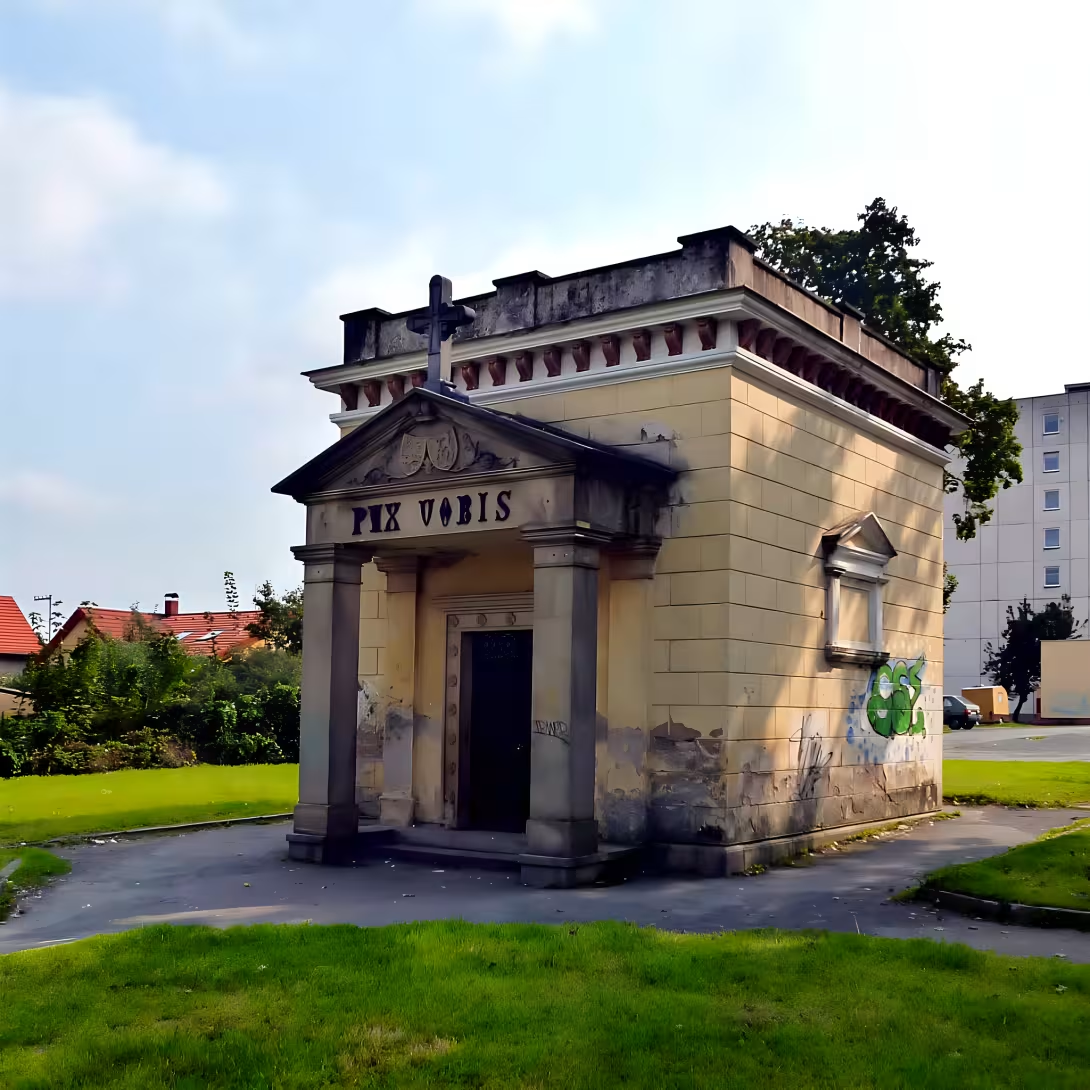
The tomb of Auerspberg is a psychic band originally of the royal royal family of Auerspberg, located in Vlašimi in the district of Benešov north of Prokopova. Today it lies in the park, which originated at the location of the abolished cemetery. The building is protected as a real estate monument and is owned by the Roman Catholic parish Vlašim.
The Vlašim estate was acquired by the Auerspberg family in 1744, when the fates of Marie Josefa of Trautson and Karl Josef of Auersperg were joined together by marriage. Original cemetery at the Holy Church Jilji was situated approximately between the streets of Komenský and Lumír Břejovský. The chapel was built here in 1884 for the owner of the then-owned Hlashim chateau. Johanna Auerspberg, born Festetics of Tolna, who died at the age of 44, was first buried here in the same year. Subsequently, her husband Adolf Karl's body from Auersperg, who died the following year, and later their premature deceased son, was buried in the chapel. When the historical cemetery was abolished in 1979, the remains of the prince's family were transferred to the crypt under the neighboring church of St. Gilya.
It is an architecturally isolated chapel in neoclassical style with a rectangular plan. The facade that serves as an entrance is deliberately turned towards the church, which also changed the orientation of the altar - it is untraditionally situated south here. The entrance is decorated with a porticus on two prismatic pillars, above which is a triangular shield ended by a stone cross. On the front wall there is a metal inscription "Room with you" in the латинčina. The shield is decorated with an alliance sign of both families - Auerspberg and Festetics - accompanied by a prince's crown and floral motifs. The stone entrance portal is framed by a floral decoration with a two-wing grid. The other facades are broken down by plaster quacking, the side walls include blind windows with tympanones. The roof of the chapel is slightly bent with a skylight, around it is a stone corral with three pillars on each side.
The inside of the chapel hides a vaulted vault with a skylight and a floor made of black and white tiles laid on a scythe. The jelly stone covering the entrance to the now empty crypt bears an engraved cross and the year 1884. The walls of the interior are divided by pilasters, from which marble altar mensa was preserved. On the east wall is a granite plate in a stucco frame with German inscriptions from 1884. The sandstone statue of the Virgin Mary and Jesus, which once contained the chapel, was moved to the hall of the next dean's church for security reasons at the end of the twentieth century.
Today, the chapel stands as a silent memory of the time when the House of Auerspbergs had its grave here and represents the last enlarged element of the extinct cemetery. Vlašimi is an interesting example of neoclassical architecture and a reminder of the complex international history of Czech countries.
Then and now
Drag the slider to compare how the landmark may have looked when it was built with the view today.
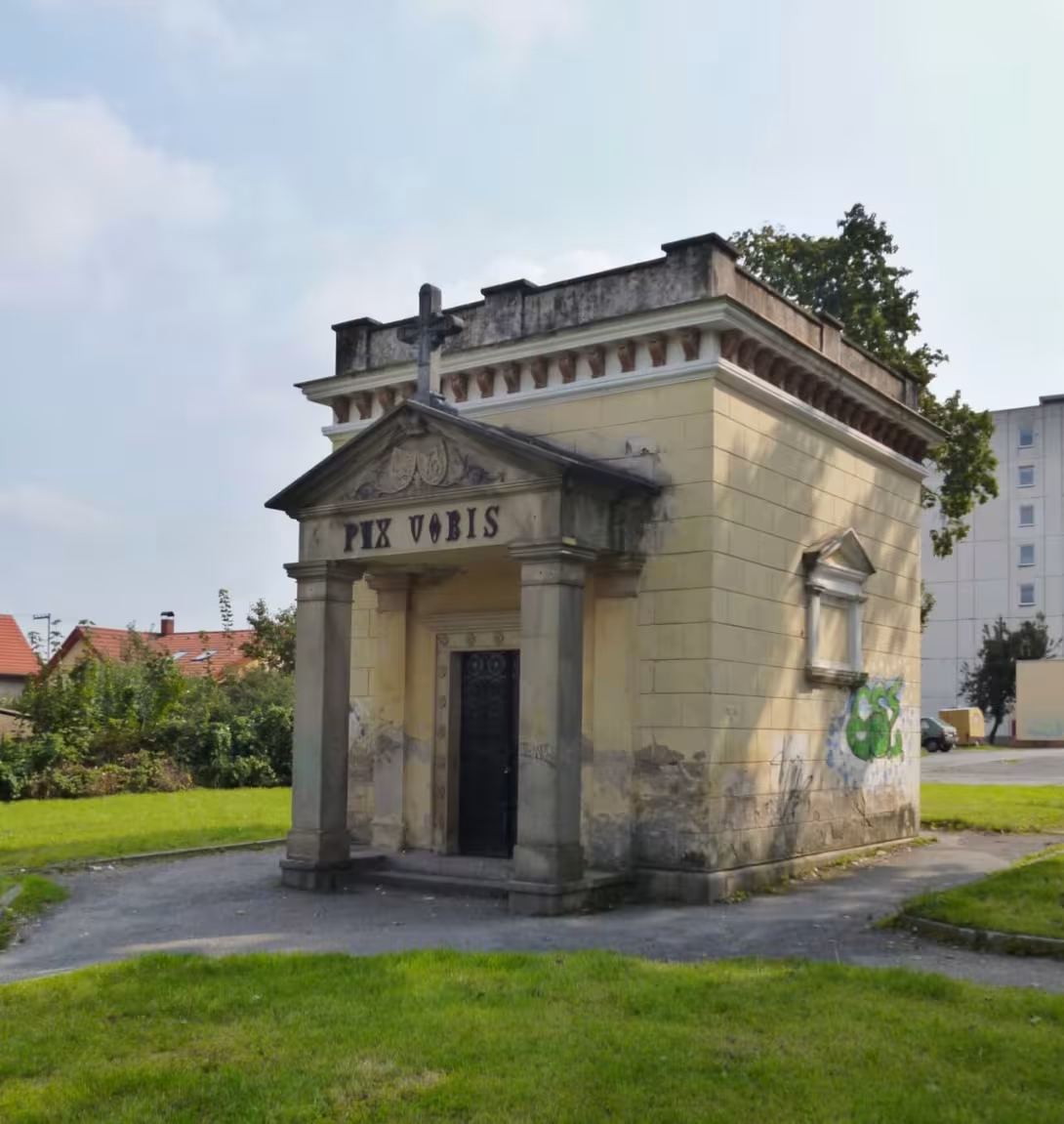

The historical appearance on the left is an AI-generated visualisation and serves as inspiration only.
Historical milestones
- 1744
- The acquisition of the Hlashim manor of the princes of Auersperg.
- 1884
- Built a funeral chapel for Johann Auersperg, born Festetics of Tolna.
- 1885
- Buried here by Adolf Karel of Auersperg, husband of Johann Auersperg.
- 1979
- The abolition of the cemetery and the transfer of the remains of the prince's family to St. Gilji's Church.
Architectural development
The chapel was built as a separate neoclassical building with a rectangular plan. The facades are broken down by plaster quad, the facade is decorated with a portic with pillars and triangular shield. The interior has a vaulted vault with marble altar and granite floor. In the 1990s, the statue of the Virgin Mary and Jesus was moved for safety reasons to the hall of the side entrance of St. Gilji's Church.
Historical events
- 1744
- The princes of Auersperg have acquired their own country by marrying Marie Josefa from Trautson with Karl Josef from Auersperg.
- 1884
- Built by the burial chapel for the burial of Johann Auersperg, born of Festetics of Tolna.
- 1979
- The abolition of the cemetery and the transfer of the remains of the prince's family to the crypt under the church of St. Gilya.
Owners
('1744-1945': 'Princes of Auersperg (through the marriage of Marie Josefa of Trautson with Karl Joseph of Auersperg)', 'since 1979': 'Roman Catholic parish Vlašim')
Points of interest
- The chapel was built in 1884 for the then owner of the House of Auerspberg.
The first person to be buried in the chapel was Johanna Auerspberg, born Festetics of Tolna, who died at the age of 44.
- The chapel is untraditionally oriented - the altar is situated south as the facade is facing the church of St. Gilya.
- On the facade of the chapel there is an alliance sign of Auerspberg and Festetics families, supplemented with a prince's crown.
- The interior of the chapel contains a brick granite plate with German inscription from 1884.
Guide
This guide is narrated by a synthetic voice generated by artificial intelligence.
Show guide text
This text was created by artificial intelligence and has not been editorially reviewed. It may contain inaccuracies.
The Auersperg Family Burial Chapel in Vlašimi is a neoclassical building from 1884. It stands in a park that was created on the site of a defunct cemetery near the Church of Saint Giles. It is a protected monument and belongs to the Roman Catholic Parish of Vlašimi.
The Auerspergs were originally a Carniolan noble family. They acquired the Vlašimi estate in 1744 through the marriage of Marie Josefa of Trautson to Karl Josef of Auersperg. The chapel was built for the then owner of Vlašimi Castle. Johanna Auerspergová, born Festeticsová of Tolny, was the first to be buried there; she died in 1884. She was followed by her husband Adolf Karel of Auersperg, who died a year later, and finally their son who died prematurely. The cemetery was closed in 1979 and the remains of the princely family were then transferred to the crypt beneath the Church of Saint Giles. The chapel remains today as the last reminder of the vanished cemetery.
The building has a rectangular floor plan. The entrance façade faces north toward the church, to which a direct path once led across the cemetery. The altar therefore unusually points south. In front of the façade stands a portico on two prismatic pillars. Above it is a triangular gable topped with a stone cross with rounded arms. On the beam above the pillars is a metal Latin inscription Pax vobis, meaning Peace be with you. In the gable is displayed a combined coat of arms of the Auerspergs and Festeticsés with a princely crown and floral motifs. Other decorations of the portico have not been preserved; they are only recalled by openings in the stone. The stone entrance portal is adorned with floral decoration and is closed by a double-winged grille.
The façades are articulated with rendered stonework, and on the sides are decorated with blind windows. A small round window in the rear wall illuminates the altar. Below the roof runs a cornice on ornate corbels and above it a stone parapet covers slightly sloped roofs with a skylight.
Inside is a barrel vault, a floor of black and white tiles laid diagonally, and granite stone above the entrance to the crypt with a cross and the date 1884. Opposite the entrance is a preserved marble altar table. On the eastern wall is set a granite plaque with a German inscription. In translation it reads: On this spot rests all that closely surrounds us. For our hearts this means the world. March 9, 1884.
A sandstone statue of the Virgin Mary with Baby Jesus once stood in the chapel. In the nineties of the twentieth century it was moved for safety reasons to the vestibule of the side entrance of the Church of Saint Giles.
Tips for visitors
The best time to visit the Auersperg Funeral Chapel is in spring or autumn when the weather is pleasant and the park around the chapel is especially flowering or coloured in autumn shades. The sunny morning is ideal for photography because light falls favourably on the facade of the chapel and creates soft shadows. Avoid the noon hours when the sun can be too intense and the chapel can be in the shade of trees, which reduces the quality of the photos.
Check the current connection and departure times in the traffic search engine.
When visiting the chapel, wear a comfortable shoe, because the path to the monument leads mainly to asphalt, but there may also be inequalities in the park. It is convenient to have a map or GPS with you in order to be easily oriented around. If you are planning a longer stay, bring water and a light snack.
Photography in the chapel is permitted, but care must be taken to respect the remains and the interior. The best places for photos are the facade of the chapel and surrounding park, especially in the morning light. In the interior of the chapel the light is limited, so bring a mobile battery or external light source if you want to capture details. In the park it is possible to photograph freely, but avoid shooting people without their consent.
In the vicinity of the chapel is worth visiting the Church of St. Gilya in Vlašimi, which is located approximately a hundred meters north of the chapel. This Baroque church from the 18th century offers an interesting history and is connected with the transfer of the remains of the prince's family to its crypt. Another interesting thing is the Vlašim Chateau, which is located approximately one kilometer west of the chapel. The chateau is famous for its rich history and architecture. Both of these places are easily accessible by foot or car.
For families with children the visit to the chapel is particularly interesting due to its historic atmosphere and the possibility of walking in a quiet park. Children can see the facade of the chapel and talk about the history of the Auersperg family. In the park you can play and discover nature. It is advisable for younger children to prepare a short story about the chapel to make their visit even more interesting. In the vicinity it is also possible to visit the Church of St. Jilje, where children can observe architectural details and listen to stories associated with the church.
Frequently asked questions
Can the monument be visited?
Religious buildings are usually open mainly during services; at other times a visit is normally arranged with the parish or the operator. We have not verified specific times.
Where is the monument?
Location: Vlašim, Středočeský kraj. The map on this page shows the exact spot.
Why is the monument protected?
It is listed in the Central List of Cultural Monuments of the Czech Republic as a cultural monument (register no. 10250/2-4279).
For kids
Imagine coming back 142 years and finding yourself in a small village called Vladí. The village was small then and most people lived in the countryside. And right here in Vlashimi, there was a beautiful family of Auerspergs.
Who lived here? The Auersperg family was a noble family that owned the estate. They were rich people who had a big farm and a lot of animals. There were many big festivals and dances at their mansion.
Businesses nearby
Do you run a restaurant, accommodation, shop, museum, rental, wellness or other visitor service near this monument? Show yourself directly to the people heading to it — this is how they will see you in the app and on the web:
Accommodation nearby
Themed route
Thematic cruise route: Prince Vlašim - Baroque and family monuments
1. Funeral Chapel of Auerspergs * Type: Sacral construction * The unique Baroque chapel from 1725 served as the last rest of the Prince's Auersperg family. Its author is Kilian Ignác Dientzenhofer, and the interior is decorated with valuable frescos and tombstones. The chapel is hidden in a quiet area that offers a quiet atmosphere for reflection on the history of local nobility.
2. Church of St. Gilji in Vlašimi * Type: Baroque Church * Just a hundred meters north of the chapel is a dominant church from 1711, where the remains of Auerspergs were stored in the crypt after the cemetery was abolished. Its interior with rich stucco decoration and organami by Ignatius Plach proves the artistic level of the time. A suitable place to compare the sacral architecture of the prince's family.
3. Vlašim Chateau * Type: Baroque residence * About a kilometer west of the chapel is the former headquarters of the Auerspergs, built in 1669-1671. Its representative facades and large interiors reflect the power and influence of the genus. Today there is an exhibition dedicated to the history of princes and their influence on the region.
4. Park at Vlašim Chateau * Type: Baroque park * The adjacent park with geometrical modifications and alleys complements the chateau area. His original form was designed by František Maximilián Kaňka, and although time had left a mark, he maintained a peaceful atmosphere suitable for walking. Ideal place to relax between sightseeing visits.
* The route is designed to gradually explore the link between the Prince's residence, the church and the burial site, thus showing the whole history of the Auersperg family in Vlašimi. *
Seasonal recommendations
Spring In the Chapel of Auerspergs nature awakens, even in the interior - the bright color of glass stained windows and sun rays that penetrate silver stained windows create a magical atmosphere. The interior light highlights the detailed decoration that remained in the dark in winter and brings to the room a vivid feeling of spring air. The first spring flowers flourish around the chapel, and when you look outside, you can enjoy a quiet neighborhood that gradually awakens to life.
When visiting this time it is worth to come in the early afternoon when the chapel is less visited and you can enjoy a quiet atmosphere without crowds. Suitable clothes should be light but still warm, because even in spring days it can be cold. Don't forget the comfortable shoes, because there are sometimes wet lawns around.
Summer In the main summer season the Chapel of Auerspergs is full of life, both in the interior and in the surrounding area. The bright colours of walls and stained glass are highlighted by the natural light that penetrates through walls, creating a sense of openness and freedom. The outer space is then full of green and flowering plants, which provide a chapel pleasant, summer atmosphere. However, there are also the most visitors in the summer days and it is therefore important to come as soon as possible to avoid crowds.
Suitable clothes should be light and comfortable, with sun protection. It is recommended to bring your sunglasses, hat or drop and light sunscreen. Come 10 hours ago to give you time to see the chapel without the big crowd. Due to temperatures it is also good to take some water and light refreshments because there is no possibility in the chapel to buy something for the trip.
Autumn In autumn days, the Chapel of Auersperg is full of secrets and historical magic. The bright colours of the glass stained glass are alternating with dark shades of wood elements, creating a harmonious and peaceful impression. The inner light is warmer, and if you look outside, you can enjoy the beauty of the autumn forest with its golden and brown tones. In the chapel, you feel like you're in some mysterious hall full of history and a quiet spirit.
At this time, visiting the chapel is ideal for those looking for peace and rest. It is recommended to come at a time when it is still slightly warm outside, but not as hot as in summer. Suitable clothes should be warm, but not too heavy to avoid overheating. Come in the afternoon when the chapel is less visited and enjoy a quiet atmosphere without crowds. Due to colder weather it is also good to take some warm clothes for any outdoor walks.
Winter On winter days, the Chapel of Auersperg is full of secrets and historical magic, but with another, colder breath. The light penetrates the glass stained glass, but its colours are less vivid, and the interior has a quiet, freezing atmosphere. The outside light is weaker, and the chapel looks like some mysterious, snowy-surrounded temple. The internal temperature is maintained so that visitors feel comfortable, but outside it is cold and therefore it is important to take warm clothes.
In winter the visit to the chapel is ideal for those looking for peace and rest. It is recommended to come at a time when the chapel is open, but visitors are less, usually in the afternoon. Suitable clothing should be warm, including warm footwear and layering. Come 14 hours ago so you have time to see the chapel without crowds. Due to the cold weather it is also good to take some warm drinks that you can enjoy in the chapel.
Visualizations and artistic views


The visualisations are generated by artificial intelligence and serve as inspiration.
Photos from the area
Real photos taken near the monument


Zdroj a licence jsou uvedeny u každého snímku.
Atmosphere of the place
This atmospheric visualisation of the place and period was generated by artificial intelligence. It is not real footage of the location.
Tips from visitors
No tips yet. Be the first!
Log in and add your tip.
Sources and literature
Photos: TommykCZ / CC BY-SA 3.0, rozlišení zvýšeno umělou inteligencí — Wikimedia Commons. The author and licence also appear when you hover over the image.
Faktickým podkladem tohoto textu byl článek na Wikipedii, jehož autory jsou přispěvatelé Wikipedie. Článek je dostupný pod licencí CC BY-SA 4.0.
Location on the map





Příběhy a pověsti
Legendy, pověsti a příběhy spjaté s touto památkou
Fotografie návštěvníků
Zatím žádné fotografie. Buďte první, kdo přidá fotografii z návštěvy!
Log in a přidejte svou fotografii nebo hodnoťte.
Za ověřenou návštěvu v aplikaci získáte víc bodů — poznáme podle GPS, že jste na místě.
Reviews and comments