



poutní areál Svatá Anna Pilgrimage resort
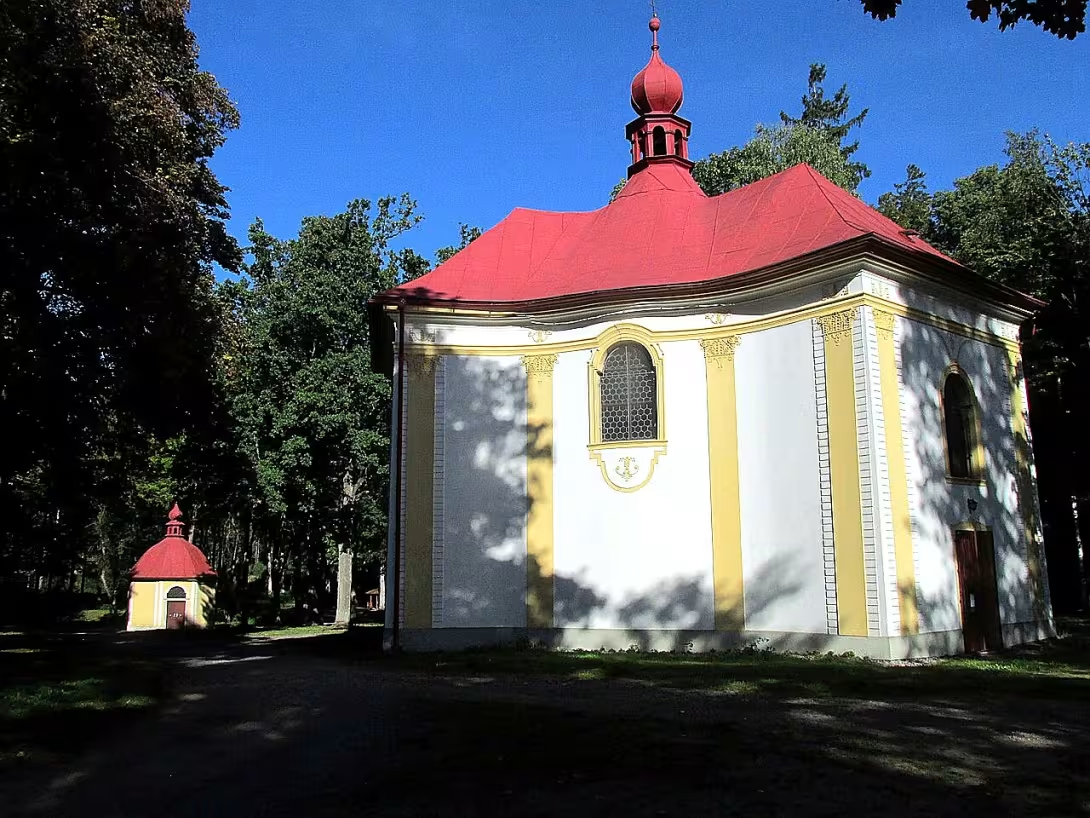
The pilgrimage area of St. Anne on the top of Calvary at the village Pohled in Havlíčkobrodsk is an important late Baroque monument. It includes St. Anne's Church, a cross road with fourteen chapel and a chapel above the well. This protected cultural site was created in the 18th century in connection with the reputation of the medicinal effects of the local spring. In the 19th century, the resort served temporarily as a spa.
The origin of the pilgrimage site dates back to 1731. At that time, the scribe had the monastery built a chapel dedicated to St. Anne as a thank you for his rescue from the marsh. During the construction, a spring was discovered, to which people attributed healing power, especially after the recovery of the local population. The popularity of the site grew rapidly, which led the Monastery to decide to establish a hermitage here. From 1752 to 1773, the hermit who lived here documented 28 miraculous recovery.
The architectural dominance is St. Anne's Church. Its construction began in 1760 from the charity of pilgrims and was consecrated in 1761. The object is characterised by a central circular boat, to which three rectangular wings and square sacristy lie radially. According to some sources, architect Santini's earlier plans were used in the design. The original chapel from 1731 was replaced by a new eight-sided chapel in 1824. The area is complemented by fourteen chapels of the cross road and a high cross, which resembles the cemetery of the victims of the plague epidemic from 1772.
The administration of the pilgrimage site was historically linked to the Monastery of Poetry. In the 19th century, Count Evžen Silva-Tarouca-Unwerth became the owner of the estate, who had the chemical composition of the water examined. Due to the content of the sulfonic-ferric substances and the then belief in water radioactivity, he founded a spa here in 1858. Guests in the spa building were treated with peat or coniferous baths, while the water was heated in copper boilers. The operation of the spa ended in 1910, after the original spring dried up and the newly seduced water no longer had the required healing properties. The spa building was subsequently converted into an inn.
During the 20th century, the pilgrimage place faced various restrictions. In particular during the period of Communist government, the pilgrims were officially moved directly to the municipality of Pohled in 1977. The tradition was restored in 1990. The spring itself has undergone changes in time; In 1887 it was seduced from the old hunting grounds, dried up again in 2016 and in 2020 the water reappeared.
Today, the area is accessible to visitors, who can find it through the lime alley from the village Pohled. The pilgrimage site represents a valuable proof of baroque piety and the history of the spa in Czech countries. The visit offers insight into the spiritual traditions of the region and technical efforts of the 19th century to use natural resources.
Historical milestones
- 1731
- Construction of the first chapel dedicated to St. Anne.
- 1761
- The consecration of St. Anne's new church.
- 1858
- Start of operation of baths using water from the spring.
- 1910
- End of spa service.
Architectural development
The original chapel from 1731 was later replaced by an eight-sided chapel. St. Anne's Church is a late Baroque building with a central circular boat and three radiant wings. A cross road was built around the church and a spa building was added in the 19th century.
Historical events
1731: Construction of the first chapel after the miraculous rescue of the scribe. 1761: The consecration of the new church of St. Anne. 1858: Establishment of a spa using a local spring. 1977: Transfer of pilgrimage to the municipality of Pohled by decision of the authorities.
Owners
Pohled monastery, Count Evžen Silva-Tarouca-Unwerth
Points of interest
- The pilgrimage place was created in 1731 after the scribe of the monastery had the chapel built as a thank you for his rescue from the swamp. A hermit who lived in the area from 1752 to 1773 recorded 28 cases of miraculous recovery. - In the nineteenth century Count Evžen Silva-Tarouca-Unwerth founded a spa where guests were treated in peat or coniferous baths. - The high cross on the grounds serves as a reminder of the cemetery where the people who died during the plague epidemic in 1772 were buried. - In 1977 the pilgrimage was officially moved to the municipality of Pohled, with the restoration of tradition in the original place only in 1990.
Guide
Show guide text
This text was created by artificial intelligence and has not been editorially reviewed. It may contain inaccuracies.
Welcome to this sacred place. Stop here and take a moment. You are standing on top of Calvary at the village Pohled and in front of you poutní areál Svatá Anna is decomposed. Can you feel the silence coming in with the wind from the surrounding fields? It's a place where faith, gratitude, and hope of recovery get married. Look around you. You see the church of St. Anne in front of you, which dominates the entire space. Next to it is a path that leads to fourteen chapels and further towards the spring where there is a small chapel above the well. These places are not just stone structures. They are living testimony about how people have sought help in the past and how they have found it.
Let's move back more than two centuries. It all started in 1731. That's when the event that changed the fate of this hill took place. The scribe of the Visiting Monastery was in danger when he was stuck in the swamp. His rescue was seen as a miracle, and he decided to pay his respects. He built a little chapel dedicated to Saint Anne. It was an act of sincere gratitude. But there was no place left for just one small building. Rumors of the healing effects of the spring have spread and people have come from far away. Popularity grew and it was clear that a little chapel was not enough. That's why a new, larger church was consecrated in 1761. It was built in the late Baroque style, which is typical of this time.
Now pay attention to the architecture surrounding you. The church of St. Anne, which you see before you, was built in the seventeenth century. Although the names of the architects involved in its creation remain unknown in history, their work stands before you and waits for your perception. The late Baroque manifests itself in harmony of shapes and emphasis on light and space, which you can see here when you look at the whole building. Look at the front of the church. Feel how the building fits into the landscape and creates a dignified framework for prayer. Remember, however, that the area is more than just a church. The cross road with fourteen chapels follows you along the whole slope and every stop is a place for thought. The journey here is not only a physical exit, but also a journey of the soul. And at the end of this journey, by the spring, stands the chapel above the well. The water that comes out here is the heart of this place. It is she who has given the initiative to make the desert hill one of the most important pilgrimage sites in the area.
Now let's think about the people who lived here and who shaped this place. In addition to the typist who laid the foundation for everything, the hermit also worked here. Between 1752 and 1773 he lived in the complex and his life was dedicated to prayer and help others. He recorded 28 cases of miraculous recovery. These records are a valuable testimony to us today about what people were experiencing at the time. It wasn't just abstract numbers. It was fate that intersected with the desire for health. Persons associated with this place include Kandida Marešová. Her name appears in the chronicles of this place as part of his spiritual history.
In the nineteenth century, the fate of the compound changed again. In 1858, the spa operation started, using water from the spring. The Count Evžen Silva-Tarouca-Unwerth was responsible for the development of this project. The spa operation lasted here for over a hundred years and brought many people here looking for relief from disease. Water from the spring was considered a cure. But this bloom should not last forever. In 1910 the spa operation was completed. Today, all that was left behind was the memory and memory of the time when faith and health care were bound here.
You now have the opportunity to look at one interesting thing that gives this place a special atmosphere. Imagine you're standing on this hill 200 years ago. You hear the noise of water and the silent footsteps of pilgrims who came here with hope. The hermit who lived here had a day after day full of prayers and records. Every miraculous case he described was proof that this place had its power. These records are a valuable treasure for us today. Today, if you look at the chapel above the well, you can imagine that the water is still flowing in it just like it was centuries ago. It's a place where time flows differently. Where the past is bound to the present. Where silence becomes a voice only you hear.
In conclusion, I urge you to explore this place more closely. Walk along the cross road. Stop by every chapel. Feel the peace and quiet that belongs here. Don't forget to visit the chapel above the well and enjoy the view from the top of Calvary. This place is ready to remind you that gratitude and hope are forces that go beyond time. Thank you for your attention. Have a nice day and good luck on your journey.
Tips for visitors
The best time to visit is during the morning or at sunset, when the light beautifully depicts the details of the cross road and the architecture of the church. In these classes, there is also the greatest peace of mind.
If you travel by public transport, use the local connection to the village and walk the rest of the way along the marked route leading to the picturesque lipos alley.
For visiting we recommend fixed shoes suitable for walking in nature and on unpaved roads. Don't forget to pack a bottle of water, especially in the summer months, and the camera, because the complex offers breathtaking views and photogenic chapels.
We recommend the photographers to focus on the cross road with fourteen chapel, which offers a great composition in combination with the surrounding greenery. The best images are taken in the soft morning light that passes through the trees.
For families with children, the place is ideal for a light nature walk. Children can discover individual stops of the cross road and explore the surroundings of the well, which makes the visit an interesting discovery of the history associated with the movement outside.
Frequently asked questions
Can the monument be visited?
We have not verified whether this monument is accessible. Please ask the owner or operator, or the local municipal office.
Where is the monument?
Location: Pohled, Kraj Vysočina. The map on this page shows the exact spot.
Why is the monument protected?
It is listed in the Central List of Cultural Monuments of the Czech Republic as a cultural monument (register no. 1000131468).
Businesses nearby
Do you run a restaurant, accommodation, shop, museum, rental, wellness or other visitor service near this monument? Show yourself directly to the people heading to it — this is how they will see you in the app and on the web:
Nearby
Obec Pohled, lipová alej vedoucí k poutnímu místu, bývalý klášter v Pohledu.
Accommodation nearby
Themed route
1. Municipality of Pohled (Place of start) - This settlement is the perfect place to start your journey. 2. Former monastery in Pohled (Historical object) - Here you can see traces of ancient architecture. 3. Lip alley leading to pilgrimage place (Natural path) - This path will gently guide you under the shadow of the trees towards the finish line. 4. St. Anne's pilgrimage resort (Main destination) - Here is the heart of the entire route.
Seasonal recommendations
In the spring the grounds flourish and nature around the monument gets fresh, green color. The soft spring light beautifully highlights the details of architecture and surrounding landscape. We recommend wearing more layers of clothing because the weather is variable. It is best to visit the place in the morning when the peace and air is the cleanest.
The summer season brings intense colors and bright sun that illuminates the whole space. The atmosphere is full of energy, but there are more visitors in the high season. To avoid the biggest crowds and heat, come very early in the morning. Don't forget light summer clothes and plenty of fluid to go.
Autumn turns the surroundings into a sea of colors, when golden and red leaves create a romantic background. The fog in the valley gives the place a mysterious feel and a quieter pace. Hot clothes and solid shoes are suitable for wet terrain. For the most beautiful views of the landscape, choose the late afternoon when the sun is lower.
In winter the area is quiet and in the case of snow it looks like a fairy tale. The contrast of white surface and historic buildings creates a unique atmosphere of solitude. It is necessary to wear warm thermal layers and waterproof shoes. Due to the shorter opening time, we recommend planning a visit by noon.
Visualizations and artistic views


The visualisations are generated by artificial intelligence and serve as inspiration.
Photos from the area
Real photos taken near the monument


Zdroj a licence jsou uvedeny u každého snímku.
Tips from visitors
No tips yet. Be the first!
Log in and add your tip.
Sources and literature
Photos: Helena Dvořáková / CC BY-SA 4.0 — Wikimedia Commons. The author and licence also appear when you hover over the image.
Faktickým podkladem tohoto textu byl článek na Wikipedii, jehož autory jsou přispěvatelé Wikipedie. Článek je dostupný pod licencí CC BY-SA 4.0.
Location on the map



Příběhy a pověsti
Legendy, pověsti a příběhy spjaté s touto památkou

Fotografie návštěvníků
Zatím žádné fotografie. Buďte první, kdo přidá fotografii z návštěvy!
Log in a přidejte svou fotografii nebo hodnoťte.
Za ověřenou návštěvu v aplikaci získáte víc bodů — poznáme podle GPS, že jste na místě.
Reviews and comments