



Poutní cesta z Libkovic do Mariánských Radčic Chapel
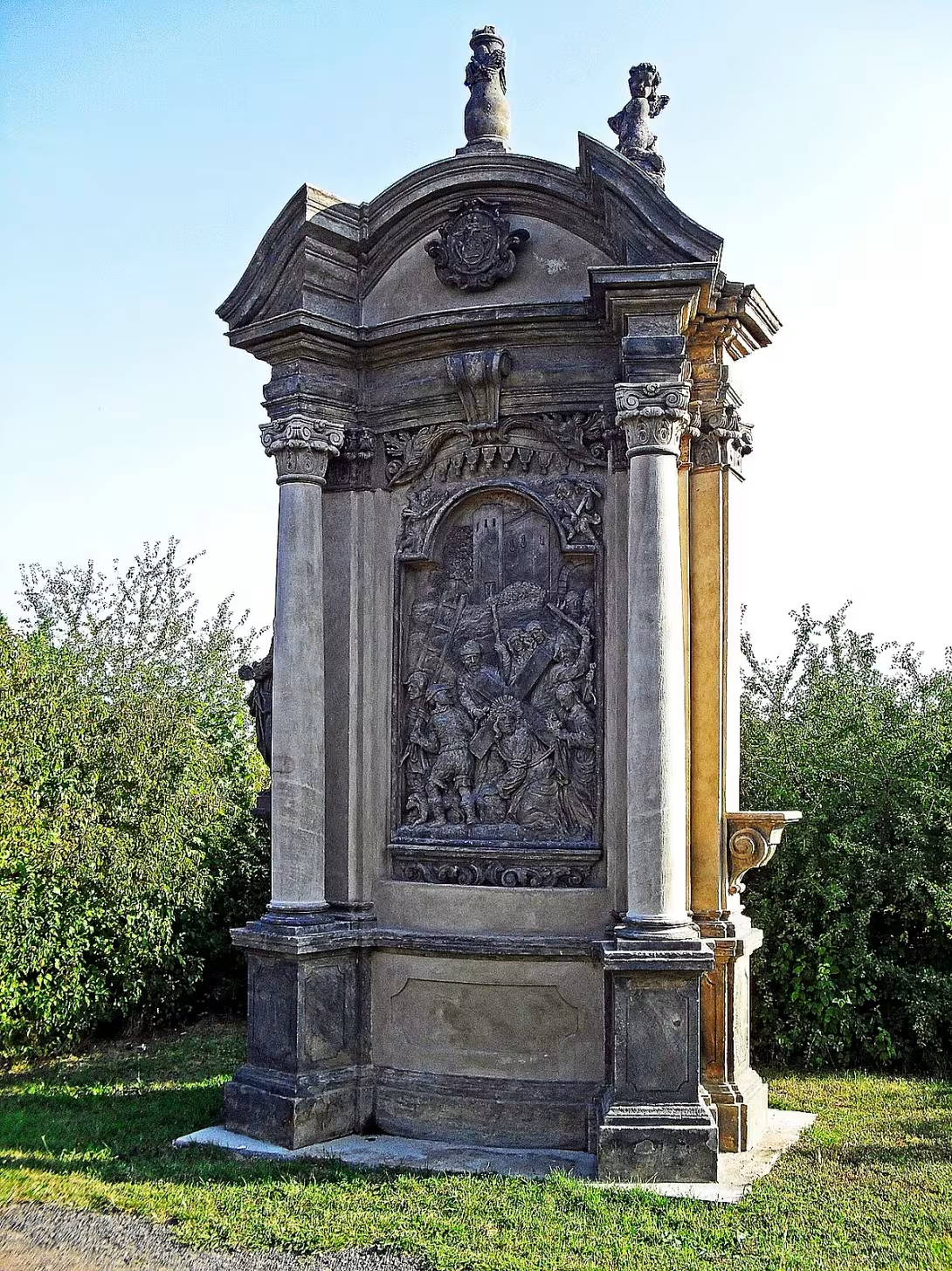
Poutní cesta z Libkovic do Mariánských Radčic is a baroque monument connecting the already non-existing village of Libkovice with the pilgrimage church of Our Lady of Pain in Mariánské Radčice. This path was lined with seven chaplains, four of which are now located in the Vteln near the Church of the Holy Cross. The history of these chapels dates back to the 18th century, when they were built as part of the pilgrimage route from the Cisteriac monastery in Osek. Since 1958 they have been recognised as a real-estate cultural monument.
In the Baroque era, when pilgrimage in the Czech countries reached its peak, the chapel was built between 1725 and 1742 thanks to pilgrims' contributions. The original part of the journey between Libkovice and Mariánské Radčice included seven niche chapels symbolizing the seven pains of the Virgin Mary. Architect Octavian Broggi designed these chapel from mixed plastered masonry and sandstone with elements of Ionian order, segmental shields and volutes.
The Cistercian monastery in Osek was the original owner and administrator of this route. The monastery was also covered by the church of Our Lady of Pain, which was led by the historic Baroque way. In 1848 the monastery stopped having property control over Libkovice. At the end of the 1980s, four preserved chapel were moved to Vtelna for the destruction of Libkovic due to coal mining. The restaurant took place between 1989 and 1990 under the auspices of the academic sculptors Michael Bílický and Bohumil Zemánek.
Chapel has its unique history. The Chapel of Circumcision of Christ was built by vicar Prokop Wolf after 1720, while the Nose Cross was built by the Elder Abbot of Jerome around 1727. The escape to Egypt was repaired in 1915 by the construction plant D. Ferber thanks to the financial contribution of the manufacturer Schick of Litvinov. Some of the chapel, such as Christ on the Cross and the scanning of Jesus Christ from the Cross, have suffered damage and have not been preserved.
Today, the chapel is accessible by foot or by bicycle route No. 3110. The pilgrimage journey is an important cultural and historical monument, which represents a rich Baroque pilgrimage in the region with its architecture and history. Conservation and restaurants allow visitors to feel part of a long tradition connecting spiritual and cultural aspects of Czech countries.
The pilgrimage is a testament to the Baroque era and a reminder of the spiritual life of the region. The Chapel illustrates the deep roots of the Catholic faith in the Czech countries and the influence of the Cisteriac Order on the development of pilgrimage routes. For historically and architecturally interested, visiting these chapels is a real reward.
Historical milestones
- 1725-1742
- Construction work for niche chapels
- 1958
- Notification of the file as a cultural monument
- 1989- 1990
- Restaurant of walled chapel by academic sculptors Michael Bílk and Bohumil Zemánek
Architectural development
The chapel was designed by architect Octavian Broggio from mixed plastered masonry and sandstone. The architecture uses elements of the Ionian Order, segment shields with volutes and embossed images. From 1989 to 1990 they passed through the walls of restaurants.
Historical events
The chapel was built between 1725 and 1742. In 1958, the ensemble was declared a cultural monument. At the end of the 1980s, the preserved chapel was moved to Vtelna.
Owners
Zistercian monastery in Osek (until 1848)
Points of interest
- Poutní cesta z Libkovic do Mariánských Radčic is a baroque monument connecting the already existing village of Libkovice with the pilgrimage church of Our Lady of Pain in Mariánské Radčice. - This road has been lined with seven chaplains, four of which are now located in the Vteln near the Church of the Holy Cross. - Chapel have an architecture designed by Octavian Broggim from mixed plastered masonry and sandstone with elements of Ionian order, segmental shields and volutes. - The Zistercian monastery in Osek was the original owner and administrator of this route. - Chapel is recognised as a real-estate cultural monument since 1958.
Guide
Show guide text
This text was created by artificial intelligence and has not been editorially reviewed. It may contain inaccuracies.
Welcome to a place where silent history meets the fragility of human destiny. You are standing in the village of Vtelno, near the Church of the Holy Cross, and before your eyes are those four saved chapel that are so important to us today. Even though they may seem to you as part of today's peaceful surroundings, each of them carries the memory of a long forgotten path that once led to a completely different path. Feel this atmosphere, feel the calm that prevails here, and try to imagine that you are walking in the footsteps of hundreds of people who traveled in the same direction several centuries ago, but with a completely different sense of their movement.
This pilgrimage path you now admire was once much longer and more complex than you see today. It was not just an ordinary path between two places, but a Baroque route that had a deep spiritual meaning. It connected the defunct village of Libkovice with a significant pilgrimage goal, which was the church of Our Lady of Pain in Mariánské Radčice. At the time of its creation, in the period between a thousand seven hundred twenty-five and a thousand seven hundred and forty-two, this journey was full of living faith and religious excitement. For the people at that time, it was not just a path from A to B, but a path to spiritual purification, to prayer and to seek a connection with the divine. This whole set of chapels was designed to remind each stop of certain moments that formed a spiritual whole. Originally, these chapels were seven, and each of them was niche, which means that their shape created such a kind of deeper space, a niche that was intended to honor memories. Each of these seven chapels had a role to play, for they represented seven pains of the Virgin Mary, a topic very close to the human heart at that time.
Now pay attention to the very form of these structures. Even though we see only four of the original seven today, their architecture still tells us the story of the Baroque era. Notice their walled walls and the shape that suggests their original destination. They're niche chapels whose construction was designed to create intimate space for prayer. For their overall design and architectural design, Oktavián Broggio, the man who breathed into these buildings order and beauty typical of his epoch. It's important to remember how much work people put into these chapels hundreds of years ago. And although time and change in the landscape were harsh, we managed to preserve these chapel. Did you know that these walls have undergone a thorough renewal in recent history? Between a thousand and nine hundred and eighty-nine and a thousand and nine hundred and ninety, two important academic sculptors named Michael Bílek and Bohumil Zemánek have devoted themselves to their restaurant. Thanks to their professional commitment and attention to detail, we can now perceive these shapes in their almost original beauty and perceive the firmness and finesse that the baroque style combines.
However, the history of this place is not only about stones and building elements, but above all about the people who have connected with it. Besides architect Broggio, there are other names in history that you should remember if you're interested in this place. They're Jeroným Besnecker, Benedikt Littwerig and Prokop Wolf. Although their names may not be known immediately to everyone, they were people who at that time shaped the life and form of this region. Their presence in documents and in the memory of the place reminds us that every chapel, every stone and every journey was the result of human effort, faith and craft.
Now, however, we must stop at what is perhaps the most important and fascinating part of the story. You may be wondering why these chapel are standing right here in Vteln, at the Church of the Holy Cross, and not on its original route, which led to Mariánska Ráčice? Why did most of the original road that once connected Libkovice to the pilgrimage church just disappear? The answer is in the depths of the earth beneath your feet. This area has been significantly affected in the past by coal surface mining. However, this activity, which was necessary for industrial development, had a price. The mining literally rewrote the face of the whole landscape and caused the original route of the pilgrimage to be destroyed irreparably. The original road was destroyed as the country was changing under the strain of mining machinery. But these four chapel you see are survivors. They were saved from total destruction and moved here to continue their existence. They're actually pilgrims who had to leave their home to survive. It is a fascinating but also a bit of a sad mystery how human efforts to acquire raw materials can also threaten the rarest traces of our culture and spiritual heritage.
This monument, which was officially recognized as a cultural monument in a thousand and nine hundred and fifty-eight, serves as a reminder of what we can lose, but also of what we can save. Although the original journey from Libkovic to Mariánské Radčice is only a memory in the books and in these saved chapel, its spirit still works here.
Let us now walk quietly around these chapels. Feel their presence, feel their quiet dignity, and try to connect these four points in spirit with the seven original stops that once formed the whole journey. I wish you that this short journey into the past will enrich you and bring you a moment of peace and reflection. Thank you for your attention and I wish you a pleasant continuation in this beautiful neighborhood.
Tips for visitors
The best time for a walk along this Baroque road is spring or autumn. Nature around Vtelna these months offers beautiful colors that complement the atmosphere of historical chapels.
The journey is available by car and public transport; Check the current connection in the search engine. We recommend shoes suitable for walking in the field and plenty of drinking water, as the route leads through rural landscape.
For the best photos we recommend morning or late afternoon light, which gently illuminates the details of the seven niche chapels. Interesting images are created when capturing the chapel in the context of the surrounding landscape.
There are several important places nearby. You can visit the Church of the Elevation of the Holy Cross in Vteln, the pilgrimage church of Our Lady of Pain in Mariánské Radčice or the Cistercian monastery in Ossek.
For families with children the journey is suitable as an educational walk. You can involve children in finding all seven chapels that make up this historic route.
Frequently asked questions
Can the monument be visited?
Religious buildings are usually open mainly during services; at other times a visit is normally arranged with the parish or the operator. We have not verified specific times.
Where is the monument?
Location: Vtelno. The map on this page shows the exact spot.
Why is the monument protected?
It is listed in the Central List of Cultural Monuments of the Czech Republic as a cultural monument (register no. 1000155025).
Businesses nearby
Do you run a restaurant, accommodation, shop, museum, rental, wellness or other visitor service near this monument? Show yourself directly to the people heading to it — this is how they will see you in the app and on the web:
Events nearby



Zdroj akcí: otevřená data měst a obcí ČR (Národní katalog otevřených dat) a kalendář akcí Národního památkového ústavu.
Nearby
Kostel Povýšení svatého Kříže ve Vtelnu, poutní kostel Panny Marie Bolestné v Mariánských Radčicích a cisterciácký klášter v Oseku.
Accommodation nearby
Themed route
Thematic cruise route: Poutní cesta z Libkovic do Mariánských Radčic
1. Church of the Elevation of the Holy Cross in Vtelna - Type: Church - Why is it worth a visit: This church is an important sacral monument with rich history and architecture. Its interior offers beautiful frescos and artistic elements that attract visitors from all over the region.
2. The pilgrimage church of Our Lady of Pain in Mariánské Radčice - Type: Chapel - Why is it worth visiting: This chapel is the main destination of our route and serves as a place of prayer and peace. It is famous for its pilgrimage events and beautiful views, which you can enjoy here.
3. The Cistercian monastery in Osek - Type: Monastery - Why is it worth a visit: This monastery is an example of tanker architecture and history. Its quiet environment, gardens and the opportunity to explore the monastery buildings make it an ideal place to relax after the pilgrimage.
This route offers a combination of spiritual sense and beauty of architecture, which will lead you to a deep sense of peace and reflection.
Seasonal recommendations
In the spring, the landscape is awakened around the road to the town hall into life. They dominate the fresh shades of green and the first flowers in the fields, creating an atmosphere of hope and recovery. We recommend moisture-resistant shoes because roads can be muddy after melting snow. The best thing to do is to go for the morning dew when the light is soft and the air is the cleanest.
The summer season offers dense greenery and intense colors of surrounding nature. The road is full of sunshine, which creates a clear and energetic mood. Due to high temperatures, it is advisable to choose light, breathable clothing and to take plenty of fluids with you. The ideal time for walking is early morning or late afternoon to avoid the greatest heat.
Autumn comes with colorful leaves and frequent mists that provide a mysterious and peaceful touch along the pilgrimage path. The light is golden and soft, which highlights the details of the landscape. It is practical to dress up in several layers of clothing and choose fixed shoes suitable for wet leaves. The walk is the best in the afternoon when the sun paints the trees red and yellow.
In winter there is silence around Vtelna and the landscape is covered with white snow. The atmosphere is humble and calm, with sharp, cold light. It is necessary to wear warm thermobrushing, waterproof shoes and wool accessories. We recommend traveling in the time of the highest sunlight to make the journey safe and clear.
Visualizations and artistic views

The visualisations are generated by artificial intelligence and serve as inspiration.
Photos from the area
Real photos taken near the monument


Zdroj a licence jsou uvedeny u každého snímku.
Tips from visitors
No tips yet. Be the first!
Log in and add your tip.
Sources and literature
Photos: Terez / CC BY-SA 3.0 — Wikimedia Commons. The author and licence also appear when you hover over the image.
Faktickým podkladem tohoto textu byl článek na Wikipedii, jehož autory jsou přispěvatelé Wikipedie. Článek je dostupný pod licencí CC BY-SA 4.0.
Location on the map
Příběhy a pověsti
Legendy, pověsti a příběhy spjaté s touto památkou
Fotografie návštěvníků
Zatím žádné fotografie. Buďte první, kdo přidá fotografii z návštěvy!
Log in a přidejte svou fotografii nebo hodnoťte.
Za ověřenou návštěvu v aplikaci získáte víc bodů — poznáme podle GPS, že jste na místě.
Reviews and comments