



pramen svatého Václava Fountain
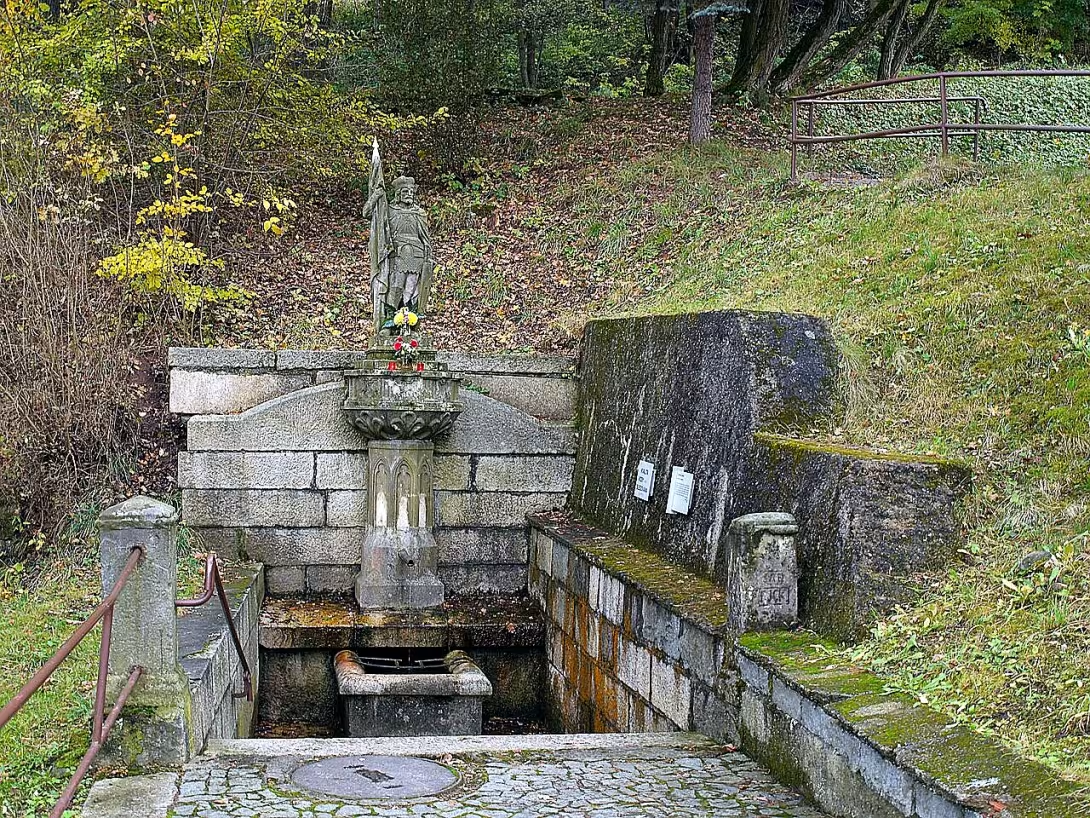
St. Wenceslas fountain is a stone fountain in Semilech, district Semily, Liberec region, dating back to the 19th century. It is located on Jílovická Street northeast of St. John the Baptist Church and has been registered in the state list of cultural monuments since 1964.
The source in this location has been known since 1793. The first reconstruction took place in 1857 when Petr Hýrek set up a stone well. The current appearance of the building was obtained in 1894 or 1895, when the Semilian trader Václav Zákoucký converted the fountain into a small scale. During this adjustment a staircase was added and the statue of St. Wenceslas was placed.
The fountain is set in a sloping terrain where the box of a rectangular plan with a length of 5.3 metres is diagonally deepened. The north and south walls are made of granite blocks. The east lateral wall is embossed from massive oblong blocks with a massive segment arch on top. The south wall protects the concrete supporting wall while the east wall is protected by a low wall of stone blocks. The lodge has a granite double-quadruple tile base and a four-step staircase to it from the west.
Along the west wall is a stone terrace with an arch bath. The water flows from a metal pipe in a plinth which passes into an octave base with gotissing embossed motifs and vegetation elements. It has a four-sided plate and another plinth with a central ledge.
On the plinth is a statue of St. Wenceslas, approximately 140 cm high, oriented west. The saint is depicted as a younger man in armour with thick hair and beard, wearing a quad-side wedding cap and a long cloak thrown over his shoulders. He has a flag in his right hand, he has a shield in his left, he has an eagle's motive, he has a sword on his left side.
Water from the fountain was previously considered to be medicinal for iron content. Today it is no longer monitored and its consumption is at its own risk, as the signs point out. In the vicinity of the fountain, about 100 meters southwest, there are three conservation grafted houses with numbers describing 102, 103 and 104 from the turn of the 18th and 19th centuries.
St Wenceslas's fountain is a valuable example of the development of urban infrastructure and stone craftsmanship in Semily, which makes it interesting to visit during a walk around the city.
Historical milestones
- 1793
- The source in this location was known.
- 1857
- Petr Hýrka has set up a stone well.
- 1894-1895
- Václav Zákoucký rebuilt the fountain and added the statue of St. Wenceslas.
- 1964
- Listing to the state list of cultural monuments.
Architectural development
The original spring was converted into a stone well in 1857, which was later modified to a fountain with a statue of St. Wenceslas. The fountain has granite wall and gotifying decoration.
Historical events
- 1793
- The source was already known in this location.
- 1857
- Construction of the spring has been completed and a stone well has been set up with a load of Petr Hýrka.
- 1894
- The fountain was adjusted to a small fountain with a statue of St. Wenceslas at the expense of Václav Zakoucký.
Points of interest
- The spring of St. Wenceslas is a stone fountain from the 19th century. - It is located on Jílovická Street northeast of St. John the Baptist Church and has been registered in the state list of cultural monuments since 1964. - The first construction work took place in 1857 when Petr Hýrek set up a stone well. - The current appearance of the building was obtained in 1894 or 1895, when the Semilian merchant Václav Zákoucký rebuilt the fountain and added the statue of St. Wenceslas. - The fountain is a valuable example of the development of urban infrastructure and stone craftsmanship in Semily.
Guide
Show guide text
This text was created by artificial intelligence and has not been editorially reviewed. It may contain inaccuracies.
Welcome to Semilos. You are standing in front of one of the most interesting local treasures that offers you a moment of peace and a view of history hidden in stone and running water. The pramen svatého Václava stands before your eyes. Notice how this stone structure fits into the surrounding terrain. It cannot be in an equal place, but must adapt to the complex, weighted surface of the ground on which it stands. This discrepancy of terrain gives the whole place a special dynamic and the feeling that this monument is returning directly to nature and the natural decline of the earth. Behold the solid matter of the stone that resists time and weather. It's a fascinating view of how human work can use what nature gives us and give it a firm and lasting form.
In order to fully understand the importance of this place, we must go back deep into the past together. To understand why this place is so important, we need to go back deep into the past. Already in the 1970s, the eighteenth century, people knew there was water in this area. The spring was known here long before it was anchored in the form you see today. At that time it was mainly a natural resource that was necessary for the surrounding population. The first big step to becoming a solid stone well was made by a man named Petr Hýrka. This happened in '57 in the nineteenth century. That's when something permanent began to be built here to serve people for many generations. Petr Hýrka was a man who understood the need to have stable and reliable access to water in this part of the city. His work was the basis on which later builders could continue to work.
Now pay attention to the very form of this building and how it changed over time. Although we do not know the names of those who designed the first stone foundation, we can see in his figure the pursuit of endurance. Note, however, how this resemblance changed over the years. In ninety-four, shortly after seventy-seven in the nineteenth century, there was a fundamental change that gave what you see today's face. Václav Zákoucký, a man with a great vision, has performed a large reconstruction here. It is thanks to his work and his modifications that the fountain has acquired its present, balanced appearance. Zakoucký did something very important here. He added to the entire construction of the statue of St. Wenceslas. Look at her now. This statue is not only an ornament, but it is a key element that gives the whole place a spiritual dimension and combines this water source with the most important figure in our history. This statue has become a dominance that reminds people of the protection and sanctity of this place.
Now let's think about the people who left their trail. Petr Hýrka and Václav Zákoucký are two names you must know in connection with this spring. While Hýrka was the one who gave the water a fixed path through the stone well, Zukoucký was the one who brought the artistic feeling to this place and created a whole that now calls us that. While their work took place in various parts of the nineteenth century, it combines them with a common goal - to create a place not only useful, but also beautiful. This connection between two men who worked at different times, but in the same place, creates an invisible thread that leads us through centuries.
Notice exactly where you are. You are standing on Jílovická Street, in a place that is strategically located northeast of St. John the Baptist Church. This proximity to the church underlines the religious and historical importance of the whole area. It's where the daily life of the city meets the spiritual world. Which is why this monument is so valuable. It is an incredible thing that this spring and this fountain have been protected as a cultural monument since the year one thousand nine hundred sixty-four. This means that the state and people realized how important this stone unit is to our identity and to Semil's history. It is proof that even a small thing like a stone fountain can be of great value if it is preserved for future generations.
The interesting thing you may not realize when you look at this spring is how much this place has become a symbol of stability. While the world around you was changing, while the streets, buildings and people were changing, this spring and its stone form remained true to their purpose. It's one of those little points where you can feel the connection to the people who stood here before you hundreds of years ago. You can imagine people stopping here to take water, or people meeting here in the nineteenth century at Peter Hýrka's new, solid well. This continuity is something we are looking for in today's rapidly changing world.
Now that you know the story of this place, I suggest you enjoy silence for a while and observe the detailed work in the stone. Feel the atmosphere of this place, which is integrated into the swarming ground. It's a place that requires attention and humble sight. Every stone here has its own speech, and every drop of water reminds of the long journey that this spring has traveled since the 193rd 18th century until today.
Thank you for stopping by and paying attention to this spring of St. Wenceslas. We hope that this brief insight into the past has brought you new insights and that the history of Semil will continue to fascinate you. Continue to walk around our city and let yourself be carried away by the beauty of the other places you will find here. We wish you a pleasant continuation in discovering our historical treasures. Goodbye.
Tips for visitors
The best time to visit St. Wenceslas fountain is in the spring or autumn season when the terrain is green and sunny days bring ideal lighting. This time of year also offers fewer visitors compared to sunny summer times.
We recommend checking the current connection before departure.
When planning a visit, wear clothes suitable for outdoor activities such as shoes and cap. It is also important to have water and sun cream with you, especially during the summer.
For shooting the fountain of St. Wenceslas are the best times in the morning or in the evening when light is softer and shading favorable. Also remember to include the surrounding historical houses No. 102, 103 and 104 in your photos.
In the vicinity of the fountain is the church of St. John the Baptist, which is an ideal place to explore architectural details and quiet moments. This place can be reached on foot in about 10 minutes from the fountain.
Frequently asked questions
Can the monument be visited?
This is a structure in a public space that can usually be seen from outside free of charge. We have not verified that this particular one is freely accessible.
Where is the monument?
Location: Semily, Liberecký kraj. The map on this page shows the exact spot.
Why is the monument protected?
It is listed in the Central List of Cultural Monuments of the Czech Republic as a cultural monument (register no. 1000149678).
Businesses nearby
Do you run a restaurant, accommodation, shop, museum, rental, wellness or other visitor service near this monument? Show yourself directly to the people heading to it — this is how they will see you in the app and on the web:
Nearby
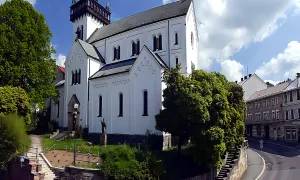
Kostel sv. Jana Křtitele se nachází severozápadně od kašny.
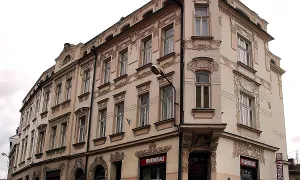
Tři roubené domy č.p. 102, 103 a 104 jsou historicky cenné.
Accommodation nearby
Trips and activities nearby
Guided tours, tickets and activities nearby from GetYourGuide
Affiliate link: if you buy from the partner, we may receive a commission. The price for you does not change.
Search tours and activities →Themed route
Thematic cruise route Semily
1. The spring of St. Wenceslas (fountain)
Type: Historical monument
Why is it worth a visit: This spring is connected to the legend of St. Wenceslas, who drew water here in his youth. It's a place full of history and impressive nature where you can enjoy peace and beauty.
2. Church of St. John the Baptist
Type: Religious object
Why is it worth a visit: This church is located approximately 500 meters northwest of the fountain. Its architecture and history make it an interesting location for those interested in spiritual monuments and ancient buildings.
3. Three Gagged Houses No. 102, 103 and 104
Type: Historical architectural complex
Why is it worth a visit: These houses are an example of a historic residential building in Semily. Their unique design and preservation of old traditions make them an ideal place for those interested in cultural heritage.
This track offers a view of the historical and natural beauty of the village Semily and is suitable for visitors interested in local monuments.
Seasonal recommendations
Spring brings with it awakening greenery and fresh colors that accompany the fine sunlight. The mood is soothing, and everything is alive thanks to the blooming nature. I recommend wearing layered clothes because the morning cold can still be felt. It's the best time for a quiet walk because the traffic is still low.
In the summer months, the spring is surrounded by a dense shadow and the sun creates sharp light differences. The water is very refreshing during hot days. For a higher number of people, I suggest you come early in the morning to enjoy your peace before the main summer period. Don't forget the light clothes and the headgear.
Autumn brings golden shades and a foggy morning to Semil, which gives the spring a mysterious touch. The colored leaves create a beautiful contrast to the original construction. It is advisable to carry a waterproof jacket and warmer clothing. The best is to visit the place in the afternoon when the light is the most golden.
Winter turns the space around the fountain into a quiet and freezing landscape where the water around the edges can be frozen. The day is short, so plan to visit around the noon hours when there is the most light. The need is for good winter clothes, including hats and scarves, so that the frost doesn't get you wet or warm enough.
Visualizations and artistic views


The visualisations are generated by artificial intelligence and serve as inspiration.
Photos from the area
Real photos taken near the monument


Zdroj a licence jsou uvedeny u každého snímku.
Tips from visitors
No tips yet. Be the first!
Log in and add your tip.
Sources and literature
Photos: Luděk Kovář – ludek@kovar.biz / CC BY-SA 3.0 — Wikimedia Commons. The author and licence also appear when you hover over the image.
Faktickým podkladem tohoto textu byl článek na Wikipedii, jehož autory jsou přispěvatelé Wikipedie. Článek je dostupný pod licencí CC BY-SA 4.0.
Location on the map

Příběhy a pověsti
Legendy, pověsti a příběhy spjaté s touto památkou

Fotografie návštěvníků
Zatím žádné fotografie. Buďte první, kdo přidá fotografii z návštěvy!
Log in a přidejte svou fotografii nebo hodnoťte.
Za ověřenou návštěvu v aplikaci získáte víc bodů — poznáme podle GPS, že jste na místě.
Reviews and comments