



Radkovský mlýn Water mill
Radkovský mlýn, also known as Kashparova, is a former water mill in the village of Hostim in Znojemsk. The building is located on the river Nedvece and represents a document of historical technical equipment of the countryside. In the past he served as a scrapper driven around on top water.
The first written mention of the mill dates back to 1824, when it was recorded on Imperial prints under the name Kaspar Mühle. At that time, during the national revival and maturing classicism, these mills performed the role of key economic nodes for the processing of agricultural crops.
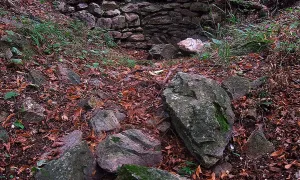
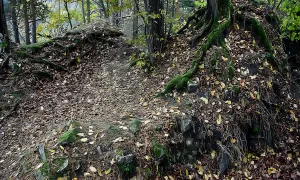
Architecturally, it's a wall of a one-story building. The mill and residential area are united under the same roof, although they are available separated. To drive the device, the wheel was used for the upper water. At a drop of 4.3 meters and a flow of 0.107 cubic meters per second, the power was 4 horsepower. In addition to the main building there was also a barn and other economic facilities. The remains of the drive are still visible in the field.
In 1930 he was the owner of the Antonín Radkovský building and at that time the mill worked as a scrapper. Later, the building was protected by monuments; in 1958 it was included in the list of real cultural monuments of the Czech Republic. This status was maintained by the mill until 1987 when the protection was terminated.
At present only parts of the drive and the masonry of the farm have been preserved from the original technical equipment. Today, the building serves as a reminder of the fading forms of rural management and the technical history of the region. Visiting this place offers the opportunity to explore the history of small rural architecture and to understand the importance of water structures for the then agricultural operation.
Historical milestones
- 1824
- The first written record of the mill on Imperial prints under the name Kaspar Mühle.
- 1930
- The object acted as a scrap metal driven by one wheel on top of the water.
- 1958
- Registration of the mill into the list of real cultural monuments of the Czech Republic.
- 1987
- Termination of monument protection of the building.
Architectural development
The building is walled and single storey, the mill and house are united under one roof. To drive the mill wheel was used a drive whose remains are still visible in the field. There was also a barn and other economic facilities.
Historical events
In 1824 the mill was first recorded on Imperial prints under the name Kaspar Mühle. In 1930, the object worked as a scrapper with a power of 4 HP. Between 1958 and 1987, the building was a state-protected cultural monument.
Owners
In 1930 he was the owner of Antonín Radkovský.
Points of interest
- The mill is also known as Kaspar's and lies on the river Nedveka. - The first written mention of the building dates back to 1824, when it was recorded under the name Kaspar Mühle. - The top water wheel reached four horsepower output at a given drop and flow. - In 1930 he was the owner of the Antonín Radkovský building and the mill worked as a scrapper. - The building was included in the list of real cultural monuments in 1958, which lasted until 1987.
Guide
Show guide text
This text was created by artificial intelligence and has not been editorially reviewed. It may contain inaccuracies.
Welcome to the village Hostim. You're standing in front of one of the most interesting places in this neighborhood, in front of Radkov Mill. Before we go into his story, let yourself stand for a moment and soak up the atmosphere of this place. Feel how the river Nedvek flows here and how its constant movement gives life to this whole place. In front of your eyes is a solid, walled building, which is very stable and permanent with its presence. It's a one-story building that has two worlds in it. Notice how one large guard covers the entire object, and yet everything is divided inside. On the one hand there is space for work, for mills, and on the other hand there is a residential area where human life was once led. This separation of spaces under one roof is a typical feature of buildings that had to be also a functional machine and home for their inhabitants.
Let us now move further into time together and look at how this mill was formed. Although this building may seem to you as part of the current landscape, its roots go much further than they might at first glance. The first clues we can find about this place in the written records dates back to 1824. Back then, the mill was recorded in documents under a name that may seem foreign to us today, but at that time it was quite common. That's when Kaspar's mill was written about him. Since then, this place has undergone many changes, but its essence as a place of water and work has remained. It's fascinating to think about how many people have worked in these areas and how many generations have been changing over the years.
Now pay attention to the construction itself and to what you can see directly. Focus on the wall and the overall structure of the building. Even though the mill is no longer used for original technical purposes, its architecture still tells the story of what it was used for. It is a building built with respect to the power of water and the need for resistance. In the past, it was not just about housing, but mainly about operating a machine. Notice how the building is adequate for the stream of the Nedveka. This whole object was considered very valuable in a certain period, namely from 1958 to 1987. It was included in the list of real cultural monuments of the Czech Republic. This means that people were aware of its historical weight and its importance to our history. Although this official protection was terminated after several decades, the value of this place as a witness to the past remains undeniable.
When we look at the history of this place, we can't forget the names that are associated with it. One of the important men we know about is Antonín Radkovský. In 1930, he was the owner of this building. You can imagine what it must have been like to manage a mill like that at the time. Radkovský became part of the history of this place and his name is firmly linked to him, as well as the mill in the people's memory connects with the name Kashparov. These names give us a human dimension, show us that behind every wall and every piece of wood were real people, their efforts, their work and their lives.
Now I want to invite you to think about one technical interesting thing that might surprise you. Imagine the power that once ruled this place. In 1930, the mill worked here as a crushing facility, a so-called scrapper. This machine was not powered by electricity or any other modern source, but by the river itself. It used a bicycle placed on top of the water. This means that the water hit the wheel from above, which required some construction and proper water flow. And the power was really impressive. With a certain flow of water and the correct slope of the river, this wheel was able to develop a performance that matched the force of four horsepower. Imagine the incredible energy that was poured through the wooden and metal parts of the machine and turned into a movement that could crush and process material. It was a combination of the natural power of water and human technical art.
There may not be much left of the original technical equipment today, but the atmosphere of the old working mill is still felt in every corner of this place. It's a place where calm nature meets the legacy of human labor. You are standing in front of a monument that has survived centuries, which has been protected as a treasure for our history, and which still reminds us today how people have been able to use nature's forces to make life easier for themselves.
I hope you're interested in this brief insight into the history of Radkovsky Mill. Before you go on your journey, I suggest you stand by the riverbank for a while and listen to the noise of water. You might hear in that sound the echo of an old wheel that once worked so hard. Welcome again to Hostimi and wish you a beautiful and inspiring walk around this beautiful neighborhood. Explore other secrets that this journey will offer. Goodbye.
Tips for visitors
The best time to visit is during sunny days in spring or autumn when the surroundings of the Nedveka river are picturesque and the state of the building is better visible without dense summer vegetation. Due to the poor condition of the building we recommend a visit only from outside in daylight.
You can easily reach the village Hostim by car. Check the public transport in the current search engine for Znojmo County.
Take with you fixed shoes because the terrain around the mill can be uneven and wet. Remember the charged camera if you want to capture the historical architecture of the mill and residential areas under one roof.
Soft morning or late afternoon light is most suitable for photography, which highlights the details of the masonry facade. The best shots are taken from the bank of the Nedvek River, from where you can see the overall layout of the building.
For families with children the location is suitable as a stop when walking around the river Nedveka. Due to the poor condition of the monument, take care of safety and do not enter the building, rather tell the children about the history of the miller's craft right in front of the building.
Frequently asked questions
Can the monument be visited?
This is a technical monument. Some are open as exhibitions, others are out of use or on private land. We have not verified whether this one is accessible. According to the heritage register the structure is in poor condition – do not enter it and take care nearby.
What are the opening hours and admission?
We have not verified the opening hours or admission. Current information is published by the operator.
Where is the monument?
Location: Hostim, Jihomoravský kraj. The map on this page shows the exact spot.
Why is the monument protected?
It is listed in the Central List of Cultural Monuments of the Czech Republic as a cultural monument (register no. 1000161808).
Businesses nearby
Do you run a restaurant, accommodation, shop, museum, rental, wellness or other visitor service near this monument? Show yourself directly to the people heading to it — this is how they will see you in the app and on the web:
Events nearby
Zdroj akcí: otevřená data měst a obcí ČR (Národní katalog otevřených dat) a kalendář akcí Národního památkového ústavu.
Nearby
Mlýn se nachází v obci Hostim v okrese Znojmo, v blízkosti říčky Nedveka.
Accommodation nearby
Themed route
Thematic cruise route: Radkovský mlýn and surroundings Hostim
1.Radkovský mlýn
Type: Mill
Why is it worth visiting: This historic mill is a unique example of the traditional agricultural industry. Visit him to see the ancient technique and understanding the former life in this area.
2
Type: River
Why is it worth a visit: Nedveka is a small but attractive river that gives the mill energy. A short walk along its shore offers a quiet and green atmosphere, ideal for relaxation.
3. Hostim Square
Type: City Centre
Why is worth a visit: The square in Hostim is the heart of the village and offers a view of historical architecture. It is an ideal place to relax after exploring the surrounding monuments.
4. Hostim Park
Type: City Park
Why is worth a visit: Park in Hostim is a beautiful place for relaxation and walks. Its green spaces are ideal for relaxing on a sunny day.
5. Hostim Municipal Building
Type: Historical building
Why is it worth a visit: This building is an important local monument that shows the history and culture of the village. Its architecture attracts people interested in the region's heritage.
This route offers visitors a view of the cultural and natural wealth of Hostim, with an emphasis on the historical mill as the main attraction.
Seasonal recommendations
In spring the mill will surround the lush greenery and awakening nature, creating a strong contrast with the crumbling state of the monument. The atmosphere is full of hope, but the surrounding roads may be wet. I recommend a shoe that can withstand mud, and a visit in the morning when the light is fine and pleasant.
The summer season brings thick foliage and sharp sun, which highlights every crack in the plaster. The air is getting hot and there are more visitors in the high season. It is best to come very early in the morning to avoid the biggest crowds, and choose light clothes and plenty of fluids.
In autumn, the landscape will turn into golden and brown tones, underlining the melancholy of this neglected place. The fog in the valley gives the building a mysterious touch and the silence is deeper. Suitable are layered dresses and a walk in late afternoon hours when the sun throws long shadows.
In winter, the white snow covers the mess and the mill works in the freezing silence very hard. The lighting is cold and the days are short. Don't forget to wear very warm clothes and tight shoes against glide.
Visualizations and artistic views

The visualisations are generated by artificial intelligence and serve as inspiration.
Tips from visitors
No tips yet. Be the first!
Log in and add your tip.
Sources and literature
Faktickým podkladem tohoto textu byl článek na Wikipedii, jehož autory jsou přispěvatelé Wikipedie. Článek je dostupný pod licencí CC BY-SA 4.0.
Location on the map


Příběhy a pověsti
Legendy, pověsti a příběhy spjaté s touto památkou
Fotografie návštěvníků
Zatím žádné fotografie. Buďte první, kdo přidá fotografii z návštěvy!
Log in a přidejte svou fotografii nebo hodnoťte.
Za ověřenou návštěvu v aplikaci získáte víc bodů — poznáme podle GPS, že jste na místě.
Reviews and comments