



Radnice v Benešově nad Černou Building
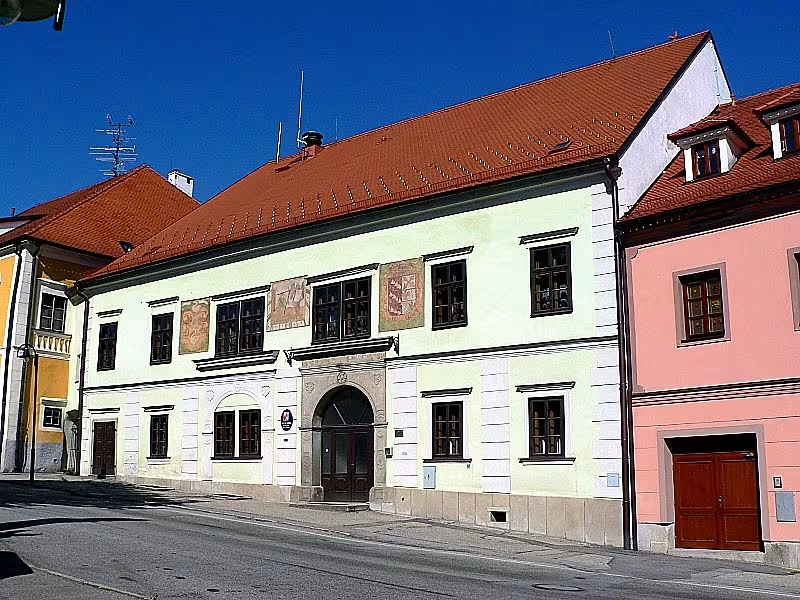
Radnice v Benešově nad Černou is a Gothic-Renaissance building from 1594. It stands in the northern part of the square in the village Benešov nad Černou in the district of Český Krumlov in the South Bohemia region. It is a major monument protected building and part of the urban monument zone registered in the Central List of Cultural Monuments of the Czech Republic.
The building was built in 1594, although an older building could have stood there earlier. At the time of construction there was already a brewery on part of the property. He had Jakub Krčín z Jelčan a Sedlčan built here in 1570, the then Rožberg Regent.
From the point of view of architecture it is a single-storey house on a rectangular plan, located in a mild slope. The ground floor of the facade is divided into six axes. The dominance is two semi-circular stone portals decorated with five-leaf Rožmberk roses. The entrance to the building ends with a forward ledge. The roof is saddle and covered with a giant. In the interiors are preserved original structural elements, namely rolled vault in passage, cross vaults in rooms and stone lining of portals.
The façade on the level of the first floor carries a sun clock and two fresco coat of arms. The emblem with swan belongs to the masters of Švamberk and the second, an alliance sign, belonged to Countess Maria Magdalena di Biglia. This symbol is related to the period when Benešov nad Černou, along with other Neo-hradian assets, belonged to the Buquoys. Jan Jiří ze Švamberka won the city in 1611 after the death of Peter Vok from Rožmberk. He gave the residents the right to cook beer and organize annual markets for St. James's Day and Easter Tuesday.
The town hall was originally joined by a rectangular wing of the brewery on the west side of the parcel. It was torn down by the late 1970s. The town hall itself was repaired in 1995.
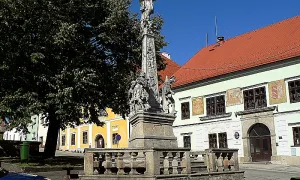
The building is immediately adjacent to the west with the Gothic-Renaissance townhouse No. 125. This is where the information centre, the municipal library and medical offices are located. Right in front of the town hall there is one of the three baroque couches and baroque pestilence column with statue of St. John Nepomuk and other sculptures of saints.
The town hall presents an authentic example of Renaissance architecture with distinctive nobility. Its visit allows you to perceive the historical character of the whole square and its monument zone.
Historical milestones
- 1570
- Jakub Krčín built a brewery on the site of the town hall
- 1594
- Building a Gothic-Renaissance Town Hall
- 1611
- Jan Jiří ze Švamberka acquired the city into its possession
- 1978
- Disposal of adjacent brewery wing
- 1995
- Town Hall Building Repair
Architectural development
The building is characterized as a Gothic-Renaissance building with a saddle roof covered by a bimbo. The interiors preserved rolled and crossed vaults and stone lining of portals. The building was originally joined by a brewery wing that was demolished in the late 1970s.
Historical events
1594 - city hall construction; 1995 - repair of city hall building.
Owners
In the past, the Rožmberk, Švamberk and Buquoy families linked the building and the surrounding property.
Points of interest
It's a Gothic-Renaissance building from 1594. - The dominant are two stone portals decorated with five-leaf roses of the family Rožmberk. - The facade on the first floor carries a sundial and two fresco coat of arms. - The brewery wing was originally attached to the premises, which was demolished in the late 1970s. - In the interiors are preserved original elements, such as a rolling arch in the passage and cross vaults in the rooms.
Guide
Show guide text
This text was created by artificial intelligence and has not been editorially reviewed. It may contain inaccuracies.
Welcome to Benesov over Montenegro. Right now, you're facing one of the most important buildings in the city, which is the town hall. If you look at it, you'll see a beautiful house with a rectangular base, which is gently leaning on a slight slope in the north of the square. It's a place where time stops and where you can feel the hollow space of history in every stone. Feel its overall form, which combines the transition of two great epoch, goth and renaissance, and thus creates a harmonious image that is not so common these days. Now let's go back a little bit in time to understand how this place came to be. The story of the town hall begins in the year of a thousand five hundred seventy, when Jakub Krčín z Jelčan a Sedlčan built a brewery here. At that time, beer was an important source of income and a heart of economic activity. But the city grew and the needs of administration changed. A few decades later, specifically in 1594, a building was created that you see before you in its present form. It was built as a town hall to serve as a centre of power and administration for the inhabitants and noble families who ruled around. The history of this place is closely linked to important personalities. In the year of a thousand sixties one took over the city into its ownership of Jan Jiří ze Švamberka, which left its mark. Together with him, names like Maria Magdalena di Biglia appear in connection with the city, which shows us that Benešov nad Černou was not just a small town, but a place where the paths of influential people crossed. Now I ask you to pay full attention to the details that you can see right in front of you. Look carefully at the stone entrances, the portals. They're the dominance of the entire building. Note the delicate decoration in the shape of five-leaf roses. These roses are not just a random ornament, but they are a symbol of the mighty Rožmberk family, which had a great influence in these areas. It's fascinating how such a small detail tells about political ties and who was holding the reins in their hands at the time. When you've already focused on the lower part of the building, raise your eyes higher, towards the front of the first floor. Notice the sun clock. At a time when no one had digital devices in their pocket, these clocks were a necessary helper for all the bystanders to know just how much time it was. Next to the clock you will also see a historical coat of arms that are carried out in the form of frescoes. These paintings on the plaster are silent witnesses of the past and remind us of the people and families who once decided on the fate of the city. The whole facade works like an open book, which you just need to read carefully. Let's stop for a moment with one interesting thing that may not be visible at first sight, but it's important to understand how the town hall looked earlier. If you look at the space around the building, you might feel that there might be something more. And you're right. Originally attached to the town hall was the brewery wing, which follows the beginnings of this place, which we talked about at Jakub Krčín. But this wing remained a memory because it was demolished in the late 1970s, namely in the year one thousand nine hundred seventy-eight. That changed the silhouette of the building we know today. However, the town hall survived these changes and in the year one thousand nine hundred and ninety-five it underwent a repair, which is now in such good condition and can be registered in the Central List of Cultural Monuments of the Czech Republic. It's fascinating to think how many generations of people have gone through these portals with five-leaf roses. How many debates took place in the town hall and how many views fell on the sun clock on the facade. The building stands in a slight slope, which gives it a certain dynamic character, as if reaching from the square. It is a place where the craftsmanship of unknown architects combined with the ambition of a nobleman and the needs of the people. Now that you have looked at the main details and learned about the history of this Gothic-Renaissance house, I would advise you to take a moment quietly to perceive the atmosphere of the square. Try to imagine the sound of cars on stony roads and hKrav people meeting here hundreds of years ago. Radnice v Benešově nad Černou is more than just an administrative building, it is a monument to time and human effort. Thank you for coming through the history of this beautiful place. I hope that this information has enriched you and that you have noticed all the details, from the little roses on the portals to the sun clock high on the wall. Now you can continue to explore the beauty of this city. I wish you a pleasant walk and many other discoveries. Goodbye.
Tips for visitors
For the best observation of architecture we recommend a visit during bright days when the sun lights up stone portals. The ideal time is the morning when the light is soft and suitable for shooting facade details.
The city hall can be reached by car and public transport; Check the current connection in the electronic search engine. The trip to Benešov nad Černou is easy and the surroundings offer a pleasant environment.
The best place for photography is right in front of the building, where the Baroque pestilence column with the statue of St. John Nepomuk and the Baroque fountain can be captured. On the west edge of the square you can see the Gothic-Renaissance townhouse No. 125.
If you come with your family, we recommend you bring a drink and a snack. For children it can be an interesting experience to view statues and historical fountain right on the square.
Frequently asked questions
Can the monument be visited?
The building is in use (offices, a school, shops and the like). The interior is generally accessible only during operating hours and tours are not usually offered; we have not verified the details. You can see the exterior from the street.
Where is the monument?
Location: Benešov nad Černou. The map on this page shows the exact spot.
Why is the monument protected?
It is listed in the Central List of Cultural Monuments of the Czech Republic as a cultural monument (register no. 1000131146).
Businesses nearby
Do you run a restaurant, accommodation, shop, museum, rental, wellness or other visitor service near this monument? Show yourself directly to the people heading to it — this is how they will see you in the app and on the web:
Nearby
Přímo před radnicí stojí barokní morový sloup se sochou svatého Jana Nepomuckého a jedna z tří barokních kašen. Na západě navazuje goticko-renesanční měšťanský dům čp. 125.
Accommodation nearby
Trips and activities nearby
Guided tours, tickets and activities nearby from GetYourGuide
Affiliate link: if you buy from the partner, we may receive a commission. The price for you does not change.
Search tours and activities →Themed route
Here is a proposal for a short walk through the centre of the village:
1. Radnice v Benešově nad Černou - Main building of municipal administration. It is a central point of visit and architecture of local importance.
2. Plague column - Baroque monument with statue of St. John Nepomuk. He's standing right in front of City Hall, reminiscent of ancient times.
3. Baroque fountain - Historical water source. One of three similar water containers in the area that decorate the area outside the town hall.
4. Town House No. 125 - Gothic-Renaissance building. Located west of town hall and represents a rare piece of old urban housing.
Seasonal recommendations
In spring, the surrounding area of the building awakens into green colour and the fresh air accompanies the first sun rays. It is advisable to start in the morning when the light is fine and suitable for observation of the facade. We recommend light but layered clothing to protect against changing weather.
In the summer months, clear light and hot air dominate space. It is best to visit the place in the early hours of the morning or at dusk to avoid the hot heat. Practical is the choice of breathable clothes and hat for head.
Autumn brings golden shades of leaves and a specific, quieter atmosphere to the surroundings. The walks are pleasant in the afternoon when the sun paints the walls into warm tones. It is advisable to choose waterproof shoes and a light jacket.
In winter, the construction works in contrast to freezing air and possible snow. The ideal is a visit in the Advent time, where the surroundings get cozy. Hot clothes, including gloves and hats, are essential to avoid cooling.
Visualizations and artistic views

The visualisations are generated by artificial intelligence and serve as inspiration.
Photos from the area
Real photos taken near the monument


Zdroj a licence jsou uvedeny u každého snímku.
Tips from visitors
No tips yet. Be the first!
Log in and add your tip.
Sources and literature
Photos: Lovecz 10:12, 24 September 2006 (UTC) / Public domain — Wikimedia Commons. The author and licence also appear when you hover over the image.
Faktickým podkladem tohoto textu byl článek na Wikipedii, jehož autory jsou přispěvatelé Wikipedie. Článek je dostupný pod licencí CC BY-SA 4.0.
Location on the map
More monuments – Benešov nad Černou
Show all in the municipality
Příběhy a pověsti
Legendy, pověsti a příběhy spjaté s touto památkou
Fotografie návštěvníků
Zatím žádné fotografie. Buďte první, kdo přidá fotografii z návštěvy!
Log in a přidejte svou fotografii nebo hodnoťte.
Za ověřenou návštěvu v aplikaci získáte víc bodů — poznáme podle GPS, že jste na místě.
Reviews and comments