



Radnice v Sušici Town hall
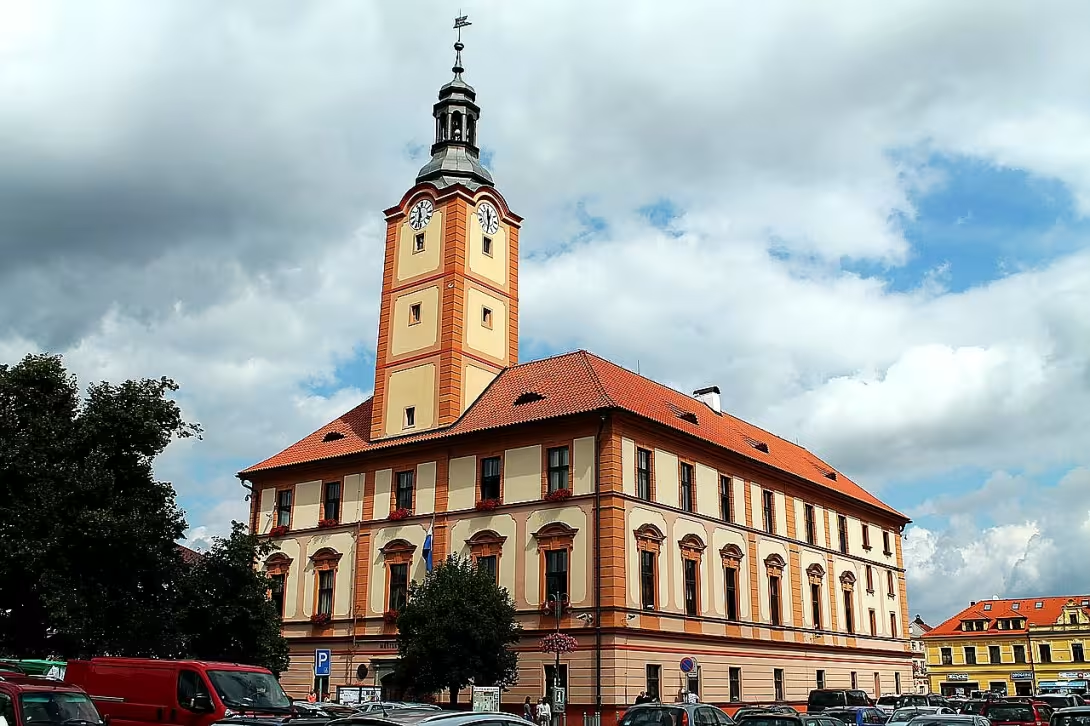
Sushi Town Hall, located in the middle of the rectangle of Svoboda Square in the heart of Susice, is a historic monument with a rich past background. Originally built at the end of the 16th century, the town hall won its present form only in the middle of the 19th century. Its dominant element is a 31 metre tall tower, accessible to the public after the request at the information centre. The town hall is protected as a cultural monument of the Czech Republic and today serves as a seat of the Municipal Office, local police and information centre.
The history of the Sušice Town Hall is characterized by repeated fires that hit the city in the 16th century. After a big fire in 1592, a new town hall in the Renaissance style was built on the square. This building was captured by the local humanists who wrote poems about it, especially because of its clock and tower. However, after another big fire in 1707, the building was badly damaged. The reconstruction was led by Italian builder Carlo Zanetti, who added new elements and expanded the building. In 1850-1851 there was a significant change when the town hall acquired its present form.
Architecturally, the Dry Town Hall went through several phases. The original Renaissance style was rebuilt after the fire in 1707 and extended under the direction of Carlo Zanettiho. In 1850-1851 there was another change when the town hall acquired its present form. The last big change occurred in 1898 when builder Rajmund Denk removed Renaissance windows and classicist shields.
Over the years, the city hall has changed several times. After the fire in 1707 the building was rebuilt Carlo Zanettim, which enlarged it and added new elements. In 1850-1851 there was another change when the town hall acquired its present form. The last big change occurred in 1898 when builder Rajmund Denk removed Renaissance windows and classicist shields.
Drying Town Hall is full of interesting things. In the wall in the lobby there is a stone slab of Jan of Luxembourg, which reminds of the construction of city walls in 1322. In reconstruction in 2002- 2004, cracks were discovered after a fire in 1707 and 19th century paintings. On the left corner was preserved the bell Planýr, which was used to report fires.
Today, Susická Town Hall is not only a cultural monument, but also an active place for city authorities. Its history and architecture make it an important attraction for tourists and the inhabitants of Susice. Visiting the town hall offers an opportunity to become familiar with the rich past of the city and appreciate the artistic elements that make it unique.
Dushika Town Hall is not only a monument to architecture, but also a witness to the history of the town of Susice. Its importance for the local community and tourists today remains unchanged. Visiting this monument offers a unique opportunity to become familiar with the region's rich history and culture.
Historical milestones
- 1322
- Building city walls
- 1592
- Great fire and subsequent construction of the new Renaissance Town Hall
- 1707
- Large fire and subsequent reconstruction by builder Carlo Zanettim
- 1850-1851
- Significant transformation of the building into its current form
- 1898
- Removal of Renaissance windows and shields by Rajmund Denko
- 2002-2004
- Reconstruction and discovery of historical paintings and cracks
Architectural development
Dry Town Hall has undergone several phases of construction and reconstruction. Originally built in the Renaissance style, it was badly damaged after the fire in 1707. The reconstruction was led by Italian builder Carlo Zanetti, who added new elements and expanded the building. Between 1850 and 1851 there was a significant change when the town hall acquired its present form.
Historical events
- 1592
- After the fire, a new town hall was built in the Renaissance style.
- 1707
- The big fire has damaged the building considerably.
- 1850
- The building acquired its present form during reconstruction.
Points of interest
- Sushice Town Hall is located in the middle of the rectangular Square of Svoboda in the center of Susice. - Originally built at the end of the 16th century, it gained its present form in the middle of the 19th century. - In the wall in the vestibule there is a stone slab of John of Luxembourg, which reminds of the construction of the city walls in 1322. - In reconstruction in 2002- 2004, cracks were discovered after a fire in 1707 and 19th century paintings. - On the left corner, the planner bell was preserved, which was used to report fires.
Guide
Show guide text
This text was created by artificial intelligence and has not been editorially reviewed. It may contain inaccuracies.
Welcome to the heart of the city of Susice. Stop for a moment, take a breath and look around you. Right now, you're standing in the center of the rectangle of Liberty Square, which forms the natural core of this city. In front of you is a building that is not only the administrative center, but above all a silent witness to centuries of local history. It's Drying Town Hall. Look at her face, perceive her power and the sense of stability that radiates. It is a place where, for generations, decisions have been made about the fate of the city, where citizens met and the history of this area was written.
When you look at this construction today, you see the result of a long and sometimes very dramatic process. To understand why City Hall looks like this, we have to go back to the past in our minds. The story of this building is the story of constant renewal and efforts to rebirth. The first major breakthrough came in a thousand five hundred ninety-two. At that time, the city hit a big fire that destroyed many valuable buildings. It was from the ashes of this disaster that a new Renaissance town hall was built at the end of the 16th century. At that time, the town hall was a symbol of the prosperity and ambition of Susic, a reflection of contemporary taste and desire for modernity.
But fate was once again cruel to the building. In a thousand and seven hundred and seven, the city once again engulfed a devastating fire. Imagine the chaos and despair of the people who saw their center go up in flames again. But even this time, the Sushi didn't let them beat each other. A builder named Carlo Zanetti was invited to the reconstruction. It was his hands and visions that helped the building to rise again from the wreckage and brought new elements to its appearance that reflected the needs and style of the time.
If you look carefully at the overall form of the town hall, you will see something other than pure Renaissance or early Baroque style. This is because the building underwent its most significant transformation in the mid-nineteenth century. Between a thousand and eight hundred and fifty and a thousand and eight hundred fifty one, the town hall was essentially rebuilt into the form you see in front of you right now. It was a time of great changes in architecture and society, and the town hall was supposed to reflect a new era.
Now please pay attention to the most significant element of the entire building. Look up. Your sight is certainly dominated by a tall tower that reaches a height of 11 meters. This tower is not only an ornament, but it served as a view and symbol of the city's power. It's fascinating to think how many people were looking at the surrounding landscape from the top or watching passengers arriving in town. The good news for you is that this tower is open to the public, so if you have the opportunity, I suggest you visit it and see the city from a bird's-eye perspective.
Interestingly, the building was also changing in details that may no longer be seen today, but left a trail in its history. The end of the nineteenth century, namely the year one thousand eight hundred ninety-eight, brought another hit. The builder Rajmund Denk decided to remove Renaissance windows and shields. By doing so, the building definitely got rid of part of its original Renaissance appearance and gained a face that was consistent with the ideas of aesthetics at the time. It is a reminder of how the perception of beauty and architecture changes over time and how each generation has made it easier to build its own piece.
Now let's think about what's inside. Even though City Hall today serves as a city office, its walls keep secrets from much older times. If you enter the lobby, I suggest you look up one very important thing. There is a stone slab of John of Luxembourg in the wall. This board brings us even deeper into history, up to a thousand three hundred twenty-two. Reminds her of building city walls that once surrounded and protected them from enemies. It's a fascinating contrast when you find a 19th-century trail in one of the buildings, and also a reminder of the 14th-century walls. This board is a bridge between today and the early Middle Ages.
The history of the town hall does not end with the construction of stones and facades. Modern times have brought us new discoveries. In the years two thousand two to two thousand four, there was extensive reconstruction. Something unexpected happened during these works. Under layers of paint and dust were discovered historical paintings and cracks that tell their own, silent story about the antiquities of this place. These findings are for historians because they allow us to look beneath the surface of the present and see what the building looked like in the past centuries.
Today, when you stand before this cultural monument of the Czech Republic, feel it as a living organism. It's not just dead stone and mortar, it's a record of human endurance. She's been hit three times by a disaster or a major change, and she's recovered three times. From the Renaissance beginnings to the interventions of Carl Zanettiego and Rajmund Denko to today's care for her details.
Notice how City Hall fits into the overall rhythm of Liberty Square. Its location right in the middle of the rectangular space gives it a natural authority. It's the center of the city's life. It's a place where official duty blends with a deep sense of history.
Now that you know the story of this building, I suggest you examine it closely. Walk around her facade, perceive the texture of the walls and try to imagine what she would look like in a thousand seven hundred or a thousand eight hundred fifty. Look at that tall tower again, and you might see a guard in it who's been watching the peace of the Susic for hundreds of years.
I hope this short trip in time has helped you understand more what you see before you. The city hall in Sushice is proof that even if fire destroys material things, the will of people to build and create remains. It's a place that connects Jan Luxembourg to modern citizens of the city.
That concludes our stop at City Hall. It's up to you now. Explore the surroundings, feel the atmosphere of the square and let yourself be inspired by the history that is present in every stone. I wish you a pleasant continuation in discovering the beauty of the city of Susice. Goodbye.
Tips for visitors
The best time to visit the Sušice Town Hall is in the spring or autumn season when the weather is pleasant and sunny and gives the buildings a life. This light is ideal for photography, especially in the morning or evening when shadows can be used to highlight architectural details.
When visiting City Hall, bring your protective sunglasses, especially during the summer period when the light can be strong. Photographing the building is the best of all angles, whether you're standing on the street or looking from the surrounding heights.
There is no other place to visit in the vicinity of the town hall. However, the centre of Susice offers several historic buildings and picturesque streets that can be explored on foot.
Frequently asked questions
Can the monument be visited?
The building is in use (offices, a school, shops and the like). The interior is generally accessible only during operating hours and tours are not usually offered; we have not verified the details. You can see the exterior from the street.
Where is the monument?
Location: Sušice I. The map on this page shows the exact spot.
Why is the monument protected?
It is listed in the Central List of Cultural Monuments of the Czech Republic as a cultural monument (register no. 1000154324).
Businesses nearby
Do you run a restaurant, accommodation, shop, museum, rental, wellness or other visitor service near this monument? Show yourself directly to the people heading to it — this is how they will see you in the app and on the web:
Events nearby
Zdroj akcí: otevřená data měst a obcí ČR (Národní katalog otevřených dat) a kalendář akcí Národního památkového ústavu.
Nearby
🏰 Historic sites (148)
- Arnošt Fischer 0.0 km
- Josefina Fischerová 0.0 km
- Bedřich Borger 0.0 km
- Jan Seitz 0.0 km
- Karel Gutmann 0.1 km
- Karolina Gutmannová 0.1 km
- Otto Gutmann 0.1 km
- Rudolf Gutmann 0.1 km
- Emil Lažanský 0.1 km
- Olga Fürthová 0.1 km
- Arnošt Fürth 0.1 km
- Pamětní deska Brána Šumavy v Sušici 0.1 km
- Irma Laschová 0.1 km
- Hynek Lasch 0.1 km
- Muzeum Šumavy v Sušici 0.1 km +420 376 528 850 web
- Josef Klinger 0.1 km
- Hermina Klingerová 0.1 km
- Františka Klingerová 0.1 km
- František Klinger 0.1 km
- Antonín Klinger 0.1 km
🍽️ Restaurants and dining (106)
- Bistro Sirena 0.0 km +420 776 640 479
- Vinárna U Štepána 0.1 km
- Kavárna Koruna 0.1 km
- U Rybicek 0.1 km
- Občerstvení McVítek 0.1 km
- Café & Snack Madam Čokoláda 0.1 km
- Kavárna Galerie 0.1 km +420731055432 web
- Pípa & Vývrtka 0.1 km
- Rejnička Kafe 0.1 km +420 731 021 771 web
- Restaurace Fialka 0.1 km
- Pizzeria Paradiso 0.1 km
- Restaurace U Muzea 0.1 km
- Café L´amour 0.1 km
- Bejkárna 0.2 km
- Lidový dům 0.2 km
- Snackdog Bistro 0.2 km
- U Vítovců 0.2 km +420 376 523 224 web
- Sokolovna Sušice 0.3 km
- Hotel Fuferna 0.3 km web
- U Chovatelů 0.3 km
🏨 Accommodation (84)
- Hotel Gabreta 0.2 km +420376523308 web
- Pension Milli 0.2 km
- Vítovec 0.2 km +420376523224 web
- Restaurace Hotel Na Pekárně 0.5 km
- Hotel U Daliborky 0.6 km
- Chatová Osada Luh 1.1 km +420 601 264 019 web
- Svatobor chata 2.4 km +420 605 418 433 web
- Kemp Sušice 2.4 km web
- Lázně Wodolenka 2.6 km +420 607 833 081 web
- Hotel Pod Svatoborem 3.7 km
- Zámek Hrádek, s. r. o. 3.7 km web
- Penzion v Lukách 4.0 km +420 731 458 267 web
- Chalupa na Šumavě 4.3 km +420 777 34 30 51 web
- Dobršín 4.4 km +420724517143
- Gandalf 5.0 km
- Autokemp Annín 2 5.7 km
- Annín Tree Park Camp 5.7 km web
- Autokempink Nové Městečko 5.8 km web
- Penzion Pozorka 5.9 km
- U Luhanů 5.9 km +420 376 588 193 web
🚲 Rentals and sport (18)
- Sport Zdeněk Schwarzkopf 0.1 km
- CYKLO A SKI SERVIS Vlastimil Míčka 0.1 km +420 376 523 384 web
- Jízdní Kola - Petr Čácha 0.2 km
- Highpoint.cz - Sport Schwarzkopf 0.2 km
- Sportovní hala 0.3 km
- OP kola 0.3 km
- Otava - Na Fufernách 0.3 km
- Půjčovna lodí Lodní servis Strakonice - výdejní místo Sušice 2.8 km +420 775 552 232 web
- Samba 2.8 km +420 604 904 737 web
- Samba 2.9 km +420 604 904 737 web
- koupaliště 5.3 km
- koupaliště 5.7 km
- Čápovna 6.4 km
- koupaliště 7.8 km
- Sportovní a rekreační areál TJ Žihobce 7.8 km web
- Koupaliště 8.1 km
- Střelnice Ústaleč / Shooting range 10.0 km +420 723 247 293; +420 602 524 544
- Sportovní hala Kašperské Hory 10.0 km
🥾 Hiking and nature (264)
- Vrch Anděla Strážce 0.7 km
- Stará Vodárna 1.0 km
- Lesopark pod Kalichem 1.1 km
- Žižkův vrch 1.1 km
- Okrouhlice 1.2 km
- Šibeník 1.3 km
- Mrozovka 1.7 km
- Hrádek 2.2 km
- Kalovy 2.2 km
- Svatobor - rozhledna 2.4 km web
- Svatobor 2.4 km
- Kozlová 2.5 km
- Studánka Kalovy 2.5 km
- V Zálužském lese 2.7 km
- Suchý vrch 3.0 km
- Hřeben 3.2 km
- Lejtná 3.5 km
- Na homolce 3.6 km
- Zámecký park 3.6 km
- Hora 3.6 km
Accommodation nearby
Themed route
Thematic cruise route from Dusice with the main destination of City Hall
1. Radnice v Sušici (Town Hall) Type: historical monument Why is it worth a visit: This town hall is one of the oldest and most important Gothic buildings in Central Bohemia. Its distinctive gothic elements, such as the slender rising towers and rich history, make it necessary for every visitor of the city. In addition, we find a museum offering a view of the history of Susice.
2. Square of Peace (Square) Type: public square Why is it worth a visit: Peace Square is the center of the city and creates a unique atmosphere with surrounding buildings. It's a place where history and modernity meet. Here you can enjoy quiet moments in the square or explore nearby shops and restaurants.
3. Church of St. Jacob the Greater (Church) Type: sacral monument Why is worth a visit: This church is an example of Baroque architecture and is famous for its rich history and artistic elements. Its interior offers a view of beautiful paintings and sculptures, which are an important part of the cultural heritage of the city.
4. Dryer Dryer (brewery) Type: historical brewery Why is worth a visit: The brewery is one of the oldest and most famous in the Czech Republic. Here you can explore the brewing process and, of course, enjoy the drinks that are the result of the tradition of thousands of years.
5. Square of Liberty (Square) Type: public square Why is it worth a visit: This square is another center of the city where there are various cultural and historical monuments. It is a place to relax and explore other attractions of Susice.
This route allows you to explore not only the main monument, but also other key points of the city that bring a rich cultural and historical experience.
Seasonal recommendations
In spring, the town hall building will be surrounded by a fresh green and fine light. The atmosphere is full of hope and awakening nature around the square. I recommend wearing more layers of clothing because the weather is variable. The best time to observe the facade is morning hours, when the sun illuminates the details gently.
The summer season brings sharp sun and rich colors of surrounding vegetation. The square is vibrant and dynamic. Choose light, breathable substances for a comfortable walk. To avoid the greatest heat, plan your visit to late afternoon hours when the air is more pleasant.
In autumn, the surroundings of the town hall turn into golden and brown tones, while morning fog gives the place a mysterious touch. The light is softer and richer in this period. Don't forget the waterproof coat or umbrella and warmer sweater. Ideal is the morning time, when the colours of the leaves are the most distinctive.
In winter, the historical building is very quiet, often accompanied by snow sheets and short days. Evening lighting in advent time creates a cozy mood. It is necessary to wear a warm coat, gloves and a hat. Due to the rapid setting of the sun, I suggest we start in the morning.
Visualizations and artistic views

The visualisations are generated by artificial intelligence and serve as inspiration.
Photos from the area
Real photos taken near the monument

Zdroj a licence jsou uvedeny u každého snímku.
Tips from visitors
No tips yet. Be the first!
Log in and add your tip.
Sources and literature
Photos: Harold / CC BY-SA 3.0 — Wikimedia Commons. The author and licence also appear when you hover over the image.
Faktickým podkladem tohoto textu byl článek na Wikipedii, jehož autory jsou přispěvatelé Wikipedie. Článek je dostupný pod licencí CC BY-SA 4.0.
Location on the map
More monuments – Sušice I
Show all in the municipality



Příběhy a pověsti
Legendy, pověsti a příběhy spjaté s touto památkou
Fotografie návštěvníků
Zatím žádné fotografie. Buďte první, kdo přidá fotografii z návštěvy!
Log in a přidejte svou fotografii nebo hodnoťte.
Za ověřenou návštěvu v aplikaci získáte víc bodů — poznáme podle GPS, že jste na místě.
Reviews and comments