



Rotunda svatého Michala Church
Under the floor of the parish church of St. Michael's archangel in the Old Town near Uherské Hradiště lies the remains of the Grand Moravian Rotunda. The building from the 9th century was unveiled in 1962 by archaeologist Vilem Hrubým during a survey of the church, approximately 23 centimetres below the pavement at the time. Today, the remains of the foundation and above-ground masonry are 22 centimeters high under a transparent glass plate that was installed after a large archaeological research in 1997.
Rotunda had a circular ship with a half-assed eastern-oriented priesthood. The builders built it out of quarry sandstone bound with lime mortar and supplemented it with old burnt bricks from the dismantling of nearby Roman buildings from the 3rd century. These bricks were marked by the 14th Legion of Carnunt. From the inside, the rotunda was plastered with a white plaster, the floor formed a layer of rock covered with mortar. Archaeologists found that the floor was repaired during use, suggesting a relatively long construction function.
Rotunda wasn't lonely. In its vicinity were found the remains of the palace of an important great moss with traces of a luxurious regretted floor. Both buildings connected the gravel road. This proves that it was a property church of the Grand Moravian Emperor and part of the Grand Moravian Empire's power district.
Surprisingly, the rotunda survived the fall of Great Moravia. The finding of King Ota I. 's denar from 1061 to 1086 proves that the settlement continued here. In the 11th and 12th centuries there was a parish and cemetery church. At the beginning of the 13th century it was converted into a hall church with a rectangular boat, which is still here.
The dating was difficult because on the spot it was continuously buried for eleven centuries and the layers mixed. Archaeologists therefore helped themselves by comparing the findings of Mikulčice, Pohanska in Breclav and other major Moravian sites. The quality of high lime mortar, second-used Roman bricks, painted floors and graves with large Moravian jewellery clearly confirms the dating and origin of the construction. Rotunda is one of the most valuable documents of Great Moravian architecture in the region and is part of the Old Town character.
Then and now
Drag the slider to compare how the landmark may have looked when it was built with the view today.

The historical appearance on the left is an AI-generated visualisation and serves as inspiration only.
Historical milestones
- 1962
- Discovering the foundations of the rotunda by archaeological exploration of Wilhelm Hrubý during the reconstruction of the parish church.
- half of the 9th century
- The position of the rotunda as the sacral structure of the Grand Moravian monarch or the Grand Master.
- 1. half of the 13th century
- Rebuilding the rotunda into a hall church, where part of the foundation was dismantled.
- 1997
- Control archaeological research after the flood with the visibility of rotunda remains.
Architectural development
Rotunda was built from quarry sandstone and lime mortar using Roman bricks from the 3rd century. Some of the foundations and 22 cm above ground masonry were preserved with white plaster. In the 1st half of the 13th century, the rotunda was converted into a hall church, with part of the foundations being dismantled and used in reconstruction. In 1962, the bases were exposed by archaeological research, and in 1997 a flood inspection was carried out with visible remains.
Historical events
9th century: Construction of the Rotunda
Points of interest
- Rotunda svatého Michala was built in the 9th century and its remains were uncovered in 1962 by archaeologist Wilhelm Hrubým.
- The building was built from a quarry sandstone and old burnt bricks from a Roman building from the 3rd century, bearing the marks of the 14th Legion of Carnunta.
- Rotunda had a circular boat with a half-assed eastern-oriented priesthood and was plastered with a white plaster.
- In its vicinity were found the remains of the palace of an important great moss with a luxurious regretted floor, connected with a rotunda gravel road.
- The finding of King Ota I. 's denar from 1061 to 1086 proves that the settlement continued after the fall of Great Moravia.
Guide
This guide is narrated by a synthetic voice generated by artificial intelligence.
Show guide text
This text was created by artificial intelligence and has not been editorially reviewed. It may contain inaccuracies.
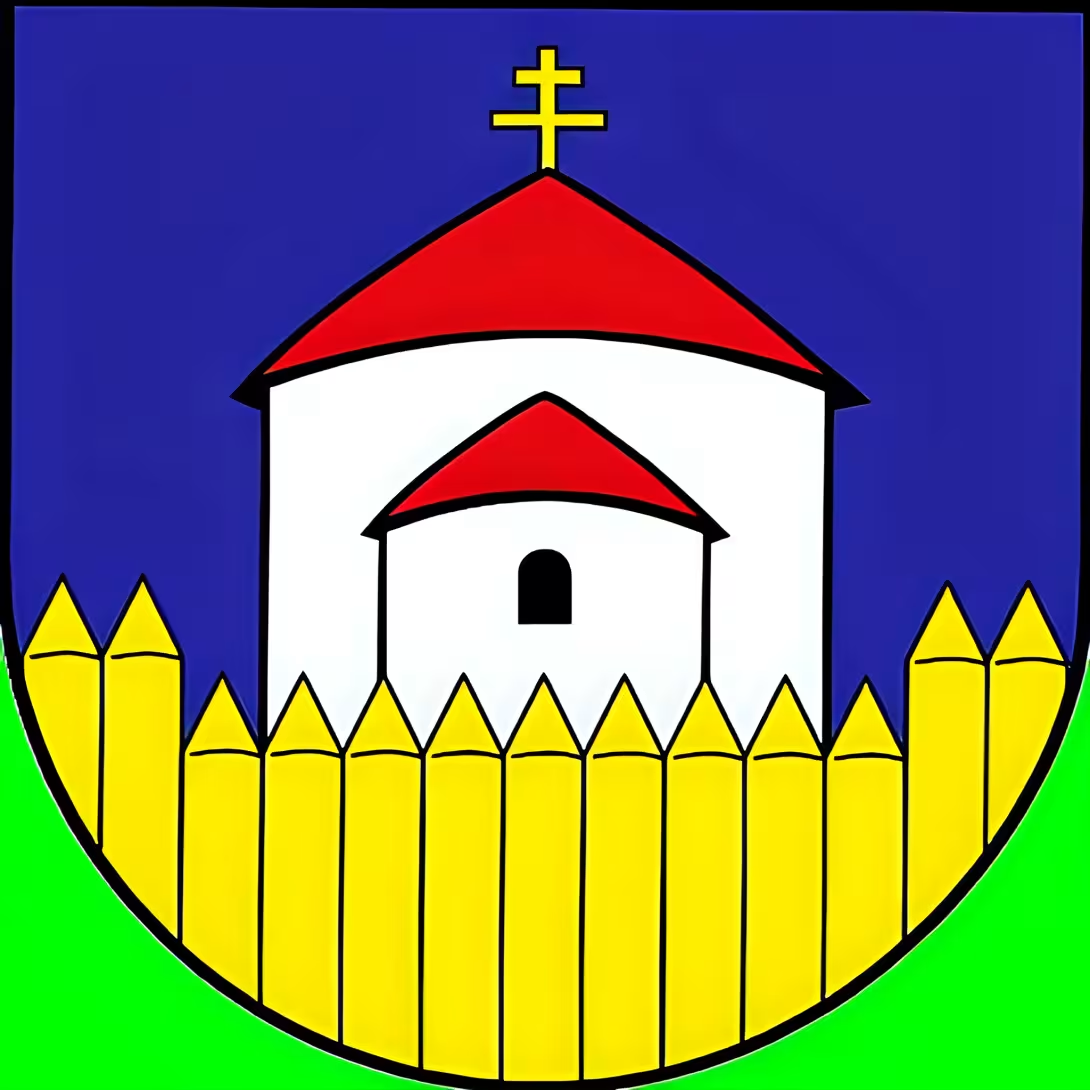
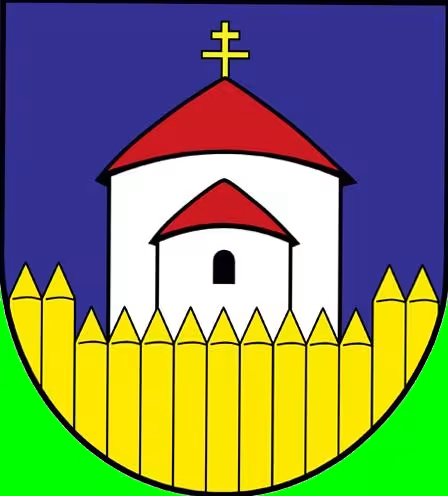
In Old Town near Uherské Hradiště, there stood a Great Moravian rotunda of Saint Michael in the 9th century. Together with a palisade, it is today the main motif of the coat of arms of Old Town.
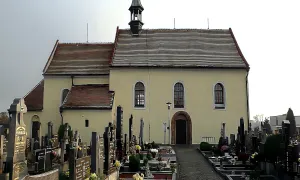
Its foundations were discovered by archaeologist Vilém Hrubý in 1962. He was then examining the interior of a late Romanesque parish church of Saint Michael the Archangel. It is a hall-type building from the first half of the 13th century in the eastern part of the Old Town cemetery. The remains of the rotunda lay only 23 centimeters below the floor level at that time. The foundation of the circular nave made of quarried sandstone bonded with lime mortar was preserved. Above it remained a 22-centimeter-high piece of wall, plastered on the inside with white plaster. The rest of the foundations outside the church did not survive because builders dismantled the stones and reused them. Only faint traces of the chancel remained under the sacristy that was added in 1939.
It was not possible to determine the age by the layers. After all, people have been buried in the cemetery continuously for eleven centuries and the layers are completely mixed. Archaeologists therefore compared the rotunda with findings from Mikulčice, from Pohansko near Břeclav, and from other locations in Old Town. Great Moravian origins are documented by Roman bricks, high-quality mortar with a higher proportion of lime, cast mortar floors similar to terrazzo, and graves with typical Great Moravian jewelry. The building probably began in the middle of the 9th century.
The rotunda had a circular nave and a semicircular chancel to the east. In addition to sandstone, fired Roman bricks were used during construction, often bearing the stamp of the fourteenth legion from Carnuntum. They probably come from a nearby, still undiscovered Roman building from the 3rd century. The floor was made of fine aggregate poured in mortar. Later it was renewed in a different way: on the original layer was added rammed earth, crushed sandstone and brick fragments, all again poured in mortar. This too testifies to the fact that the rotunda was in use for a relatively long time.
It was probably a proprietary church of a Great Moravian ruler. Nearby, foundations of a stately palace were found, connected to the rotunda by a gravel path. Thus the rotunda belonged to an important seat of power and possibly to the entire Great Moravian Empire.
It survived the fall of Great Moravia. This is documented by a penny of Otto the First the Handsome from the years 1061 to 1086 and also by an S-shaped bronze hair ornament, the so-called earlock clasp. In the first half of the 13th century, Cistercian monks from Velehrad rebuilt it into a larger hall church with a rectangular nave.
After the major flood in 1997, another investigation took place. Since then, part of the foundations has been illuminated and covered with a transparent glass plate.
Tips for visitors
Best visiting time
Visiting St. Michael's rotunda is best planned for spring or autumn months when there is pleasant weather and fewer visitors. The sunny morning clock provides ideal light for shooting indoor spaces. If you want to avoid crowds, go on Monday or Wednesday, when the interest in memory is lower. In summer it is advisable to wear light shoes to places with shadows because the surroundings are often sunny.
It is recommended to use public transport as the centre is often burdened with transport. The location is well accessible by car on the roads leading to the historical core.
What to take with you
When visiting rotunda take comfortable shoes because it is a historic location with uneven terrain. It is important to have enough water, especially in the summer months. A small flashlight or mobile light will be useful for interior photography, because the lighting in the rotunda can be limited.
Photography - best places and light
The most beautiful photos can be taken when entering the rotunda, where the circular plan is combined with the surrounding historical environment. For the interior is ideal light in the morning, when the sun rays illuminate the walls and ceiling. The best angle for shooting is from the outside where the overall rotunda architecture is captured. It is possible to capture the surrounding cemetery with tombs, which offers interesting contrasts between nature and historical findings.
What to visit in the vicinity (within 30 minutes)
In a radius of 30 minutes from the rotunda of St. Michael there are several interesting locations. You can visit the parish church of St. Michael Archangel from the 13th century, which is just a few minutes walk from the rotunda. There is a cemetery nearby with tombs from the 11th-13th century, which offers the opportunity to know the medieval culture of burial.
Tips for families with children
Rotunda svatého Michala' is ideal for families with children because it offers space to explore and discover historical findings. Children can see the circular structure and imagine what the great Moravian sacral architecture looked like. It is possible to visit the cemetery with tombs where children can talk about medieval customs. It is recommended to take some activity with you, such as painting or plates, so that children have something to do during the tour.
Frequently asked questions
Can the monument be visited?
Religious buildings are usually open mainly during services; at other times a visit is normally arranged with the parish or the operator. We have not verified specific times.
Where is the monument?
Location: Staré Město, Zlínský kraj. The map on this page shows the exact spot.
For kids
Imagine going back to when Staré Město was young and full of life. The church of St. Michael was the first tree in the woods to lie around the river. It was like a game where the lead hero starts his way to success.
At that time, people lived in nearby villages, which fed on agriculture and animal husbandry. In the vicinity of the church there were forests full of wild animals that lured hunters and nomads. The Church of St. Michael was their refuge and a place of prayer.
Businesses nearby
Do you run a restaurant, accommodation, shop, museum, rental, wellness or other visitor service near this monument? Show yourself directly to the people heading to it — this is how they will see you in the app and on the web:
Nearby
Within a 5 km radius is the parish church of St. Michael Archangel (13th century), cemetery with tombs from 11th to 13th century, nature reserve Certova lobe and historical core of Old Town with other archaeological sites.
Accommodation nearby
Themed route
Thematic cruise route: Archaeological site Rotunda svatého Michala and surroundings
1. Rotunda svatého Michala (archaeological site) * Type: * Archaeological site * Why is it worth a visit: * Explore one of the most famous archaeological sites in the Czech Republic. Rotunda svatého Michala is known for its ancient findings, which provide valuable information on the life and culture of early medieval inhabitants.
2. St. Michael's archangel parish church * Type: * Church * Why is it worth a visit: * This historic church from the 13th century is not only an important sacral monument, but also a place with a rich architectural history. Its Gothic elements and spiritual atmosphere attract visitors from all over the world.
3. Cemetery with tombs from the 11th-13th century * Type: * Historical cemetery * Why is it worth a visit: * Get close to the past and explore ancient graves that show the lifestyle and burial habits of people living in this area thousands of years ago. The cemetery is a key place to understand the historical context of the surrounding monuments.
4. Natural Reservation of the Devil's Back * Type: * Natural reservation * Why is it worth a visit: * Visit this unique natural site where rare species of plants and animals can appear. The Devil's Ridge offers beautiful views of the surrounding countryside and is an ideal place to relax in nature.
5. Historical Core of Old Town * Type: * Historical location * Why is it worth a visit: * Explore streets and houses with rich history that form the heart of the village Staré Město. This part of the city is full of other archaeological sites and monuments that bring the impression of life in the past.
This route offers a comprehensive view of the history and culture of the village Staré Město, from archaeological findings to rich nature.
Seasonal recommendations
Spring During spring, Rotunda svatého Michala dresses in light and green, when the surrounding meadows and forests awaken to life. The morning sun penetrates through trees and creates fine shadows on stone walls, while wet air currents bring the smell of wet earth and blooming bushes. The atmosphere is quiet, almost meditative, as visitors are still thinners and the monument offers space for private tours. It is practically advisable to visit it early in the morning or in the afternoon when the sun rises low and illuminates the interiors of rotunda pleasantly, without direct sunlight. Clothes should be layered - spring weather is variable, although temperatures are around 10- 15 ° C, sudden rain may occur. Comfortable shoes are suitable, as the terrain of the archaeological site is sometimes uneven and moist.
Summer In the summer months, Rotunda svatého Michala becomes a place where the hot sun meets historical peace. The warm days and long dawn create golden sparks around the monument, while the shadows of the trees on the village create pleasant shelters from the direct sun. In the main summer season, however, it is necessary to count on a higher number of visitors, especially in the afternoon when families with children explore archaeological findings. It is recommended to come before 10:00 in the morning to avoid crowds and to be able to see not only the rotunda but also the surrounding exposition. Clothes should be light, airy and protect from the sun - hat or scarf and sunglasses are not useless. Water is a necessity, because in summer heat (often over 25 ° C) the shade is limited around the monument.
Autumn Autumn brings a rich variety of colours around the Rotunda of St. Michael, where tree leaves turn into shades of yellow, orange and red, while cooler air gives the atmosphere a nostalgic touch. The sun shines lower here, creating dramatic shadows on stone structures and highlighting their historical depth. During this period the visit is calmer, as tourists are starting to return home, and the monument offers ideal conditions for photography. It is practically advisable to visit it in the morning when the air is clean and light friendly for detailed inspections. Clothes should be warm but not too mass - temperatures fall to 10- 15 ° C, although rainy days with wind weather are no exception. The waterproof shoes and umbrella are suitable as autumn showers can be sudden.
Winter The winter visit to the Rotunda of St. Michael is like an entrance to another world, when the white snow coat and grey sky connect with the warm interior of the stone building. Freezing air and short days create a mysterious atmosphere where the monument appears to be a shelter from winter cold. In advent time, the surrounding area can be decorated with lighting ornaments, which gives the place a holiday. In winter, however, shorter opening times (usually up to 15-16 hours) and possible closures in the event of severe snowstorms must be envisaged. It is recommended to visit it in the afternoon when the sun rises above the horizon and illuminates the interiors with pleasant, soft light. Clothes should be warm, layered and protected from wind - temperatures often fall below freezing point, although the interior of the rotunda is pleasantly warm. Also suitable are hamsters or warm gloves, as archaeological sites can be slippery in winter.
Visualizations and artistic views


The visualisations are generated by artificial intelligence and serve as inspiration.
Atmosphere of the place
This atmospheric visualisation of the place and period was generated by artificial intelligence. It is not real footage of the location.
Tips from visitors
No tips yet. Be the first!
Log in and add your tip.
Sources and literature
Photos: autor neuveden / Public domain, rozlišení zvýšeno umělou inteligencí — Wikimedia Commons. The author and licence also appear when you hover over the image.
Faktickým podkladem tohoto textu byl článek na Wikipedii, jehož autory jsou přispěvatelé Wikipedie. Článek je dostupný pod licencí CC BY-SA 4.0.
Příběhy a pověsti
Legendy, pověsti a příběhy spjaté s touto památkou
Fotografie návštěvníků
Zatím žádné fotografie. Buďte první, kdo přidá fotografii z návštěvy!
Log in a přidejte svou fotografii nebo hodnoťte.
Za ověřenou návštěvu v aplikaci získáte víc bodů — poznáme podle GPS, že jste na místě.
Reviews and comments