






Rudoltice Castle
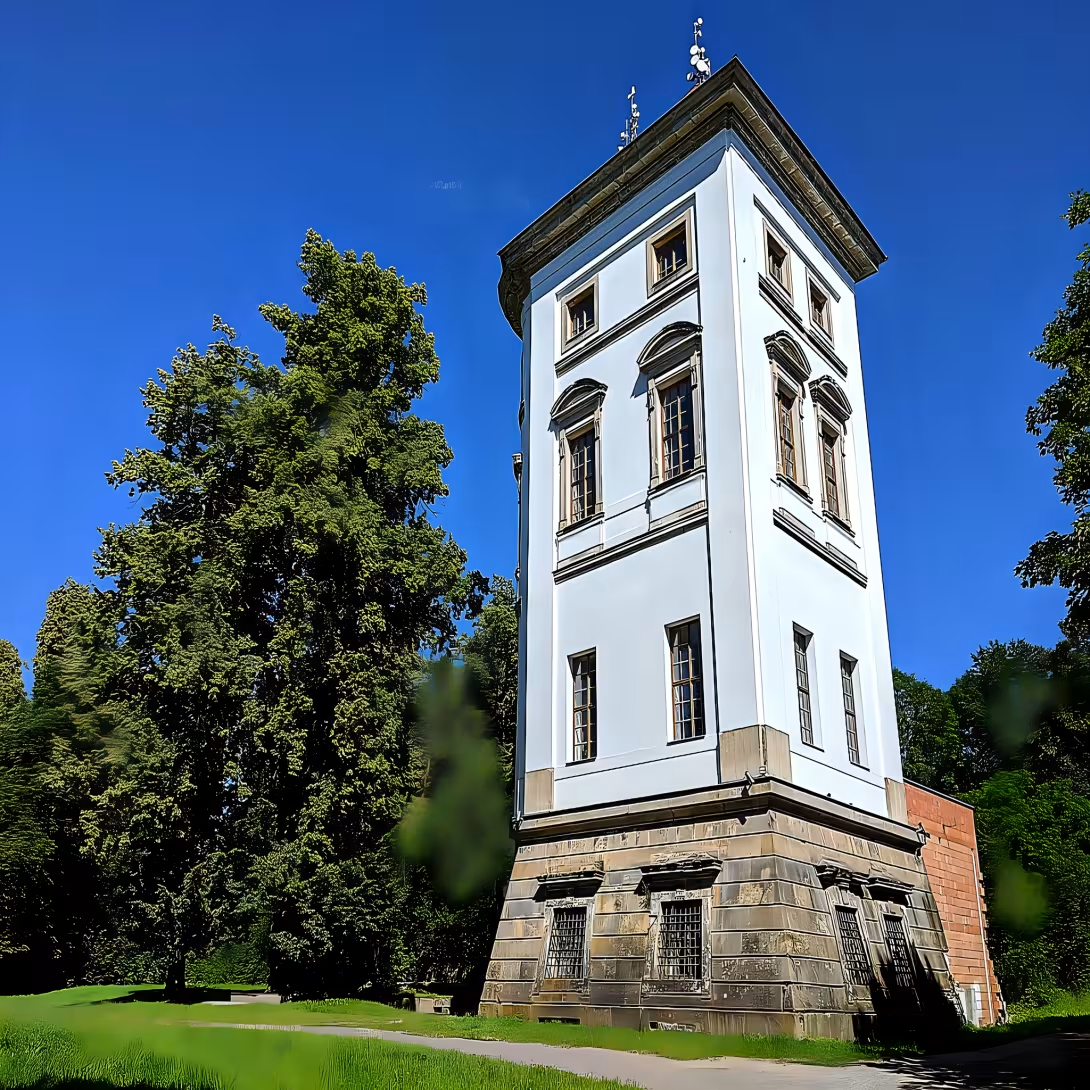
The new castle near Rudoltic is a partially extinct building in the Ústí nad Orlicí district. It stands between Rudolticemi and Lanškroun and is today protected by the status of cultural monument.
The chateau was founded at the end of the seventeenth century by Jan Adam I. z Lichtenštejna as the superseded residence of its Lankouleun estate. The construction took place from 1699 to 1712 under the leadership of the construction managers Antonio Sally and Giovanni de Gabrieli. The Italian architect Domenico Martinelli participated in the design. Among the preserved names of craftsmen are the carpenter Lorenzo Kaplan of Lanškroun and the stonemason Václav Roeder of Olomouc.
Soon after construction, the building was hit by a disaster. In 1714 the castle was completely burned down. During the following years there were partial repairs and the new crows were completed in 1717, but the full renewal failed. After the death of John Adam I, his son Jan Nepomuk Karel z Lichtenštejna inherited the estate. During his minors, he was managed by a relative of Josef Václav z Lichtenštejna, who in 1733 entrusted with overseeing the repairs of architect Anton Erhard Martinelli. A year later, however, Josef Václav decided on demolition. Between 1756 and 1780, most of the building was demolished - only one wing kept its appearance as a three-storey tower with a rounded southwest corner.
The remaining tower gradually found new applications. In 1802 (sometimes mentioned in 1801) it was adapted to the inn and its cellars served for the Supremacy brewery in Lanškroun. After 1945, the building was confiscated from Liechtenstein and converted into an agricultural estate. In 1969, it was taken over by the Lanbermouth National Committee, which had no immediate use for it. The repair of the degraded torso started only in 2006 and the following year the castle was made available to the public.
The three-story tower has a spiral staircase in the core that connects the floors. Each floor contains a pair of rooms. The original building had a floor plan of the letter H and was surrounded by a park that was declared in 1848.
Today, the New Castle at Rudoltic is the testimony of Baroque architecture and the fate of the great nobles. The tower that survived allows you to look into the construction practice of the early eighteenth century and into the transformation of buildings that lost their original purpose over time.
Then and now
Drag the slider to compare how the landmark may have looked when it was built with the view today.
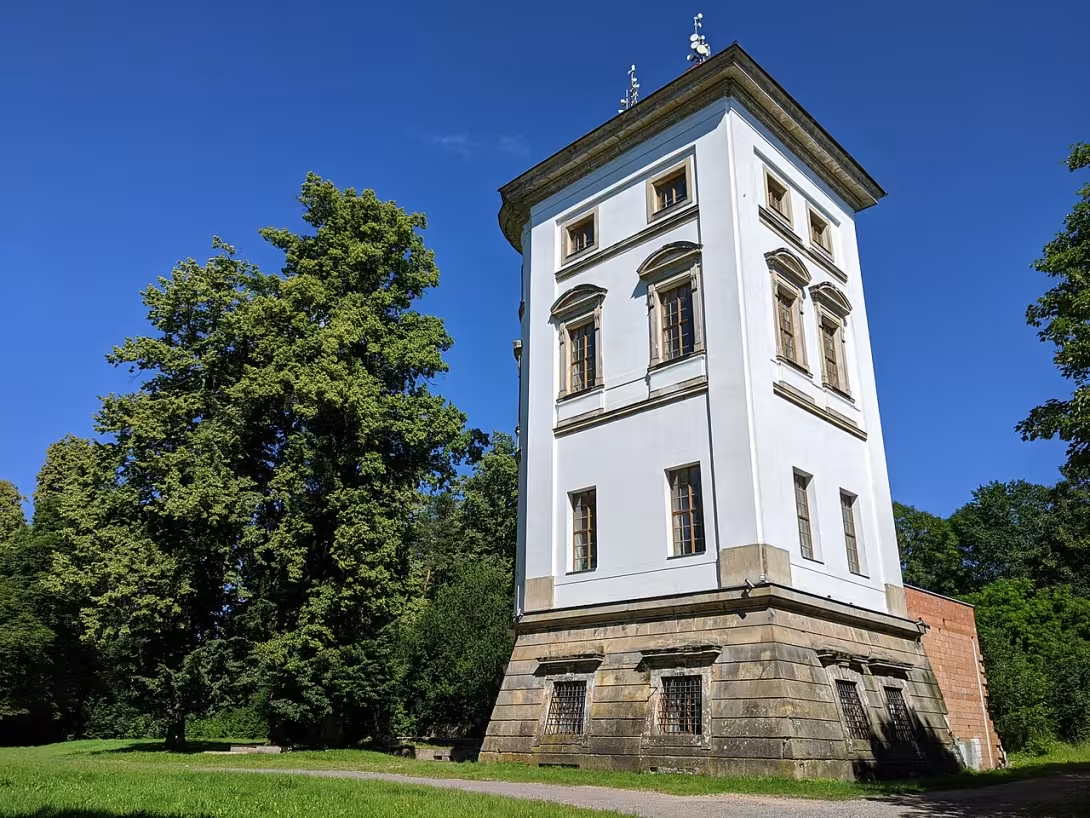
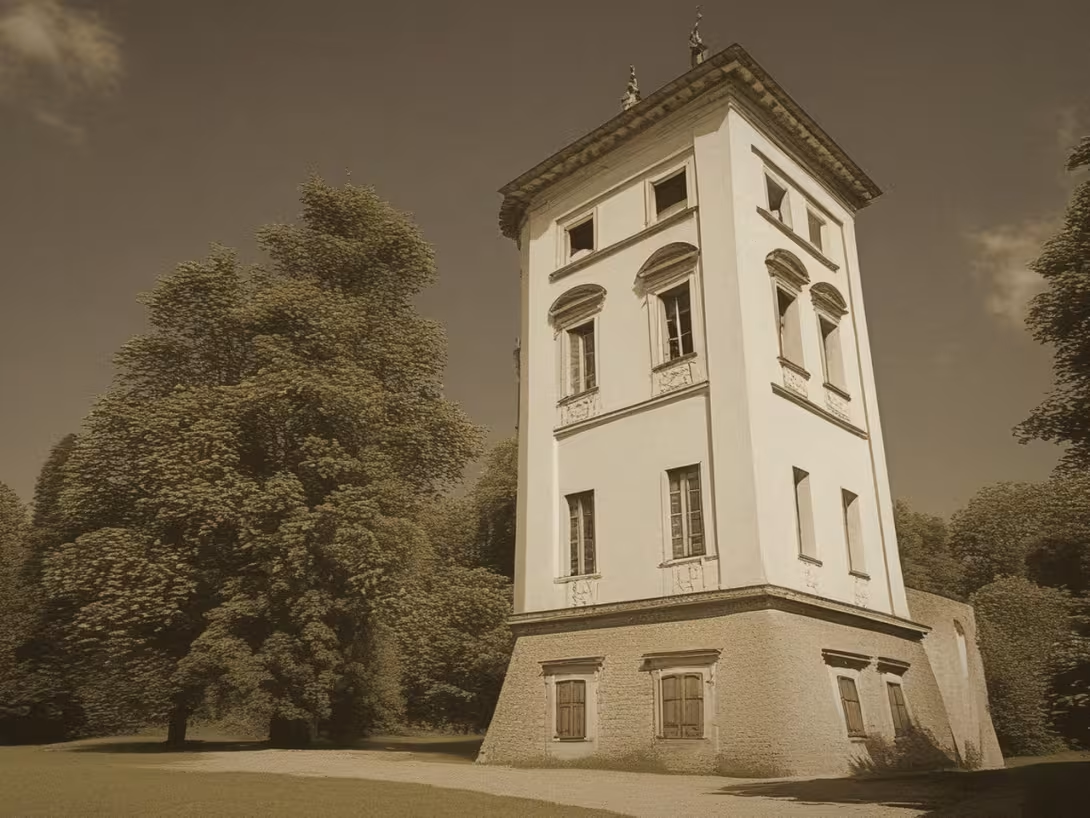
The historical appearance on the left is an AI-generated visualisation and serves as inspiration only.
Historical milestones
- 1714
- The castle burned down.
- 1756
- The beginning of the demolition of the castle.
Architectural development
The original building was three storeys with the ground plan of the letter H. After the fire and partial repairs, only the tower was left. In 1802 the torso was adjusted to the inn.
Historical events
- 1714
- The castle burned down.
- 1756
- The beginning of the demolition of the castle.
- 1780
- Finishing the demolition of most of the building.
Owners
Jan Adam I. z Lichtenštejna (founded), Josef Václav z Lichtenštejna (managed), Jan Nepomuk Karel z Lichtenštejna (heir), Lanbroshun National Committee (after 1969)
Points of interest
- The new castle at Rudoltic was founded by Jan Adam I of Liechtenstein at the end of the seventeenth century as the superseded residence of his Lancescheon estate. - The construction took place from 1699 to 1712 under the guidance of Antonio Sally and Giovanni de Gabrieli, with the design of Italian architect Domenico Martinelli. - After the castle burned out in 1714 only partial renewal was carried out, the full one failed. - The remaining three-storey tower had a new use as a inn and for the cellars of the Suprenosten brewery after 1802. - Today, the castle represents the testimony of Baroque architecture and the fate of noble settlements, with a tower showing the construction practice of the early eighteenth century.
Guide
This guide is narrated by a synthetic voice generated by artificial intelligence.
Show guide text
This text was created by artificial intelligence and has not been editorially reviewed. It may contain inaccuracies.
Welcome to Rudoltice, a mysterious place full of history and beauty. You are standing in front of the rest of what once was a new castle near Rudoltic, a partially extinct monument between Rudolticemi and Lanškroun in the district of Ústí nad Orlicí. What you see before you is a three-storey tower, the only remains of the original baroque nobility. This tower stands as a witness to the past, retaining memories of the famous family of Liechtenstein.
The new castle near Rudoltic was built in the late seventeenth century by Jan Adam I from Liechtenstein as a superseded residence for his Lancescheon estate. This ambitious project began in 1699 and lasted until 1712 when it was designed by Italian architect Domenico Martinelli. Originally, the building was run by Antonio Sally and Giovanni de Gabrieli, which meant a combination of talent and artistic spirit into one place.
Look up at this distinguished tower. It is the most preserved part of the castle after the fire which destroyed it in 1714, and the subsequent demolition in 1756. Although most of the structure was dismantled, this tower stands as a monumental monument to the rich history of the castle.
The key personalities associated with this location include Jan Adam I of Liechtenstein, who laid the foundations for this impressive mansion. His heirs, such as Josef Václav and Jan Nepomuk Karel z Lichtenštejna, also played an important role in the administration and history of the estate.
The interesting thing about this place is its connection to Italian architect Domenico Martinelli. His presence at this place shows the cultural ties and artistic prestige that the family of Liechtenstein appreciated.
Now that you've explored this historical monument, we'll invite you to another tour of the surrounding region. Every corner of Rudolph offers new views and stories. We hope your visit here was full of discoveries and inspiration. When we meet history again, be welcome to explore again. Thank you for your attention and I wish you comfort on your next trips along these Czech landscapes.
Tips for visitors
The best time to visit the castle Rudoltice is in the spring or autumn season when vegetation in the park is best visible and nature offers beautiful colors. This time of the season also means fewer visitors compared to sunny summer days.
Parking is possible near Rudoltic, but for precise location we recommend using GPS or online maps. The castle can also be visited by public transport; you can verify the current connection in the route search.
To visit the castle bring comfortable shoes because the terrain around the castle is unbalanced and the park is located on a slightly steep dawn. Don't forget to bring your sunglasses, especially in the summer months.
For photography it is best to wait for morning or late light when the sun is lower above the horizon. It provides milder and warmer colours for photos of the lost castle and park. Remember also to pick up a map or plan that may be available at the entrance.
In the vicinity of Rudoltic you can visit Lanškroun, a small town famous for its history and architecture. For families with children it is a suitable place for a short walk or purchase food in one of the local shops.
Frequently asked questions
Can the monument be visited?
Yes. We verified the opening hours or admission on the official website (3. 8. 2026); you will find them in the visitor information on this page. Please double-check with the operator before you travel.
What are the opening hours and admission?
Details verified on the official website (3. 8. 2026) are listed in the visitor information on this page. Official website: http://www.novyzamek.cz/
Where is the monument?
Location: č.p. 159, Rudoltice, Pardubický kraj. The map on this page shows the exact spot.
Why is the monument protected?
It is listed in the Central List of Cultural Monuments of the Czech Republic as a cultural monument (register no. 28992/6-4049).
For kids
Imagine going back to when Rudoltice was a small town in the heart of Bohemia. The castle, known today as the New Castle at Rudoltic, was the new and lean seat of the rich Liechtenstein family.
Who lived here? Who came here? They were people who fed on agriculture, trade and craft. The city was full of life, music and dancing. And in the center of the city there was a castle, which was like a castle, bounded by tall walls and towers.
Businesses nearby
Do you run a restaurant, accommodation, shop, museum, rental, wellness or other visitor service near this monument? Show yourself directly to the people heading to it — this is how they will see you in the app and on the web:
Nearby
Preserved park cleared in 1848. The castle is located between Rudolticemi and Lanškroun.
Accommodation nearby
Themed route
Thematic cruise route castle Rudoltice
1. Castle Rudoltice - Type: Historical castle - Why is it worth a visit: Castle Rudoltice is a beautiful representation of 19th century architecture, offering a view of the rich history and culture of the area. Its elegant buildings and locations between Rudolticemi and Lanškroun attract visitors seeking peace and beauty.
2. Park by the castle - Type: Historical park - Why is it worth a visit: The park banished in 1848 is part of the castle complex, offering a beautiful opportunity for relaxation and walking. Its ancient trees and carefully maintained paths create an idyllic space to rest.
3. Castle tank - Type: Historical courtyard - Why is it worth a visit: The tank is the centre of the castle area where architectural details can be explored and panoramic views of the surrounding landscape can be enjoyed. It is an ideal place to understand the history and heritage of the castle.
4. Castle Tower - Type: Historical tower - Why is it worth visiting: The tower offers a unique view of the surrounding landscape and is an important part of the history of the castle. Its height allows visitors to appreciate the extent and beauty of the area, which adds interest to the whole tour.
5. The Castle Exposure - Type: Historical exposure - Why is it worth a visit: The exhibition in the castle offers insight into the history and culture of the region, presenting artifacts and information about the past of the area. It's a great way to learn more about the Rudoltic heritage.
This route offers a comprehensive view of the historical and cultural value of the castle Rudoltice and its surroundings.
Seasonal recommendations
Spring: In the spring period Rudoltice offers attractive experiences where the castle opens in a beautiful flower dress. The green covered park is full of life with the first flowering trees and bushes, which adds to the atmosphere of calm and restoration. At this time the weather can suddenly be variable, so it is advisable to equip yourself with clothes according to temperature. Visiting the castle in spring time is ideal for those looking for a place without crowd overcrowding because many people have not yet started their vacation.
Summer: Summer in Rudoltice offers an unforgettable experience with long days and warm sunshine, which illuminates the ruins of the castle in beautiful colours. The park is full of flowering shrubs and trees, providing an ideal environment for picnics or relaxation on the natural background. Due to the popularity of summer time, it is recommended to visit the castle earlier in the afternoon to enjoy a place without excessive crowd. Don't forget your glasses and enough drinking water.
Autumn: In autumn months, Rudoltice offers a lovely atmosphere with a colourful background of leafy trees that are transformed into pink and yellow shades. The sunny days are ideal for shooting these beautiful landscape scenes, while cooler evenings can bring a sense of peace in the historic environment. Visiting this season is suitable with warm clothes and a hat because the weather can change quickly.
Winter: Winter Rudoltice offers a unique view of the ruins of the castle under the cover of snow or in the ice light. The atmosphere is calm and quiet, which allows you to enjoy a historic place without a crowd of tourists. The opening times of the lock may be shorter due to winter conditions, so it is advisable to equip yourself with warm clothes and protective shoes. Visiting this season offers a sense of mystery and peace that are special for winter months.
Visualizations and artistic views


The visualisations are generated by artificial intelligence and serve as inspiration.
Photos from the area
Real photos taken near the monument


Zdroj a licence jsou uvedeny u každého snímku.
Atmosphere of the place
This atmospheric visualisation of the place and period was generated by artificial intelligence. It is not real footage of the location.
Tips from visitors
No tips yet. Be the first!
Log in and add your tip.
Sources and literature
Photos: MartinVeselka / CC BY-SA 4.0, rozlišení zvýšeno umělou inteligencí — Wikimedia Commons. The author and licence also appear when you hover over the image.
Faktickým podkladem tohoto textu byl článek na Wikipedii, jehož autory jsou přispěvatelé Wikipedie. Článek je dostupný pod licencí CC BY-SA 4.0.
Location on the map

Příběhy a pověsti
Legendy, pověsti a příběhy spjaté s touto památkou
Fotografie návštěvníků
Zatím žádné fotografie. Buďte první, kdo přidá fotografii z návštěvy!
Log in a přidejte svou fotografii nebo hodnoťte.
Za ověřenou návštěvu v aplikaci získáte víc bodů — poznáme podle GPS, že jste na místě.
Reviews and comments