



Ruský pomník bitvy roku 1813 se strážním domkem Building complex
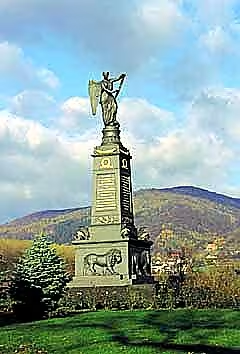
The Russian memorial in Prestana is a war monument which commemorates the heroism of the Russian Guard Regiment and their commander General Ostermann Tolstoy during the Battle of Chlumce in 1813. This empire monument, designed by the court architect Petr Nobil, is located in the northern Bohemian village of Přestanov and is accompanied by a guard house and a park. It is protected as a cultural monument and forms part of the landscape monument zone at Chlumce.
The memorial was built in 1835-1837 in memory of the selfless defense of Russian troops, which prevented the French troops from penetrating the Teplice pelvis. This defense was crucial in order to save the move of a receding Allied army and contributed to the victory of the allies in Chlumka, which had a major impact on the future of the Napoleon wars. The ceremonial laying of the base stone took place with the participation of major European monarchs, which underlines the international importance of this event.
The architecture of the monument is characteristic of the Empire style which is reflected in the structure and decorative elements. The monument reaches a height of 12 meters and is decorated with the statue of the goddess of victory of Nika on top, which symbolizes triumph over the enemies. Massive cast iron parts were produced in iron mills in Komarov and then transported to the place where they were assembled.
The monument is part of the battlefield near Chlumce, which has turned into a unique piety area protected as a landscape monument zone. In addition to the Russian monument, there are other monuments such as the Prussian cast-iron obelisk in Varvajov and the Austrian monument to General Colloredo-Mansfeld. The site complements the mass grave with the remains of approximately 10,000 fallen soldiers, stressing the tragic loss of lives during the battle.
Today, the Russian monument in Prestana is not only a monument to historical significance, but also a natural and cultural centre that attracts visitors from all over the world. Its placing in the places of the heaviest battles on the first day of the battle at Chlumce gives him deep emotional and historical significance. Although the monument underwent several reconstructions, it remained one of the aesthetically most impressive monuments on the battlefield.
Visiting the Russian memorial in Prestana offers an opportunity to explore the important historical events that shaped the current European political order. It is a place where visitors can think about the heroism and dedication of soldiers from the past and appreciate their contribution to freedom and peace in Europe.
Historical milestones
- 1813
- Battle of Chlumce and heroic defense of troops against French troops
- 1835-1837
- Construction of an empire monument designed by architect Petr Nobil
- around 1835
- Festive laying of the base stone with the participation of European monarchs
Architectural development
The memorial was designed by the court architect Petr Nobil and built in 1835-1837. The Empire style is highlighted by the statue of Nika on top of the monument, which symbolizes victory.
Historical events
- 1813
- Battle of Chlumce
- 1835
- Opening of the monument construction
Points of interest
- The Russian memorial in Prestana commemorates the heroism of the Russian Guard Regiment and their commander General Ostermann Tolstoy during the Battle of Chlumce in 1813. - The memorial was built in 1835-1837 in memory of the dedicated defense of Russian troops, which prevented French troops from penetrating the Teplice pelvis. - The ceremonial laying of the base stone took place with the participation of major European rulers, which underlines the international importance of this event. - The monument is protected as a cultural monument and forms part of the landscape monument zone of the battlefield near Chlumce. - The architecture of the monument is characteristic of the Empire style which is reflected in the structure and decorative elements. The monument reaches a height of 12 meters and is decorated with a statue of the goddess of victory of Nika on top.
Guide
Show guide text
This text was created by artificial intelligence and has not been editorially reviewed. It may contain inaccuracies.
Welcome to this historic place where you will open a chapter from the past full of heroism and architectural art. You are standing before a Russian monument, witnessing the fighting and courage of 1813. This monument tells you the story of the remnant and brave soldiers who opposed the French forces.
The monuments were built as a tribute to the Russian Guard Regiment and their commander General Ostermann Tolstoy. The Battle of Chlumce in 1813 became the key moment when these troops showed courage and defense against French troops. The memorial was built between 1835 and 1837 according to the design of architect Peter Nobil, who gave him empirical form.
Look up at the statue of the goddess of victory, Nika. This detail is one of many that enrich this memory. The monument is supplemented by a guard house and a park, which creates a harmonious whole. Notice how the monument stands as a solid symbol of courage and memory.
Key personalities associated with this site include General Ostermann-Tolstoy, but also European monarchs such as Ferdinand I., Mikuláš I. and Fridrich Vilém III., who participated in the ceremonial laying of the base stone.
The interesting thing is that this monument not only remembers the heroism of Russian troops, but also represents a cultural heritage protected as a monument. It is part of the landscape monument zone and offers us the opportunity to immerse ourselves in history.
Let's move on and explore other parts of this place to see all its beauty. Notice the atmosphere of the park and how the monument is harmonically related to the surrounding area.
Thank you for your visit to this historic place. I hope you enjoyed exploring this monument and its stories. I invite you to explore and explore the surrounding parts of this interesting place.
Tips for visitors
The best time to visit the Russian monument in Prestana is autumn, when the landscape is coloured with living colours of leaves. This period offers not only beautiful nature, but also ideal light for a photo of the monument and its surroundings.
For those travelling by public transport, it is advisable to check connections in online traffic search engines.
When planning a visit, remember comfortable shoes and clothes suitable for outdoor conditions. If you intend to take pictures, remember to equip yourself with a high-quality camera with the possibility to set the exposure.
Photographs of the monument and surrounding region offer the best results at the beginning of the morning or evening when light is softer. Don't forget to include a tour of the Prussian cast iron obelisk in Varvajov and the Austrian memorial of General Colloredo-Mansfeld, which are nearby.
For families with children, visiting the sights is an opportunity to learn about the history and importance of the place. You can also design a short walk around the protected landscape, which will also be fun for adults.
Frequently asked questions
Can the monument be visited?
Some buildings of this kind are open for guided tours, others serve another purpose or are privately owned. We have not verified whether and when this monument is open – please ask the operator.
What are the opening hours and admission?
We have not verified the opening hours or admission. Current information is published by the operator.
Why is the monument protected?
It is listed in the Central List of Cultural Monuments of the Czech Republic as a cultural monument (register no. 1000155648).
Businesses nearby
Do you run a restaurant, accommodation, shop, museum, rental, wellness or other visitor service near this monument? Show yourself directly to the people heading to it — this is how they will see you in the app and on the web:
Nearby
Památky v okolí zahrnují pruský litinový obelisk ve Varvažově a rakouský pomník generála Colloredo-Mansfelda. Krajina je chráněna jako krajinná památková zóna.
Accommodation nearby
Trips and activities nearby
Guided tours, tickets and activities nearby from GetYourGuide
Affiliate link: if you buy from the partner, we may receive a commission. The price for you does not change.
Search tours and activities →Themed route
Thematic cruise route around the Russian memorial battle in 1813
1.Ruský pomník bitvy roku 1813 se strážním domkem - Type: Historical landmark - Why is it worth a visit: This monument celebrates the victory of allies over Napoleon's armies in 1813. The Watchhouse serves as an information centre where you can see the historical details and comments of the battle.
2. Prussian cast iron obelisk in Varvajov - Type: Memorial This obelisk is dedicated to the Prussian soldiers who fought on the side of the allies. It's a memory of their courage and contribution to the end of the Naples wars. The obelisk is located in a picturesque landscape protected as a monument zone.
3. Austrian memorial of General Colloredo-Mansfeld - Type: Historical landmark This monument celebrates the Austrian general's contribution to victory over Napoleon's forces. It is an important historical landmark that reminds Austria of its strategic role in this battle.
This route offers a view of key sites associated with the battle history of 1813 and allows visitors to explore the rich history of the region in the context of the landscape monument zone.
Seasonal recommendations
Spring: In the spring period, the historical monument of the Russian Memorial of the Battle of 1813 is oddly impressive thanks to the lighting that changes with long and sunny days. Green nature begins to bloom around, creating a lively atmosphere full of hope and renewal. Visitors are advised to wear clothes suitable for mild temperatures with the possibility to add a layer because spring weather can be variable. The best time to visit is at noon, when the sun shines the strongest and the monument lights up to full beauty.
Summer: The memory of the Russian monument to the battle of 1813 is gained by intense atmosphere thanks to long days and warm sunlight. Nature is in full power, with rich green trees and flowering bushes, which adds to the beautiful landscapes around the building. Visitors are advised to wear light clothes, protective sunglasses and plenty of water, especially if they plan an extended tour. The best time to visit is usually early morning or late evening to avoid heat and today's crowds.
Autumn: In the autumn period, the Russian monument to the battle in 1813 becomes melancholic charm when tree leaves start to change colour and fall. A colour palette of green, yellow and red shades appears around, creating a unique and absorbing environment. Visitors should wear warmer clothes and perhaps an umbrella, because autumn weather can suddenly be wet or cold. The best time for a tour is between sunny and freezing days when nature appears in its most beautiful autumn clothing.
Winter: During winter, the Russian memorial of the battle in 1813 takes on a freezing and mysterious character, when the sun is projected on the snow and ice landscape. If there is enough snow, the object can be surrounded by views of snowy mountains or fields, creating a fantastic environment for visitors. Visitors are advised to wear warm clothes, including fur hats and gloves, to enjoy a tour without discomfort from the cold. The best time to visit is usually during bright, freezing days when the atmosphere is calm and the monument is illuminated in an unusual light.
Visualizations and artistic views

The visualisations are generated by artificial intelligence and serve as inspiration.
Photos from the area
Real photos taken near the monument

Zdroj a licence jsou uvedeny u každého snímku.
Tips from visitors
No tips yet. Be the first!
Log in and add your tip.
Sources and literature
Photos: Kulm / Public domain — Wikimedia Commons. The author and licence also appear when you hover over the image.
Faktickým podkladem tohoto textu byl článek na Wikipedii, jehož autory jsou přispěvatelé Wikipedie. Článek je dostupný pod licencí CC BY-SA 4.0.
Location on the map
More monuments – Ústecký kraj
Show all in the region

Příběhy a pověsti
Legendy, pověsti a příběhy spjaté s touto památkou
Fotografie návštěvníků
Zatím žádné fotografie. Buďte první, kdo přidá fotografii z návštěvy!
Log in a přidejte svou fotografii nebo hodnoťte.
Za ověřenou návštěvu v aplikaci získáte víc bodů — poznáme podle GPS, že jste na místě.
Reviews and comments