

Silnice s inundačním mostem Inundation bridge
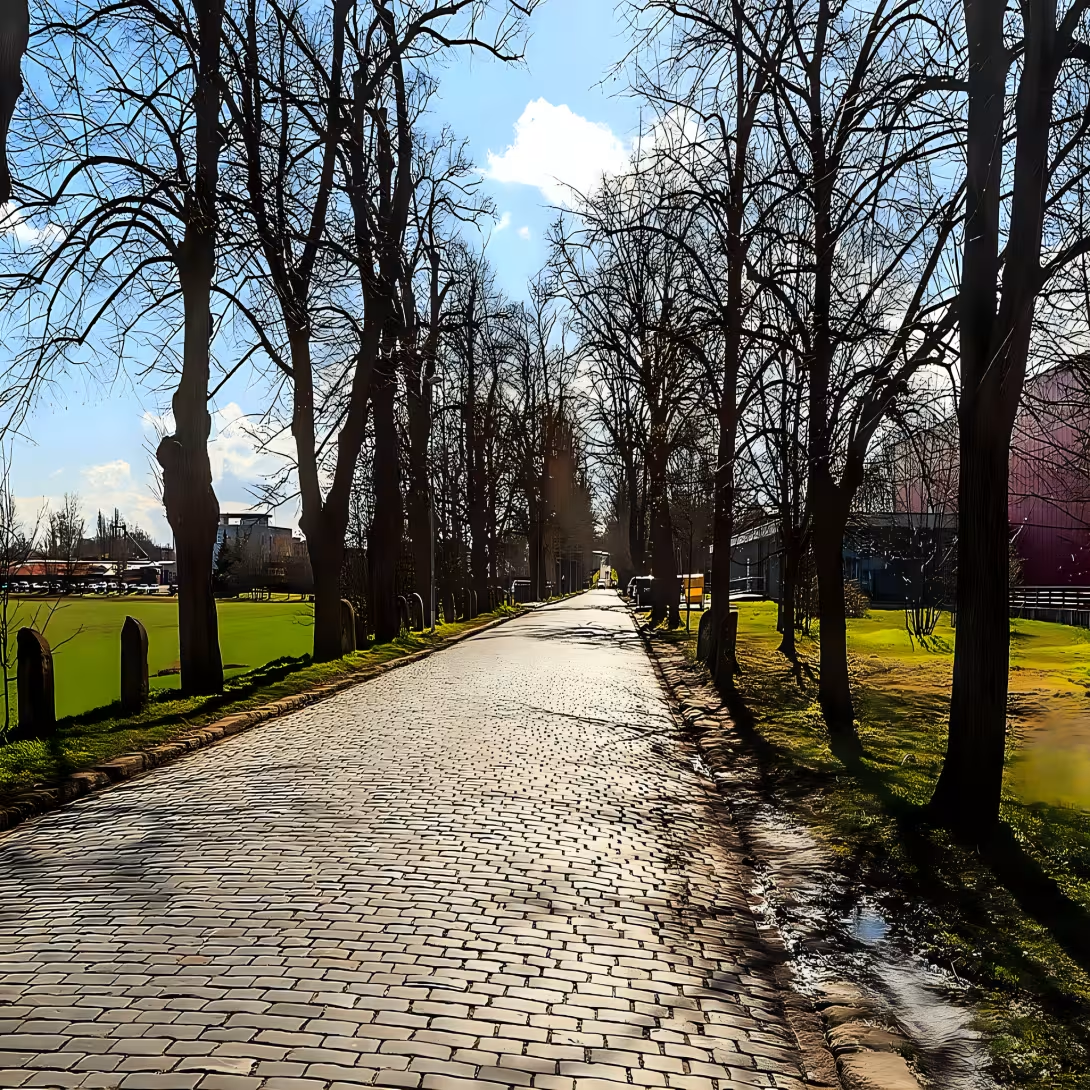
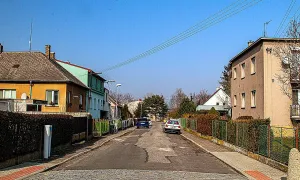
Silnice s inundačním mostem in Pardubice is a well-preserved section of the former imperial road from 1818- 1826, which associated Pardubice with Hradec Kralove. The building is remarkable with stone bridge, terrain embankment and accompanying lime alley. The monument is an important element of the early modern road network.
The system of imperial roads formed the basis of transport infrastructure in the Austrian Empire. It was established according to the patent of Empress Marie Terezie from 1778 in order to accelerate the transport of goods and movements of troops. Pardubice was connected to this network in 1818-1826 by the construction of the route Hradec Králové - Pardubice - Chrudim, which is now the road I / 37. The section from the Elbe Bridge towards Opatovice was completed in 1823.
Today's preserved part is located in Kunettika Street. They form a section of the road from the bridge above the ride to the roundabout on the Brickland. The communication is performed in a significant terrain. The stone inundation bridge is a key architectural element. This was intended to protect the road from occasional flooding from the regulation of the Elbe and the increase of the dam.
The Inundation Bridge consists of three discontinuous parts. The southern section is shortest and contains two flat segment arches. The middle part also consists of two arches. The northern segment is significantly longer, it has six arches with a higher rise and stands on massive dividing pillars, which are partially filled with terrain from the neighbouring field. The surface of the bridge and the road itself is made of granite longitudinal cubes, so called cat heads; Some parts are covered with old layers of asphalt.
The monument is now accessible as part of public communications in Pardubice. The combination of stone bridge, historical embankment and lime alleys allows you to see the way of planning and building roads in the first half of the 19th century.
The building is a valuable technical testimony about the development of transport and the solution of river flooding problems in the early period of modernization. Visiting this section offers the opportunity to see unique details of a classical road building in natural context.
Then and now
Drag the slider to compare how the landmark may have looked when it was built with the view today.
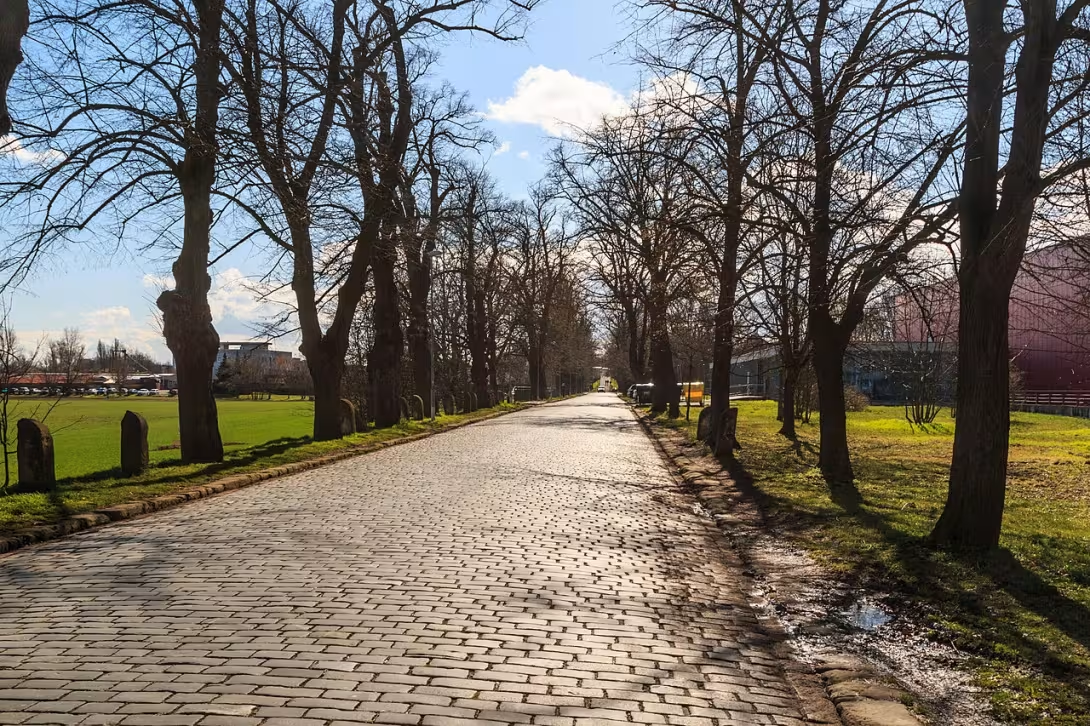
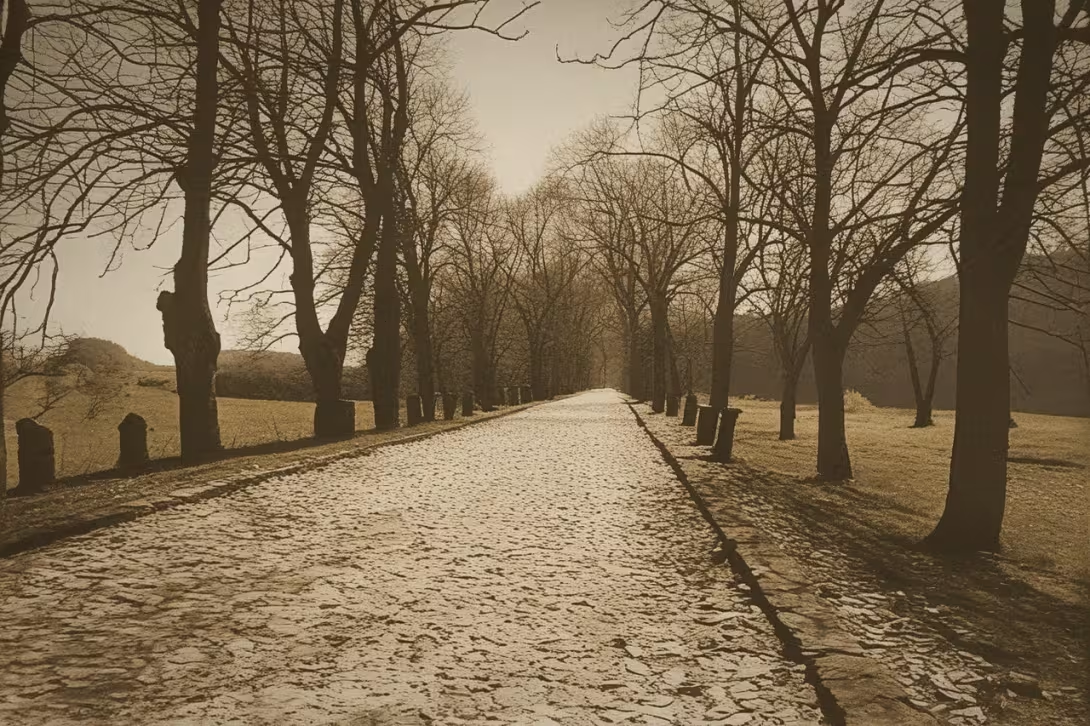
The historical appearance on the left is an AI-generated visualisation and serves as inspiration only.
Historical milestones
- 1778
- Issue of the patent of Empress Marie Terezie on the construction and maintenance of imperial roads.
- 1818
- The beginning of the construction of the imperial road Hradec Kralove - Pardubice - Chrudim.
- 1823
- The extension of the road from the Elbe Bridge towards Opatovice.
- 1826
- The construction of the imperial road in a given section.
Architectural development
The road was built in 1818-1826, while the section to Opatovice was completed in 1823. The inundation bridge consists of three discontinuous segments with segment arches in different numbers and voltages. The surface of the road and the bridge is made of granite longitudinal cubes, part of which is covered with asphalt.
Historical events
1778 - issue of the patent Marie Terezie on the construction of imperial roads; 1818-1826 - construction of road Hradec Králové - Pardubice - Chrudim; 1823 - extension of the road to Opatovice.
Owners
State Road Administration / Imperial Road Administration (since 1818), today the Directorate of Road and Motorways of the Czech Republic
Points of interest
- It is a well-preserved section of the former imperial road from 1818-1826, which connected Pardubice to Hradec Králové. - The monument is remarkable with stone bridge, terrain embankment and accompanying lime alley. - The stone inundation bridge was supposed to protect the path from occasional flooding before the Elbe regulation and by increasing the dam. - The bridge consists of three discontinuous parts, the northern segment being the longest and has six arches. - The surface of the bridge and road is made of granite longitudinal cubes.
Guide
This guide is narrated by a synthetic voice generated by artificial intelligence.
Show guide text
This text was created by artificial intelligence and has not been editorially reviewed. It may contain inaccuracies.
Welcome to Pardubice. Stop for a second and look around you. You are standing in front of one of the very interesting testimonies of the transport history of our region. In front of you, there is a stretch of road that may look like an ordinary old road at first glance, but in fact it is a rare piece of history from the beginning of the foreign century. Notice how this road stands out over the surrounding terrain. You're on a embankment that once served as a major artery connecting two important cities. Look at the stone bridge you see here. It's not just an ordinary bridge to cross the stream, it's a so-called inundation bridge. It is this element that dominates the whole place and reminds us of a time when nature was much more unpredictable than today.
Let us now look together at how this road came to be and why it is here at all. It all started much before the first stones of this particular section were laid. Already in the year seven hundred seventy eight Empress Marie Terezie issued an important patent. This document has laid down rules for the construction and maintenance of so-called imperial roads. The aim was to create a high-quality network of routes that would allow faster and safer movement of troops, couriers and merchants across the vast empire. It was in this spirit that eight hundred and eighteen years ago the construction of the road connecting Hradec Kralove, Pardubice and Chrudim began.
When you realize that at that time there were no machines like we know today, building such a journey is a huge performance. The work progressed gradually. In the year eight hundred twenty-three, the road was extended from the Elbe Bridge to the Opatovice, and this entire section, which you are standing with, was definitely completed in the year eight hundred twenty-six. So imagine that carriages and horse-drawn carriages have been on this road for nearly 200 years. It was a modern journey of time that fundamentally changed the way people moved between cities.
Now pay attention to the details surrounding you. Look under your feet and then forward. Notice that the road does not lead in a plane, but is built on the embankment. This artificial terrain lift wasn't random. He was supposed to ensure that the journey remained passable even when the surrounding landscape suffered from moisture or mild flooding. And here we come to the most interesting, which is the stone inundation bridge.
Try to imagine the Elbe River as it looked before its regulation. The Elbe was not at the time in the tightrope we see today. It was a wild river that often flooded the surrounding areas during spring thaw or heavy rains. That's why this bridge was built. His task was not only to bridge the water, but to serve as a safe point in the case of large waters. The Inundation Bridge was intended to protect communication from flooding and ensure that even at critical times the link between Pardubicemi and Hradec Králové remained functional. It's a fascinating example of the engineering thinking that had to count on the dangers of nature.
If you look around you, notice also the beautiful lipa alley that accompanies this stretch of road. Lips are a traditional symbol in our regions and their presence gives the whole place a special atmosphere. Imagine how these trees gave shade to passengers on hot summer days over a century ago. The combination of stone bridge, elevated embankment and a series of Lips creates a whole that is now very rare. It is a harmonious combination of technical function and aesthetics that allows us to feel the spirit of early modern road construction.
Although we do not know the specific names of architects who designed this project, their work remains within us. It's a silent monument to human efforts to overcome obstacles. The mystery remains how many thousands of people have gone through this very place and what stories they have brought with them. Which of them watched the rising surface of the Elbe in distress, and again who was grateful to fall from the carriage to rest in the shadow of the lime trees? This journey witnessed the changes of the century, saw the arrival of the first cars and the gradual change of landscape around us.
But the most interesting thing is the contrast between then and now. Today we have modern levees and regulated riverbed, so you may be asking if such a bridge is still needed. From the point of view of practical operation, maybe not, but from the point of view of history, the bridge and the whole embankment are irreplaceable. It's a physical proof of how people had to deal with nature before we could completely contain it. It is a reminder of a time when the journey from one city to another was a real adventure, and every obstacle, like a flooded road, required a clever solution.
Let us now have this moment filled with silence and insight into the details of stone and foliage. Feel the atmosphere of this place that connects the past to the present. You are standing on a section that was once the peak of technology and which today serves as a silent archive of our ancestors.
I hope you are interested in this short journey back in time and that you now see more than just a part of the landscape in this bridge. It's a piece of history that we can still admire that tells us about the courage and balance sheet of builders from the beginning of the 10th century. Now invited to further explore the surroundings. Walk slowly through this section, perceive the stability of the stone bridge and let the shadow of the lime trees lead you further into space. Thank you for your attention and I wish you a pleasant journey along the Pardubice.
Tips for visitors
The best time to visit is early morning or late afternoon, when the sun falls at a sharp angle and highlights the structure of the old embankment and details of the bridge. For photography we recommend looking for views that capture the line of the former imperial road leading towards the Cihelna estate.
Since it is an object in public space, no special equipment is needed, comfortable shoes are sufficient to walk around.
In the vicinity you can visit the hill above the horse or take a walk in the Cihelna estate. All of these places are located close to the monument and allow a short walk in nature and the urban environment.
For families with children, the ideal form of education is through observation; children can explore the difference between the modern path and the historical rise from the beginning of the international century. We recommend you prepare a simple story about how people from Pardubice to Hradec Králové once wandered.
Frequently asked questions
Can the monument be visited?
This is a structure in a public space that can usually be seen from outside free of charge. We have not verified that this particular one is freely accessible.
Where is the monument?
Location: Pardubice. The map on this page shows the exact spot.
Why is the monument protected?
It is listed in the Central List of Cultural Monuments of the Czech Republic as a cultural monument (register no. 1999992007).
Businesses nearby
Do you run a restaurant, accommodation, shop, museum, rental, wellness or other visitor service near this monument? Show yourself directly to the people heading to it — this is how they will see you in the app and on the web:
Nearby
🏰 Historic sites (166)
- Východočeské muzeum v Pardubicích 0.5 km
- Východočeská galerie v Pardubicích 0.5 km
- sv. František z Pauly 0.6 km
- sv. Jan Nepomucký 0.6 km
- Pěsti a květy 0.6 km
- Památník boje studentů za svobodu 1939 a 1989 0.6 km
- Galerie města Pardubic 0.7 km web
- Gočárova galerie 0.7 km
- Padlým sportovcům 0.7 km
- Svatý Jan Nepomucký 0.8 km
- Památník osvobození 0.8 km
- Pomník obětem 1. světové války 0.9 km
- Mázhaus 0.9 km
- Art Space NOV 0.9 km Pernštýnské náměstí 49 +420 777 280 549 web
- Gočárova galerie 0.9 km Pernštýnské náměstí 50 +420 466 501 897; +420 723 731 001 web
- Galerie FONS 0.9 km Pernštýnské náměstí 51 +420 467 003 111 web
- Institut Paměti národa 1.0 km web
- Bedřich Smetana 1.0 km
- Jan Kašpar 1.1 km
- Pomník obětem náletu spojeneckých vojsk 1.1 km
🍽️ Restaurants and dining (449)
- Zmrzlinárna u zdymadla, Pardubice 0.3 km
- Lanové centrum Pardubice 0.3 km
- GARDEN Restaurant & Pension 0.4 km
- Na Rychtě 0.4 km
- Cartellone 0.4 km
- U Josefa 0.4 km K Cihelně 4 +420 466 435 197
- Bufet II. 0.4 km
- Žlutý pes 0.4 km
- Dýdy baba 0.4 km Studentská 583 +420 773 118 800 web
- Bufet I. 0.5 km
- Bum bum 0.5 km web
- Zámecká kavárna 0.5 km +420 724 737 199
- Arnošt z Pardubic 0.6 km +420 602 484 620 web
- Marcel bistro 0.6 km
- Barka 0.6 km U Josefa 119
- Áčko 0.6 km Studentská 268 +420 466 036 339 web
- Cihelna Kebab 0.6 km
- U Cvoka 0.6 km
- Viva 0.6 km
- Pizza Bueno 0.6 km +420 703 139 699 web
🏨 Accommodation (56)
- Autokemp Cihelna Pardubice 0.3 km Husova 1089 +420 466 415 833
- Hotelový Dům Pardubice 0.8 km Bělehradská 458 web
- U zlatého anděla 0.8 km
- Hotel Zámecká 17 0.8 km
- Kostelní 102 0.8 km
- Hotel 100 0.8 km web
- Hotel MRÁZEK 0.8 km web
- Zlatá štika 1.0 km web
- Penzion Hacienda Ranchero 1.0 km web
- Pension Austria 1.2 km Smilova 312 +420 721 500 150 web
- Hotel Atrium 1.3 km Smilova +420 466 615 146
- Penzion 2727 1.3 km
- Pension Podkova 1.3 km Smilova 335 +420 466 611 206 web
- Penzion City 1.4 km Hronovická 708 +420 777 002 272 web
- Penzion Cafe City 1.4 km Hronovická 708 +420 777 002 272 web
- Arnošt 1.5 km web
- Birdie 1.5 km Hlaváčova 392
- Hotel Euro 1.6 km Jiráskova 2781 +420 466 414 255 web
- Hotel Kristl 1.6 km +420 739 287 636 web
- Ubytování v Pardubicích 1.9 km
🚲 Rentals and sport (65)
- Lanové centrum 0.3 km
- CFIG Aréna 0.5 km
- Přístaviště − Loď Arnošt z Pardubic 0.6 km
- Cyklocentrum 0.6 km
- BikeHouse 0.7 km U Mlýnů 1901 +420 725 971 515 web
- HC Pardubice Fan Shop 0.8 km
- Stockrider 0.8 km Svaté Anežky České 121 +420 603 258 314 web
- SCOTT 0.9 km +420608537637
- Pulsmetry.cz 0.9 km náměstí Republiky 1400
- Laser Space 0.9 km třída Míru 2671 +420 602 650 075; +420 777 824 846 web
- Intersport 1.0 km Masarykovo náměstí 2799
- Rock Point 1.0 km Masarykovo náměstí 2799 web
- Sport Vision 1.1 km Masarykovo náměstí 2799
- Yetti 1.1 km
- Decathlon 1.1 km Poděbradská 588 +420 464 603 800 web
- HB Sport;HC Sport 1.1 km Sladkovského 486 +420 730 915 783
- Sokol 1.2 km +420 466 614 681 web
- KEEPER sport 1.2 km Palackého třída 1930
- CYKLO CONTENT 1.2 km +420466615277 web
- Plavání u Majáku s.r.o. 1.2 km Štrossova 172 +420 732 211 747 web
🥾 Hiking and nature (104)
- Tyršovy sady 0.5 km
- původní loděnice AROSA 0.7 km web
- Elektromotor s čerpadlem 0.7 km
- Loď Otava 0.8 km
- SILVER A - rodina Krupkova 0.9 km
- Zelená brána 0.9 km web
- Bubeníkovy sady 1.2 km
- Vila Václava Ulrycha 1.3 km
- Náměstí Československých legií 1.4 km
- park Jiřího Srbka 1.6 km
- Lesopark Jiřího Potůčka 1.8 km web
- Bombové krátery z roku 1944 2.0 km web
- Park Vinice 2.1 km
- Park Ohrádka 2.2 km
- Mostní pilíř technické cvičiště 2.5 km web
- Park Pardubičky 2.6 km
- náměstí 9. května 2.8 km
- Zámeček 2.9 km
- tvrz Nemošice 3.8 km web
- Medárium 4.2 km
Accommodation nearby
Themed route
Here is the design of the thematic route:
1. Cihelna settlement (residential district) - The starting point of the road where you can observe local architecture. 2. The bridge above the lake (bridge construction) - A short walk to the water for pleasant views and relaxation in nature. 3. Silnice s inundačním mostem (technical monument) - The main destination of the trip, where you will see a specific solution of the bridge designed for flooding.
Seasonal recommendations
In spring, the surrounding area of the bridge awakens into life and green grass contrasts with the stone of the building. The air is fresh and light soft, which is ideal for shooting details. We recommend moisture-resistant footwear because the landscape can be wet after melting snow. Best to visit the place in the morning when dew is still seen in the meadows.
Summer brings bright sun and hot air that creates a dream atmosphere on hot days. Nature around the bridge is in full bloom and the colors are very rich. It is advisable to choose light summer clothes and hat to protect from the sun. Due to high temperatures it is best to come early in the morning or at sunset when the light is golden and pleasant.
In autumn the landscape of the around bridge is colored in yellow and red tones, which gives the place a melancholy touch. There are often fog that affect the construction and create a mysterious mood. It's practical to bring a waterproof coat or a warm sweater. The ideal time to visit is in the afternoon, when the low sun beautifully highlights the texture of the old stone.
In winter, the bridge operates strictly and minimistically, especially if covered by a layer of white snow. The atmosphere is quiet and calm, which allows you to focus on the architecture itself. Hot clothing, gloves and tight shoes with anti-slip soles are essential to prevent falls on the frozen surface. The best is to visit the place at noon when the most daylight is.
Visualizations and artistic views


The visualisations are generated by artificial intelligence and serve as inspiration.
Photos from the area
Real photos taken near the monument


Zdroj a licence jsou uvedeny u každého snímku.
Tips from visitors
No tips yet. Be the first!
Log in and add your tip.
Sources and literature
Photos: Petr1888 / CC BY-SA 4.0, rozlišení zvýšeno umělou inteligencí — Wikimedia Commons. The author and licence also appear when you hover over the image.
Faktickým podkladem tohoto textu byl článek na Wikipedii, jehož autory jsou přispěvatelé Wikipedie. Článek je dostupný pod licencí CC BY-SA 4.0.
Location on the map

Příběhy a pověsti
Legendy, pověsti a příběhy spjaté s touto památkou
Fotografie návštěvníků
Přidat fotografiiZatím žádné fotografie. Buďte první, kdo přidá fotografii z návštěvy!
Máte k místu vzpomínku nebo zajímavý příběh?
Log in a přidejte svou fotografii nebo hodnoťte.
Za ověřenou návštěvu v aplikaci získáte víc bodů — poznáme podle GPS, že jste na místě.
Reviews and comments