






Skalka (hradiště) Hillfort
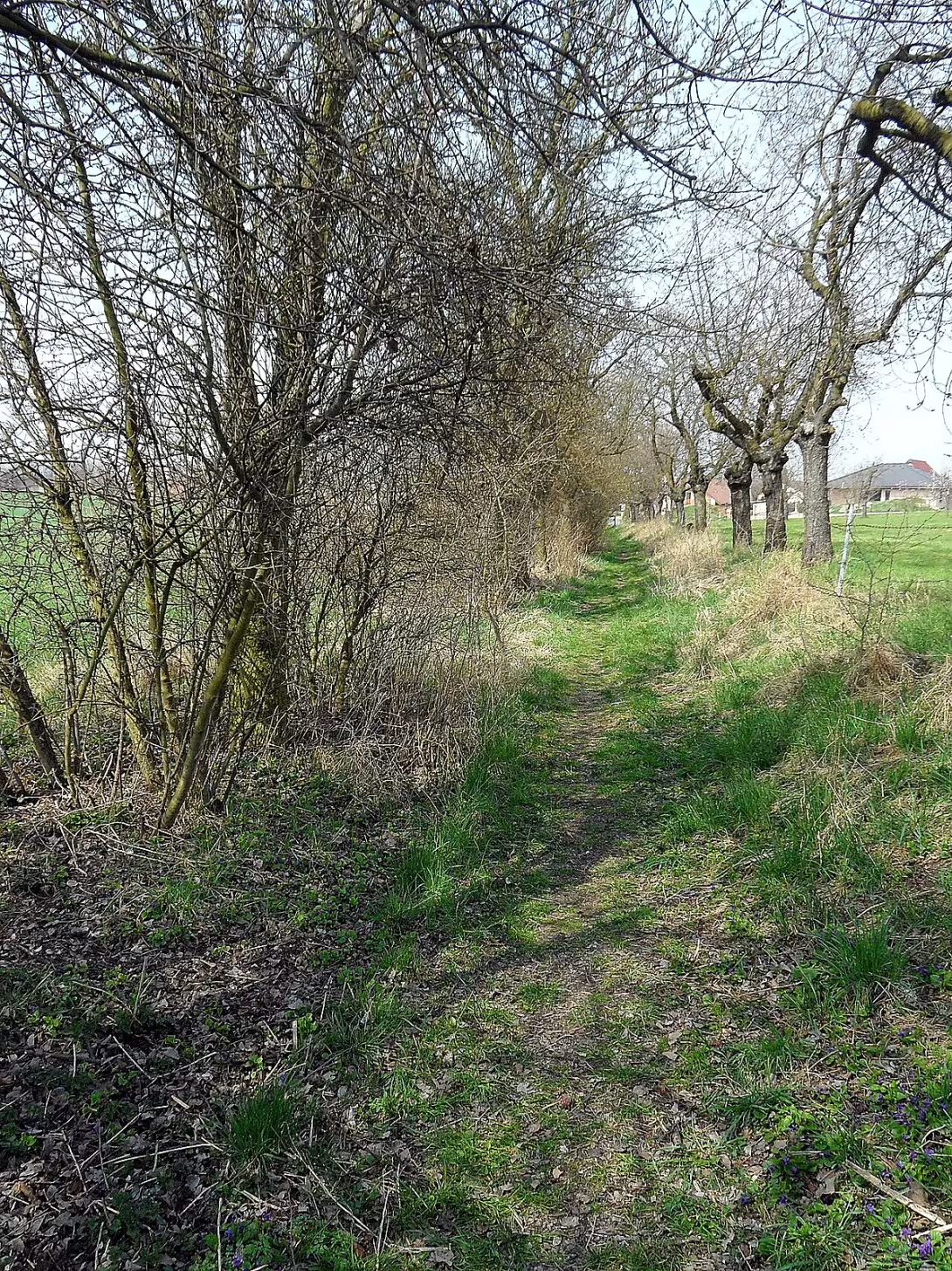
Rock at Velimi is an important prehistoric castle on the eastern edge of the same-name village in the district of Kolín. The locality was mainly inhabited by members of the Middle Dodenai mound culture in the middle of the Bronze Age. Since 1987 the site has been protected as a cultural monument and represents one of the largest fortified areas of its time in the region.
The fort was established during the period when moth cultures developed in Central Europe and strengthened the social hierarchy. At that time, power and business centers controlled strategic routes were formed. But the place was also inhabited in other epoch. About the exact function of the fort there are various scientific theories; a significant business, religious or power centre or a purely military object is considered. The religious significance of the site is supported by the findings of a large number of human skeletons, some of which bear traces of human damage.
The construction form of the castle on the insignificant hill Skalka, which reaches an altitude of 210 metres, included an extensive fortification system built in at least two phases. The whole complex was spread out in an area of 70 to 80 hectares, up to 1100 times 700 metres. The inner fortification formed a circular area about 160 metres in diameter, defined by the system of moats and palisades. The outer moat was up to 5.5 metres wide and 1.6 metres deep; followed by a palisade and a second moat. The wall consisted of two rows of palisades, and the space between them filled with stones and clay. The outer fortification, surrounding the whole surface, probably also had a circular plan of 280 metres in diameter and consisted of a pair of moats with a palisade. In front of this outer part was found another extensive system of fortifications up to 60 metres wide, comprising a ten-metre wide moat and a stone wall with a front wall of beech stakes.
Scientific interest in the site began to form in 1885, when gold spirals and casting forms were found on the area of the castle. The first archaeological research led between 1923 and 1924 by František Dvořák. However, most of the knowledge about the construction structure comes from the period after 1984 when rescue archaeological research was launched in connection with the gradual construction of family houses on the west side of the hill.
Currently, no visible remains of buildings are visible on the terrain surface. However, from the point of view of archeology, locality is an extremely valuable testament to the maturity of prehistoric construction and the social organization of the Middle Dodenan mound culture. Visiting this place offers the opportunity to realize the historical depth of the Polish landscape, which still hides traces of ancient power centers.
Historical milestones
- 1885
- The discovery of gold spirals and casting forms, which highlighted the importance of the site.
- 1923
- Opening of the first archaeological research under the leadership of František Dvořák.
- 1984
- The launch of extensive rescue archaeological research for the construction of family houses.
- 1987
- The location was declared a cultural monument.
Architectural development
The fort shows at least two building stages of fortifications consisting of a system of moats and palisades. The inner fortifications defined the circular area, while the outer fortifications surrounded the entire surface. The construction of the walls used wooden stakes, stones and dirt.
Historical events
1885: first findings of gold spirals and casting forms. 1923-1924: the first archaeological research conducted by František Dvořák. 1984: launch of rescue archaeological research due to the construction of family houses.
Points of interest
- The locality was mainly inhabited by members of the Middle Dodenai mound culture in the middle of the bronze era. Since 1987, the site has been protected as a cultural monument. - The religious significance of the site is supported by the findings of a large number of human skeletons, some of which bear traces of human damage. - The whole area was decomposed on an area of 70 to 80 hectares, up to 1100 times 700 meters. The inner fortification formed a circular area about 160 metres in diameter. - Scientific interest in the site began to form in 1885 when gold spirals and casting forms were found on the area of the castle. - There are currently no visible remains of buildings on the terrain surface.
Guide
Show guide text
This text was created by artificial intelligence and has not been editorially reviewed. It may contain inaccuracies.
Welcome to the place where time has stopped and where the country under your footsteps touches the ancient millennia. You are standing right in front of the Skalka, an important archaeological site which is situated on the eastern edge of the village Velim. Look around you and see the atmosphere of this place. You may only see a slight ripple of terrain, green hills and a quiet landscape, but in this very silence and in this view of the horizon lies an incredible history. This site is not just an ordinary place in nature, it is a witness to the rise and fall of entire cultures that once were governments. Feel the cool breeze and imagine that the same wind must have flogged the faces of the people who lived here, built and believed thousands of years ago.
Let's go back deep into the past together to understand what you see. This fort was not built yesterday. Its roots go back to the Middle Bronze Age, a period that fundamentally shaped the history of our territories. At that time, there were people from the mound culture who spread along the Danube River and its surrounding roads. Imagine this place as a living center that wasn't just an isolated settlement. The rock was a huge area that was spread out on an area of up to 80 hectares. This is a surface area that must surprise you if you realize how advanced this company must have been to manage such an extensive territory. This fort did not only fulfil the function of fortified sanctuary, but probably also served as a key business centre. Imagine the endless processes of merchants who came here with their goods, turning their products into gold or metal, where different worlds and ideas met.
Now pay attention to how this place has been secured. Even if you don't see tall stone walls or monumental gates that you could find in other parts of the world today, archaeological research revealed that Skalka was incredibly well fortified. Now if you look at the shape of the terrain and how the slope of the slopes changes, try to draw the shapes that were once there in your mind. There was an extensive defence system in the various construction phases, which included deep trenches and massive palisades. These wooden structures had to be incredibly strong and could serve as the first line of protection from enemies. This architecture was the result of long-term efforts and the need to secure not only the inhabitants, but also the precious goods and wealth that attracted this place. Every phase of construction of these fortifications tells us something about how the situation in the area changed and how much people needed safety at this time.
But to learn how valuable this place really is, we need to look at the stories of the people who tried to expose it. The whole journey to our knowledge today began very unexpectedly in 1885. At that time, objects were found that immediately caught the attention of researchers - gold spirals and special forms for casting metals. These findings were like lightning from the clear sky, because they clearly showed that the Skalka was not just an ordinary residence, but a place with incredible wealth and technological maturity. Subsequently, in 1923, the in-depth examination of this place began to take care of František Dvořák. His work was crucial and it is thanks to his determination and expertise that we are now able to speak with such precision about this place. Another dramatic moment occurred in 1984. At that time the site was threatened by the construction of family houses, which caused the need to carry out extensive rescue archaeological research. It was a race against time to preserve what was hidden in the country. Thanks to this intensive work, an enormous amount of information was saved. Since 1987, Skalka has been officially declared a cultural monument, which is proof that its importance to our history is undeniable.
But Skalka isn't just about business, gold or fortification. There is also one deep and perhaps chilly mystery that makes us think about what people believed then and how they perceived the world. In archaeological research, a large number of human bones were found here. This finding suggests that Skalka also had a strong religious significance. The place probably served as a place of ritual or sacred center. However, some of these bones bear traces of damage caused by humans. This raises questions that archaeologists are still looking for answers to. Were these rituals part of something that we find frightening today, or was it part of the way that the gods and the ancestors worshipped at the time? This ambiguity gives the whole place a strange, mystical atmosphere. Now that you're looking at the surrounding landscape, try to realize that under every piece of earth there may be another secret waiting to be revealed.
Now we leave you with your own thoughts and the atmosphere of this special place. Explore the surrounding terrain, feel the silence and try to reconstruct the huge palisades and busy trade routes that were once there. Every breath of air here carries traces of history that is older than our entire modern civilization. Thank you for taking this journey through time with Skalka. We wish you a pleasant further continuation in discovering the beauty and mystery of this monument.
Tips for visitors
The best time to visit is during spring or autumn months when vegetation is lower and the terrain of the fort is better clear. In summer, the site can be overgrown, making it difficult to navigate in archaeological terrain.
The location is located on the edge of the village Velim. We recommend using individual car transport or public transport to the village; Check the exact connection in the current timetable search engine. Parking is possible in adjacent parts of the village.
For a visit, wear fixed shoes suitable for the field and clothing corresponding to your stay in the agricultural landscape. Due to the nature of the site there are no facilities or services, therefore pack enough water and snacks.
For photography it is ideal to low the sun during a gold watch that highlights the terrain inequalities and the walls of the castle. The best shots can be taken from elevated points on the edge of the location, from where there is a nice view of the region.
For families with children, the place is suitable as an easy walk in nature. You can bring children closer to the history of prehistoric settlement and Middle-Dodenai moth culture in the field where they can explore the natural relief of the castle.
Businesses nearby
Do you run a restaurant, accommodation, shop, museum, rental, wellness or other visitor service near this monument? Show yourself directly to the people heading to it — this is how they will see you in the app and on the web:
Nearby
Municipality of Velim, district of Kolín, agricultural landscape Polabi.
Accommodation nearby
Trips and activities nearby
Guided tours, tickets and activities nearby from GetYourGuide
Affiliate link: if you buy from the partner, we may receive a commission. The price for you does not change.
Search tours and activities →Themed route
1. Municipality of Velim (municipality) - The starting point of the trip where you can observe architecture and life in the village of Poland. 2. Agricultural landscape Polabi (natural landscape) - Walk in open terrain, which shows the typical face of Central Bohemian fields. 3. Skalka (hradiště) (archaeological site) - The destination of the journey where the remains of the ancient fortified settlement can be studied.
Seasonal recommendations
Spring: In spring, the fort awakens into life under the body of fresh green and blooming meadow flowers. Light is soft in this period and very suitable for capturing details of historical terrain. We recommend wearing layered clothes because the morning cold can be friendlier than afternoon heat. The journey to the place is peaceful at this time, which allows you to perceive the atmosphere of archaeological sites without much excitement.
Summer: The summer season offers the longest days and intense sunlight that highlights the shapes of old ruins and hills. Nature is in full bloom, but the terrain can be even drier due to drought. Due to the increased attendance in the high summer season, it is best to arrive early in the morning to avoid the biggest crowds and the most intense heat. Don't forget enough water, headgear and fixed shoes to move in uneven terrain.
Autumn: Autumn brings to the surroundings Velimi magical atmosphere thanks to golden shades of leaves and morning fog, which obscure the castle with mystery. The lighting is low at this time and very impressive for landscape lovers. It is advisable to prepare a waterproof jacket and firmer shoes because moisture and falling leaves can cause slippery paths. It is the perfect time for those who seek peace and melancholy views of history.
Winter: In winter, Skalka acts raw and monumental, especially when the landscape is covered with snow or frost. The atmosphere is quiet and lonely, which increases the sense of historical continuity. Due to short days and lower temperatures, we recommend that you carry very warm clothes and plan a visit at a time when there is most light. The weather can be unpredictable, therefore it is important to monitor the prediction before leaving.
Visualizations and artistic views

The visualisations are generated by artificial intelligence and serve as inspiration.
Photos from the area
Real photos taken near the monument

Zdroj a licence jsou uvedeny u každého snímku.
Tips from visitors
No tips yet. Be the first!
Log in and add your tip.
Sources and literature
Fotografie: Stribrohorak / CC BY-SA 3.0 — Wikimedia Commons. The author and licence also appear when you hover over the image.
Faktickým podkladem tohoto textu byl článek na Wikipedii, jehož autory jsou přispěvatelé Wikipedie. Článek je dostupný pod licencí CC BY-SA 4.0.
Location on the map
More monuments – Velim
Show all in the municipality
Příběhy a pověsti
Legendy, pověsti a příběhy spjaté s touto památkou
Fotografie návštěvníků
Zatím žádné fotografie. Buďte první, kdo přidá fotografii z návštěvy!
Přihlaste se a přidejte svou fotografii nebo hodnoťte.
Za ověřenou návštěvu v aplikaci získáte víc bodů — poznáme podle GPS, že jste na místě.
Reviews and comments