



Sloup Nejsvětější Trojice (Jaroměřice nad Rokytnou) Plague column
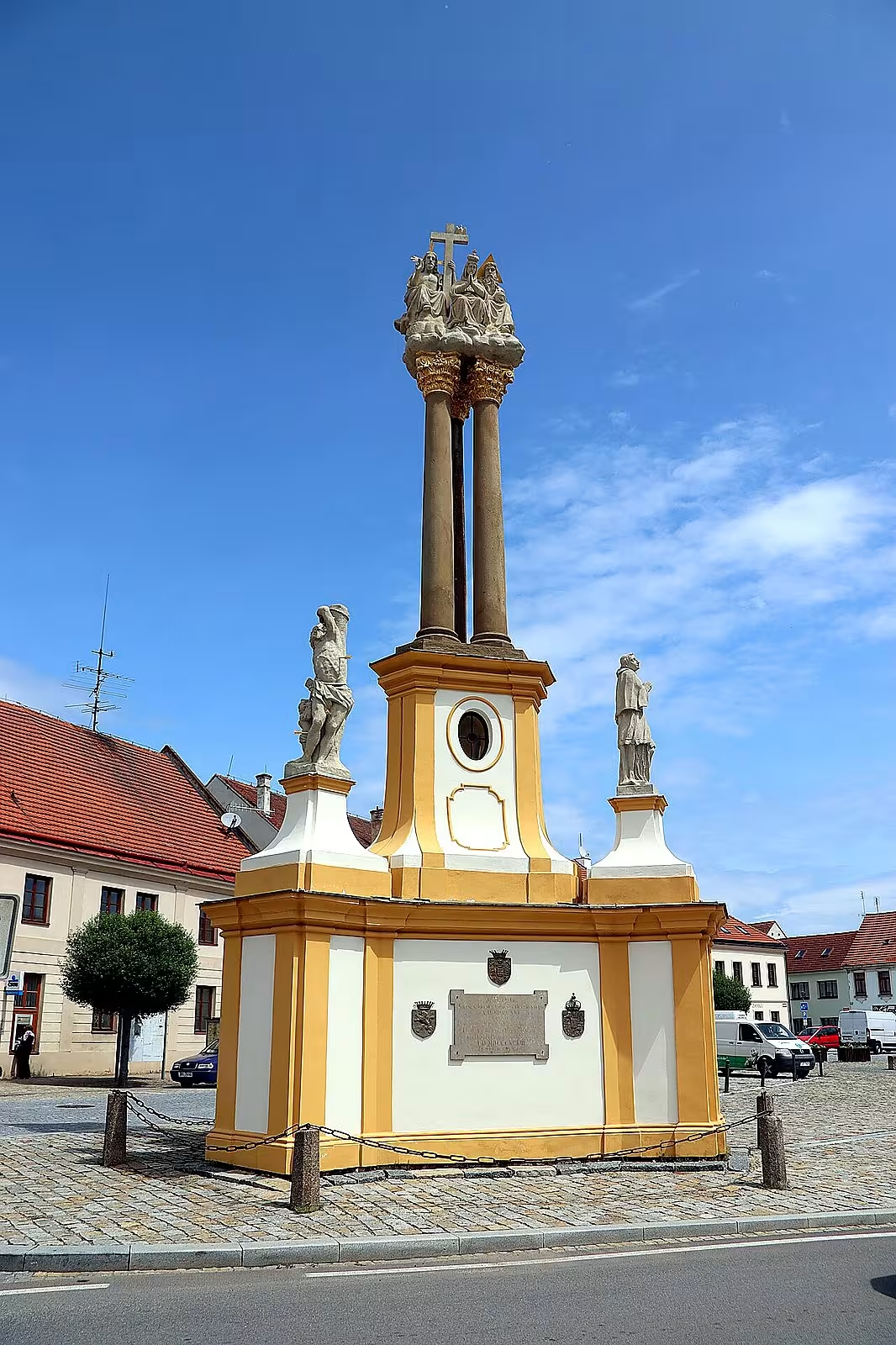
Column Biggest The Trinity is a baroque monument to Peace Square in Jaroměřice nad Rokytna. This cultural object was created in 1716 as an expression of religious piety and social status of the then owner of the estate.
The piece was made by Jan Adam z Questenberka. 1500 gold pieces were spent on its implementation, and the city covered the statue of St. Shebestian. The main aim of the builder was to strengthen the faith of the subjects. For this purpose, Jan Adam founded a foundation ensuring eternal light on the sculpture. At the same time, he ordered the vicar and parochial singers to sing the litany to the Most High Trinity every Sunday after all. For this service, Jan Adam undertook that both he and his successors would supply beer from the master brewery in any quantity in exchange for measuring wheat and barley.
The monument is built of stone and bricks. The foundation forms a ground plan triangle with cut corners and bent sides, which ends with a profiled ledge. In each corner there is a statue on the low needles pedestal: St. Charles of Boromei, St. Roch and St. Sebastian. Among them is a higher and more robust triangular base carrying three cylindrical columns. On them lies the cloud base for the statues of the Most High Trinity whose faces are facing the castle.
The first significant renewal was carried out in 1898 by the owner of the Jaroměřický estate Rudolf Kristián hrabě z Vrbna-Kounic. The reconstruction cost 3500 crowns. During it, the masonry of the pedestal was fixed and plastered, while the original sculpture of the Greatest Trinity replaced the sandstone copy. The restaurant and preservation of the sculpture took place in 2005 with the total cost of CZK 370,000. In the summer of 2017 another repair was completed, which included cleaning and renovation of plaster and sculptures.
The memorial stands in the eastern part of the Square of Peace near the castle in Jaroměřice nad Rokytna. It is proof of the baroque effort to consolidate faith through monumental structures. Visiting this place offers insight into the history of the local estate and of the religious traditions at the time.
Then and now
Drag the slider to compare how the landmark may have looked when it was built with the view today.
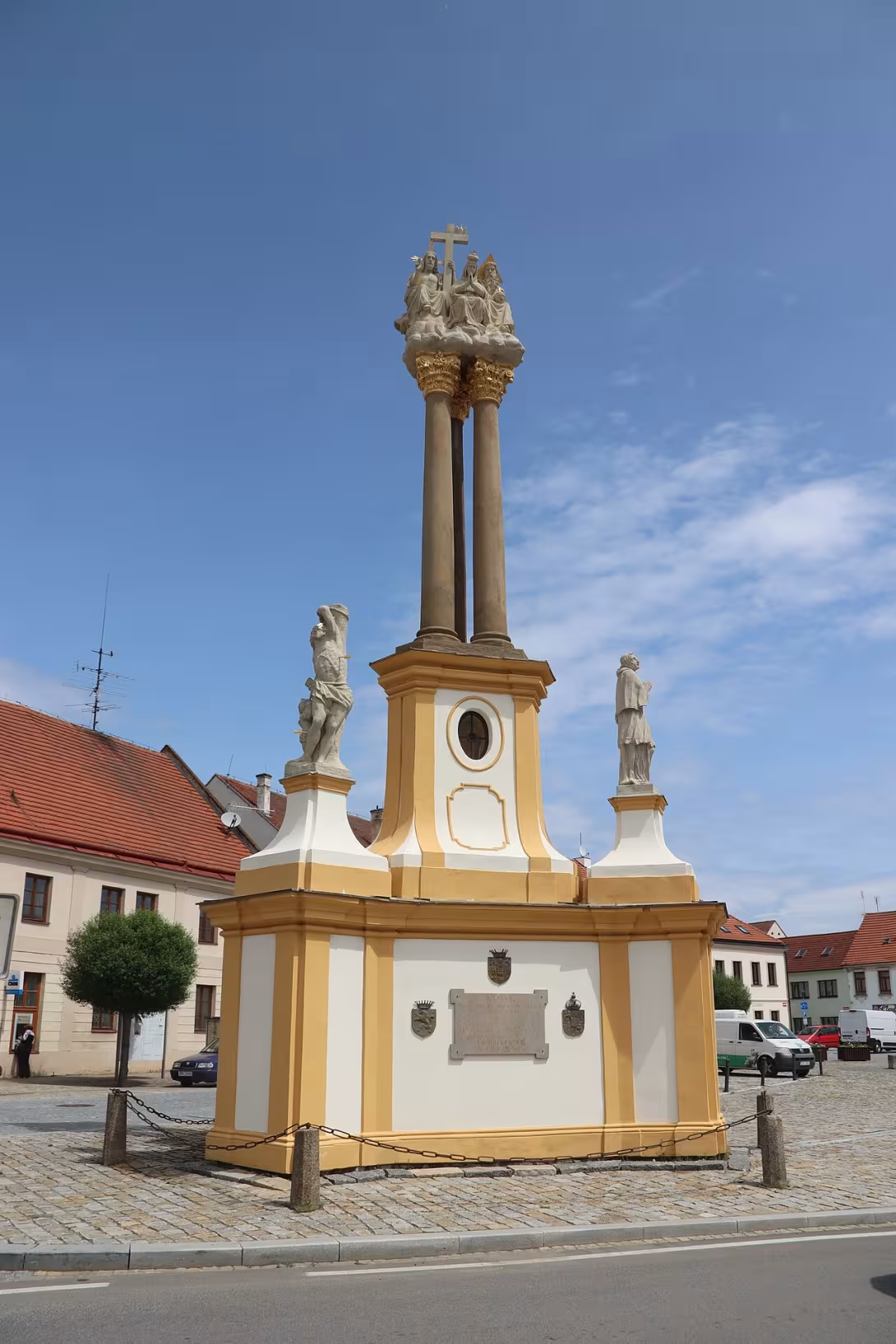

The historical appearance on the left is an AI-generated visualisation and serves as inspiration only.
Historical milestones
- 1716
- Made by John Adam of Questenberg.
- 1898
- Restoring the pedestal and replacing the sculpture with sandstone copies.
- 2005
- Restaurant and preservation of sculptures.
- 2017
- Reconstruction of plaster and cleaning of statues.
Architectural development
Baroque building made of stone and bricks with triangular base. In 1898 the original sculpture was replaced by a sandstone copy. In recent times, the plaster has been repaired and sculptures preserved.
Historical events
1716: The creation of a pillar at John Adam's expense from Questenberg. 1898: Restoration under the direction of Rudolf Kristian Count of Vrbna- Kounice. 2005: Restaurant and preservation of sculptures. 2017: Reconstruction of plaster and cleaning of sculptures.
Owners
Jan Adam z Questenberka, Jaromeric Manor
Points of interest
- Column of the Holy One The Trinity is a baroque monument to Peace Square in Jaroměřice nad Rokytna. - This cultural object was created in 1716 as an expression of religious piety and social status of the then owner of the estate. - The work was made by Jan Adam z Questenberka, which was spent 1500 gold on its implementation. - John Adam founded a foundation to ensure eternal light on the statue and ordered the vicar and parochial singers to sing the litany to the Most High Trinity every Sunday after the nimble. - The first major reconstruction was carried out in 1898 by Rudolf Kristián hrabě z Vrbna-Kounic, which cost 3500 CZK.
Guide
Show guide text
This text was created by artificial intelligence and has not been editorially reviewed. It may contain inaccuracies.
Welcome to Jaroměřice nad Rokytna. You've just stopped at Peace Square, a place where history meets the daily life of this city. In front of your eyes is a monumental baroque monument that immediately captures your view with its height and complex form. It is a pillar of the Holy Trinity, a symbol of the deep faith and the social position of the people who once ruled these spaces. Let yourself be carried away for a moment by the atmosphere of this place and perceive the power of this stone sculpture that has been standing here for centuries.
Let us now look together at how this monument originated and what is behind it. To understand the meaning of this work, we must return to the year one thousand seven hundred and sixteen. That's the year the column was made. The main character who was responsible for his creation was Jan Adam z Questenberka. At that time, such a pillar was not only an artistic work but, above all, a strong expression of religious godliness. At the same time, however, it also served as clear evidence of the social status of the owner of the estate. At that time, the ability to have such a monumental work was a clear signal of power and wealth. The name of Count Rudolf Kristián of Vrbna-Kounice is closely related to this history and importance, which is one of the key personalities associated with this place and its history.
Now pay attention to the architecture itself and the details you have right in front of you. If you look down at the base of the entire sculpture, you'll see a stone pedestal. It has a delicate, very specific shape of a triangle whose corners have been professionally cut off. This geometric basis gives the whole part stability and interesting visual rhythm. There are statues on this pedestal that must impress you with their presence. They're statues of St. Karl Boromei, St. Roch and St. Shebestian. These figures form the bottom floor of the whole sculpture and prepare your view of what comes above.
Once you raise your sight even higher, your attention will shift to the central part of the entire monument. The body of the column consists of three distinct, cylindrical columns. These three shapes bear the most important and most important part of the work - the statues of the Holy Trinity. But this whole sculpture is not randomly placed. Notice how the whole building is oriented. The whole monument heads towards the castle, creating a visual and symbolic link between the religious expression in the square and the seat of the nobles. It's like an invisible line that connects different parts of this historic space.
Although this column may seem immutable to you, it has been through many changes over the years. History tells us that in the year one thousand eight hundred ninety-eight there was an important restoration of the pedestal. At that time, the statues were replaced with sandstone copies, giving us an idea of how the care of this work evolved over the centuries. In modern times, we then witness further care for this baroque jewel. In the year two thousand and five there was a thorough restaurant and preservation of the whole sculpture. And to make the monument look as you see it now, in the year two thousand and seventeen, another reconstruction of the plaster and a thorough cleaning of all the statues was carried out. This continuous care allows us today to perceive the beauty of details that would otherwise destroy time.
The interesting thing to realize when you look at this monument is the contrast between its spiritual content and its political significance. Column of the Holy One The Trinity is not only about prayer and faith, but it is also a stone document about who made the decisions in Jaroměřice over Rokytna. Every detail, from the shape of a triangle pedestal to the direction in which the columns are filmed, tells the story of an attempt to connect celestial to earthly power.
Now that you know the secret of this column, I suggest you continue your walk around the square. Focus on the castle to which the column is oriented and try to imagine what this city looked like when Jan Adam z Questenberka first finished its work. Thank you for spending this moment with us and paying attention to this Baroque monument. We wish you a beautiful and inspiring visit to Jaroměrec nad Rokytna.
Tips for visitors
The best time to visit is late afternoon, when the sun gently illuminates the Baroque details of the statues. For the best photos we recommend to observe the memory from the various angles of the Square of Peace to excel the triangular shape of the pedestal.
The location is easily accessible by car and public transport; Check the current connection in the search engine.
We recommend to bring comfortable shoes for a walk around the square. For families with children, the space around the pillars is in a pleasant environment where children can see stone figures.
In the immediate vicinity there is a castle in Jaroměřice nad Rokytna and the Square of Peace itself, which complements the overall impression of visiting this historic location.
Frequently asked questions
Can the monument be visited?
This is a structure in a public space that can usually be seen from outside free of charge. We have not verified that this particular one is freely accessible.
Where is the monument?
Location: Jaroměřice nad Rokytnou, Kraj Vysočina. The map on this page shows the exact spot.
Why is the monument protected?
It is listed in the Central List of Cultural Monuments of the Czech Republic as a cultural monument (register no. 1257650193).
Businesses nearby
Do you run a restaurant, accommodation, shop, museum, rental, wellness or other visitor service near this monument? Show yourself directly to the people heading to it — this is how they will see you in the app and on the web:
Nearby
Náměstí Míru a zámek v Jaroměřicích nad Rokytnou.
Accommodation nearby
Themed route
1. Square of Peace (central space) - The entry point of the road where you can feel the atmosphere of the village. 2. Column of the Holy Trinity (memorial) - The main destination of the trip, which represents the peak of baroque art in this area. 3. Castle in Jaroměřice nad Rokytna (construction) - An impressive mansion that complements the cultural richness of the whole complex.
Seasonal recommendations
Spring: In spring, the surroundings of the monument awaken to fresh green and flowery gardens. The light is very soft and sharp in this period, which creates a calm atmosphere for observing artistic details. I recommend arriving early in the morning when the air is still fresh. Dress with layers, because the morning cold can still feel, even though the sun is starting to warm.
Summer: The summer months bring strong sunlight and long days that highlight the monumental state. In the main summer season there are more visitors around the monument, so it is best to arrive immediately after opening to enjoy more peace. Don't forget the light clothes, sun cover and plenty of fluids because heat can be very intense.
Autumn: Autumn visit offers a fascinating view thanks to the golden and brown leaves in the area. The morning mist gives the place mystery and a quiet, slightly melancholy touch. It is advisable to wear stronger shoes because the road can be slippery due to moisture and falling leaves. The ideal time for a tour is the lunchtime when the sun shines the most through the colorful trees.
Winter: During winter, the pillar is very strong in the landscape, especially if everything is covered with snow or frost. The atmosphere is quiet and lonely, allowing a deeper perception of history without disturbing influences. Due to the short days and the low sun, I recommend planning a visit around noon. The need is very warm clothes, including gloves and hats, so that you don't miss the beautiful panorama in the freezing air.
Visualizations and artistic views


The visualisations are generated by artificial intelligence and serve as inspiration.
Photos from the area
Real photos taken near the monument


Zdroj a licence jsou uvedeny u každého snímku.
Tips from visitors
No tips yet. Be the first!
Log in and add your tip.
Sources and literature
Photos: Jiří Sedláček / CC BY-SA 4.0 — Wikimedia Commons. The author and licence also appear when you hover over the image.
Faktickým podkladem tohoto textu byl článek na Wikipedii, jehož autory jsou přispěvatelé Wikipedie. Článek je dostupný pod licencí CC BY-SA 4.0.
Location on the map
More monuments – Jaroměřice nad Rokytnou
Show all in the municipality


Příběhy a pověsti
Legendy, pověsti a příběhy spjaté s touto památkou
Fotografie návštěvníků
Zatím žádné fotografie. Buďte první, kdo přidá fotografii z návštěvy!
Log in a přidejte svou fotografii nebo hodnoťte.
Za ověřenou návštěvu v aplikaci získáte víc bodů — poznáme podle GPS, že jste na místě.
Reviews and comments