



Sloup se sousoším Nejsvětější Trojice (Žlutice) Holy trinity column
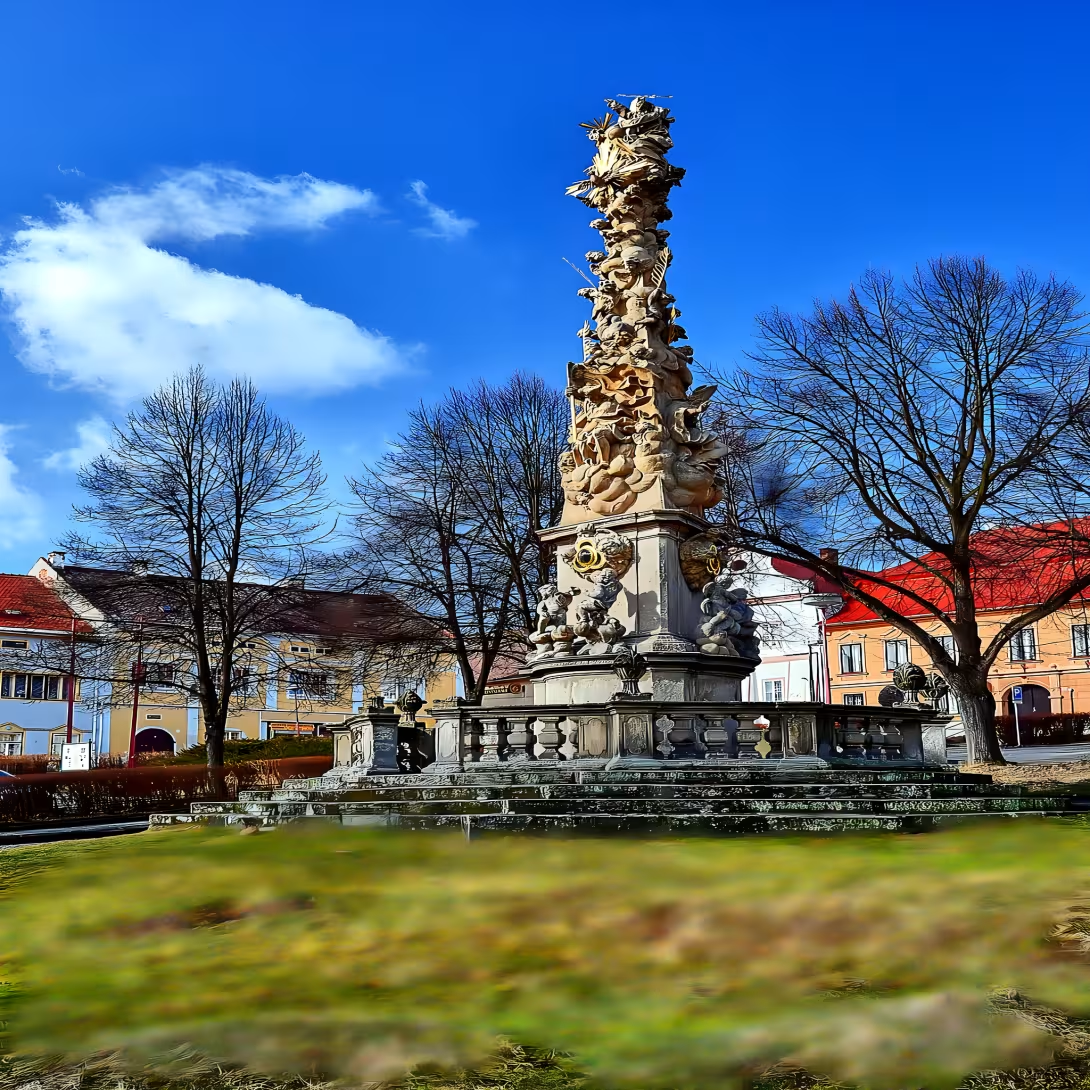
The column of the Holy Trinity, also known as the Plague Column, is a Baroque sculpture monument located in the historical part of the village Žlutice in the district of Karlovy Vary. This triple column was built on the square in 1701 and since 1964 it has been protected as a cultural monument. Its location between the grown-up apples, Baroque architecture and rich sculptures makes it an important historical monument.
The creation of the column is closely linked to the Baroque era, which in Central Europe has brought the boom of artistic and architectural forms. In Bohemia, this style was adopted with great enthusiasm, which is reflected in many sculptures of the time. On 2 May 1701 the Yellow City Council decided to build a column to honor the Holy Trinity. She approached and subsequently made a contract with local sculptor Oswald Josef Wenda, who undertook to perform the work. The commitment is worth the fact that the column was built according to the supplied drawing and fitted with thirteen angels. The stone and sculpture works lasted until 1704, as confirmed by the chronogram on the column.
Architectural is this trigon column The Holy Trinity is classified as a pebble type. It is possible that the inspiration for its creation was the Column of the Holy Trinity am Graben in Vienna. The author of the whole sculpture was the yellow sculptor Oswald Josef Wenda, perhaps according to the design of Peter Brandle. The column stands on a stone several tiered suspicion balancing the sloping terrain. The bottom part of the column is completed with a profiled top plate with commemorative inscription of renovation. Under a massive ledge are placed glass boxes on lanterns, composed of three intermingling circles. In the plinth part there are inscription boards and statues of Holy Patrons of Bohemia - Saint Wenceslas, Saint Ludmila and Saint Vojtěv. At the top of the column there are statues of angels with gilded palm branches and at the top of the sculpture many heads of angels. The column is completed by the sculpture of the Holy Trinity supplemented by a part of the celestial world with angels.
The column was built at the cost of the village and the stones were provided free of charge by the superintendent Kokořovková of Kokořov. The gilding of the column was performed by the Klatov goldsmith in 1707. Over the years, the sculptures were supplemented with balustrad and pine cones, which contributed to its present appearance. The column has undergone several repairs; the first documented correction took place in 1759, when the funds were raised by the collection due to the lack of money in the city's treasury. Other repairs took place in 1798, 1853, 1886, 1905, 1929 and 1935. In 1967-1969 the monument was restored in several stages and the last repair took place in 1989- 1990. The long-prepared restoration of the column began in July 2011 and ended in 2012 with total cost of reconstruction of CZK 1 584 000.
Today the Column of the Holy Trinity is not only a cultural monument, but also an attractive destination for tourists and historians. Its location on the square in Yellowery makes it an easily accessible object that offers a view of the past and resembles the rich Baroque tradition of the region. Visiting this column is not only a way to understand the historical development of the local community, but also an opportunity to appreciate the artistic value and architectural skill of past generations. Column of the Holy One The Trinity is therefore not only a monument at local level, but also an important part of the cultural heritage of the Czech Republic.
Historical milestones
- 1704
- Completion of sculptures and stonework.
- 1712
- The sacred column.
- 1964
- Preservation as a cultural monument.
Architectural development
The column was built between 1701 and 1704. During its existence it underwent several repairs, most recently in 1989- 1990. In 2012, a thorough restoration took place with a total cost of CZK 1,584 000.
Historical events
- 1701
- The decision of the Yellow City Council to build a column.
- 1712
- Sanctification by Prior Carmelite monastery in Hýší.
- 1964
- Preservation as a cultural monument.
Points of interest
- Column of the Holy One The Trinity is also known as the Plague Column. - It was built on the square in 1701 and since 1964 it has been protected as a cultural monument. - Its location between the grown-up apples, Baroque architecture and rich sculptures makes it an important historical monument. - The column was built at the cost of the village and the stones were provided free of charge by the superintendent Kokořovková of Kokořov. - On 2 May 1701 the Yellow City Council decided to build a column to honor the Holy Trinity.
Guide
Show guide text
This text was created by artificial intelligence and has not been editorially reviewed. It may contain inaccuracies.
Welcome to the picturesque Yellows. Right now, when you listen to these words, you're standing in the heart of the historic square, and one of the most important and beautiful symbols of this city stands before your eyes. Stop for a moment, relax and feel the atmosphere of this place. Look around you. Do you see those tall, grown lashes that surround you and create a natural, green frame for this space? Their shadows are slowly moving around the earth, creating a game of light and darkness that gives this place a sense of peace and nobility. And right in the middle of this green circle is him, the column of the Most High Trinity. It's a monumental work that carries a cramped history, faith, and the hope of an entire city.
Look at his shapes. Even if it's just a rock, in its baroque processing, you feel incredible dynamics and movement. This column is not just an ordinary sculpture piece; It's a so-called plague column. To understand its meaning, we must go back deep into the past, to a time when people lived in constant fear of invisible enemies such as the disease. In seventeen hundred and one, when this building began to be planned, the existence of such monuments was a way of expressing gratitude for survival or begging for protection from evil. This column was built as an expression of deep faith and as a reminder of the difficult times that the community in the Yellows had to go through. He is a stone witness to history, standing here to remind people of their fragility and their strength in times of greatest need.
Now pay attention to the details you see right in front of you. Although time is relentlessly moving forward, this baroque entity has preserved its rich sculptures. Feel the complex shapes and artistic elements that are drawn on it. The Baroque style that you will find here is characterized by this richness and the desire to express strong emotions. Notice how the column lines seem to be in constant motion, how they swung and how different sculptures intertwine. This whole project wasn't random. It came from a careful drawing of a sculptor who was Oswald Josef Wenda. This man had the ability to bring not only shapes to stone, but also the soul of his work. It is very interesting that his work was not an isolated success, but was deeply influenced by inspiration from the great city, namely from the famous column of the Most High Trinity in Vienna. This tells us that even in this smaller town, such as Žlutice, the highest artistic currents of the time met.
If you look at the chronology of this place, you realize how long this column has traveled. Working on it wasn't fast. While the very intention and beginnings of the building are calculated by the year seventeen hundred and one, only in seventeen hundred and four were completed all the complex sculptures and stonework. Imagine the craftsmen who worked every detail with respect and patience to achieve the perfection you see today. Another important moment came in seventeen hundred twelve, when the column was officially sanctified. That was the moment when the stone work became a sacred place for the whole village. And history in this place doesn't end in the eighteenth century. This column was so important that in the year one thousand nine hundred sixty-four it became a protected cultural monument. It means that for decades, we've been looking after him to preserve him for future generations, just like you see him now.
There's one interesting thing that might interest you. Although this column is now such a solid part of the square, its presence between these lashes creates a strange, almost mysterious atmosphere. Lips are in our culture câymi that bear the symbolism of wisdom and protection. When you look at the column through their branches, you feel that this monument is protected by nature itself. It is a combination of human art and the power of nature that has been here in the Yellows for hundreds of years. The column stands here as a silent observer of everything that takes place in this square - from happy city festivals to quiet, lonely rains.
Now that you've learned the basic story of this place, I suggest you stop for a while and just observe. Don't rush anything. See how light changes on the surface of the stone, how the shadows of the sticky leaves dance beside it. Feel the weight of history that just hangs in the air in this place. It's a rare opportunity to become part of this continuum that connects the people of seventeen hundred and one with you.
Thank you for taking the time to pay attention to this baroque gem. We hope that this brief insight into the past has helped you better understand the soul of the Yellow. Please continue your walk around this historic city. Every aisle and every square here has its own story waiting for you. We wish you a beautiful and inspiring encounter with the other secrets that this place offers. Goodbye.
Tips for visitors
The best time to visit this Baroque work is the spring and autumn months, when the weather is mild and the surrounding greenery give the pillar contrast. The morning or late afternoon light creates interesting shadows on the statues and columns that underline the details of the sculpture work.
When planning your trip to the Yellow Sea, consider that the city is available both by car and public transport. The specific connection and departure times should be checked in the current search engine or carrier's pages as they can change. If you arrive by car, look for places around the historical core where the column is located and respect local traffic signs.
For a comfortable tour take with you fixed shoes that allow you to walk safely on the pavement of the square. Although the monument is outdoor, it is good to have a light jacket, especially in colder seasons, and in summer sunscreen and water. Since this is a historic place, it is advisable to prepare in advance information about the history of the pestilence columns to better appreciate the symbolism of the work from 1701.
For photographers it is ideal to capture the column in the overall context of the square in order to see its relation to the surrounding architecture. Try to stand on the opposite side of the square and photograph the column at an angle that highlights its height and baroque dynamics. The morning light falling from the side can brightly illuminate the faces of statues and the texture of stone. Avoid sharp midday sun, which can create too hard shadows and reduce contrast details.
Since there are no specific places in the area in the background, we recommend to walk along the historical Yellow Core and admire other architectural monuments in the immediate vicinity. Children may notice details of statues and try to identify individual figures of the Trinity, which may be an interesting educational activity.
Frequently asked questions
Can the monument be visited?
This is a structure in a public space that can usually be seen from outside free of charge. We have not verified that this particular one is freely accessible.
Where is the monument?
Location: Žlutice. The map on this page shows the exact spot.
Why is the monument protected?
It is listed in the Central List of Cultural Monuments of the Czech Republic as a cultural monument (register no. 1000136184).
Businesses nearby
Do you run a restaurant, accommodation, shop, museum, rental, wellness or other visitor service near this monument? Show yourself directly to the people heading to it — this is how they will see you in the app and on the web:
Events nearby
Zdroj akcí: otevřená data měst a obcí ČR (Národní katalog otevřených dat) a kalendář akcí Národního památkového ústavu.
Nearby
🏰 Historic sites (51)
- Sloup Nejsvětější Trojice 0.0 km
- Mazanec 0.4 km
- Zřícenina hradu Nevděk 1.0 km
- Štědrý hrádek 3.8 km
- sv. Barbora 3.9 km
- Hradiště Vladař 3.9 km
- Rohlerův Mlýn 6.1 km
- Karel Čapek 6.2 km
- Panna Marie 6.5 km
- sv. Jan Nepomucký 6.8 km
- Tomšův Mlýn 7.9 km
- Doubský Mlýn 8.0 km
- Kostel sv. Jiří 8.4 km web
- 1914 - 1918 8.4 km
- Tvrz Vlkošov 9.6 km
- Památce padlým 10.2 km
- Pomník padlým 10.2 km
- Hartenštejn 10.6 km
- hrad Sychrov 10.6 km
- sv. Jan Evangelista 10.6 km
🍽️ Restaurants and dining (18)
- Zámecký pivovar 6.3 km +420 728 948 868 web
- Stop Cafe 10.1 km
- Penzion Laura 10.5 km
- Jídelna U Zlaté koule 10.5 km náměstí Míru 42
- Radniční sklípek 10.5 km náměstí Míru 1
- Restaurace Slunce 10.6 km náměstí Míru 35
- Hospůdka U Macháčků 10.6 km náměstí Míru 30
- Hostinec u Kamenného mostu 10.7 km +420 603 223 618 web
- Četnická stanice 10.7 km +420 728 215 628 web
- Valečský dvůr 11.2 km
- Zámecká restaurace Manětín 12.2 km web
- Hostinec Na Radnici 12.9 km +420739303558;+420373313132
- Hostinec u Kameného stolu 13.1 km web
- Sázavan 13.2 km
- U Čapků 13.2 km
- Hospoda Na hřišti 13.2 km +420604675213 web
- Stop Cafe 13.6 km
- Čoubův mlýn 14.7 km
🏨 Accommodation (13)
- Pension Harmonie 0.7 km Žižkov 540 web
- Semtěš 5 2.6 km web
- U Devíti Vidlí 2.7 km web
- Karavanserai 5.2 km
- Zámecký penzion Chyše 6.3 km Chyše 54 +420353396336 web
- Osada Šárka 9.3 km +420 725 813 526 web
- Penzion u Kapličky 9.9 km Kozlov 110 00420603145076 web
- Plot 11.6 km
- penzion a restaurace U zámku 12.6 km
- U kaprů 13.2 km +420 604 741 337 web
- Bývalý špitál 13.7 km +420373313104 web
- Levande Ranč 14.4 km
- Zámek Nečtiny 14.8 km
🚲 Rentals and sport (1)
- Sokolovna 12.9 km
🥾 Hiking and nature (228)
- Hlínovec 0.8 km
- Nevděk 1.0 km
- Krkavec 1.8 km
- Lamberk 2.4 km
- Žlutické Lurdy 2.5 km
- Za transformátorem 2.9 km
- Na vršku 3.4 km
- Holý vrch 3.6 km
- Na Karlově 3.8 km
- Pohořelec 3.8 km
- Mlyňanský vrch 3.8 km
- Ptačí vrch 4.0 km
- Doubrava 4.0 km
- Vladař 4.0 km
- Studánka víly Irmulky 4.4 km
- Nad hřbitovem 4.5 km
- Nad ovčínem 5.0 km
- Havraní vrch 5.0 km
- Na zadu 5.1 km
- Vraní vrch 5.5 km
Accommodation nearby
Trips and activities nearby
Guided tours, tickets and activities nearby from GetYourGuide
Affiliate link: if you buy from the partner, we may receive a commission. The price for you does not change.
Search tours and activities →Themed route
1. Column with the statue of the Holy Trinity, type: sculpture. The main point is a tour of this religious column. It fascinates with its detail and spiritual significance. 2. Bottom part and base of column, type: architectural detail. Here you can closely watch carving work on a stone base. It's the best place to look at art in detail. 3. Upper part of statues, type: artistic detail. A view of characters representing divine unity. This section requires careful monitoring of facial details and gestures. 4. The immediate area of the sights, type: open space. This part allows you to go around and watch it from all sides. It provides a quiet environment for observing the overall work.
Seasonal recommendations
Spring brings nature to the Roads, which contrasts beautifully with the stone mass of the Trinity Column. The surrounding trees and shrubs are developing fresh green leaves, which gives the monument a live and fresh character. Light can be soft and diffuse at this time, often intersecting through the fog that is held in the valleys in the morning. For visitors, spring is an ideal time for walking, because temperatures are warm, but not as hot as summer. We recommend taking a light jacket with us, because spring weather can be variable and it can be cold in the morning. The best time to visit is the late morning when the sun is already getting high and better illuminates the details of the sculpture decoration. Nature around the column is in full bloom, which creates a pleasant background for photography and relaxation.
Summer offers the longest days and brightest light that reveals every groove and detail on the stone sculpture. The sun rises high, so the shadows are short and sharp, which may be convenient for a close-up tour, but it may also be unpleasant for longer standing. The surrounding vegetation is fully developed, dense and dark green, providing a pleasant shade in the afternoon. In this period there are more people around who use free days to take trips, so it is good to avoid the main midday peak time. Clothes should be light, breathable and with sun protection such as a hat or glasses. The morning clock is ideal when the air is fresh and light soft, while the evening temperatures are slightly cooling and the sun sets, creating dramatic and warm tones on the stone.
Autumn brings a rich palette of colours to the landscape around Zhůří, from golden to rich red, which perfectly matches the grey tone of the stone. The tree leaves fall down, which reveals more architectural elements of the column and allows better clarity of the whole object. Light is lower and warmer, often golden, which creates a romantic and slightly melancholy atmosphere. The temperatures are dropping, which is why it is necessary to carry layered clothes, including a warm jacket and scarf. Morning freezers can be cold while the afternoon is still relatively warm. The best time to visit is the late afternoon when the sun shines low and creates long shadows that highlight the relief elements of sculpture. Nature around the column is calmer and less disruptive, which allows focused observation.
Winter brings a quiet and peaceful atmosphere to ŽStreet, often reinforced by snow, which covers the surroundings of the pillar and creates a pure white contrast with a dark stone. Light is usually weak and gray, with short days, which gives the scene a dramatic and dreamy character. The temperatures are low, often below zero, so it is necessary to dress in warm winter clothes, including gloves, hats and warm shoes. The visit is especially suitable in the afternoon, when there is still plenty of light and temperatures are highest. The snow cover can be slippery, so it is important to keep your shoes safe. The winter landscape around the pillar is minimalist and calm, without disturbing leaves, allowing full appreciation of the monumental character of the monument in its most sober form.
Visualizations and artistic views

The visualisations are generated by artificial intelligence and serve as inspiration.
Photos from the area
Real photos taken near the monument


Zdroj a licence jsou uvedeny u každého snímku.
Tips from visitors
No tips yet. Be the first!
Log in and add your tip.
Sources and literature
Photos: Petr Kinšt / CC BY-SA 3.0, rozlišení zvýšeno umělou inteligencí — Wikimedia Commons. The author and licence also appear when you hover over the image.
Faktickým podkladem tohoto textu byl článek na Wikipedii, jehož autory jsou přispěvatelé Wikipedie. Článek je dostupný pod licencí CC BY-SA 4.0.
Location on the map
Příběhy a pověsti
Legendy, pověsti a příběhy spjaté s touto památkou
Fotografie návštěvníků
Zatím žádné fotografie. Buďte první, kdo přidá fotografii z návštěvy!
Log in a přidejte svou fotografii nebo hodnoťte.
Za ověřenou návštěvu v aplikaci získáte víc bodů — poznáme podle GPS, že jste na místě.
Reviews and comments