



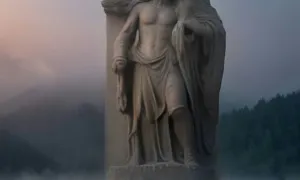
socha svatého Jana Křtitele v Lubně Statue
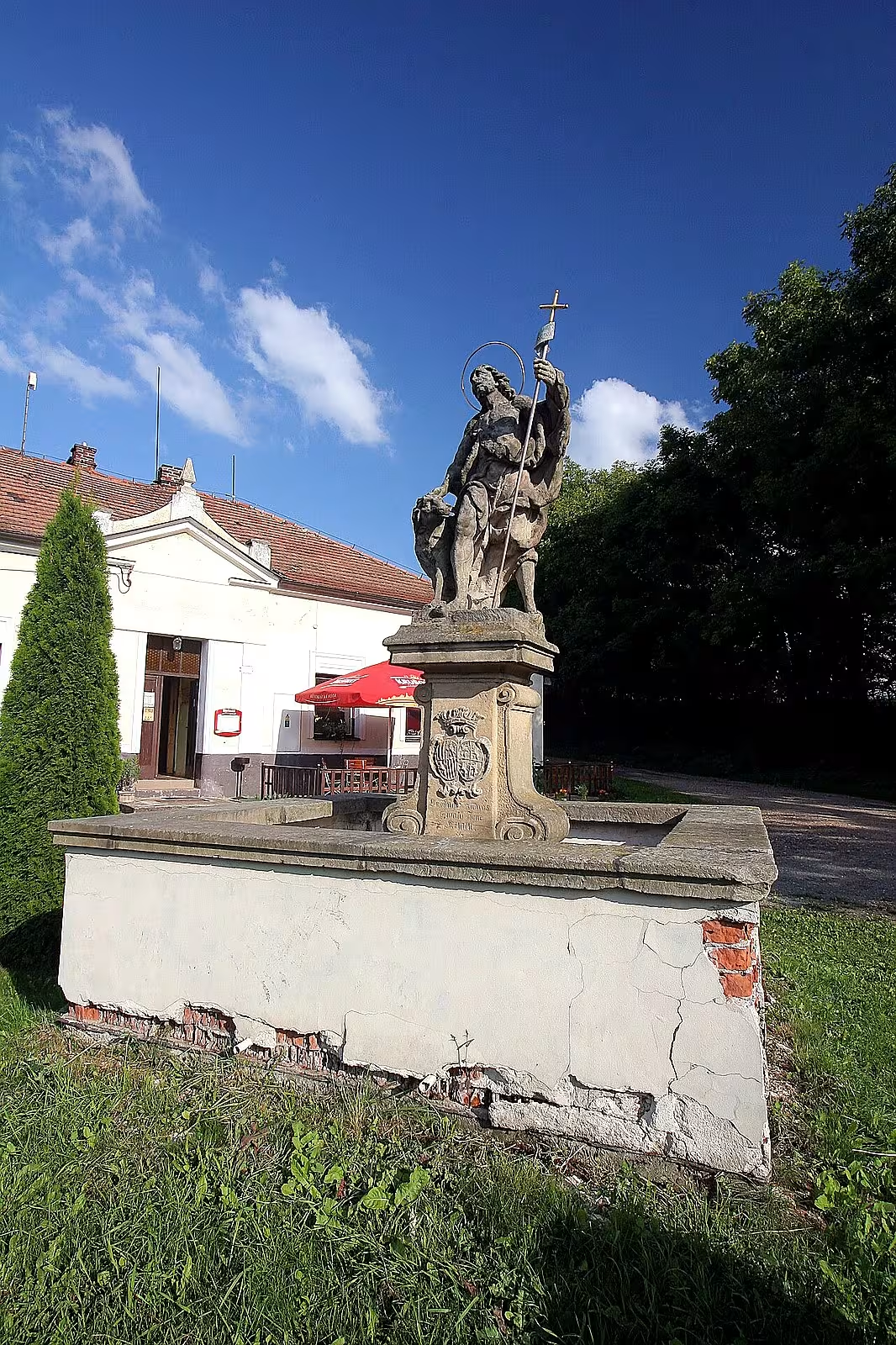
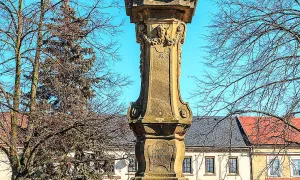
The Baroque statue of St. John the Baptist with a lamb in Lubna, part of the city Nechanice in the district of Hradec Králové, is an important cultural monument of the Czech Republic. Born in the first half of the 18th century, the statue boasts rich history and architectural features that make it a unique heritage of the region. Since 1958 it has been protected as a real-estate cultural monument of the Czech Republic.
The statue is located in a square porridge with smooth walls and sandstone parapet. It is built on a prism plinth decorated with volutes, ended with a profiled ledge. On the front side of the plinth is carved embossed with embossed alliance coat of arms of Donors - Schaffgotschs and Valdštejns, under which is the inscription 'Orodug for us / Swat Jene / Baptist /'. The statue represents a saint in a cloak on a naked body with his right foot on it, holding a stick with a cross and a lamb standing on his right. There's a circular halo around the head.
The Baroque style of this time manifests itself with rich ornaments and dramatic forms, also visible on the statue. The Baroque was a period of political change within the Habsburg monarchy, which could affect the location and patrons of the work.
The statue was repaired for the first time in 1847 and subsequently between 1994- 1995. These adjustments ensured the preservation of its historical and artistic features for future generations.
The statue of St. John the Baptist in Lubna is architecturally interesting and bears a mark of the history of the region. Its protected status highlights cultural and historical value. For visitors it offers a view of the past when it was created with great artistic intent.
Visiting this monument is an opportunity to explore its historical and cultural context. The statue stands as a testament to the region's rich past and its artistic heritage, which makes it an interesting place for historians and any interested in cultural monuments of the Czech Republic.
Historical milestones
- first half of the 18th century
- Creation of the Baroque statue of St. John the Baptist
- 1847
- First repair of the statue
- 1958
- Entry into the list of protected cultural monuments
- 1999-1995
- Performing further repair of the statue
Architectural development
The statue was first repaired in 1847 and then in 1994- 1995. It is a Baroque work from the first half of the 18th century, which is part of a fountain with smooth walls and sandstone parapet.
Historical events
- 1958
- The statue with fountain was protected as a real cultural monument of the Czech Republic.
Points of interest
- The statue was created in the first half of the 18th century and since 1958 it has been protected as a real cultural monument. - It is located in a square porridge with smooth walls and sandstone parapet. - On the plinth is carved embossed with embossed alliances of Donors from the Schaffgotsch and Valdstein families along with the inscription. - The saint is depicted in a cloak on a naked body with a stick with a cross and a lamb on his right. - Repair of the statue took place in 1847 and subsequently in 1994- 1995.
Guide
Show guide text
This text was created by artificial intelligence and has not been editorially reviewed. It may contain inaccuracies.
Welcome to Lubna, in this quiet part of the city of Nechanice, where time stopped. Right now, you're facing one of the local spiritual and artistic gems that welcomes you with its quiet presence. A Baroque sandstone statue of St. John the Baptist stands before you. The first impression that radiates from it is a sense of stability and deep faith, which is so typical of the period in which it originated. Look at the overall composition. The statue is not only the figure of the saint itself, but forms a harmonious whole with the water element in which it is placed. It's a place that was designed to stop the pilgrim, to make him think and pray.
Let us now look at how this monument was created and in what context it was created. This statue dates back to the first half of the eighteenth century. So imagine the time of the high baroque, when art was a tool that was supposed to trigger strong emotions and show the glory of God and the power of the then noble generations. At that time, it was common for rich donors, so-called donors, to finance the construction of similar statues and chapel to express their gratitude or to ask for protection for their community and family. Although we do not know exactly who was the author of this work today, it is clear that it was a master of skill who was able to develop fine details and a dynamic expression in hard sandstone.
Now pay attention to the architecture itself and to what you see right in front of you. The statue of St. John the Baptist is not just on the ground, but placed in a fountain. Notice her floor plan, which is exactly square. The porridge walls are smooth, creating a clean contrast to the richly decorated statue above them. The whole area is closed by sandstone parapet which separates the water surface from the surrounding terrain.
Now lift your gaze above, on the foundation on which the saint stands. It is a prism plinth, which is a truly exemplary element of baroque style. Notice the so-called volutes, which are the elegant snail spirals that decorate the corners and sides of the plinth. These elements give the whole object a feeling of lightness and movement, even if it is made of heavy stone. The upper part of the plinth ends with a profiled ledge which clearly separates the base from the figure of the saint.
If you approach the front of the plinth, you will see a very important detail. A relief alliance coat of arms is carved here. The word alliance here means it's a union of two generations. This sign tells us who the people who paid for the statue were, and they had it built here. These are representatives of the Schaffgotsch and Valdstein families. Both of these families were among the most important and powerful families in the former countries, and their presence in the form of coat of arms in this place is indicative of their influence in the vicinity of Chenice.
Right under the coat of arms you will find a sign that is written in period Czech. Try reading it. The words of Orodug stand for us, Swatý Jen Baptist. It is a simple but strong request for representation and prayer for the people who passed this statue. This inscription brings us back to a time when faith was an integral part of every man's everyday life, from the poorest cottage boy to the highest nobles.
Now let's look at St. John the Baptist himself. The saint is depicted in a cloak that covers his body, and accompanied by a lamb. The Lamb is a key symbol because John the Baptist in the Bible described Jesus as the Lamb of God, who takes the sins of the world. This symbolism was immediately understandable to the visitor at the time and reminded him of the role of John as a herald and a baptist.
When you look at the statue, you might notice that the surface of the stone is not perfectly smooth. This is due to the time and ventilation of sandstone, which is a material that is beautiful and well worked but also vulnerable to the effects of weather. That is why the statue has been repaired several times over the centuries. The first major repair was made in the year one thousand eight hundred forty-seven, i.e. in the middle of the nineteenth century, when it became more careful to preserve old monuments. Another major recovery took place much later, in the years one thousand nine hundred ninety-four and ninety-five, to ensure the stability of the statue and to preserve its details for future generations.
It is also interesting that this statue is not just an ornament, but is officially recognised as a cultural monument. The list of protected cultural monuments was registered in the year one thousand nine hundred fifty-eight. This means that the state recognised its historical and artistic value and decided that it must be protected from extinction. It's fascinating to think how many generations of people this statue has served as a point of orientation, a place of peace or a place of prayer in Lubna.
When you now notice the total involvement of the statue in the landscape. Baroque art has always worked with space. This statue in the porridge was not placed randomly, but should have been seen to form a center of attention in a given place. Imagine how in the summer months the water shined in the fountain and how the figure of St. John reflected in it. It was all meant to create an atmosphere of sanctity and peace.
This monument tells us the story of a union of power and faith. On the one hand, we see the religious humility expressed by the figure of the saint and the supplication in the inscription; on the other hand, we see the pride and status of the noblemen of Schaffgotsch and Valdstein, who have left their coat of arms in the history of this place. It is a silent testimony about how in the eighteenth century the interests of the Church, the nobles, and the locals were mixed.
Now that you have looked at all the details, from the smooth walls of the square porridge to the snail volutes on the plinth to the symbolic lamb at the holy feet, I suggest you stand still for a moment and perceive the atmosphere of this place. The sandstone that you can feel in the air and see in the colors of the statue is a material that breathes through history.
Thank you for spending time with us at the statue of St. John the Baptist in Lubna. We hope that this short trip to the eighteenth century has helped you better understand the beauty and importance of this Baroque monument. We now invite you to explore further the surroundings of Chechanic and their beautiful corners. We wish you a pleasant continued journey and many other discoveries. Goodbye.
Tips for visitors
The best time to visit the statue of St. John the Baptist in Lubna is autumn or spring when vegetation is less dense and sunlight allows beautiful photos. These periods are also suitable for travelling in mild temperatures.
For arrival we recommend the use of a passenger car or a visit with public transport. The current connection can be found in the online search engine.
When visiting the statue, bring a sun protection cover that will be useful especially in the summer months. Photography is possible from different angles, with the best light offered from morning to noon.
For families with children, visiting the statue is an interesting opportunity for a short walk and exploring historical monuments. Children can be interested in the architectural detail of the statue and its location in the fountain.
Around the statue there is a crossroads leading to other parts of the city Nechanice. These paths are suitable for short walks or biking, allowing better knowledge of the surrounding region.
Frequently asked questions
Can the monument be visited?
This is a structure in a public space that can usually be seen from outside free of charge. We have not verified that this particular one is freely accessible.
Where is the monument?
Location: Nechanice. The map on this page shows the exact spot.
Why is the monument protected?
It is listed in the Central List of Cultural Monuments of the Czech Republic as a cultural monument (register no. 1000143182).
Businesses nearby
Do you run a restaurant, accommodation, shop, museum, rental, wellness or other visitor service near this monument? Show yourself directly to the people heading to it — this is how they will see you in the app and on the web:
Events nearby


Zdroj akcí: otevřená data měst a obcí ČR (Národní katalog otevřených dat) a kalendář akcí Národního památkového ústavu.
Nearby
🏰 Historic sites (357)
- sv. Jan Křtitel 0.0 km
- Vesnický mini skanzen 0.1 km
- Pomník obětem války 1866 0.3 km
- socha T. G. Masaryka 1.3 km
- Muzeum starých hraček 1.4 km web
- Památník Selské jízdy 1947 1.5 km
- Památník obětem světových válek 1.6 km
- Válka 1866 1.6 km
- Válka 1866 1.6 km
- tvrz Nechanice 1.6 km
- Pomník Františka Chvojky 1.8 km
- Válka 1866 1.8 km
- Památník Dr. Strose 1.8 km
- Zámek Hrádek u Nechanic 2.1 km +420 495 441 244 web
- Madona 2.1 km
- Pomník obětem světových válek 2.4 km
- Pomník obětem války r. 1866 2.5 km
- sv. Václav 2.5 km
- Madona 2.8 km
- Válka 1866 2.9 km
🍽️ Restaurants and dining (331)
- Restaurace u Ságnerů 1.4 km +420777 643 039 web
- Koruna 1.5 km Palackého 80
- Café U Rybiček 1.7 km +420 604 929 231 web
- Kiosek na Hřišti 2.5 km
- Hostinec Na kopečku Hrádek 2.8 km +420 603 149 917
- V Kopečku 2.8 km
- Hospoda U havrana 3.0 km
- Hostinec U Prcka 3.9 km
- Hospoda Stodola 4.1 km Radíkovice 1 +420 723 107 579
- Hostinec XIII 4.3 km Probluz 13
- U Jezírka 4.4 km
- U Karla IV. 4.6 km
- Občerstvení Mokrovousy 4.7 km +420 603 576 150
- Hospoda Střezetice 4.8 km
- Pohostinství U Hysků 5.4 km
- Občerstvení Stěžírky - požární nádrž 5.7 km
- Pivovar & restaurace Lindr 6.3 km
- Hostinec u Růženky 6.4 km
- Stop Cafe 7.0 km
- Bistro Lila 7.0 km
🏨 Accommodation (42)
- Soukromé kempové místo 2.4 km
- Venkovský dům Dolní Přím 4.0 km web
- Kemp Lodín 4.7 km web
- Smetanův statek 7.5 km Klacovská 50/10 +420 777 741 473
- Motel Roudnice 7.7 km web
- Dog hot, psí hotel 7.8 km
- Petříkův Statek 8.2 km +420 608 520 274
- Svatby od srdce 8.5 km +420606 378 779 web
- u Svatého Jana 9.0 km Spojovací 72/46
- Motorest TIR 9.1 km
- Motorest TIR 9.1 km
- Kemp Milovice u Hořic 10.1 km web
- Černý kůň 10.5 km web
- Penzion UNO 10.8 km +420 495 535 467 web
- Koloťuk 11.4 km +420 774 716 339 web
- Černigov 11.6 km
- Penzion MAR 11.6 km
- Hertz 11.7 km Kydlinovská 335/46a
- Penzion Pupendo 11.7 km
- Hotel Okresní dům 12.8 km Palackého 6 +420 495 054 300 web
🚲 Rentals and sport (158)
- Autokros 1.0 km
- Motokros 1.2 km
- V SPORT HK s.r.o., prodej sportovních potřeb 2.9 km
- Myslivecký klub 3.9 km
- Tělocvična 7.5 km
- Krytý bazén 7.6 km
- Krytý bázen 7.6 km
- Nextbike 9.4 km web
- Nextbike 10.1 km web
- Nextbike 10.3 km web
- Nextbike 10.6 km web
- Nextbike 10.7 km web
- Nextbike 10.7 km web
- Nextbike 11.0 km web
- Autocross KPM KOSICE 11.3 km
- Nextbike 11.4 km web
- Nextbike 11.4 km web
- Nextbike 11.5 km web
- Sportisimo 11.5 km
- Nutrend 11.5 km
🥾 Hiking and nature (131)
- Akvadukt 0.4 km
- Jehlický vrch 1.1 km
- Jehlický vrch 1.4 km
- Štrosovy sady 1.8 km
- roubená chalupa 1.9 km
- Popovický roubený mlýn 2.4 km
- Nový 2.5 km
- Stromořadí šesti dubů 2.8 km
- Dubina 2.9 km
- Babylon 3.9 km
- pomníky z bitvy 1866 4.2 km
- U Tomáškova lesa 4.2 km
- pomníky z bitvy 1866 4.3 km
- roubená chalupa 4.4 km
- Nerošovský roubený mlýn 4.6 km
- Gril 4.7 km
- Kozí kopec 4.8 km
- Dohaličky 5.0 km
- Strahovský bor 5.0 km
- Borek 5.1 km
Accommodation nearby
Themed route
Thematic cruise route from Nechanic to the statue of St. John the Baptist in Lubna
1. Statue of St. John the Baptist in Lubna (statue) This statue is our main destination. It stands by the road and attracts attention with its historical value and location in a picturesque landscape. It's the perfect place to understand local spiritual life.
2. Saint Anne's Chapel (Chapel) The chapel is located near the statue and is famous for its historical architecture. It's a place of peace where you can enjoy a beautiful view of the surrounding countryside. To visit her is worth it for her artistic elements and spiritual atmosphere.
3. Non-chonic pond (pond) This pond is an ideal place to relax after visiting the chapel. It offers a pleasant walk around the water surface and the opportunity to observe wild animals or birds. It is also a great corner for a short rest.
4. Hechanic rectory It is not far from the pond and is famous for its historical construction and architecture. To visit her is worth it for her rich history and importance to the local community. It's also a place where you can recognize local traditions.
5. Non-Economic Municipal District (municipality) Take a look at the center of Chenice and their historic buildings. This place offers an overview of life in this location, with the opportunity to explore local shops and restaurants.
This route offers a combination of cultural knowledge and natural beauty. Each point has its own unique meaning and enables visitors to take a deeper look at the history and culture of the Chenice region.
Seasonal recommendations
In the spring around the statue blooms and nature gets fresh, green color. The soft spring light gently highlights the details of the stone and creates an optimistic atmosphere. We recommend visiting the place in the morning when the air is the cleanest. Don't forget the light jacket because it can still be cold in this area.
The summer season brings rich greenery and sharp contrasts due to strong sun. The atmosphere is playful and full of life. The best time for the tour is early morning or late evening when the sun does not burn and the temperature is more pleasant. Light, breathable clothes and sunscreen protection are suitable.
In autumn, the landscape around the monument is colored in gold and red tones, creating a melancholy environment. Often in the morning there is a fog that gives the place mystery. We recommend warm clothes and waterproof shoes, ideally in the afternoon when the light is softest and most suitable for observing details.
In winter, the statue works very strongly, especially if it is surrounded by a white snow blanket. There is peace and quiet, which encourages thought. It is necessary to choose very warm winter clothes and visit the site during a short day to provide enough natural lighting for safe field movement.
Visualizations and artistic views

The visualisations are generated by artificial intelligence and serve as inspiration.
Photos from the area
Real photos taken near the monument

Zdroj a licence jsou uvedeny u každého snímku.
Tips from visitors
No tips yet. Be the first!
Log in and add your tip.
Sources and literature
Photos: Petr1888 / CC BY-SA 3.0 — Wikimedia Commons. The author and licence also appear when you hover over the image.
Faktickým podkladem tohoto textu byl článek na Wikipedii, jehož autory jsou přispěvatelé Wikipedie. Článek je dostupný pod licencí CC BY-SA 4.0.
Location on the map
Příběhy a pověsti
Legendy, pověsti a příběhy spjaté s touto památkou
Fotografie návštěvníků
Zatím žádné fotografie. Buďte první, kdo přidá fotografii z návštěvy!
Log in a přidejte svou fotografii nebo hodnoťte.
Za ověřenou návštěvu v aplikaci získáte víc bodů — poznáme podle GPS, že jste na místě.
Reviews and comments