



Socha svatého Jana Nepomuckého (Dolní Přím) Statue
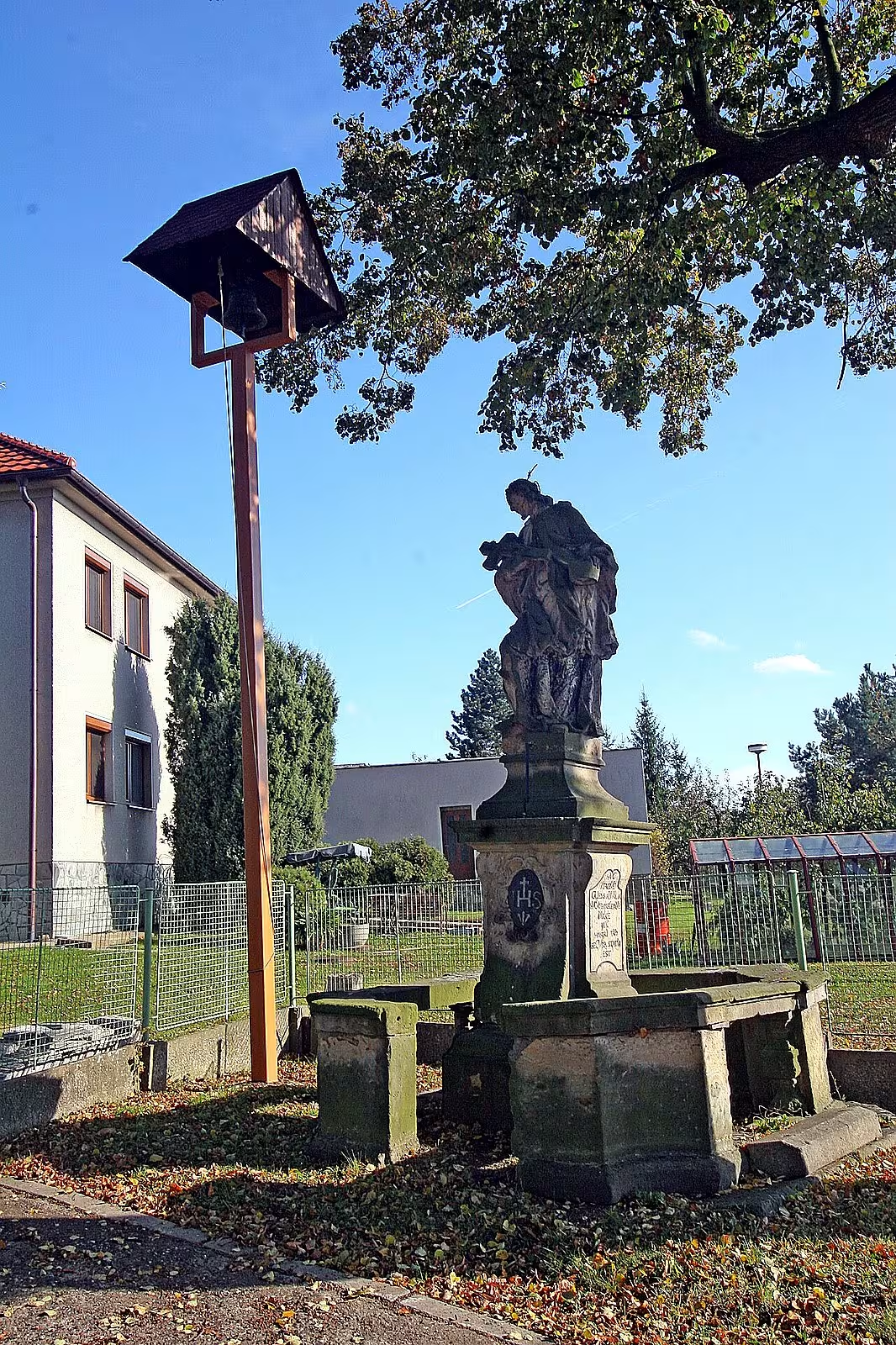
The Baroque sandstone statue of St. John Nepomuk in the village Dolní Přím in the district of Hradec Králové dates back to 1747. The author is an unknown artist and has been protected as a cultural monument of the Czech Republic since 25 August 1994. This monument is a valuable Baroque sculpture set in a rural environment near the county city.
The creation of this statue falls into the mid-eighteenth century, namely 1747. During this period for the reign of Marie Theresa in Czech countries continued the development of the top Baroque art. This strongly reflected Catholic piety and the cult of St. John Nepomuk. This period has been marked by the backwardness of the Silesian wars and the pursuit of both economic and cultural reconstruction of the countryside. The author of the work himself remains unknown.
The work is carved from sandstone and depicts a lifelike saint. The figure stands on a high four-sided pedestal with cut corners and indicated volut sides. The front side of the pedestal is embossed cartouche with IHS symbol and inscriptions are placed on its sides. The statue is set in a four-sided corral with convex cut corners, which was originally equipped with balustrad. The saint himself is portrayed in a traditional iconographic concept as a simple-haired man with a short beard, dressed in canovice clothing. He holds a biret in his left hand and holds a crucifix in his right hand. The statue's head is attached to the back of a wire halo made of six-sided stars.
No written sources are mentioned about the ownership history, administrators or possible dramatic changes and the fate of this object. Two milestones are documented from the chronological data, namely the year 1747 as the date of origin and the year 1994, when the statue was declared a cultural monument of the Czech Republic and the National Monument Institute leads it in the catalogue of monuments under register number ÚSKP 10263 / 6-5733.
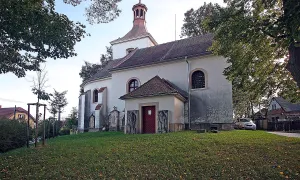
Among the key and preserved attractions are the fact that the author of the valuable Baroque sculpture has not yet been identified. In the immediate vicinity of the statue and the road leading to Hradec Králové also stands the historical bell tower.
Today, the statue is located in the village of Dolní Přím on the road to Hradec Králové and in its surroundings is the mentioned historical bell tower. The whole area is located close to the county town and is easily accessible.
This Baroque monument resembles the artistic level and piety of the countryside in the eighteenth century. On the way to Lower Direct it is worth visiting this historical statue by the way personally.
Historical milestones
- 1747
- The creation of a Baroque sandstone statue of St. John Nepomuk in Lower Direct.
- 1994
- Declaration of the statue for the cultural monument of the Czech Republic.
Architectural development
The statue is carved from sandstone and lies on a four-sided pedestal with cut corners, which carries embossed cartouche on the front side and inscriptions on the sides. Around the statue was built a four-sided corral with convex cut corners, originally equipped with balustrad. An additional wire halo made up of six-sided stars was attached to the head of the statue.
Points of interest
The author of a valuable Baroque sculpture remains unknown. - In the immediate vicinity of the statue and the road is also the historic bell tower.
Guide
Show guide text
This text was created by artificial intelligence and has not been editorially reviewed. It may contain inaccuracies.
Welcome to our audio guide. You are standing right in front of a beautiful historical monument, which is the Baroque sandstone statue of St. John Nepomuk in the village Dolní Přím. You are on the road leading to Hradec Králové, where this remarkable sculpture has been building the character of the surrounding countryside for centuries. Let us together imagine her story and look at the details you now have right in front of your eyes.
When you look around you carefully, you will see that the entire piece is set in a four-sided fence, which was originally made up of balustrad and has a convex cut-out corner. Right in this demarcated space, there is a life-sized saint. It is located on a high four-sided pedestal, whose sides have curved decorative shapes and on the front side carries embossed cartouche with the symbol of the so-called IHS, which stands for the name of the savior. The figure of the saint is portrayed in a traditional design, which for this time and this favorite saint was so typical.
Let us now look deeper into history and imagine the time of the creation of this work. The year is a thousand seven hundred forty-seven, when this Baroque sandstone statue first saw the light of the world. At that time, a whole number of monuments were created in the whole Czech country celebrating this saint. People saw him as a protector of floods, a danger to water, but also as a patron of confessional secrets, and as a protector of bridges or fields. Although we know the exact number of years of the creation of this art splendor, the name of his creator has not been preserved until today. Thus, the author of the valuable Baroque sculpture remains completely unknown. However, we know that working with sandstone required masterful craftsmanship, which the unknown sculptor undoubtedly endured. The long decades and centuries passed, until the year came a thousand nine hundred ninety-four. This year the statue was officially declared a cultural monument of the Czech Republic, confirming its huge historical and artistic value for future generations.
Now, if you continue to observe, notice how harmonically the whole works. The statue of St. John Nepomuk has been looking down on travelers and pilgrims for generations. Saint Jan Nepomucký himself is a figure whose life is connected to Prague, where he was a vicar general of the Archbishop of Prague. His tragic fate, when he refused to release the confessional secret to King Wenceslas IV. and was cast from the Charles Bridge to Vltava by order of the sovereign, became a legend. He became a symbol of unbreakable loyalty to truth and faith. This is why we often meet his statues not only in large cities, but also in the countryside, near roads and bridges where they were meant to protect the local population.
Now pay attention to one more interesting thing that is in the immediate vicinity of this place. Right next to the statue and busy road is also a historic bell tower. Together with the statue of St. John Nepomuk, it creates a picturesque and traditional element of our landscape, which remembers the old times and the former life of our ancestors. In the past, the bell in its voice told people of important events, noon, impending weather, or accompanied the locals on their last journey. The connection of the statue of the saint and the bells creates a unique historical corner, which is worth contemplating.
We hope you enjoyed our joint stop at this Baroque monument. We invite you to explore further the surroundings of the village Dolní Přím, where you can discover further traces of the past. Thank you for putting on the headphones and listening to our audio guide. We wish you a beautiful rest of the day and a happy journey on your other marbles. Goodbye.
Tips for visitors
A tour of the historical Baroque statue of St. John Nepomucký in the village Dolní Přím can be planned for any hour during the day, as the monument is free in the open air. The best time to visit is in daylight when the details of the old sandstone from 1747, the author of which is an unknown creator, stand out.
Take a good camera or smart phone with you on your way to capture this valuable historical plastic. There will also be comfortable shoes for walking around the village and possibly raincoat, because the whole tour takes place outside without a roof.
To get the best pictures we recommend to use the morning or late afternoon light, which will nicely draw the shape of a four-sided base. You can photograph the wall around the road from where the statue has a very good view from all sides under natural daylight.
In the wider area within 30 minutes of the journey there is the county town of Hradec Králové, which offers a large number of valuable historical buildings and museums. In the village Dolní Přím you can also see the old historical bell tower, which forms a harmonious whole with sandstone monument.
Frequently asked questions
Can the monument be visited?
This is a structure in a public space that can usually be seen from outside free of charge. We have not verified that this particular one is freely accessible.
Where is the monument?
Location: Dolní Přím. The map on this page shows the exact spot.
Why is the monument protected?
It is listed in the Central List of Cultural Monuments of the Czech Republic as a cultural monument (register no. 1000121528).
Businesses nearby
Do you run a restaurant, accommodation, shop, museum, rental, wellness or other visitor service near this monument? Show yourself directly to the people heading to it — this is how they will see you in the app and on the web:
Events nearby


Zdroj akcí: otevřená data měst a obcí ČR (Národní katalog otevřených dat) a kalendář akcí Národního památkového ústavu.
Nearby
V obci Dolní Přím se v blízkosti sochy nachází historická zvonička a celá oblast leží nedaleko krajského města Hradec Králové.
Accommodation nearby
Themed route
Here is the proposed thematic cruise route:
1. Statue of St. John Nepomuk - statue. This main objective of our journey represents an important historical work of art that is worth visiting for its spiritual and artistic value in the village.
2. Historical bell tower - construction. This interesting monument is located in the immediate vicinity of the statue and attracts a tour as a demonstration of traditional folk architecture in the village Dolní Přím.
3. The surroundings of the village Dolní Přím - wider area. The whole area is located near the county town of Hradec Králové and offers quiet walks through the rural landscape in close proximity to both above mentioned sites.
Seasonal recommendations
Spring: In the spring period, the statue of St. John Nepomuk in Lower Direct can enjoy mild temperatures and the first flowering trees that bring soft green shine to the surroundings. Sun rays illuminate the statue in the most beautiful shades, creating a wonderful atmosphere for honest tours. It is recommended to visit the morning or evening when there are fewer people and the sun illuminates the statue from the best angle.
Summer: Summer brings long days with intense sunlight, which emphasizes the details of the statue in an excellent way. More visitors may appear during the main summer season, so it is advisable to visit the memory in early dawn or late afternoon when the temperature is lighter. Put on light and comfortable clothes with sun protection glasses.
Autumn: Autumn brings beautiful colours of leaves that create a remarkable landscape around the statue. The sunlight is less intense and long shadows give the scene a melancholy character. It is advisable to visit the memory during the afternoon hours, when the colours of the leaves are particularly visible.
Winter: Winter freezing weather adds a statue of St. John Nepomuk's mystical and peaceful appearance. The sun rays reflected on ice or snow illuminate the statue in a special way. Visiting the sights is recommended at noon, when the best light is for photo and in cold weather avoid long-term stay outside. Wear warm clothes with protective glasses against frosty light.
Visualizations and artistic views

The visualisations are generated by artificial intelligence and serve as inspiration.
Photos from the area
Real photos taken near the monument


Zdroj a licence jsou uvedeny u každého snímku.
Tips from visitors
No tips yet. Be the first!
Log in and add your tip.
Sources and literature
Photos: Petr1888 / CC BY-SA 3.0 — Wikimedia Commons. The author and licence also appear when you hover over the image.
Faktickým podkladem tohoto textu byl článek na Wikipedii, jehož autory jsou přispěvatelé Wikipedie. Článek je dostupný pod licencí CC BY-SA 4.0.
Location on the map
Příběhy a pověsti
Legendy, pověsti a příběhy spjaté s touto památkou
Fotografie návštěvníků
Zatím žádné fotografie. Buďte první, kdo přidá fotografii z návštěvy!
Log in a přidejte svou fotografii nebo hodnoťte.
Za ověřenou návštěvu v aplikaci získáte víc bodů — poznáme podle GPS, že jste na místě.
Reviews and comments