



Socha svatého Jana Nepomuckého (Hlinsko) Statue
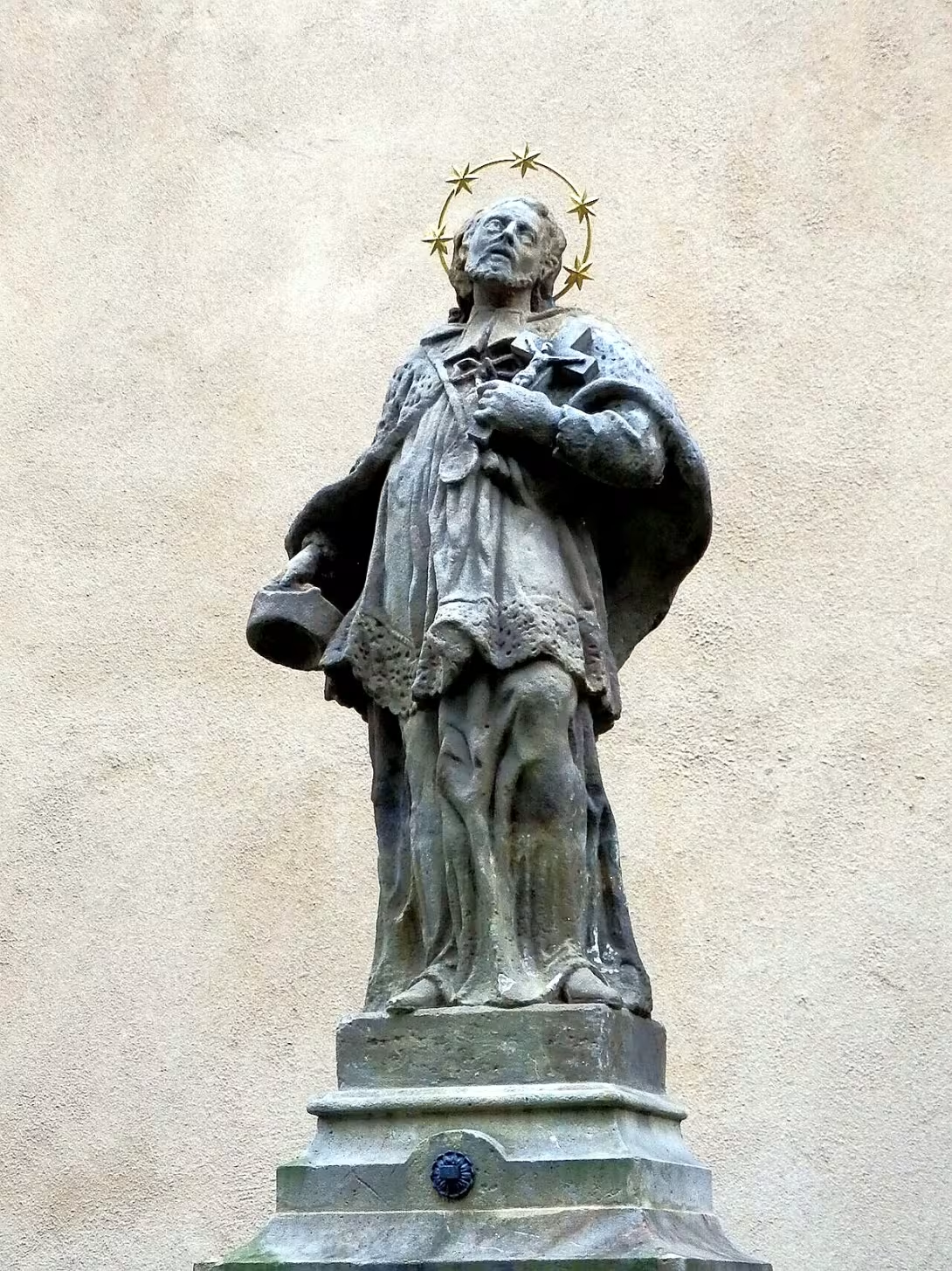
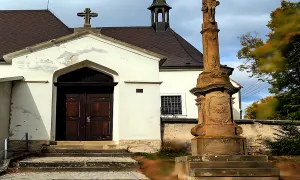
The Baroque sandstone statue of St. John Nepomuk in Hlinsk represents an important sacral monument from the 18th century. It is currently located at the east wall of the Church of the Birth of the Virgin Mary. Since 3rd June 2005 the building is protected as a real-estate cultural monument of the Czech Republic.
The work was created during the period of the high Baroque, when the cult of this saint was very strongly supported in Czech countries. This fact was strongly reflected in the sculpture at the time.
The sculpture is carved from sandstone and consists of a pedestal with a pillar which ends with a profiled ledge. On the base there is a low prism pedestal with cut edges. It follows a narrow pillar, on whose front side the inscription "Sv. JANE NOT FORMED ORODUE FOR US" is carved in the shallow frame. At the top of the pillar lies a statue of a saint in life size. Jan Nepomucký is depicted as a simple-haired man in a traditional canoeing robe with a halo of five stars. In his right hand, he holds a biret and his head curls to a crucifix held in his arms.
Originally, the statue stood on a bridge across the Srna creek on Jungmann Street. At the end of the 19th century, this bridge was the main entrance to Hlinsko from the northeast. Later, the monument was moved to its present location at the eastern wall of the Church of the Birth of the Virgin Mary, where it is located together with the statue of St. Wenceslas.
Today, the work is accessible on the premises of the Church of the Birth of the Virgin Mary in Hlinsk in Chrudim district. Visiting this place offers the opportunity to look at the Baroque sculpture concept of the 18th century, which is a testament to the religious respect and artistic craft at the time.
Historical milestones
- around 1700-1799
- The creation of a baroque piscove statue in the time of the peak baroque
- end of 19th century
- Statue stood on the bridge of Srnsky creek in Jungmannove street
- 2005
- Object declared real estate cultural patriot of Ceske Republic
Architectural development
The statue is carved from sandstone and formed by a pedestal with a pillar which ends with a profiled ledge. The statue of a lifelike saint is placed on a low pedestal at the top of the pillar. The overall composition corresponds to the baroque sculpture concept of the 18th century.
Historical events
The original location on the bridge in Jungmann Street, a later transfer to the east wall of the Church of the Birth of the Virgin Mary, a declaration for cultural monument in 2005.
Points of interest
- The statue is protected as a real cultural monument of the Czech Republic since the third June of the year. - The work was originally located on a bridge across the Srnské potok in Jungmann Street, which was at the end of the nineteenth century the main entrance to the city from the northeast. - The saint is depicted as a simple-haired man in canovice robes with a halo made up of five stars. - In his right hand, he holds the headgear and the head swells to the cross with the body of Christ he holds in his arms. - The monument is located at the east wall of the Church of the Birth of the Virgin Mary together with the statue of St. Wenceslas.
Guide
Show guide text
This text was created by artificial intelligence and has not been editorially reviewed. It may contain inaccuracies.
Welcome to Hlin, where history meets every step you take here. Please stop for a moment and focus fully on what you see right in front of you. You're standing in front of one of the great sacral monuments of this city, the statue of St. John Nepomuk. The first impression that radiates from it is peace and deep devotion. He is a character who, with his quiet presence, accompanies you to stop in today's rush world. Feel her form, her materiality and the way in the space asserts. This statue is not just a stone painting, but a testament to the faith and art of the time that sought in detail the path to the divine. Now let's look together at where this statue came from and at what time it came from. The work was created during the period of the high baroque, namely between seventeen hundred and a thousand seven hundred ninety-nine. The Baroque was an era that loved dynamics, emotions and deep symbolism, which is also evident here. Although the name of a particular author, an architect or sculptor, remains forgotten at times and is now unknown, craftsmanship and a sense of material are evident in this work. _ At that time, the similar statues of St. John Nepomuk were very popular and often placed on bridges or near watercourses, because Saint John is perceived as a protector of floods and the patron saint of bridges. Now I would like to ask you to pay attention to the specific details that you can see right now. Look at the material first. The whole statue is carved out of sandstone. Notice how this stone has acquired its characteristic patina over time, which gives it the nobility and sense of antiquity. Now watch the holy garment. Jan Nepomucký is shown in the traditional canovice robe. Follow the lines of the fabric, the way the sculptor worked out folds and layers of clothing that work almost lightly even though they are hard stone. It's typical of the baroque style that tried to capture movement and life in the stone. Your attention should now be directed towards the Holy Head. Notice the halo surrounding his face. It consists of five stars. These stars are not only an ornament, but have a deep symbolic meaning, reminiscent of the light of faith and purity. The Holy One holds a crucifix in his arms, a cross with the figure of Christ suffering. Watch as the holy grips him gently and respectfully, underlining his deep spirituality and humility. Finally, please look down on the foundation on which the statue rests. It is a profiled base that gives the whole piece stability and grandeur. If you take a closer look, you'll see the inscription drawn. It is a request for an intercession that should have encouraged bystanders to pray and think in the past. Who was this man that you see here? Jan Nepomucký is one of the most important personalities of Czech spiritual history. His life story is linked to courage, silence, and loyalty by his conviction. He is known as a martyr who refused to reveal the secret of confession, and paid for his intransigence with his life. That's why his character is so strongly connected to water and bridges, because according to legend, he was thrown into the river Vltava. This statue in Hlinsk thus brings this universal story of integrity and spiritual power directly to the local space. Now take you on a short journey in time and space to discover one interesting thing that relates to this statue. Where you see her now is not her original place. Imagine we're going back in time to the end of the nineteenth century. At the time, this statue was not at the Church of Birth, but it was located on a small bridge across the Srna creek on Jungmann Street. Try to imagine. Jungmann Street was at that time the main entrance to the city from the northeast. Everyone who came to Hlinsk this way had to pass by St. John Nepomuk. The statue thus served as a spiritual gateway to the city, welcoming travelers while protecting them on their way across the stream. Later, however, it was decided to move the statue to its present place to the Church of Birth, where it can be better protected and where it forms a harmonious entity with the sacred space of the temple. It's fascinating to think about how the city's landscape changes and how its sights move with it. In order to preserve this value for future generations, the building was officially declared a cultural monument of the Czech Republic. It happened on June 3rd in the year two thousand and five. This recognition confirms that the statue is not just a local ornament, but a work that has its value throughout the national heritage. Now, if you look at St. John again, see him as the link between the past and the present. This sandstone figure has survived centuries, changes in modes, relocation and adverse weather effects. He is a silent witness to the history of Hlinsk. Notice how baroque elegance combines with the stillness of sandstone and how in this connection a sense of hope and peace arises. I hope this short trip to history has helped you see this statue in a new light. It's not just a rock, it's a story about faith, a forgotten artist, and the ways people entered this city over a century ago. Now, let's invite you to take a slow look around and perceive the atmosphere of this place. If you are interested in the history of Hlinsk, I suggest you continue to explore the surroundings and discover the other hidden cover that this city offers. Thank you for your attention and for spending time with us at this beautiful Baroque monument. I wish you a pleasant continuation in your discovery of Hlinsk and may your next journey follow you as calmly and inspiratively as the sight of St. John Nepomuk's face. See you in other parts of our guide.
Tips for visitors
To visit the statue, choose the morning hours when the sun lights the face of the saint and highlights the details of the sandstone robe. This afternoon, the object may be in contrast, making it difficult to get detailed images. For photography we recommend to use a wide-angle lens to capture the statue in the context of the surrounding building or a close-up of the halo with five stars. In the immediate vicinity you can visit the Church of the Birth of the Virgin Mary and the statue of St. Wenceslas, with a pleasant walk at the Srnské creek.
Frequently asked questions
Can the monument be visited?
This is a structure in a public space that can usually be seen from outside free of charge. We have not verified that this particular one is freely accessible.
Where is the monument?
Location: Hlinsko. The map on this page shows the exact spot.
Why is the monument protected?
It is listed in the Central List of Cultural Monuments of the Czech Republic as a cultural monument (register no. 1027243436).
Businesses nearby
Do you run a restaurant, accommodation, shop, museum, rental, wellness or other visitor service near this monument? Show yourself directly to the people heading to it — this is how they will see you in the app and on the web:
Nearby
Kostel Narození Panny Marie v Hlinsku, socha svatého Václava, Srnský potok.
Accommodation nearby
Themed route
Thematic cruise route Hlinsko
1.Socha svatého Jana Nepomuckého (Hlinsko)
Type: Historical statue
Why is it worth a visit: This famous statue is a symbol of the city of Hlinsk and a monument to St. John Nepomuk, who became the patron saint of the country. Its location in the heart of the city offers a beautiful opportunity for photo and knowledge of history.
2. Church of the Birth of the Virgin Mary
Type: Church
Why is it worth visiting: This Baroque church is not only the spiritual centre of the city, but also architectural pearls with rich interiors. Its important ship and beautiful statues dedicate visitors to history and art.
3. Statue of St. Wenceslas
Type: Historical statue
Why is it worth visiting: The statue of St. Wenceslas, another Czech patron, adds a historical dimension to the local cultural environment. Its location near the church and other monuments underlines the spiritual and national identity of Hlinska.
4. The Sr. stream
Type: Natural element
Why is it worth a visit: This stream is part of the local region and offers quiet moments for relaxation on its shores. It is an ideal place for a short walk or picnic where you can enjoy the natural environment and sounds of the water flow.
This route offers a combination of historical monuments and nature, allowing visitors to Hlinska to explore local culture and landscape in a comfortable order.
Seasonal recommendations
In the spring, the surrounding area wakes up and the colors of the trees turn fresh green. The morning mist can create a very poetic atmosphere around the statue. The light is soft and pleasant in this period. I recommend wearing layered clothes because morning cold can be surprising. The best place to visit is in the morning when the air is fresh.
In summer days, the surroundings are full of life and the sun shines the strongest. The days are long, allowing for a quiet walk even in the late evening. If you are planning a visit at noon, don't forget your headgear and sun protection. For best experiences, choose the time just before sunset when the light is warm and shadows long.
Autumn season offers a beautiful palette of yellow and red shades in the surrounding nature. The low sun creates interesting shapes and deep shadows on the stone surface. It is advisable to carry a warmer jacket and possibly an umbrella due to wet weather. The ideal time for observation is in the afternoon, when the colour of the leaves shines most.
Zimą can make the monument feel very quiet, especially if everything is covered with snow. The light is weak in this period and the days are short, so it is best to come around noon. Take care when walking if the road is wet or frozen.
Visualizations and artistic views

The visualisations are generated by artificial intelligence and serve as inspiration.
Photos from the area
Real photos taken near the monument

Zdroj a licence jsou uvedeny u každého snímku.
Tips from visitors
No tips yet. Be the first!
Log in and add your tip.
Sources and literature
Photos: Isolda11 / CC BY-SA 3.0 — Wikimedia Commons. The author and licence also appear when you hover over the image.
Faktickým podkladem tohoto textu byl článek na Wikipedii, jehož autory jsou přispěvatelé Wikipedie. Článek je dostupný pod licencí CC BY-SA 4.0.
Location on the map
Příběhy a pověsti
Legendy, pověsti a příběhy spjaté s touto památkou

Fotografie návštěvníků
Zatím žádné fotografie. Buďte první, kdo přidá fotografii z návštěvy!
Log in a přidejte svou fotografii nebo hodnoťte.
Za ověřenou návštěvu v aplikaci získáte víc bodů — poznáme podle GPS, že jste na místě.
Reviews and comments