



socha svatého Jana Nepomuckého (Sušice - Moravská Třebová) Statue
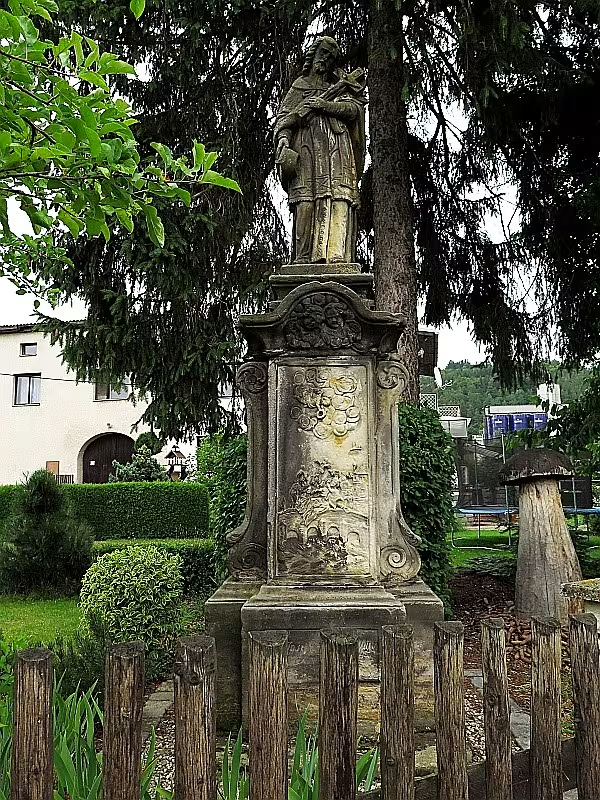
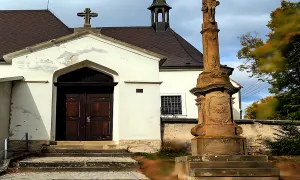
The statue of St. John Nepomuk in the garden of the farmhouse in Moravian Třebov-Susice is a cultural monument of the Czech Republic, announced in 1958. This statue shows long-term respect for John Nepomuk and represents an important element of Baroque art from the mid-18th century, supplemented by elements from the mid-19th century.
The creation of the statue is connected with the peak of the Baroque in the Czech lands and the spread of the cult of St. John Nepomuk, which then spread massively. The Baroque pedestal, dated 1748, is quad-sided with volute wings and decorated with relief depicting the overthrow of Jan Nepomucký in Vltava. There are two angels' heads above this relief, which adds richness and detail typical of Baroque art.
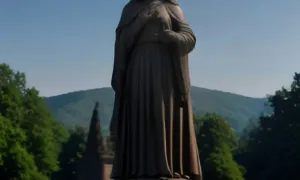
The statue itself is younger from the mid-19th century. It depicts a saint in Canovnik's garment with a cross in his left hand and a biret in his right, stressing his spiritual status. The head of the statue is tilted to the left shoulder with a Latin-German inscription on the back side and a roll of 1748. The front side of the pedestal contains a hard to read inscription, suggesting the historical value of this work of art.
The statue is considered to be a good work of a regional author and represents an important monument, which shows deep Midsummer respect in this area. Its historical context is linked to the peak period of Baroque and later history, when religious monuments were restored and supplemented.
Today, the statue of St. John Nepomuk stands as an important cultural element in the garden of the farmhouse in Moravian Třebová-Susice. Its accessibility and historical value make this monument interesting for the visit, especially for those interested in baroque art and history of Czech countries. The statue of St. John Nepomuk is not only a monument to cultural significance, but also a place where the wealth of the region's history and artistic tradition can be appreciated.
This statue recalls the importance of preserving cultural monuments as a means of understanding the past and their importance for the present. Visiting this place offers a unique opportunity to immerse yourself in history and appreciate the work of art that has remained preserved for centuries.
Historical milestones
- 1748
- The emergence of a baroque pedestal with relief of the overthrow of the Holy One into the Vltava.
- about 1850
- The creation of the statue of St. John Nepomuk himself.
- 1958
- Announcement of the statue by cultural monument of the Czech Republic.
Architectural development
The monument was created in two stages of time. In 1748 a baroque four-sided base with volute wings was created. The statue of St. John Nepomuk was completed later, in the middle of the 19th century.
Points of interest
- The statue of St. John Nepomuk is a cultural monument of the Czech Republic, declared in 1958. - The Baroque base of the statue is 1748 and is decorated with relief showing the overthrow of Jan Nepomucký to Vltava. - The statue itself dates back to the middle of the 19th century and depicts the saint in Canovnik's garment with a cross and a biret, highlighting his spiritual position. - The head of the statue is tilted to the left shoulder and on the back side it bears a Latin-German inscription with a crows of 1748. - The statue represents an important monument, which shows deep satojan respect in this area and is linked to the peak of the Baroque and later history.
Guide
Show guide text
This text was created by artificial intelligence and has not been editorially reviewed. It may contain inaccuracies.
Welcome to the quiet and quiet part of Sushice near Moravian Třebová. Stop for a moment, take a breath and feel the atmosphere of this place. Right now, you're standing in the garden of one of the local estates where you're welcomed by a silent witness of the past century. The statue of St. John Nepomuk stands before you. It's a work that, at first glance, seems like a whole, but if you look at it more closely, you'll find that it has a story of two different times and two different approaches to art.
Look at the overall composition first. You see the figure of a saint standing on a decorative pedestal. It is in this connection that one of the most interesting properties of this monument is. Because it's not a work that was created at the same time. What you see is a confluence of the baroque spirit of the eighteenth century and a calmer sound of the nineteenth century. Let's take a closer look at the details that will help you understand how this statue changed over time and what it wants to tell us.
Now pay attention to the lower part of the baroque pedestal. This is the oldest element you see here. It was created in 1748, at a time when the Baroque dominated European architecture and sculpture with its dynamics, emotions and desire for decoration. Notice how the base is richly worked. With your eyes now follow the relief that is carved into it. This little painting tells one of the most famous stories associated with St. John Nepomucki. It shows the moment of its overthrow into the Vltava waves. It is a dramatic scenario that depicts the moment of sacrifice and faith in the Baroque style.
In addition to this main painting, note other minor details on the pedestal. Here you will see two little angel heads that accompany the whole scene. These small figures are typical of their time and are tasked with delivering a piece of celestial dimension and softness that contrasts with a dramatic fall into the river. This whole base from 1748 serves as a solid and symbolic foundation, on which the holy figure itself grew later.
Now move your view above, to the very statue of St. John Nepomuk. As we have already mentioned, this part is much younger than the base. It was created in the middle of the nineteenth century, about a hundred years after the foundation was created. Notice the difference in the atmosphere. While the base is full of baroque movement, the character itself seems more calm and balanced. The saint is depicted in Canovice's garment, which is the traditional garment of the priests from that time. Follow the line of his coat and the way in which the fabric of his clothing is shown.
Now look at what the saint holds in his hands. In his left hand he grips the cross, which is a symbol of his faith and suffering. In his right hand he holds a biret, which is a typical bookbinding hat, which emphasizes his office and social position in the church. This combination of cross and biret is very characteristic of Jan Nepomuk and helps us to recognize him immediately, even if we do not know where we are.
Who was this man that you are now observing? Jan Nepomucký is one of the most popular figures in Czech spiritual history. His story is connected to Prague and the secret of religion. According to legend, John was a canon who refused to reveal to the Queen the secret of her wife's confession. For his intransigence and loyalty to his promise, he was punished by death and overthrow into the river Vltava, which is the motive you see in the relief on the pedestal beneath his feet. This story has made him a symbol of secrecy, integrity and courage to stand by the truth even at the cost of his own life.
It's fascinating to think about how this sculpture became part of the landscape of Moravian Trebova. Imagine how the garden around her changed over the centuries, how other generations of people stood here, and how this statue quietly watched everyday life on the farm in Sushice. The fact that the pedestal of 1748 survived and was later supplemented by a new statue around 1850 shows the deep respect that people have held for this saint for centuries.
The interesting thing you may be missing is the official recognition of this work. In 1958, the statue of St. John Nepomuk was declared a cultural monument of the Czech Republic. This means that the state has recognised its artistic and historical value. It is not only a religious symbol, but an important element of our cultural heritage that documents the development of sculpture from Baroque to 19th century in one single place.
Now, if you look at the whole memory again, try to perceive the contrast. Below you have a dramatic baroque relief with angels and waves of Vltava from the mid-eighteenth century and a calm, dignified figure from the mid-nineteenth century. It's like a conversation between two ages that met in one garden.
This statue teaches us that history is not only about great battles or famous kings, but also about silent monuments in forgotten gardens that tell us about faith, traditions and how people decorated their space. Jan Nepomucký stands here as a guardian of peace and a reminder that some values, such as loyalty to their word, are timeless.
Before we say good-bye and you move on, I suggest you go around the statue again from different sides. Notice how the light falls on the holy garment and how the relief on the pedestal changes its expression depending on the angle you're looking at. Feel the silence of this garden, which complements the uplifting atmosphere of this place.
Thank you for stopping by this beautiful monument in Susice. I hope this short trip to history has helped you see more than a stone in this statue. I will now invite you to further explore the surroundings of the Moravian Treb and its hidden treasures. I wish you a pleasant continued journey and many other discoveries. Goodbye.
Tips for visitors
The best time to visit is early morning or late afternoon, when soft light best excels the details of the baroque base and the statue itself.
The location is available by car and by public transport; Check the current connection in the Internet search engine.
We recommend to wear comfortable shoes suitable for outdoor environments and gardens.
When shooting, focus on the contrast between the older pedestal from 1748 and the younger statue from the mid-nineteenth century. The best angles can be obtained with side lighting that highlights plastic shapes.
For families with children, a visit is an appropriate opportunity to tell about the history of local goods and how the style of sculpture changed over time.
Frequently asked questions
Can the monument be visited?
This is a structure in a public space that can usually be seen from outside free of charge. We have not verified that this particular one is freely accessible.
Where is the monument?
Location: Moravská Třebová. The map on this page shows the exact spot.
Why is the monument protected?
It is listed in the Central List of Cultural Monuments of the Czech Republic as a cultural monument (register no. 1000132988).
Businesses nearby
Do you run a restaurant, accommodation, shop, museum, rental, wellness or other visitor service near this monument? Show yourself directly to the people heading to it — this is how they will see you in the app and on the web:
Nearby
🏰 Historic sites (85)
- Josefína Lamm 1.2 km
- Alfred Lamm 1.2 km
- Oskar Holzman 1.2 km
- Třebovské Hradisko 1.3 km
- sv. František Borgia 1.5 km
- sv. Karel Boromejský 1.5 km
- sv. Petr 1.5 km
- Panna Maria Immaculata 1.5 km
- sv. Šebestián 1.5 km
- sv. Roch 1.5 km
- sv. Josef 1.5 km
- sv. Antonín Paduánský 1.5 km
- sv. Jan Nepomucký 1.5 km
- Morový sloup 1.5 km
- Městské muzeum Moravská Třebová 1.6 km Svitavská 315/18
- Zámek Moravská Třebová 1.7 km Zámecké nám. 185/1 web
- Kalvárie 1.7 km
- Brána času 1.8 km
- Brána času 1.8 km
- Pomník obětem 1. světové války 2.7 km
🍽️ Restaurants and dining (70)
- Restaurace U Nádraží 0.6 km +420 461 312 189
- U kavky 1.1 km
- Na růžku 1.1 km
- Udánská hospoda 1.4 km
- U Matouše 1.4 km
- Pivnice U Stupků 1.5 km
- Na kovárně 1.6 km
- Big Pizza & Burger 1.6 km
- Jaha 1.6 km
- Pizza Burgr Caffé 1.6 km
- Morava 1.6 km Svitavská 304/2 web
- Bar-Bar 1.6 km
- Restaurace Excalibur 1.6 km +420 777 662 662
- HOTEL - Třebovská restaurace 1.6 km
- Knížecí pivovar 1.6 km web
- Laskavárna 1.6 km +420 733 741 415 web
- Caffé Na knížecí louce 1.7 km
- Na hladince 1.8 km +420 774 301 933 web
- U štiky 2.0 km
- U komína 2.0 km web
🏨 Accommodation (14)
- Penzion U Cyrila 1.3 km Olomoucká 37 +420 777 242 118 web
- V podzámčí 1.6 km
- Best 1.7 km Brněnská 14/10 +420 605 515 256 web
- Ubytovna Na rychtě 6.6 km
- Rekreační areál Motýlek 7.9 km web
- Trnavský grunt 8.1 km +420604316913
- Klášter sv. Alfonze z Liguori 8.9 km web
- Vermon 13.8 km Česká 6/1 +420 603 109 648 web
- Penzion Oáza 13.8 km
- Pension Fontána Svitavy 14.0 km U stadionu 708/6 +420 605 404 860 web
- Hotel & Gallery Kopacka 14.4 km +420 775 912 912 web
- Kemp Opatovec 14.6 km web
- Old Mill Glamp 14.9 km Kozov 8 +46722244244 web
- Old Mill Glamp 15.0 km Kozov 8 +46722244244 web
🚲 Rentals and sport (5)
- Jízdní Kola - Jelínek 1.6 km
- Cyklo Němčík 2.0 km Gorazdova 8 +420 608 861 453
- Tělocvična 12.4 km
- Sportisimo 13.5 km web
- Koupaliště Svitavy 14.6 km
🥾 Hiking and nature (144)
- Dubina 1.2 km
- Hradisko 1.3 km
- Třebovské hradisko 1.4 km
- Luční lázně 1.5 km
- Křížový vrch 1.7 km
- Zlatník 1.8 km
- Nad Boršovem 2.9 km
- Pastýřka 2.9 km
- Strážný 2.9 km
- V Pekle 3.4 km
- Peklo 3.5 km
- Černý vrch 3.6 km
- Ostrý 3.7 km
- Liška 4.6 km
- Horka 4.7 km
- Kamenitý kopec 4.9 km
- Nad rybníčkem 5.1 km
- Gravitační anomálie (optický klam) 5.3 km
- bedna 5.6 km
- Nad Doly 5.9 km
Accommodation nearby
Themed route
1. The base of the statue of St. John Nepomuk (architectural element) - A tour of the lower part of the monument and its pedestal. 2. The figure of St. John Nepomuk (statue) - Focus on the details of the painting of the saint and his attributes. 3. Area around the statue (space) - Walk in the immediate surroundings to capture the overall impression of the work.
Seasonal recommendations
Spring: In the spring, the surroundings are waking up and the colors are getting fresh. The light is very fine in this period, which helps the perception of the details of the stone work. I recommend wearing layered clothes because the weather can change quickly. The best thing is to visit the place soon after sunrise, when the air is the cleanest.
Summer: In summer, the days are long, and the sun shines intensely. The atmosphere is warm and the surrounding green is in full bloom. It is advisable to choose light and breathable substances and take water with you. The best time to observe is late afternoon when you avoid the greatest heat and shadows are longer and more interesting.
Autumn: Autumn brings a melancholy mood to the place and the colour of leaves turns into shades of gold and brown. The fog often appears in the morning, which gives the memory a mysterious touch. You must wear waterproof shoes and warmer clothing. An ideal visit is when the sun shines low above the horizon.
Winter: Winter can be surrounded by frost or snow, creating a contrast and peaceful image. The light is gray at this time and the days are short. It's important to wear a very warm layer, hat and gloves. The best thing to do is to come around noon to make sure there's enough daylight during the tour.
Visualizations and artistic views

The visualisations are generated by artificial intelligence and serve as inspiration.
Photos from the area
Real photos taken near the monument

Zdroj a licence jsou uvedeny u každého snímku.
Tips from visitors
No tips yet. Be the first!
Log in and add your tip.
Sources and literature
Photos: Sovicka169 / CC BY-SA 4.0 — Wikimedia Commons. The author and licence also appear when you hover over the image.
Faktickým podkladem tohoto textu byl článek na Wikipedii, jehož autory jsou přispěvatelé Wikipedie. Článek je dostupný pod licencí CC BY-SA 4.0.
Location on the map


Příběhy a pověsti
Legendy, pověsti a příběhy spjaté s touto památkou
Fotografie návštěvníků
Zatím žádné fotografie. Buďte první, kdo přidá fotografii z návštěvy!
Log in a přidejte svou fotografii nebo hodnoťte.
Za ověřenou návštěvu v aplikaci získáte víc bodů — poznáme podle GPS, že jste na místě.
Reviews and comments