



Schody mrtvých Staircases
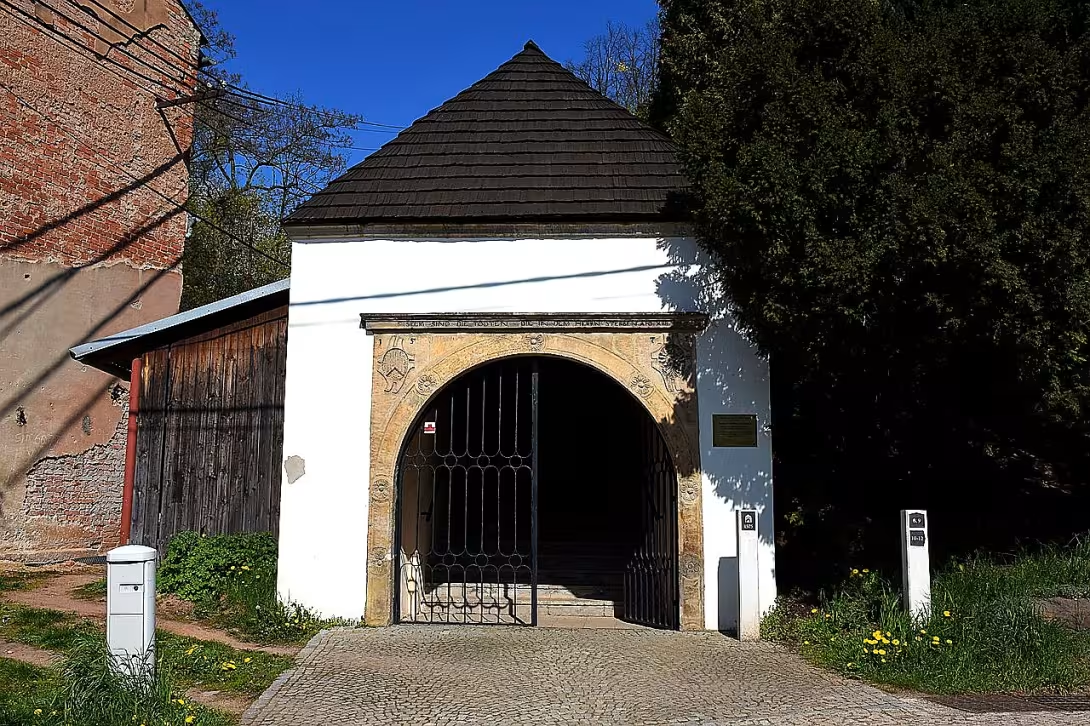
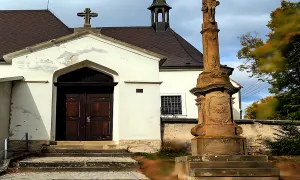
Schody mrtvých in Moravian Třebová are a historical monument, which represents a wooden staircase leading to the cemetery area of Křížový vřich. These stairs were built in 1575 by Jan of Boskovice and together with the cemetery church of Finding the Holy Cross and the morgue form a cultural monument. Their architecture is characteristic of the Renaissance style, which reflects their time of origin.
The history of stairs dates back to the 16th century when they were built by Jan of Boskovice. This period is marked by the Renaissance, which brought new cultural and architectural directions in Europe and Czech countries. Schody mrtvých is therefore not only a monument to the cemetery grounds, but also a testament to Renaissance art and architecture.
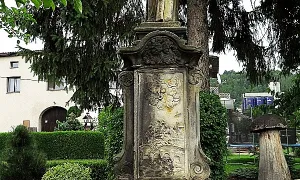
The staircase features a shingle roof and a Renaissance portal marked "Selig sind die Todten, die im Herr sterben" (Blessed are the dead who die in the Lord). This inscription refers to the Revelation of John and underlines the religious importance of stairs. The portal is also decorated by 1575, the emblem of the lords of Boskovice and Moravian eagle.
The ownership and administration of the stairs of the dead were after their formation Jan z Boskovic and subsequently other members of this family, which is evidenced by heraldic signs on the portal. Stairs were not only an architectural monument, but also part of family traditions and religious life.
The interesting thing about the stairs of the dead is their important inscription on the portal that refers to the apocalyptic Revelation of John. Stairs are also part of the hiking path Path from Renaissance to Baroque, which increases their attractiveness to visitors.
Today, the stairs of the dead are accessible on the hiking path leading to the Cross Hill. Access is possible from the lower part of the village of Moravská Třebova and from the cemetery towards the Church of the Holy Cross and Lapidariu. Schody mrtvých is not only a historical monument, but also a place of calm and religious reflection.
Schody mrtvých in Moravian The Třebes are therefore an important cultural monument, which represents the Renaissance architecture and religious life of the 16th century. Their historical significance and artistic representation make this object an interesting destination for anyone interested in the heritage of the past. Visiting the stairs of the dead offers an opportunity to reflect on life and death in the context of the historical and cultural environment.
Then and now
Drag the slider to compare how the landmark may have looked when it was built with the view today.
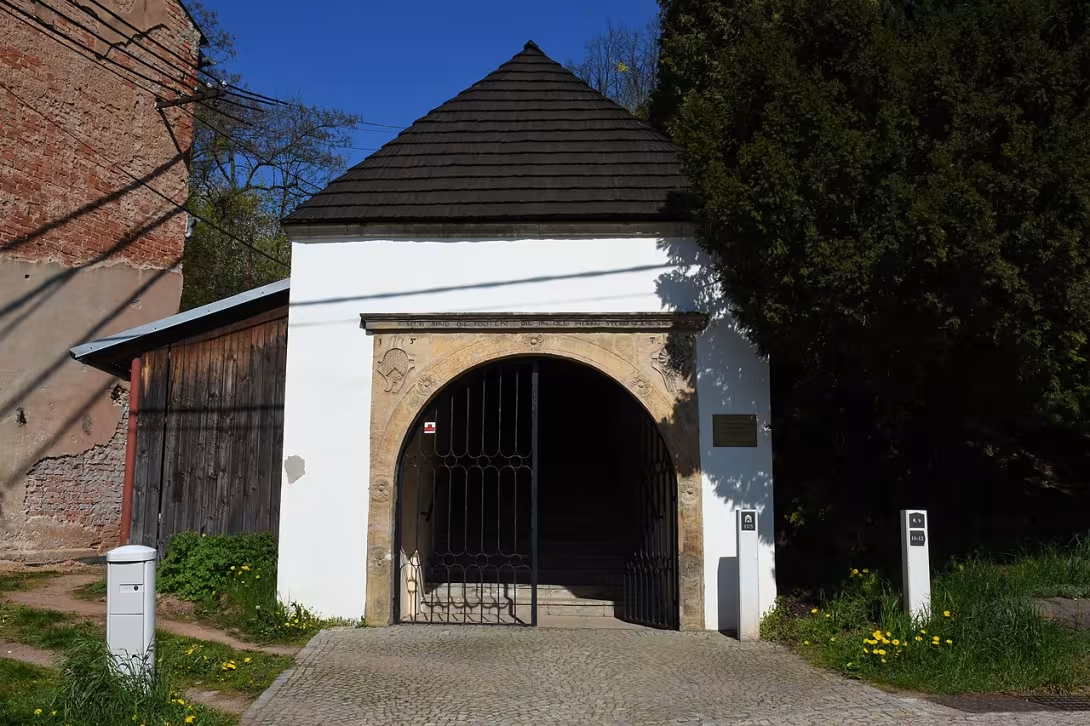

The historical appearance on the left is an AI-generated visualisation and serves as inspiration only.
Historical milestones
- 1575
- Building steps by Jan from Boskovice in Renaissance style.
- 1575
- Creating a portal with the inscription and the sign of the lords of Boskovice.
- 16th century
- The period of flowering Renaissance architecture in Czech countries.
- 21st century
- Classification in the hiking path Path from Renaissance to Baroque.
Architectural development
The building is covered with shingles roof. The main architectural element is the Renaissance portal with inscription and heraldry. The whole building is part of the cemetery area.
Historical events
1575: Building steps by Jan from Boskovice.
Owners
Jan z Boskovic (1575)
Points of interest
- Schody mrtvých is a wooden staircase leading to the cemetery area of the Cross Hill. - They were built in 1575 by Jan of Boskovice and together with the cemetery church of Finding the Holy Cross and the morgue form a cultural monument. - The architecture of the stairs is characteristic of the Renaissance style, which reflects their time of origin. - The inscription on the portal "Selig sind die Todten, die im Herr sterben" refers to the Revelation of John and highlights the religious importance of stairs. - Stairs are part of the hiking path Path from Renaissance to Baroque, which increases their attractiveness to visitors.
Guide
Show guide text
This text was created by artificial intelligence and has not been editorially reviewed. It may contain inaccuracies.
Welcome to the Stairs of the Dead in Moravian Treb! You are facing a unique monument that will lead you to the cemetery area of the Cross Hill. Look up and you'll see a wooden staircase covered with shingles roof with a distinctive Renaissance portal. This wonderful passage prepares you for the next steps that will lead you to the world of the past.
Let's go into history. In 1575 these stairs were built by Jan of Boskovice, a man whose name is inextricably linked to this monument. It was a period when Renaissance architecture blossomed in Czech countries, and Jan z Boskovic with a permanent artistic spirit added its share to the rich cultural life of that time. Schody mrtvých is not only a way to the burial site, but also a symbol of the link between life and death.
Note now the portal with the inscription and the sign of the lords of Boskovice. These details are the result of the skill of the craftsman who not only cared for the construction but also her aesthetic decorating. This portal is the first proof of the artistic taste and historical identity of this monument.
The key character associated with this place is of course Jan z Boskovic, whose influence on architecture and cultural life in the region was very significant. His work shows the expertise and artistic sense of the time.
Now let's look at the interesting thing that makes this memory even more popular. Schody mrtvých is part of the hiking path Path from Renaissance to Baroque, which means you are on a journey full of other historical gems and architectural pearls. This trail prepares you for an adventure that combines various periods of Czech art.
We wish you to dig deeper into the history and architecture of the Dead Stairs. Come to explore the surrounding cemetery area with its church Finding the Holy Cross and the morgue, which together form a cultural monument. Every step will bring you new knowledge of the past of this area.
Thank you for your visit and we hope you enjoyed exploring Schody mrtvých. Let the next step on the path from the Renaissance to the Baroque be equally full of discoveries!
Tips for visitors
The best time to visit the Stairs of the Dead is in spring or autumn, when the weather is pleasant and the light is ideal for photography. This historical element offers a beautiful view of the surrounding landscape and is less visited than in the summer months.
It is possible to use cars and public transport to access the Dead Stairs. We recommend checking the current transport connection in previous planning.
When you visit, take a suitable suit with you, because the way to the Cross Hill can be a little steep and the sidewalks are wooden. Photographers should bring a tripod to capture panoramic views and details of the construction.
Photography of the Stairs of the Dead is best in the early morning or evening when the light is softer. Don't forget to note the surrounding cemetery church of the Holy Cross and the Lapidarium, which offer interesting photographic possibilities.
In the vicinity of the Stairs of the Dead, it is possible to visit the Cemetery Church of the Find of the Holy Cross, the morgue and the Lapidarium. These places offer a rich history and a beautiful view of the Třebovka River. For families with children it is advisable to visit the entire cemetery area where children can enjoy quiet walks.
Frequently asked questions
Can the monument be visited?
We have not verified whether this monument is accessible. Please ask the owner or operator, or the local municipal office.
Where is the monument?
Location: Moravská Třebová. The map on this page shows the exact spot.
Why is the monument protected?
It is listed in the Central List of Cultural Monuments of the Czech Republic as a cultural monument (register no. 1000145183_0003). It is protected as part of a larger listed ensemble.
Businesses nearby
Do you run a restaurant, accommodation, shop, museum, rental, wellness or other visitor service near this monument? Show yourself directly to the people heading to it — this is how they will see you in the app and on the web:
Nearby
Hřbitovní kostel Nalezení svatého Kříže, márnice, lapidárium, řeka Třebůvka a Křížový vrch.
Accommodation nearby
Themed route
Schody mrtvých - historic stairs, main destination trip. They are a unique reminder of past events and provide an atmospheric introduction to the entire area.
The cemetery church of the Holy Cross - sacral building, located just a few hundred metres from the stairs. The church contains a rich decoration and a calm atmosphere that complements the historical context of the place.
Mornice - a protected building, approximately 300 m from the church. It contains the remains of old cemetery shelters, which allows you to look into traditional burial practices.
Lapidarium - exhibition of stone monuments, lies about 150 m from the morgue. It offers a collection of tombstone reliefs and inscriptions that illustrate local history and artistic craft.
Cross hill - sightseeing hill, about 500 m from Lapidarium. From the top, panoramic views of the Třebovka River and the surrounding countryside open, providing an ideal conclusion for contemplation after a tour of historical monuments.
Seasonal recommendations
In spring, the surroundings awaken to life and the young green creates a fresh contrast with the stone. The atmosphere is full of hope and fine light. I recommend moisture resistant shoes because the road can be wet. The best place to visit is in the morning when the air is the cleanest.
The summer season brings rich green leaves and sharp shadows that highlight the shape of the monument. The air is usually hot and standing, which gives the place a heavy feeling. Light, breathable clothes and a sun hat are suitable. The ideal time is the late afternoon when the sun doesn't burn so hard anymore.
Autumn is a time fog and golden colors that match the melancholy character of this place. The lighting is soft and passes into grey, which deepens the mystery. It's advisable to wear layered clothes and a waterproof jacket. I recommend a visit in the afternoon gray, when the mood is most respectful.
In winter there is silence and the landscape is stripped of leaves, so the details of the monument are clearly visible. Freezing air and any layer of snow create a strict and clean atmosphere. Hot shoes and gloves are essential. In light of the short days, it is necessary to set off immediately after sunrise to provide enough light.
Visualizations and artistic views


The visualisations are generated by artificial intelligence and serve as inspiration.
Photos from the area
Real photos taken near the monument


Zdroj a licence jsou uvedeny u každého snímku.
Tips from visitors
No tips yet. Be the first!
Log in and add your tip.
Sources and literature
Photos: Ben Skála, Benfoto / CC BY-SA 3.0 — Wikimedia Commons. The author and licence also appear when you hover over the image.
Faktickým podkladem tohoto textu byl článek na Wikipedii, jehož autory jsou přispěvatelé Wikipedie. Článek je dostupný pod licencí CC BY-SA 4.0.
Location on the map


Příběhy a pověsti
Legendy, pověsti a příběhy spjaté s touto památkou
Fotografie návštěvníků
Zatím žádné fotografie. Buďte první, kdo přidá fotografii z návštěvy!
Log in a přidejte svou fotografii nebo hodnoťte.
Za ověřenou návštěvu v aplikaci získáte víc bodů — poznáme podle GPS, že jste na místě.
Reviews and comments