



Socha svatého Jana Nepomuckého v Horních Domaslavicích Sculpture
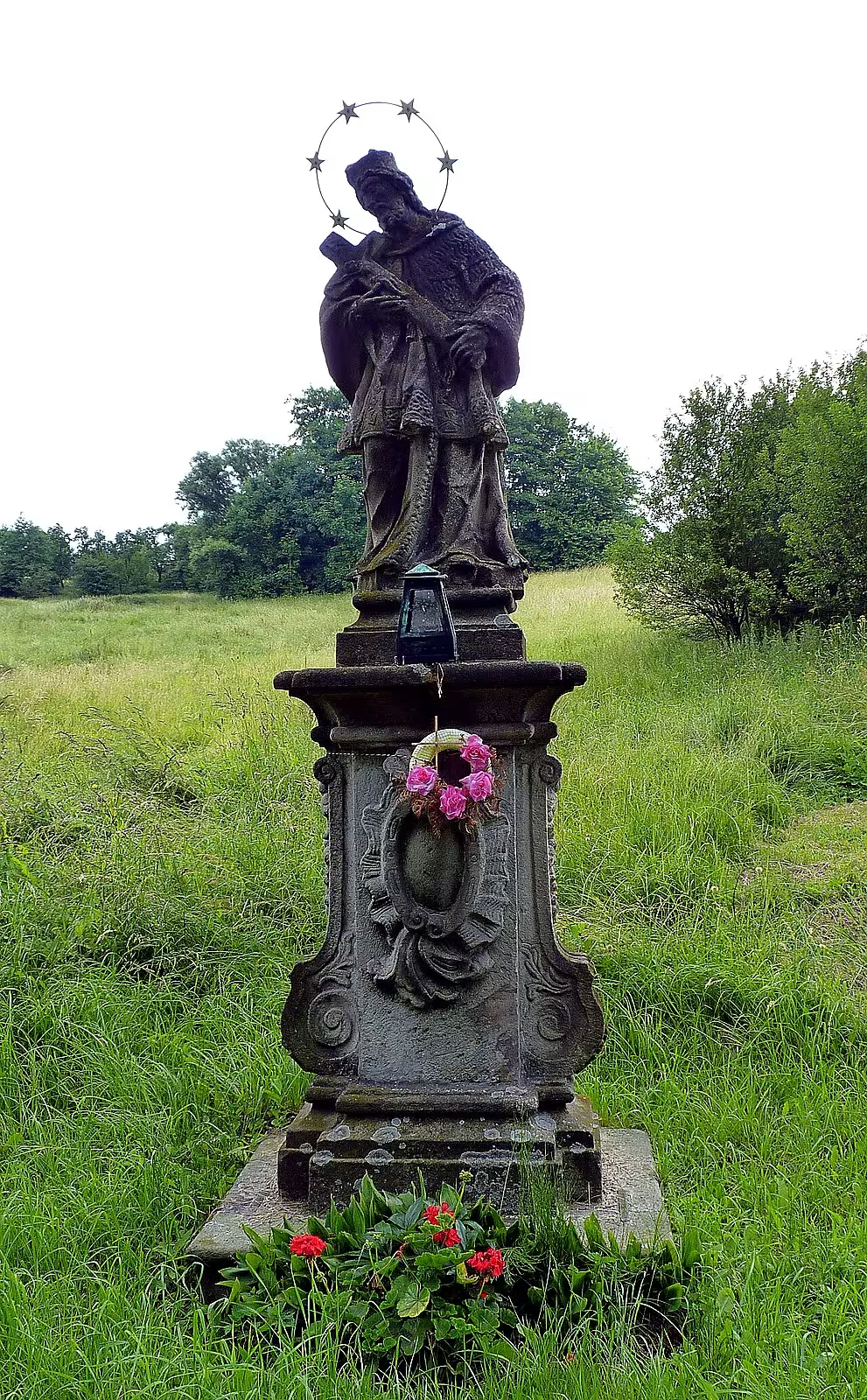
Socha svatého Jana Nepomuckého v Horních Domaslavicích is a late Baroque sandstone sculpture from 1773. Located in the village of Horní Domaslavice in the county of Frýdek-Místek. This monument-protected work is located in Upper Silesia, Podbesky hill town. It represents an important proof of the sacred art of the 18th century and is part of the local educational path.
The creation of the statue was initiated by the then priest Adam J. Grzegorzik. The work dates back to the late Baroque period when Marie Theresa ruled Czech lands. At the time, sacral creation emphasized emotional activity and rich decorativeness. The exact year of 1773 was previously evidenced by the inscription on the relief rokaj cartouche on the pedestal, but it was not preserved.
The sculpture is carved from sandstone and depicts the saint in traditional priesthood. The character stands in contrast on his right leg, wearing a biret and a halo with five stars. The head of the saint is bent towards a small cross with a crucified Jesus who holds in his hands. The whole object is based on a graduated block plinth with right-sided corners. The base is supplemented by a profiled ledge and volute wings decorated with floral elements.
A significant impact on the history of the monument was its relocation. This step took place because of the construction of a nearby Jozmanicka dam. Since 1953, the statue has been listed in the list of protected buildings as a historic work.
Currently, the monument is open to the public year round. The site is equipped with an information board that brings visitors closer to the history and description of this Baroque work.
The statue represents a valuable historical artifact, which remains an important witness to regional history despite the movements in the landscape. Visiting this place offers an opportunity to get acquainted with Baroque sculpture as part of a walk on the educational path Horní Domaslavice.
Historical milestones
- 1773
- The creation of a late baroque statue by vicar Adam J. Grzegorzik
- 1953
- Writing the statue into the list of protected objects
- around 1955
- Replacement of the statue in connection with the construction of the Kidding Dam
Architectural development
The sculpture is carved out of sandstone and lies on a graduated block plank with right-handed corners. The decoration of the pedestal consists of embossed rocaic cartouche and volute wings with floral elements. The saint is portrayed in a contrapost of his right leg with his head bent to hold the cross.
Historical events
1773: The creation of a statue from the foundation of vicar Adam J. Grzegorzik. 1953: The statue was declared a monument protected.
Points of interest
- The statue was created in 1773 and is made of sandstone. - The work was initiated by the then priest Adam J. Grzegorzik. - The original inscription with the year on the pedestal was not preserved. The memorial was moved to build a nearby dam. - Since 1953, the statue has been listed in the list of protected objects.
Guide
Show guide text
This text was created by artificial intelligence and has not been editorially reviewed. It may contain inaccuracies.
Welcome to the village Horní Domaslavice. You just stopped in front of one of the most important and oldest symbols of this place. You're standing right in front of the statue of St. John Nepomuk. Before you begin to see individual shapes and details, try to look at it as a whole. Feel the quiet, still presence this sandstone figure radiates. It is a work that has been standing here for more than two centuries and testifies to ancient faith, artistic sense, and the changes in the very landscape that you are admiring. The sandstone from which the statue is carved has its own, unmistakable texture and color that changes depending on how the sunlight hits it or how the humidity affects it. This statue is not just a stone, it is a witness to history.
Let us now return together to the deep eighteenth century to understand why this statue is here and how it was created. To understand its meaning, we need to look at 1773. This is the year this work was made. At that time, the shapes of the late Baroque were still strongly manifested throughout the country. This style was not just about beauty, but above all about expression of emotion, about movement and about certain nobility, which was meant to bring man to higher things. The man named Adam J. Grzegorzik was behind this whole creation. He was not just an ordinary man, but a priest who had great influence and significance in this area. It was his personal initiative, his effort to decorate the surroundings and his faith that led to this piece of art being made. Imagine that period atmosphere when this new, noble figure first appeared in the village to remind people of their spiritual roots.
Now pay attention to the details that are right in front of your eyes right now. Look at the saint himself. You see Jan Nepomuk in his traditional priesthood. Feel the algae and layers of cloth that the artist has managed to capture so faithfully and gently in such a hard stone. He has a biret on his head, a typical priesthood hat that gives him dignity and clearly determines his position. You will then see above his head the halos, the symbol of his sanctity and the light he radiates. But the most important thing the statue holds in its hands is a small cross with Jesus crucified. It's a moment of silent worship and deep faith carved by a sculptor hundreds of years ago to express the essence of St. John.
Now look below, what the statue stands on. The figure is not just laid on the ground, but a throne on a graduated block. Notice the beautiful, curved details on the pedestal. There are volute curves, i.e. those typical spiral shapes that are so characteristic of the baroque style and which give the whole part a sense of movement and dynamics. Among these shapes and around them you will find plant motifs. These details link the human work to nature and make the whole whole thing soft. This whole base serves to excel the statue and to elevate it above the normal level of the country.
As we have already mentioned, the key figure associated with this place is vicar Adam J. Grzegorzik. At that time, the role of vicar in every village was absolutely crucial and unrepeatable. He was not only a spiritual leader, but also a man who shaped the appearance of the village, its culture and social life. He was the one who gave the impulse to make this sandstone piece materialize in space. Thanks to his decision and willingness to support the creation of this work, we have the opportunity to see this piece of history today. It is a reminder of a time when the community was closely linked to the church and when art served as a mediator between people and their deities.
Do you feel that the statue has always stood here in this exact place? You're right and you're wrong. Here is one fascinating interesting thing that may surprise you. This statue wasn't always here where you see it right now. She must have had a big, dramatic change. Around 1955, a very large and fundamental building began to be built in the area, namely the construction of the Jedmanicka dam. This building has fundamentally changed the entire landscape and the lives of many people around it. In order for this precious monument not to be lost underwater or destroyed as a result of these great changes, it had to be moved to its present place. It's a fascinating idea of how these heavy pieces of stone had to be moved by then to save it for future generations. It's a story about an old world colliding with a new age.
And one more thing that might interest you if you look very carefully at the pedestal. You may notice something missing. Unfortunately, the original inscription, which was intended to contain the year and other important information about the creation of this work, has not been preserved over the centuries. There was only this silent presence without words, but it speaks much more with its strength than any text. This statue is a bit mysterious, because we lost its original words, but its face and its attitude remained.
This monument is very valuable, as evidenced by the fact that since 1953 it has been included in the official list of protected buildings. It's a confirmation that even a small piece of art is of great value to all of us. I hope that this brief view of history and the detailed view of the statue of St. John Nepomuk at least interested you a little bit and helped you better understand this place. Continue your tour of the Upper Domaslavice, feel the atmosphere of the surroundings and enjoy the beauty of this region. Goodbye.
Tips for visitors
The best time to visit is during a sunny morning or late afternoon when soft light highlights the details of sandstone sculpture and its baroque features. In the summer months the area is pleasantly bright, while autumn days provide a melancholy atmosphere suitable for peaceful observation.
For the photography of the statue I recommend to use the natural side light to better draw the folds of the priesthood's garment and the expression of the saint. The best shots can be taken from a slight ceiling, which excels the character's dignity on the pedestal compared to the surrounding landscape.
When visiting children, you can combine a statue tour with a walk around the village Horní Domaslavice. Children can explore details of the halo or cross that the saint holds and then take a longer trip to nature within the Podbesky hill.
In the immediate vicinity is located the Jedmanická dam, which offers the possibility of relaxing at the water after a sightseeing tour. The whole area is ideal for light hiking in the slightly curved terrain of Podbesky hill, which is available for hikers and cyclists.
I recommend that you bring with you quality footwear for field movement and camera with lens for detailed images. Since the statue is in public space, it is advisable to have protection against rain if you decide to take a longer trip to the surrounding nature.
Frequently asked questions
Can the monument be visited?
This is a structure in a public space that can usually be seen from outside free of charge. We have not verified that this particular one is freely accessible.
Where is the monument?
Location: Horní Domaslavice. The map on this page shows the exact spot.
Why is the monument protected?
It is listed in the Central List of Cultural Monuments of the Czech Republic as a cultural monument (register no. 1000131658).
Businesses nearby
Do you run a restaurant, accommodation, shop, museum, rental, wellness or other visitor service near this monument? Show yourself directly to the people heading to it — this is how they will see you in the app and on the web:
Nearby
Žermanická přehrada, obec Horní Domaslavice, Podbeskydská pahorkatina.
Accommodation nearby
Themed route
1. village Horní Domaslavice, village. Start your journey by exploring this place and its peaceful environment. Socha svatého Jana Nepomuckého v Horních Domaslavicích, statue. The main destination of the trip, which is worth the tour as an important monument. 3. Podbesky hill, landscape area. Take a walk on a slightly curved terrain and admire the local natural shapes. 4. Joke dam, water surface. End the trip with water that offers a pleasant environment for relaxation.
Seasonal recommendations
Spring in Upper Domaslavice brings renewal and green shine, when the surrounding nature comes to life after a freezing winter period. The statue of St. John Nepomuk is illuminated by sunlight, which highlights its details and creates an attractive atmosphere. Flowers begin to bloom around the building, surrounding the creature with colorful kisses of spring. For a visit it is advisable to choose a sunny day and come at the early noon when the temperature is most cosy. Due to the less large effects of the tourist stream, the object is particularly suitable for peaceful viewing.
Summer in Upper Domaslavice offers a warm and sunny day when the lighting of the statue of St. John Nepomuk is the best. Long summer days allow long tours at pleasant temperatures. When visiting, it is advisable to choose cooler times such as early morning or late afternoon when the sun is less intense and the temperature is more acceptable. Thanks to the larger doses of visitors during the summer season, it is recommended to come for a tour on the first days of the week when the level of people is lower.
The autumn surrounding the statue of St. John Nepomuk offers a breathtaking colour of leaves. The forested area around the object turns into a living flower web of different shades, giving the statue a background full of contrasts and beauty. Sunshine autumn days are an ideal time to visit when the temperature is pleasant and the atmosphere is calm. This season, it may be advisable to bring clothes with you for cooler weather, as evening temperatures fall faster.
Winter in Upper Domaslavice brings the statue of St. John Nepomuk to the atmosphere covered with snow. Sun rays are projected on the snow surface, creating breathtaking lighting and contrasts. A light layer of snow or ice shapes may be present around the building, which gives winter tours a unique character. When visiting it it is advisable to choose a sunny day and come in the early afternoon when the temperature is milder. It is important to choose on clothes suitable for cold weather such as furs or other insulation materials.
Visualizations and artistic views

The visualisations are generated by artificial intelligence and serve as inspiration.
Photos from the area
Real photos taken near the monument


Zdroj a licence jsou uvedeny u každého snímku.
Tips from visitors
No tips yet. Be the first!
Log in and add your tip.
Sources and literature
Photos: Michal Klajban / CC BY-SA 3.0 — Wikimedia Commons. The author and licence also appear when you hover over the image.
Faktickým podkladem tohoto textu byl článek na Wikipedii, jehož autory jsou přispěvatelé Wikipedie. Článek je dostupný pod licencí CC BY-SA 4.0.
Location on the map

Příběhy a pověsti
Legendy, pověsti a příběhy spjaté s touto památkou
Fotografie návštěvníků
Zatím žádné fotografie. Buďte první, kdo přidá fotografii z návštěvy!
Log in a přidejte svou fotografii nebo hodnoťte.
Za ověřenou návštěvu v aplikaci získáte víc bodů — poznáme podle GPS, že jste na místě.
Reviews and comments