



socha svatého Václava v Chlumci nad Cidlinou Statue
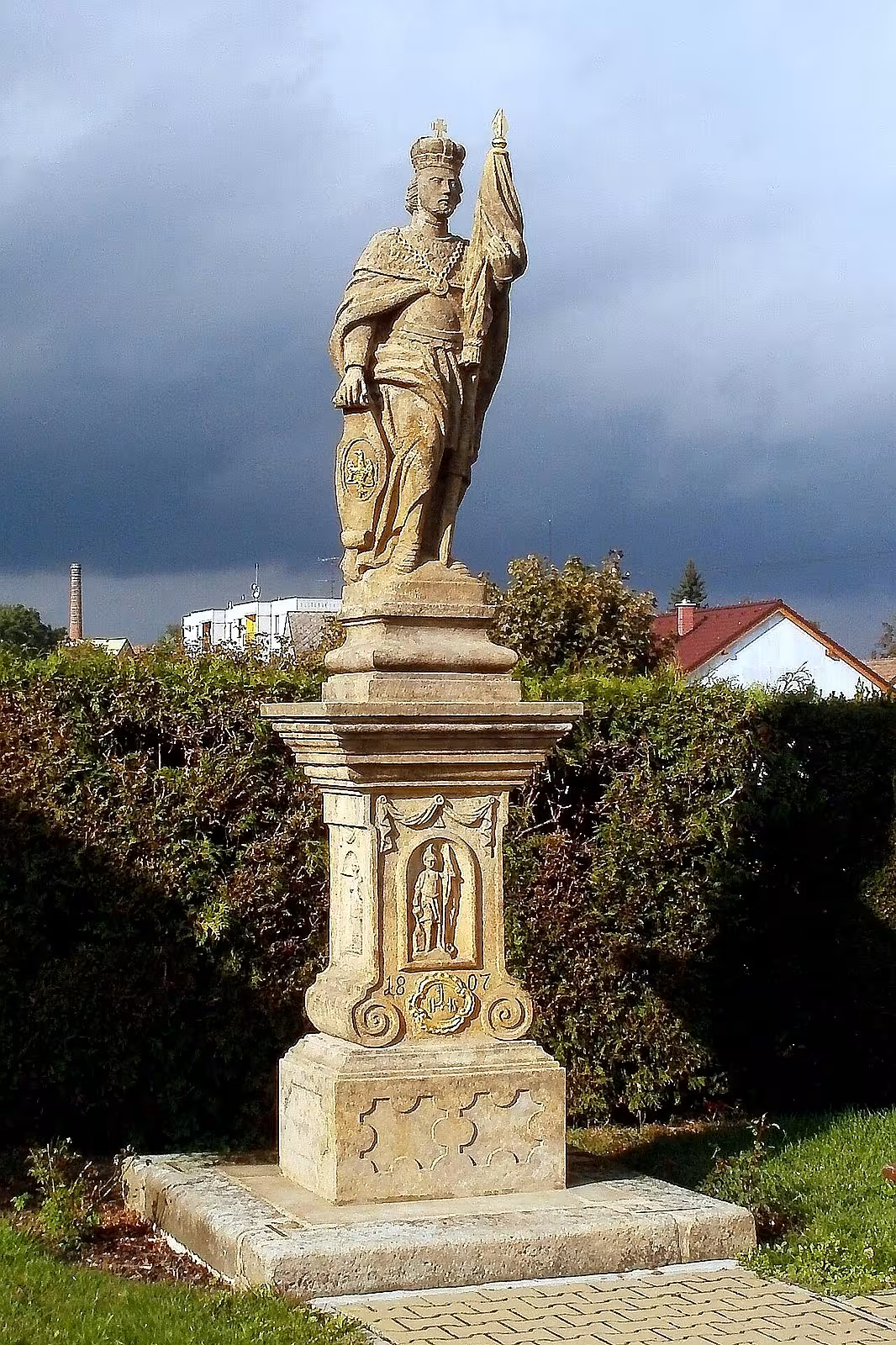
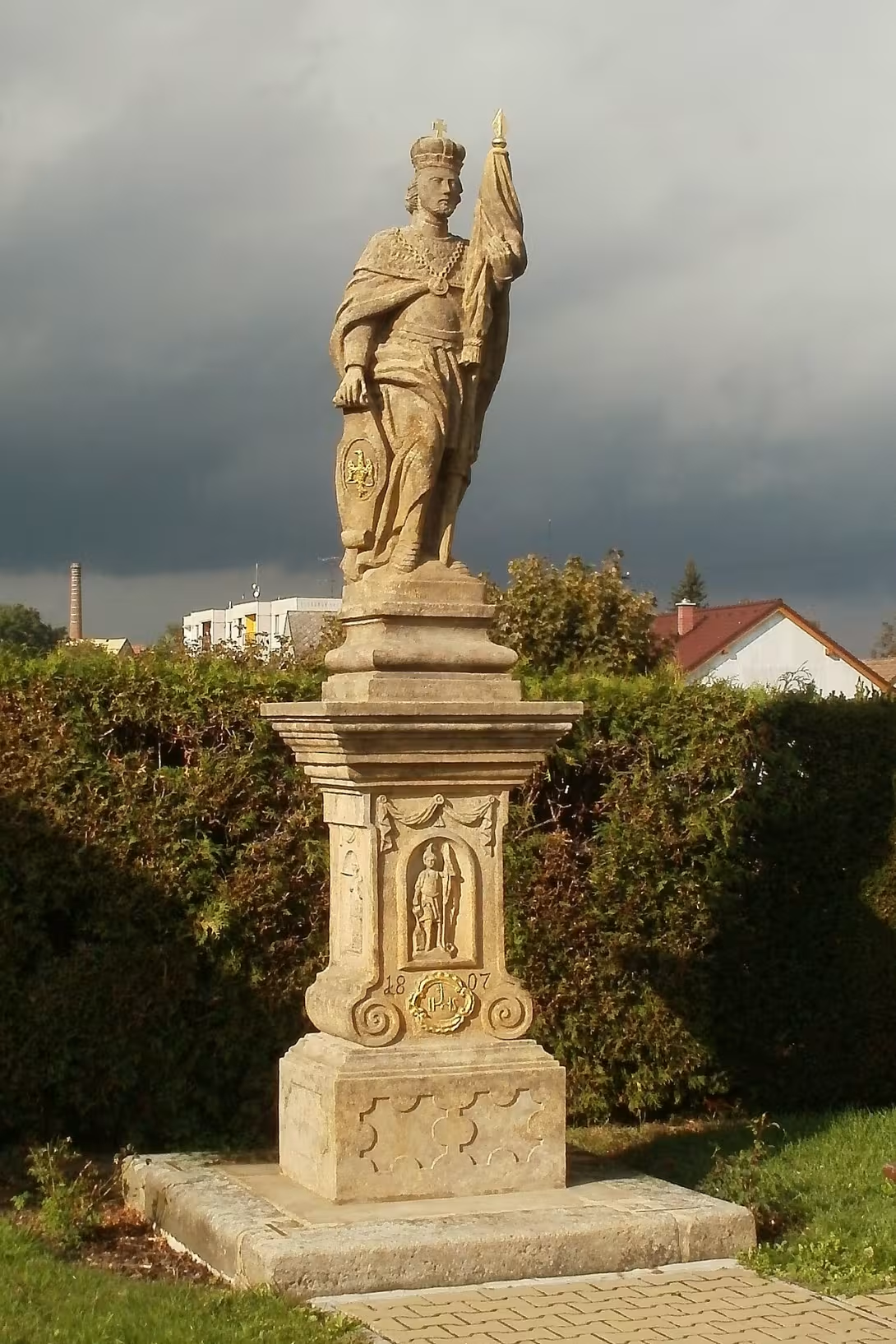
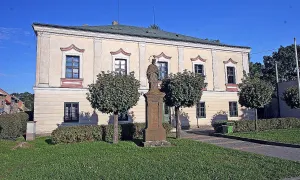
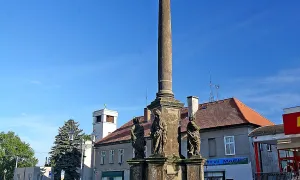
The statue of St. Wenceslas in Chlumci nad Cidlinou in the district of Hradec Králové is a classical sandstone monument from 1807. It stands at the bridge over the Cidlin river and has been protected since 1994 as a cultural monument of the Czech Republic.
The work was created in 1807, during the period of the Napoleonic wars and the transition from Baroque forms to Classicism. The author is not known.
The visual processing corresponds to traditional iconography. Saint Wenceslas is depicted with a crown on his head and a flag in his left hand, while the right one rests on a shield with an eagle. The whole object stands on a two-step prismatic base with a profiled ledge and a moulded plinth. The pillar itself ends with a ledge and its hips decorate volutes.
Detailed design of the pillar includes three niche with reliefs. On the front side there is a st. Florian in a nickel with a condom, which from a bucket waters a burning house. Above this niche is carved feston with middle curtain and tassel. Below it is a rocaic cartouche with the inscription IHS, a cross, a burning heart and the year 1807. The east side contains the relief of the Virgin Mary with Jesus and the branch in her hand, both with a hint of halo. The west side carries the relief of St. Nicholas. The back of the pillar is smooth and contains inscription in engraved frame with cut corners.
Decorative elements include gilding of eagle, IHS inscription, cross on crown and tip of flag. The number, inscription and edges of the frame are black.
The fate of the monument was dramatic in the 19th century. Originally, the statue was located directly on the bridge via Cidlin, but in 1845 it was taken by large water. The building was subsequently found in the village of Lucice and later moved to the present place.
Today the statue is written in the catalogue of monuments of the National Monument Institute under register number SAR 10251 / 6-5743. Thanks to its history and detailed execution it represents an important point when visiting Chlumce over Cidlinou. It's an example of classical art that survived the destructive forces of nature.
Then and now
Drag the slider to compare how the landmark may have looked when it was built with the view today.
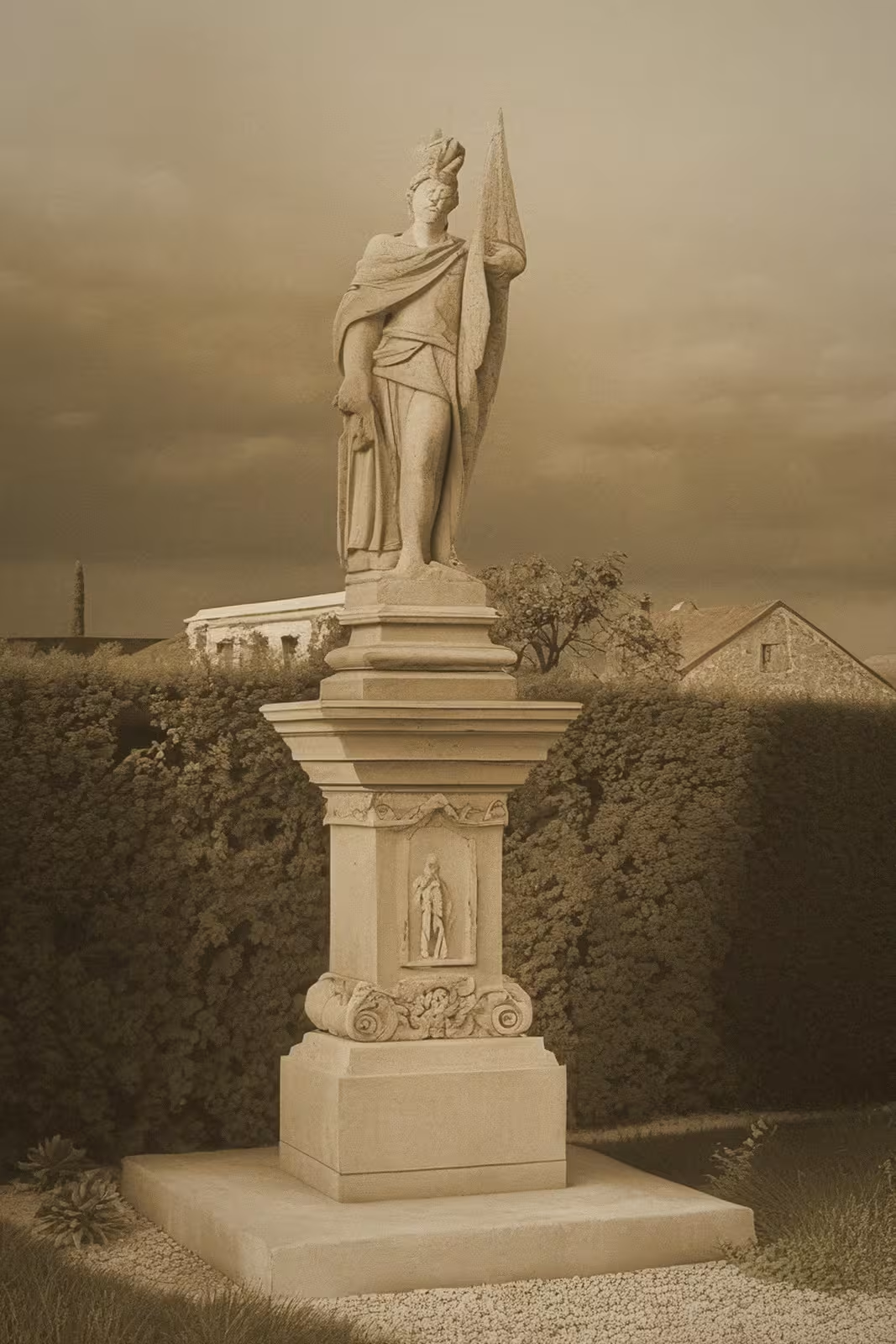
The historical appearance on the left is an AI-generated visualisation and serves as inspiration only.
Historical milestones
- 1807
- creation of sandstone statue
- 1845
- the statue was carried away with great water and found at Lucic
- 1994
- publication of the statue by cultural monument of the Czech Republic
Architectural development
The statue is made of sandstone and stands on a prism pillar with volutes and a ledge. Pillar is decorated with niche with reliefs and rocaic cartouche with IHS inscription. The base is twice graduated and ends with a profiled ledge.
Points of interest
- It's a sandstone classic monument from 1807, the author of which is unknown. - St. Wenceslas is depicted with a crown, a flag in his left hand and the right one rests on a shield with an eagle. - The Pillar contains the reliefs of St. Florian, the Virgin Mary with Jesus and St. Nicholas. - Some of the elements, such as eagle or flag tip, are gilded. - In 1845 the statue was taken by large water from the bridge, found in Lucice and then moved.
Guide
Show guide text
This text was created by artificial intelligence and has not been editorially reviewed. It may contain inaccuracies.
Welcome to Chlumps over Cidlina. Right now, you're standing in front of one of the silent but prominent witnesses of local history. In front of you is a sandstone statue of St. Wenceslas, which guards the road to the bridge over the Cidlin River. It is the first thing to welcome you here, and her presence here is very peaceful and noble. Stop for a moment, take a breath and let your eyes discover the details of this stone painting that has been standing here for more than two years.
If you look at this memory, you're going back in time to eighteen zero seven. It was this year that the statue was created. Although today we do not know exactly who was her author, it is clear that he was the master of his craft. At that time, it was customary to place the shapes of saints on roads, bridges or squares to serve as a spiritual support for the travellers and protectors of the local population. Saint Wenceslas, as our main protector, was a natural choice. It stands here as a symbol of stability and faith, carved from sandstone, which, with the advancing time, gained its characteristic patina.
Now let's take a closer look together at what you see right in front of you. Attention to the figure of St. Wenceslas. It is depicted in the traditional concept that makes it a respected ruler and warrior. He wears a crown on his head that marks his prince's dignity. In his left hand, he holds the battalion, the symbol of victory and the leadership of the nation, while with his right hand he rests on the shield. If you look closely at this shield, you'll see an eagle on it. It's a detail that connects this statue to our national symbols and gives it a deeper meaning.
But the statue is not just about the character of the prince. Let us now move the attention below to the base on which St. Wenceslas stands. The whole object rests on a decorated pillar, which itself is a small work of art. Notice the reliefs, that is, these rising images in the stone that decorate the sides of the pillar. One of them depicts Saint Florian, who is traditionally perceived as a protector of fires. Next to it you will find a picture of the Virgin Mary with little Jesus in your arms, which brings to the whole work an element of maternal care and hope. And remember to also seek out St. Nicholas, who completes this group of saints. Note also other small elements such as the IHS inscription, which is an old symbol for the name of Jesus, or details of spikes that complement the overall appearance of the monument.
When you look at the calm face of St. Wenceslas in this way, you may think that this statue has stood here in complete peace since its inception. But the truth is much more dramatic. The history of this monument is accompanied by an incredible story that resembles almost a miracle. Imagine the year eighteen zero forty-five. At that time, there was huge water. The Cidlina River spilled so much that its power was unstoppable. It was this great water that was so strong that it simply took the sandstone statue from its original place.
Imagine the confusion and sadness of the local people who suddenly found out their protector had disappeared. But the statue has not disappeared into oblivion or in the depths of the river forever. She was found at Lucice village, where the stream of water washed away. It is fascinating to think how such a heavy stone object could have been moved by the water element to a place this far away, while remaining in such a state that it could be returned. This story gives the statue a certain myth and reminds us how powerful nature is and how important it is to protect what's left of history.
For this reason, and also because of its artistic value, in the year one thousand nine hundred ninety-four statues were officially declared a cultural monument of the Czech Republic. This means that it is no longer just a local ornament at the bridge, but it is part of a national list of values that we must preserve for future generations. It is a recognition of its importance, its survival of large waters and its impact on the shape of this place.
Now, if you look at St. Wenceslas again, you see something more than just a piece of sandstone. You see a survivor who got out of the rough embrace of the river and who, again, in full dignity, is watching over Cidlina. He is a silent witness to the transformed world, which encourages us to stop and think about what is permanent and fleeting.
Imagine how many people around this statue went through those more than two walls. How many passengers sought protection for their journey at St. Wenceslas, how many locals sought comfort in difficult times. This statue is a bridge not only in literal sense, because it stands at the bridge, but it is a bridge between us and our ancestors.
Now that you've met the story and details of this sandstone beauty, I suggest you stay in its immediate surroundings for a while. Try to notice how light is reflected from sandstone in different hours of the day and how the statue changes with the season. Feel the atmosphere of this place where the calm of the river connects to the history of the city.
As soon as you're ready, you can continue to explore further corners of Chlumce over Cidlina. The city has prepared many other secrets and beautiful places for you to discover. I hope that meeting with St. Wenceslas has brought you a sense of peace and inspiration.
Thank you for your attention and I wish you a pleasant continuation of the journey towards other historical clues. Goodbye.
Tips for visitors
The best time to visit is morning or late afternoon time, when the sun hits the sandstone surface at an angle, which better excels the details of the crown and shield with eagle. The location is available by car and by public transport; Check the current connection in the search engine. For the tour we recommend to take shoes suitable for walking near the water, as the statue stands right by the river. For photography are the best places from the bridge space, from where you can capture the statue together with the flow of river in the background. Families with children can use a visit to tell about the Czech Patronage and explore the elements on the statue such as the flag or crown. In the immediate vicinity there is a bridge over the Cidlin River, which offers a pleasant walk and the possibility to observe the surrounding countryside.
Frequently asked questions
Can the monument be visited?
This is a structure in a public space that can usually be seen from outside free of charge. We have not verified that this particular one is freely accessible.
Where is the monument?
Location: Chlumec nad Cidlinou I. The map on this page shows the exact spot.
Why is the monument protected?
It is listed in the Central List of Cultural Monuments of the Czech Republic as a cultural monument (register no. 1000121529).
Businesses nearby
Do you run a restaurant, accommodation, shop, museum, rental, wellness or other visitor service near this monument? Show yourself directly to the people heading to it — this is how they will see you in the app and on the web:
Nearby
V bezprostřední blízkosti se nachází most přes řeku Cidlinu.
Accommodation nearby
Trips and activities nearby
Guided tours, tickets and activities nearby from GetYourGuide
Affiliate link: if you buy from the partner, we may receive a commission. The price for you does not change.
Search tours and activities →Themed route
Here is a proposal for a short thematic route:
1. Bridge over the Cidlin River (construction) - This building serves as an entry point to the area and offers a view of the river flow. 2. Statue of St. Wenceslas in Chlumci nad Cidlinou (statue) - The main destination of the trip, which resembles an important historical event in this place.
Seasonal recommendations
In spring, the surroundings of the statue are awakened to live colors and fresh green, creating a fresh background for visiting. We recommend to come in the morning when the light is fine and the air is clean. Due to the variable weather, it is advisable to choose layered clothes and moisture resistant shoes.
In the summer months, the bright sun and hot air dominates the space, which highlights the details of bronze. The best thing is to visit the place early in the morning or at sunset to avoid the biggest Closing heat.
Autumn brings golden shades of leaves and melancholy atmosphere to the landscape, which matches the historical character of the work. The ideal time for a tour is this afternoon when the low sun creates deep shadows. We recommend you wear a lighter jacket or coat so you don't get cold wind.
In winter, the statue works in silence and often in white snow, giving it a noble and strict expression. The tour is short because the frost penetrates quickly, therefore it is necessary to wear a warm sweater and thick gloves. The most atmosphere is during the Advent period, when the landscape seems calm and dreamy.
Visualizations and artistic views


The visualisations are generated by artificial intelligence and serve as inspiration.
Photos from the area
Real photos taken near the monument


Zdroj a licence jsou uvedeny u každého snímku.
Tips from visitors
No tips yet. Be the first!
Log in and add your tip.
Sources and literature
Photos: Chrocht / CC BY-SA 3.0 — Wikimedia Commons. The author and licence also appear when you hover over the image.
Faktickým podkladem tohoto textu byl článek na Wikipedii, jehož autory jsou přispěvatelé Wikipedie. Článek je dostupný pod licencí CC BY-SA 4.0.
Location on the map
More monuments – Chlumec nad Cidlinou I
Show all in the municipality
Příběhy a pověsti
Legendy, pověsti a příběhy spjaté s touto památkou
Fotografie návštěvníků
Zatím žádné fotografie. Buďte první, kdo přidá fotografii z návštěvy!
Log in a přidejte svou fotografii nebo hodnoťte.
Za ověřenou návštěvu v aplikaci získáte víc bodů — poznáme podle GPS, že jste na místě.
Reviews and comments