



Sochy svatého Jana Nepomuckého a svatého Floriána Set of small monuments
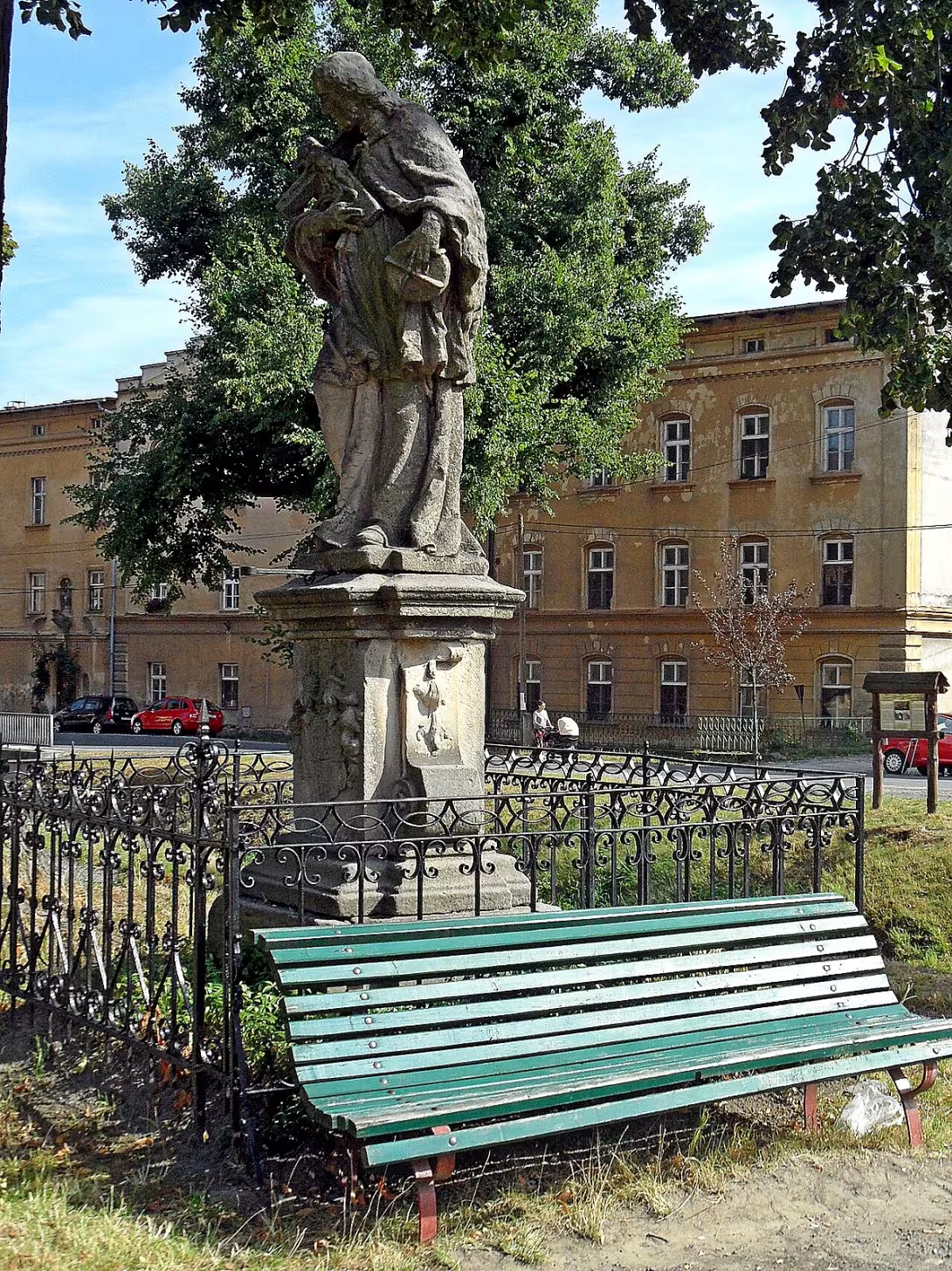
Sochy svatého Jana Nepomuckého a svatého Floriána in White Water in Jesenick are Baroque sandstone sculptures from the 18th century, registered as cultural monuments of the Czech Republic. They represent an important proof of religious respect and baroque piety in the region. Both saints join the noble rod Salm-Neuburgů, whose characters are shown on the pieces.
In the 18th century, when the Baroque style dominated Czech countries, the installation of statues on public spaces was a common expression of support for the Catholic Church and nobility. This development was closely linked to the flowering of the Midsummer and Marian cult. The statue of St. John Nepomuk was erected around 1730, while the statue of St. Florian dates back to 1766.
Both sandstone sculptures show typical features of baroque sculpture such as contrast and rich shaping of clothing. The statue of St. John Nepomuk reaches a height of approximately four metres and stands on a massive plinth with a relief alliance sign of Salm-Neuburg on the front. The saint is depicted in traditional clothing, holding a cross in his arms and a biret in his left hand. It has a metal halo over its head with stars and the entire object is surrounded by a decorative iron fence.
The statue of St. Florian, about 3.5 metres tall, is located on the village in front of house No. 5. It stands on a prism sandstone pedestal, which is partially embedded below the ground level and on its front side is a Salm-Neuburg plastic character. The saint is portrayed in ancient armor, holding the battalion in his left hand and putting out a burning house with his right hand. On the pedestal is carved inscription with chronogram and year 1766.
While the statue of St. John Nepomuk stands in the open area by the creek in front of the piarist monastery, the statue of St. Florian is situated on the village. Both monuments are now freely accessible and form an integral part of the historical character of the village of White Voda.
These works are valuable testimonies of Baroque culture and noble beneficence in Jesenick. The visit to White Water offers an opportunity to look at these historical sculptures in their original environment, which complements the nearby piarist monastery.
Historical milestones
- around 1730
- The statue of St. John Nepomuk
- 1766
- Creating a statue of St. Florian
Architectural development
Both sculptures are Baroque sandstone sculptures from the second half of the 18th century. The statue of St. Florian stands on a prism plinth with a plastic mark, while the statue of St. John Nepomuk is placed on a massive plinth with an alliance mark and is fenced by a decorative iron fence.
Historical events
1730: Statue of Saint John Nepomuk. 1766: Statue of Saint Florian with chronogram.
Points of interest
- Both sculptures are Baroque sandstone sculptures from the eighteenth century and are listed as cultural monuments. - Both works show the characters of the Salm-Neuburg family. - The statue of St. John Nepomuk was erected around 1730 and reaches a height of approximately four metres. - The statue of Saint Florian dates back to 1766, it's about three and a half meters tall, and the saint is putting out a burning house on it. - The statue of St. John Nepomuk stands at the creek outside the monastery, while the statue of St. Florian is located on the village.
Guide
Show guide text
This text was created by artificial intelligence and has not been editorially reviewed. It may contain inaccuracies.
Welcome to the unique place in White Water where history and art in the form of Baroque statues of St. John Nepomuk and St. Florian meet. You are faced with monumental sandstone sculptures, which are not only a beautiful work of art, but also witness the rich history of the region.
The statue of St. John Nepomuk dates back to approximately 1730. It is located near the creek, which gives it a mild and peaceful atmosphere. This statue is linked to the legends of St. John Nepomuk, known for his courage and obedience to the principles of secrecy. Its character reaches a height of approximately four meters and is located in such a way that it is visible from a distance.
Now look up at the statue of St. Florian, which was erected in 1766. This sculpture bears the character of the Salm-Neuburg family, which is proof of their influence and patronage in society at that time. The statue of St. Florian was built on the baits as a protector against fires and a symbol of resistance.
Note the details that characterize Baroque sculpture. Both sculptures are made of sandstone and show the richness of ornamental and dynamic expression, typical of this artistic style. The Baroque is known for its dramatic and emotional impact, which is reflected in these statues.
The key character associated with this site is Salm-Neuburg. This noble family had a great influence on the region and its patronage contributed to the creation of these monument statues. Their symbol, which is visible on both plastics, symbolizes their power and importance at that time.
The interesting thing is that these sculptures are not only artistic parts, but also cultural monuments. They are written as an indelible part of the history of the region and every detail tells the story of the past.
Let us move on to other attractions of White Water, which offers many other historical monuments and beautiful views. I hope that this visit has brought new knowledge of the region's rich history. Thank you for your attention and friends, don't forget to see other attractions of White Water!
Tips for visitors
The best time to visit is during a sunny morning or late afternoon when soft light will highlight the details of sandstone statues and their baroque decoration.
For the photography of the statues I recommend to use side angles to capture the plastic features of the saints' faces and to incorporate the surrounding green or water flow into the background.
In the immediate vicinity of the statues is the Piarist monastery in White Water, which is an ideal goal for a follow-up walk and tour of historical architecture in the region.
When visiting with children, use the quiet environment at the creek to tell stories about saints, which brings the history of the place closer to the children in a fun form without having to stand for long.
I recommend that you take with you comfortable shoes suitable for field movement in the water stream and possibly a telescope to observe the details on the statues which are placed above on the bases.
Frequently asked questions
Can the monument be visited?
We have not verified whether this monument is accessible. Please ask the owner or operator, or the local municipal office.
Why is the monument protected?
It is listed in the Central List of Cultural Monuments of the Czech Republic as a cultural monument (register no. 1000130091).
Businesses nearby
Do you run a restaurant, accommodation, shop, museum, rental, wellness or other visitor service near this monument? Show yourself directly to the people heading to it — this is how they will see you in the app and on the web:
Nearby
Piaristický klášter v Bílé Vodě.
Accommodation nearby
Themed route
Sochy svatého Jana Nepomuckého a svatého Floriána Type: Memorial statues Why is it worth a visit: these two important statues represent the cultural and spiritual heart of the site. They offer the possibility of admiration for craftsmanship and reflection on the historical context of their creation.
Piarist monastery in White Water Type: Religious monument and cultural area Why is it worth a visit: The monastery forms a natural and logical continuation of the tour as it is located in the immediate vicinity of the statues. Its architecture and quiet atmosphere complement the impression of outdoor monuments and allow a deeper insight into the history of the piaristic order in this area.
Tanks and gardens of Piarist monastery Type: Green zone and resting place Why is it worth a visit: Walk through the monastery courtyard or in neighbouring gardens provides a pleasant contrast to outdoor statues. It is an ideal place for a short rest where you can enjoy the silence and beauty of green maintenance in the area.
Chapel or prayer room inside the monastery Type: Interior sacral spaces Why is it worth visiting: If it is open to the public, this part of the monastery offers a view of the inner art and spiritual history. It allows visitors to combine the outer symbols of saints with their inner spiritual meaning in the monastery space.
This route is designed to be as efficient and focused as possible. It starts with the main target, the statues that are visually dominant. It follows a direct transition to the monastery area, which is the only listed surrounding area. The tour naturally moves from the exterior to the interior and green parts of the complex, creating a smooth and logical flow of the visit without leaving the immediate surroundings of the monument. The entire circuit can be managed in one afternoon, which ensures a comfortable pace for admiring the details of statues and monastery environment.
Seasonal recommendations
Spring: In the spring season, the statues of St. John Nepomuk and St. Florian are illuminated by sunlight, which brings living colour to the surrounding vegetation. Leaves on trees are starting to bloom again, creating a comfortable and peaceful atmosphere. When visiting, it is advisable to carry light clothes because temperatures are usually favorable, but in the morning or evening can be colder. The best time to visit is noon, when the sun illuminates the statues and the surrounding landscape in full glory.
Summer: During the summer, the statues are found in natural light of long days, which makes them an ideal place to visit during the day. Warm air and flowering green vegetation create a comfortable environment. When planning a visit, it is advisable to keep in mind that the number of visitors may increase during the summer peak. It is recommended to wear light and light clothes as well as protective sunglasses and UV cream. The best time to visit is early morning or late evening to avoid the heaviest temperatures.
Autumn: In the autumn period, the statues of St. John Nepomuk and St. Florian offer a view of the coloured leaf which provides a beautiful background. Sun rays are shorter, which creates a slightly melancholic atmosphere. The temperatures gradually decrease, so it is advisable to keep in mind clothes with multiple layers. The best time to visit is the sun day in the early afternoon, when the temperature is acceptable and the surroundings offer the most beautiful coloring.
Winter: During winter, the statues are located under cold clouds or snow cover, creating a completely different atmosphere. Sun rays are short and light weaker, which may mean the need to wear protective clothing. It is advisable to equip yourself with warm coat, gloves and hat to enjoy visitors even in cold weather. The best time to visit is the sun day in the early afternoon, when the temperature may increase and the surrounding area offers a view of the snow landscape.
Visualizations and artistic views

The visualisations are generated by artificial intelligence and serve as inspiration.
Photos from the area
Real photos taken near the monument


Zdroj a licence jsou uvedeny u každého snímku.
Tips from visitors
No tips yet. Be the first!
Log in and add your tip.
Sources and literature
Photos: Stribrohorak / CC BY-SA 3.0 — Wikimedia Commons. The author and licence also appear when you hover over the image.
Faktickým podkladem tohoto textu byl článek na Wikipedii, jehož autory jsou přispěvatelé Wikipedie. Článek je dostupný pod licencí CC BY-SA 4.0.
Location on the map

Příběhy a pověsti
Legendy, pověsti a příběhy spjaté s touto památkou

Fotografie návštěvníků
Zatím žádné fotografie. Buďte první, kdo přidá fotografii z návštěvy!
Log in a přidejte svou fotografii nebo hodnoťte.
Za ověřenou návštěvu v aplikaci získáte víc bodů — poznáme podle GPS, že jste na místě.
Reviews and comments