



Soubor 6 secesních vil Villa
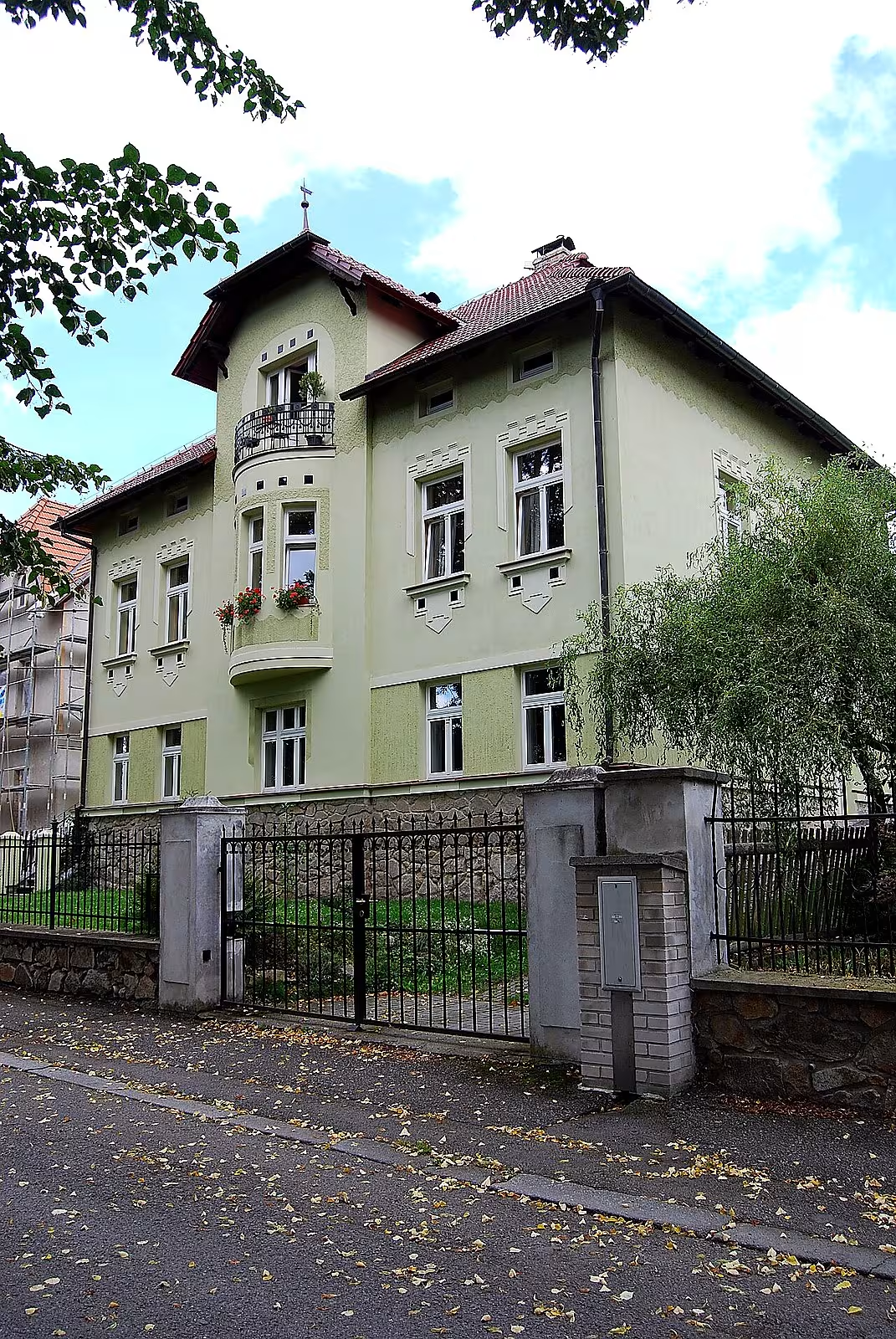
A set of six Art Nouveau villas in Milevsko, located in elevated terrain near the city centre, represents a valuable example of housing of the more wealthy layers in the early 20th century. These houses are characterized by rich use of decorative elements such as roof arches and verandas, which is typical of Art Nouveau architecture of the time. Since 2007, the whole ensemble has been protected as a cultural monument.
The villas were built in 1914, probably according to the design of the camp builder František Ješ. This architectural ensemble reflects modernization and urbanization in the Czech Republic in the early 20th century. There were intense cultural and technological changes in Europe at that time, which is also evident in the style of these houses.
Architectural are villas storey with irregular ground plan. Exteriors differ between each other, while interiors are rather uniform: residential-technical spaces such as kitchen and laundry are located on the ground floor, while residential rooms like salon and bedrooms are decomposed on the floor. In the attic there are rooms for the maid or guests. The gardens behind the houses have sloping terrain often with old trees, while in front of the houses towards the street there are front gardens closed by stone walls and fences.
The set of houses is located in elevated terrain near the city centre, which gives it a view value. Exteriors are decorated with roof arches, balconies and veranda with wooden and metal railing as well as windows with split fillings. These elements contribute to the unique appearance of each house.
Today, this collection of Art Nouveau villas is protected as a cultural monument and is worth visiting for its historical value and architectural miracle. Visitors can appreciate how the environment of the rich layers was designed at the beginning of the 20th century with regard to aesthetics and functionality.
These villas not only maintain the historical spirit of the time, but also resemble the modernization that took place at that time. Visiting these monuments offers a view of the rich architectural past and it is a valuable resource for understanding the cultural heritage of the Milevsko region.
Historical milestones
- 1914
- The villas were built.
- 2007
- Declaration for a cultural monument.
Architectural development
The villas are storey and have irregular ground plan. Exteriors differ, while interiors are rather uniform with residential-technical spaces on the ground floor and living rooms on the floor.
Historical events
- 1914
- The villas were built.
- 2007
- The whole set of houses was declared a cultural monument.
Points of interest
- A set of six Art Nouveau villas represents a valuable example of housing of more wealthy layers in the early 20th century. - These houses have been protected as a cultural monument since 2007. - The villas were built in 1914, probably according to the design of František Jesh. - Architectural are storey with irregular floor plan and decorated with roof arches, balconies and verandas. - A set of houses is located in elevated terrain near the city centre, which gives it a view value.
Guide
Show guide text
This text was created by artificial intelligence and has not been editorially reviewed. It may contain inaccuracies.
Welcome. Stop for a moment, put down your worries and let your eyes look around you. You are standing in a place that carries a piece of the history of Milevsko. In front of your eyes is an extraordinary ensemble that immediately attracts you with its elegance and special character. These aren't just ordinary houses you could see on every corner. In front of you is a collection of six Art Nouveau villas that form one complete and very rare whole. Notice how these buildings are located. They are not hidden in the valley or in backwoods, but are located in elevated terrain, just a short while from the city centre itself. This position was not random. This elevated position gives them a sense of importance and allows them to dominate the surrounding area, which exactly corresponds to their purpose and original importance.
Now, if you look at this whole group of houses, you might be interested in their inconsistency. Although it's a file, every house has its own face. Feel the atmosphere that exists here. It's an atmosphere of wealth, peace, and certain nobles that are still embedded in these walls. These villas were built in 1914. Imagine that time, the beginning of the twentieth century, when the world was on the threshold of great change. It was during this period when the company began to change and when a new need to express its success through architecture was born, that set was created. These houses were designed for the more wealthy layers of the population, for people who were looking for more than a simple refuge in their homes. They sought beauty, they sought style, and they sought a way to prove their position within society clearly and proudly.
Now pay attention to the architecture itself, which is absolutely fascinating here. If you look at the shapes of the buildings, you'll notice that they're not barren or boring. These villas are storey, and their ground features are deliberately irregular. Forget the strict geometry and straight lines you know from modern buildings. Here you meet an organic form that is so typical of Art Nouveau style. This irregularity creates a dynamic that changes depending on the angle you're looking at. If you raise your eyes above their roofs, you'll see more amazing details. Notice the skyline. These rising parts of roofs are not only a practical element for lighting the inner spaces, but they serve primarily as rich decorative elements that supply the roof with its richness and attractions.
And what may be the most tempting for the visitor's eye are the verandas. At the time of their creation, these open parts of the houses, which stand up to the outside world, were a place where people could stop, enjoy the air and observe life around them without being directly part of the urban rush. These are the spaces that connect the privacy of home to public space and supply the entire complex with its unmistakable, slightly romantic touch. This whole architecture, this rich use of decorative elements, leads us to think about who was behind it all. Although the exact names of all creators are not recorded in the records, the František Ješ was probably behind this whole proposal. His handwriting, or at least the manuscript of the school he represented, is in every crooked profile and in every decorative detail felt.
It is fascinating to think about how these houses became famous and how they managed to survive the decades that followed their construction. These are not just historical monuments that should be forgotten. On the contrary, their value was so high that they had to be protected. Since 2007, this whole set of six villas has been officially declared a cultural monument. This means that their beauty and their historical essence are now protected so that they can be perceived by future generations, just as you are now. This protection is proof that Milevsko and our entire territory appreciate this unique piece of architecture.
Perhaps you are now being told what is the greatest secret of these houses. Is that the secret of their irregular shapes? Or perhaps the way in which their interiors, which we do not see now, were the lives of the then rich families? Even though we don't know the names of the specific personalities that lived in these villas, we can imagine them. We can imagine their steps on the veranda, their views from the arches to the distance and their efforts to live in an environment that was as beautiful as their ambitions. Ironically, this ignorance of specific names gives a place of mystery. In every shadow and every decorative detail, the story of someone who once lived here can be hidden, loved and made up his history.
Now that you've looked at these villas and understood their importance, I suggest you continue your walk. Let yourself drift through the atmosphere of this place and try to find in every detail you see a reflection of the time when architecture became an art for everyday life. Milevsko has many other attractions waiting for you. Thank you for spending this moment with us and for stopping to look at this rare set of Art Nouveau villas. We wish you a beautiful and inspiring next trip.
Tips for visitors
The best time to visit a set of Art Nouveau villas in Milevsko is autumn or spring, where it is quieter and nature offers beautiful colors. This period also allows you to enjoy sunlight to photograph architectural details of houses.
For those travelling by public transport, the possibility of using buses or trams is accessible in an appropriate way. The current connection and times we recommend to verify in the online search engine.
When visiting, it is good to take a camera with you so that you can capture rich architectural detail and beautiful green spaces around the houses. A photo in the morning or evening will offer interesting light effects.
For families with children, the surrounding nature and green spaces are ideal for short walks. Children can enjoy a trip to the park or play in the playgrounds that are available near the city centre.
Frequently asked questions
Can the monument be visited?
This is a residential or farm building, not a museum with opening hours. Please view it from public space and respect the owners' privacy. We have no information about access to the interior.
Where is the monument?
Location: Milevsko, Jihočeský kraj. The map on this page shows the exact spot.
Why is the monument protected?
It is listed in the Central List of Cultural Monuments of the Czech Republic as a cultural monument (register no. 1875851484).
Businesses nearby
Do you run a restaurant, accommodation, shop, museum, rental, wellness or other visitor service near this monument? Show yourself directly to the people heading to it — this is how they will see you in the app and on the web:
Nearby
Soubor domů je umístěn ve vyvýšeném terénu blízko centra města, s předzahrady směřujícími do ulice a zahradami za domy.
Accommodation nearby
Themed route
Thematic cruise route: List of Art Nouveau villas in Milevsko
1.Soubor 6 secesních vil - Type: Architectural monument, set of houses. - Why is it worth a visit: This unique complex includes six Art Nouveau houses, which are an example of architecture at the end of the 19th and early 20th century. The views from elevated terrain provide a beautiful view of the city centre, making this set ideal for stopping and understanding the historical development of the area.
2. City center Milevsko - Type: Historical village. - Why is it worth a visit: After visiting Art Nouveau villas it is advisable to explore the city centre, which offers a view of the historical look and architecture. The centre is close to a set of houses, which allows an easy transition between visiting the sights and visiting local streets.
3. Front gardens facing the street - Type: Green spaces, gardens. - Why is it worth a visit: These front gardens are part of a set of Art Nouveau villas and provide a quiet place to relax. They are ideal for stopping, relaxing and enjoying the beauty of the outdoor environment near historical houses.
4. Gardens for houses - Type: Green spaces, gardens. - Why is it worth a visit: These gardens are part of the file and offer another opportunity to explore Art Nouveau architecture in the context of its original environment. They are suitable for visitors who want to gain a deeper understanding of how these houses were designed and used.
5. Tanks of Art Nouveau Villa Set - Type: Open space. - Why is worth a visit: The tank provides another opportunity to understand the architectural context of the file. It is an ideal place to observe the overall structure and relationship between the houses, which complements the experience of visiting the buildings themselves.
This route offers a comprehensive view of Art Nouveau architecture in Milevsko and allows visitors to explore both historical houses and their surroundings.
Seasonal recommendations
Spring: In the spring season, a collection of Art Nouveau villas in Milevsko is transformed into a haven full of life and color. When the first flowers bloom, they are lit by a sun beam, which enriches the green courtyard and gardens around the villas. The atmosphere is full of freshness and enthusiasm when nature wakes from its winter sleep. For visitors it is advisable to choose clothes according to temperature - the day can be heat, but the evening cold. The best time to visit is in the early morning or noon, when the crowd does not get too much and can enjoy a quiet moment.
Summer: In the summer period, Milevsko turns into a popular destination for visitors seeking relief from urban thermomilns. Set of villas offers a quiet and shady place where you can enjoy the sun days. The atmosphere is full of lifespan and happy families with children, which helps to create a friendly environment. It is recommended to visit early morning or late afternoon to avoid the top crowd and heat. Don't forget to take protective sun cream and light clothes suitable for heat.
Autumn: In autumn, Milevsko offers visitors a different view of Art Nouveau villas when green leaves give way to the colorful dress of walnut and oak trees. The sun illuminates the bright colours of the leaves, creating an unforgettable atmosphere of peace and quiet. This time of year is ideal for visiting because the crowd is shrinking and you can enjoy quiet moments in the beautiful landscape. We recommend wearing warmer clothes as the noon sun may still be warm, but the evening will cool quickly.
Winter: Winter visit to the Art Nouveau Villa in Milevsko offers a different, quiet atmosphere. Without a flowering garden and with fewer people, the villas are a quiet haven where you can enjoy a quiet moment. Sun rays illuminate the snow fields around the villas, creating a romantic and calm atmosphere. This season is suitable for those looking for rest from winter urban interference. It is important to choose warm clothes and take into account shorter opening times of the sights, because some parts may not be accessible due to winter conditions.
Visualizations and artistic views


The visualisations are generated by artificial intelligence and serve as inspiration.
Photos from the area
Real photos taken near the monument


Zdroj a licence jsou uvedeny u každého snímku.
Tips from visitors
No tips yet. Be the first!
Log in and add your tip.
Sources and literature
Photos: Richenza / CC BY-SA 3.0 — Wikimedia Commons. The author and licence also appear when you hover over the image.
Faktickým podkladem tohoto textu byl článek na Wikipedii, jehož autory jsou přispěvatelé Wikipedie. Článek je dostupný pod licencí CC BY-SA 4.0.
Location on the map



Příběhy a pověsti
Legendy, pověsti a příběhy spjaté s touto památkou

Fotografie návštěvníků
Zatím žádné fotografie. Buďte první, kdo přidá fotografii z návštěvy!
Log in a přidejte svou fotografii nebo hodnoťte.
Za ověřenou návštěvu v aplikaci získáte víc bodů — poznáme podle GPS, že jste na místě.
Reviews and comments